
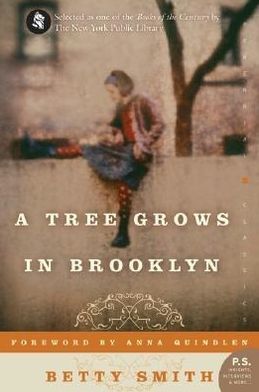
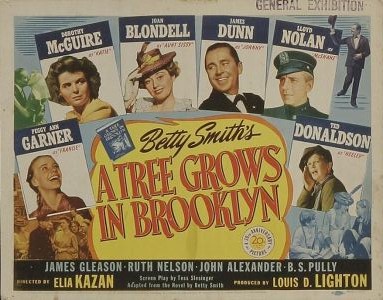
 Setting: A conference room in a Brooklyn hospital. There is a circle of chairs, but only two have women sitting in them, making introductions. One woman is 31, fat, with an Alternative Lifestyle Haircut, and biracial: Margaret E.I. The other woman is 18, thin, white with bobbed brown hair, and wears a remarkably preserved vintage dress. Also…she seems to be flickering in and out of this plane of reality. She is Francie Nolan of Betty Smith’s classic novel A Tree Grows in Brooklyn.
Margaret E.I.: [somewhat emotional] Hi, Francie.
Francie Nolan: Hi, Margaret.
MEI: [rushing and stumbling over her words] It’s SUCH an honor to meet you in person. I read A Tree Grows in Brooklyn (ATGIB) every summer (sometimes twice or more!) from ages 12 to 22. I think about your family-system for creating stories for numbers every time I have to write a rent check or figure a tip. Even with all the changes in New York since your book was published in 1943, I still think serene is a great word for Brooklyn. [quieter] Not necessarily my neighborhood, but, y’know…
FN: Why, thank you. I’ll pass that on to Ms. Smith.
MEI: I just… I never imagined meeting you to talk about this. About being survivors. [shifts in seat uncomfortably] Sorry, I just feel weird about that word.
FN: [reaches out to pat MEI’s knee] Is this ok? [MEI nods, FN pats her knee]. That’s fine. Words matter. Language is a living thing and this is a huge and hugely misunderstood topic. One of the more sinister side-effects of rape culture is the way it silences the victims on so many levels, whether in their own minds or even in safe spaces like this one.
MEI: You’ve been reading the other books on my bookshelves, haven’t you?
 FN: [smiles winningly] Of course! You have quite a collection. You really should finish Middlemarch, though.
MEI: I KNOW, right? Maybe if it just had more chapters devoted to obscure whaling techniques [they both HIGH FIVE the awesomeness of Moby Dick.]
So, my hang-up with “survivor” is that technically the rapist is also almost always a survivor of the experience, too (yours included, though just barely thanks to Mama Nolan.) More importantly, to survive an experience implies that there was a threat of murder or grievous physical harm during the interaction(s) which isn’t always true of every experience with a rapist, especially since most victims know their rapists. There are victims that don’t call what happened to them rape because the rapists were such insidious predators that they never had a need to make threats of physical harm.
Of course there are also people (and politicians) who have never been raped and have their own creepy-ass benchmarks for how much violence must be present for an experience to qualify as rape (real answer: none), but those people make me too angry to converse civilly.
FN: Deep breaths.
MEI: [inhales] Thanks. One of the reasons I wanted to talk to you, specifically, is that your character’s fictional experience of an attack by a rapist (in Chapter 33, Book Three) in many ways conforms to the Idealized Rape Narrative (IRN) promoted by rape culture.
FN: Maybe you can explain what the IRN is?
MEI: Sure. Full disclaimer, it’s a term I made up for myself in the course of trying to figure out why I couldn’t identify with one of my favorite fictional characters in terms of being a rape survivor.
FN: I see. My Aunt Evy liked to make up stories, too. Go ahead.
MEI: [exhales] So. IRNs are an experience of rape as idealized by a culture that doesn’t know how to deal with rape, because Patriarchy. Think: rape myths taken at face value. The purpose of idealizing an experience of rape over others is to use it as an impossible measuring stick for every victim’s experience. This ensures that no person ever feels that their experience matches up to the IRN or at the very least an attempt can always be made to make the victim feel inadequate in comparison to this other, imaginary, idealized victim. Thus, fewer rapes are understood as rapes, so rape is a smaller and smaller problem to the point that we can probably nip it in the bud with some pink rape whistles for the lucky few, right?
Because it is idealized, the IRN often conflicts with real-life rape statistics and facts and is therefore dangerous misinformation for everyone: POLITICIANS, law enforcement, judges, POLITICIANS, teachers, families, colleges/universities, POLITICIANS, religious organizations, workplaces, you name it.
In a culture that reveres IRNs there’s a false and misleading ranking of experiences of rape and assault. By analyzing who the victim and rapist are and certain aspects of the experience itself (before, during, and after the actual violation), rape culture deems some victim’s experiences more valid and therefore more worthy of justice, attention, even abortions than others.
FN: …
MEI: No, I know.
IRNs also show up A LOT in fiction and it’s handy to be able to recognize them for what they are (often bad writing.)
The IRN manifests in ATGIB in that:
Francie:
-
is a young “virgin” (Fun fact! This definition will be determined by the Patriarchy) and likely heterosexual at the time of the attack.
-
is white.
-
is a cisgender woman.
-
is not engaged in un-ladylike or frowned-upon activities at the time of the attack (i.e., drinking, drugs, being out too late, etc.)
-
is not dressed “provocatively.”
-
does not “act older than she is” (an accusation typically applied to young black women) or have a “bad reputation” (for both, see Fun Fact after “virgin” above)
-
fights back against the rapist after a few seconds of shock.
-
is upset immediately after the attack (“I want my leg cut off.”)
While the attacker:
-
is described in ways that make him sound both unhealthy (sallow, broken teeth)
-
and noticeably unattractive (low tufts of hair, wet-looking eyes), i.e., unlikely to get sex of his own accord. Rape doesn’t happen because the rapist is sex-starved.
-
attacks “out of the blue” and only once (i.e., not preying on the same person over and over.)
-
is an outsider from the community, not a known character/person.
-
is a stranger to Francie.
-
is apprehended by the police, convicted in a court of law, and presumably “walks to the electric chair on his own.”
The IRN is subverted in ATGIB when:
-
The attack happens during the afternoon instead of at night.
-
The attack happens in Francie’s home (most rapes do happen at a residence, not in dark parking lots or jogging paths.)
-
The attacker is not a black man (a myth common in white communities, i.e., “black men rape white women.”)
Close call:
-
The attack is not a “gang rape.” Gang rapes are part of the IRN in that “ideally” a woman must be overpowered by force during a rape, but the idea that gang rapes are rare is itself a rape myth. (Also not rare: incest.)
-
Francie has no physical injuries from the attacker. A close call because the attack could be described as “interrupted” by Francie’s mother, but it is entirely possible that even if the attacker had not been interrupted, or interrupted later, that Francie would have no physical marks from her attacker. Physical injuries do not a rape make.
This doesn’t cover all rape myths by a long shot (there’s so much intersectionality stuff when it comes to who is sexually valuable and worth protecting and race and age and class and queerness and religion and being trans and marriage, etc.) Also, this list refers to a fictional experience itself described in ATGIB as “brief” and “a bare three minutes in time.” [Sighs]
FN: That list was hard for you, I can tell. Let’s break for tea.
[They do.]
 MEI: I hope this doesn’t seem too invasive, all this analyzing.
FN: No, it’s interesting. So much has changed since my day. I suppose they don’t give hypodermics anymore?
MEI: Doctors no longer make house calls and there’s been arguments about the cities and states picking up the tab for things like rape kits.
FN: My. So, getting back to IRNs: do you think ATGIB (or any other cultural product that presents an IRN) is a bad book people shouldn’t read which has nothing truthful to say about the experience of being assaulted and living in a world where rape culture often presides?
MEI: Of course not. I fucking love ATGIB and have for years, both before and since I experienced rape myself. My reading of your novel changed with all my experiences, including getting jobs, moving to New York City, and reading other authors. But I was finally able to find some comfort from ATGIB that specifically applied to my life after experiencing rape.
FN: What’s something in my story that’s helped you since you’ve been recovering from the rape? Oh! Oh! [bounces in her seat] Was it when my mother cold-blooded almost-murdered the murdering rapist?
MEI: No, but that was SO AWESOME (I do not generally condone violence and want to state that the death of a rapist is unlikely to undo all of a victim’s psychic damage, but let’s be real, I’ll happily cheer loudly for the wounding of a fictional rapist by Francie’s indomitable and imperfect mom, yes to that)!? Also, wow, she got away with it (unlikely today, probably?)!?
No, the part I love is the aftermath with the newspapers and the gossip in your neighborhood.
FN: [nodding] A drunken reporter got Mother’s name wrong (O’Leary instead of Nolan) when writing up about the shooting, and when it was picked up again in two other newspapers—
MEI: —so many newspapers back then! Blogs of their day!
FN: I know; I used to work at a clipping agency! Well, the other newspapers got it totally the wrong way ‘round, saying that this “Mrs. O’Leary” had herself been shot by the prowler, if you can believe it.
MEI: And then the neighborhood—
FN: —the neighborhood! This neighborhood that had been wrapped up for more than a month in the rapes and murdering of two of their own children, the neighborhood that came together in the stairwell of my building to LITERALLY rip the pants off of and grind their heels into the already gut-shot rapist! Well! …well here’s a quote:
Eventually, the whole affair faded away into the background. Katie [Francie’s mother] was a neighborhood heroine for awhile but as time passed, the neighborhood forgot the murdering pervert. They remembered only that Katie Nolan had shot a man. And in speaking of her, they said that she’s not one to get into a fight with. Why she’d shoot a person just as soon as look at them.
MEI: Yeah!
 FN: But tell me, what do you find so empowering about those parts? They’re basically two more examples of rape culture. The newspapers assumed my mother to be the victim rather than a person capable of shooting someone threatening, and my community went from obsessed and panicked at the spectacle of the crimes to forgetting they had ever happened.
MEI: Very true. Yet as someone who was raped, reading those two passages one after the other… they really speak to me.
Your mom—despite shooting the man who had been terrorizing your neighborhood!—is misnamed, then erased by the media. Your community forgets a murdering rapist (and, presumably his previous victims who weren’t as fortunate as you), but they can’t forget that your mom stepped outside of the limiting gender roles assigned to her, and hold it against her.
A world with rape culture sucks and it wants to forget the parts of you and your history that are in its best interest to forget, no matter how obviously badass you are.
I’m sure “damned if you do, damned if you don’t” seems like a bad Aesop, but it was freeing for me. The truth is, even if I’d had a gun the day I was attacked (for a billion and one reasons, I, personally, should never own or touch a gun… maybe not even a hat pin), even if I’d been able to cause grievous harm to the man who hurt me when I was 19, even if I’d been able to get it together enough to go to the police or a doctor, report what had happened, and see the asshole get convicted at trial and go on to the electric chair (or life in prison, as New York state no longer does capital punishment): rape culture would still exist. The newspaper would get my name and important facts wrong. My community would remember me however they wanted to… if they even wanted to.
No one’s story is one hundred percent in their own control all of the time. Heroines and cultural memory often don’t mix.
FN: My book has a whole mess of heroines.
MEI: [Smiles] I know. And I related to different ones at different times in my life. After the rape, I couldn’t relate with most of your experiences with the assault (some were too idealized, some were just out of date), but what happened to your mother afterwards feels timeless to me. Importantly: timeless in a way that makes me want to fight another day, not give up or hide. I’ve always had a soft spot for the heroines with the thankless jobs. That’s where a lot of the important work of any revolution gets done.
In a way, engaging with the text of your novel was one of the first safe spaces I made for myself after I was raped.
FN: I’m so glad you could and did.
MEI: [looks around at the empty chairs] In real life I haven’t been able to make myself go to a rape survivor’s support group yet. I’m afraid of talking about what’s happened to me. I’m afraid the parts of my story that conform to the IRN will make others in the group feel falsely less than and make me look like someone to be pitied. I’m afraid the parts of my story that don’t conform will confirm that I am less than. In that way I’ve let rape culture and the Patriarchy win and stunted my own recovery process, probably. I let myself be silenced.
Rape culture instills the lesson in rape victims that they will be misunderstood and then silenced, but I didn’t realize I’d internalized so much and was doing it to myself, too. It’s a less obvious form of self-destruction in the name of self-preservation, which I understand a lot of survivors deal with and is what these kind of support groups are really about. I think I see why my therapist recommends this whole “communication” thing now. [laughs quietly to self]
But I feel safe with you and I’m glad you felt safe enough to let me dissect your experience in order to think about my own.
FN: [nods] You should try one of these with real live humans.
MEI: I know. I’m working on it. Thanks for being here for me in the meantime.
FN: (begins to flicker more and fade from reality) I’ll always be here for you.
MEI: I know. [exits]
Tags: a tree grows in brooklyn, books, margaret e. ikeda, rape, sexual assault
Related Posts




I love ATGIB and I love Katie Nolan and I love Francie Nolan and I love this articulation of how our beloved books function as imperfect-but-necessary equipment for navigating real life. Your conceptualization of the IRN is productive and I’ll cite you. Thanks for all of this, Margaret.
Wow, thanks so much ehmgeebee. I’m so, so glad you found the concept discussed productive. It’s something that’s been on my mind forever and really wanted to share with a receptive audience. Thanks again.
“Your conceptualization of the IRN is productive and I’ll cite you. Thanks for all of this, Margaret.”
This! Thanks for putting my thoughts into words.
Thank you for this! I’ve been reading vast amounts of “women’s fiction” (I loathe that descriptor, but lack a better one) over the last few years, as a means of dealing with some very hard stuff, and I love your vision of text-as-safe-space.
Thank you, Bessie, and I hope your reading continues to be an aid for you (and I’m so grateful this take on reading could help in any way). Books by women, both fiction and non-, have been an important part of my recovery. I think a self-guided reading of women’s writings can really yield rich rewards and open up the life (both past and present) of a reader and I wish that for you.
welp, it’s 11:35 on a Monday and I already want to cry into my keyboard. This is great. <3
♥♥♥
I just finished rereading ATGIB last night and this is terrific. I would love to see the conversation continue to include Francie’s experience of how the “bad women” like Aunt Sissy and Joanna were treated (the stoning of Joanna is particularly harrowing) and the stigma the families of the other victims feared for their children.
Also before Francie’s near rape there are rumors about the candy store where the owner took a child to the back room. I wonder about how differently the neighborhood reacted to that versus the serial rapist.
♥♥Aunt Sissy♥♥ and whelp, that scene with Joanna. There’s definitely a Toast post just in that scene.
I wonder, too, about the stigma the other victims feared for their children. I imagine it’d be experienced rather differently by girl-children than boy-children.
The rumors about the other candy-store man are a good point and, by my understanding, a very realistic way that this sort of issue is dealt with in communities even today, or at least when I was young (unevenly spread information, rumors, and conjecture). It’s interesting to re-read the part in ATGIB and see that child molesters were considered a part of *city* life in particular, and that “every neighborhood had one” and it’s *only* when a child is murdered that children are warned to come in off the streets and parents become watchful. Oddly, I think nowadays parents wouldn’t consider molestation a given of living in an urban area, but are also are much more watchful in general (just an impression, as I’m childless myself). Perhaps there is better understanding today of the importance of communication with children and the harm even non-fatal assault can inflict, but we still have a long way to go.
This is wonderful. I just read ATGIB for the first time a few months ago so Francie-love is very fresh in my heart, and IRNs are something I’ve been thinking about abstractly for a while now–thank you so much for putting it into words so clearly and concretely.
I’m so glad the concept of the IRN came across clearly. As I said above, it was something that weighed on my mind for a while and particularly came to the forefront in the 2012 elections when phrases like “legitimate rape” were used (and thankfully sank the careers, at least temporarily, of the candidates that used them). And Francie was a very useful “friend” to have to explore an issue that is both broadly political and deeply personal. Thank you for reading and commenting!
*starts the slow clap*
This is such a lovely, creative piece. I’m so thankful that your recovery can evolve in a safe place such as a novel. I haven’t actually read ATGIB, but that definitely didn’t keep me from identifying with your inner musings on the IRN and its place in patriarchal/rape culture. You make some excellent points about the “validation” of rape that I’ll be thinking about for a long while.
Thank you, GreenGrasses, that’s awesome to hear!
I also haven’t read ATGIB, but you can bet I’m going to now.
Francie Nolan is my favorite fictional character, and I love this book for so many reasons. Thank you for writing this; it was wonderful.
Thank you, ectocool. Francie is my favorite fictional character, too.
This is so very very very wonderful. ATGIB is my favorite book of all time, and I also read it yearly into my twenties – I’m 33 now, with two daughters of my own, and it’s obviously time for me to pick it up again. The last time I read it – in bits and pieces – was over the day and two nights I was in labor with my oldest.
Finding healing in literature has also been a big part of my own life. A beautiful piece, Margaret. Thank you so much for sharing it.
Thank you for reading and commenting, roxy! I love that you last read ATGIB while in labor with your oldest. That is so beautiful.
I know this post is old but I wanted to let you know I reread it in the middle of the night while nursing my firstborn over the course of a few weeks. It was me and my daughter and Francie in the dark. It’s one of my loveliest memories from that crazy time.
Oh, this is so beautiful, and you are wonderful. I did not read A Tree Grows in Brooklyn until I was an adult, because it didn’t sound like “my sort of book,” and then I read it and it was perfect and I was sorry I’d lost so much time in finding it.
Last year, when I was working on my thesis, I did a lot of research about Victorian divorce (almost none of which made it into the final paper) and I came away with an idea of something I was calling “the ideal victim” of domestic violence. It is strikingly similar in many respects to your IRN, and I was struck while reading, once more, with how little things have changed. My Victorian ideal female victim is still, in many ways, the ideal victim. We want her to be virtuous and chaste and penitent and pretty, with all the loaded baggage of meaning and identity attached to each of those words. What chilled me most in my own research, and what I think is still a largely unspoken ideal, was that the Victorian victim was at her most ideal when she had the physical testimony of marks on her body, but she refused to speak out against her attacker, even defending him to others. This narrative is slightly different than the IRN, but it has a shared root and a shared sensibility, and you’ve brought in a bunch of ideas I hadn’t considered when I was working out my thoughts on the ideal victim. Like others above, I’ll be citing your IRN idea when I am discussing this in future.
Wow, Kristen, that take on the Victorian ideal domestic violence victim is chilling and all too familiar.
Part of what infuriated me during the 2012 election “legitimate rape” debacle was the idea of using some rape victim’s experience of rape to discount other victim’s experience. Parts of my rape experience did happen to line up with the IRN, and it infuriated me to think that because I happened to have choke marks on my neck or have been a young woman at the time of my experience, that other women might see that and think “my experience wasn’t that bad” and so feel coerced into silence. Such a big part of my recovery was listening to other victims find their voice that I hated to think that anything I would say would bring any additional shame and silence to someone else.
I’m incredibly humbled that anyone would cite what I wrote when discussing this topic, but I am really honored that you think I contributed something worth sharing. Besides healing for other victims and their loved ones, the continuation of this discussion in public and private is what I most hoped for.
[deep breath] Whoa. That was astonishing. I haven’t read ATGIB, but it’s going on my library list right now.
In real life I haven’t been able to make myself go to a rape survivor’s support group yet.
… I… oh. It had literally never occurred to me to attend a rape survivor’s support group, but maybe that would be a good thing to check out, even all these years later. I will… think about that. I’ll just put in in a mental back pocket and think about it.
But because I cannot think about it now, I’ll move on to this:
I KNOW, right? Maybe if it just had more chapters devoted to obscure whaling techniques [they both HIGH FIVE the awesomeness of Moby Dick.]
I’m going to redact some of this, mostly because it’s not my business to tell someone else’s story.
So one night I was out with a group of friends and somehow rape in general came up, with everyone at the table (several men, several women) discussing it as if it were some outside abstraction. After a bit, I couldn’t stand that fiction and I said, as offhand as possible, “Well, when I was raped [whatever whatever whatever] so my experience is [I also don’t remember what I said here].”
There was an awkward pause, then the woman sitting next to me agreed, saying “Yes, my rapist [whatever whatever], so [whatever whatever].” Then she turned toward me where we sat side-by-side on a bench, reached a hand out toward me hesitantly.
I looked blankly at her, said “Rape-survivor high five? SURE” and slapped her some skin.
She started laughing the kind of laugh you laugh instead of crying and said “Well, I was going to hug you but I’m awkward.”
I said “Me, too,” and we hugged. Then we pulled back and high-fived again, because we deserve every possible self-congratulation for making it through whatever different experiences we had, and also for letting ourselves feel good about speaking up when we were moved to correct the erasure of our experiences in that conversation. (Obviously, each person will find their own best self-care in any given moment. For me, and for my friend, the best self-care was to acknowledge in the moment that the conversation we were hearing wasn’t reflective of our experiences.)
Rape-survivor high-fives for the win. Hugs are good, too. I offer you the internet-equivalent of both.
I’m just restarting a search for a group after flaking out on one last year because of the kind of fears I described in the article and, believe me, the group was not my idea but my therapist’s. So. Yeah. Something to think about (I had to think about it for a long, long time, and still, the flaking). My rape experience was over a decade ago now, and some days it’s that far away and some days it’s right behind me. Having an imaginary practice session with Francie and hearing stories like the one you shared (thank you, thank you) help me see how a real group could be very helpful, too.
Your story is a great example of how every time someone speaks up it helps someone else somehow, sometimes to the point where they can speak up, too. That’s amazing when there’s that perfect storm of a place to speak, an ability to speak, and the will to speak. I’m so glad you and your friend had that moment. I’m so thankful there’s a community here that allowed me to have a moment to speak up, too. Thanks so, so much for reading and commenting.
Ok, that just made me tear up. At work, while I’m supposed to be doing something other than FEELING THINGS.
I hope you find whatever you need to help, whether its a support group or anything else. But I’m glad there are people out there who we can bond with over getting through these terrible experiences. People who can high five over surviving.
I love that high five. I love that so much.
Ok, crying at my desk again.
[deep breath] Whoa. That was astonishing. I haven't read ATGIB, but it's going on my library list right now.
In real life I haven’t been able to make myself go to a rape survivor’s support group yet.
… I… oh. It had literally never occurred to me to attend a rape survivor's support group, but maybe that would be a good thing to check out, even all these years later. I will… think about that. I'll just put in in a mental back pocket and think about it.
But because I cannot think about it now, I'll move on to this:
I KNOW, right? Maybe if it just had more chapters devoted to obscure whaling techniques [they both HIGH FIVE the awesomeness of Moby Dick.]
I'm going to redact some of this, mostly because it's not my business to tell someone else's story.
So one night I was out with a group of friends and somehow rape in general came up, with everyone at the table (several men, several women) discussing it as if it were some outside abstraction. After a bit, I couldn't stand that fiction and I said, as offhand as possible, "Well, when I was raped [whatever whatever whatever] so my experience is [I also don't remember what I said here]."
There was an awkward pause, then the woman sitting next to me agreed, saying "Yes, my rapist [whatever whatever], so [whatever whatever]." Then she turned toward me where we sat side-by-side on a bench, reached a hand out toward me hesitantly.
I looked blankly at her, said "Rape-survivor high five? SURE" and slapped her some skin.
She started laughing the kind of laugh you laugh instead of crying and said "Well, I was going to hug you but I'm awkward."
I said "Me, too," and we hugged. Then we pulled back and high-fived again, because we deserve every possible self-congratulation for making it through whatever different experiences we had, and also for letting ourselves feel good about speaking up when we were moved to correct the erasure of our experiences in that conversation. (Obviously, each person will find their own best self-care in any given moment. For me, and for my friend, the best self-care was to acknowledge in the moment that the conversation we were hearing wasn't reflective of our experiences.)
I almost did not read this because I have not read ATGIB and assumed I would not get the references. I’m glad I did. This piece made me feel still and quiet.
I’m glad you read, too P_S. And that last sentence is a huge compliment; I couldn’t ask for more. Thank you.
I love the idea of fictional characters so strong, they can inhabit the same spaces we do.
This is a beautiful composition (Francie and her compositions!!) and I hope that writing it brought you some much-deserved peace.
Thank you, Katie. Writing this, publishing it here, and being able to read the comments definitely felt like getting something back that I had lost.
I should totally start talking to the characters and authors that have helped me through my own, instead of just re-reading them obsessively. This was lovely and important and a lot for a Monday (holy cow, ready for the weekend now…) and thank you so much for writing it.
I haven’t read this book, and I don’t know if I will. But I’m glad it’s been there for you through this, and I wish everyone in our lives could be as supportive as the books we read.
<3
Thank you, Alexandra, and have a great weekend.
This is a lovely piece. I am curious how you (or other people in the thread) responded to Francie’s father’s reaction to her rape, because I always thought it was one of Johnny Nolan’s truly generous and heroic acts.
This is a lovely piece. I am curious how you (or other people in the thread) responded to Francie's father's reaction to her rape, because I always thought it was one of Johnny Nolan's truly generous and heroic acts.