

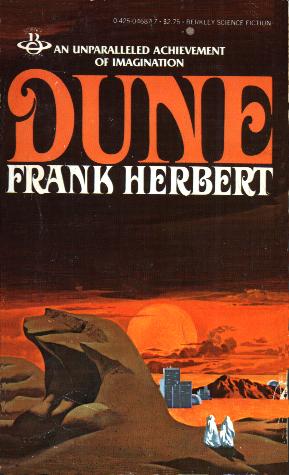
 What happens when you revisit the woefully misremembered science fiction of your youth? Joe Howley (Latin teacher) and Johannah King-Slutzky (internet wraith) asked adults to re-read their genre favorites from childhood. For the second in our series, we talked to bona fide adult Dave Klion, a foreign policy analyst and editor at World Politics Review, about Frank Herbert’s 1965 epic, Dune. We spoke with Dave via Gchat about how Dune affected his foreign policy analyst career choice, how Dune’s cultural values have held up over time, and how it relates to the only other books we’ve read– other science fiction novels and Greek tragedies. The following conversation has been gently massaged for clarity.
Also: Dune spoilers throughout. Sequel spoilers are sectioned off with **[SPOILERS]** and **[END SPOILERS]**
JOHANNAH KING-SLUTZKY: Hello Dave!
DAVE KLION: Hi!
JOE HOWLEY: Hi guys! Dave Our Guest: can you briefly introduce yourself?
DAVE: Yes. I’m an editor at World Politics Review, a subscription-based foreign affairs website based in Dumbo. I’ve held that job for about six months, and it’s great. Before that I was a full-time editor at Bloggingheads.tv and an occasional freelancer, and I’ve also variously been a defense contractor, a DC intern, an English teacher in Russia, and a PhDropout from the Soviet history program at the University of Chicago (I have an M.A. from there). I grew up in and around DC, which is how I know Joe, and my deep interest in sci-fi was probably from ages 11-15 and significantly influenced by Joe during that period.
JOE: I didn’t realize that! That’s nice to hear but also makes me feel guilty.
DAVE: Well not just you, but you were among my good friends who were also sci-fi nerds at the time.
JOE: Dune is definitely one of the earliest book experiences I remember sharing with a friend. The only book I remember you enjoying more was Foundation.
DAVE: I was definitely into Asimov, Ender’s Game, Larry Niven (your influence there), Star Wars, Star Trek (you especially, again). I first read Dune when I was 11, but didn’t really get into it until I reread it at 12 or 13. In early high school, it was my favorite book, but I’m not sure when the last time I read it was before this year.
JOE: So your background in history and your work in geopolitics, which always seems influenced by a lot of historical perspective, is why I thought Dune would be so interesting. When you were 11, 12, 13, why did the book appeal to you so much? How did you relate to it at that age?
DAVE: I’m sure like a lot of sci-fi and fantasy, the perspective of an intelligent, angry young man who’s actually a messianic figure (of sorts; more on that later) and who’s constantly manipulated by adults has a natural appeal… this accounts for the enduring popularity of Ender’s Game, no doubt. But that wasn’t the main thing. The main thing was how expansive and deep and thoroughly imagined the Dune universe is. Nothing else I’d read in classic sci-fi came close. You mentioned Foundation, which has plenty of Big Ideas but is very unimaginative in the details. Everyone is smoking a cigar or using some basic technology that is “nuclear-powered” for some reason.
JOE: Wait—I want to ask something about my great Dune shame. Although on rereading it this time, I totally clocked that the Fremen were meant to be descended from some sort of Muslim people, I completely failed to connect it in any way to the Middle East. Johannah had to hold my hand and point to “Arrakis” and “Shaddam” and also the fact that the planet’s main resource is the fuel of international trade and war. But, like, we were growing up in Gulf War Times. I never noticed any of this, ever.
DAVE: Right. You can sketch a very broad geopolitical critique knowing the book was written in the 60s and knowing a bit about Herbert. I got a bit of it when I first read Dune, but it’s more obvious now
The Atreides are Greek, hence democratic and Western and noble. “Vladimir Harkonnen” is Russian-ish. (Also gay, that’s another thing we’ll have to discuss)

JOHANNAH: He is also described as having a Roman nose, maybe related to the gay thing.
DAVE: Right. So you’ve got a sort of Cold War over the desert, populated by Arabic(ish) people who control the precious commodity that makes transportation possible. Plus you’ve got a Lawrence of Arabia-esque Mighty Whitey story. Dune is firmly in the tradition of Avatar, Dances with Wolves, etc. It’s much deeper, but still.

JOHANNAH: How much of this did you pick up when you were reading it for the first time?
 DAVE: I was vaguely aware of the concept of the Cold War and the Mideast having a lot of oil in middle school, but not like I am now. I got that it was supposed to be Middle Eastern, I caught “Shaddam” and lots of Arabic-sounding words. But I think I saw it as original, like it sprung from Herbert’s brilliant mind and wasn’t an allegory for anything.
JOE: I’m not even sure I was prepared to read for allegory at that age. I loved Star Wars, which is full of randomly borrowed language mish-mash, and I think I just took it as that.
DAVE: I often think Dune was the link between sci-fi nerdery and history nerdery for me. It helped me transition from one to the other. Because real politics and warfare and religion and civilizational clash is endlessly fascinating in the same way these imagined universes were for me.
JOHANNAH: Were there any particular details in the book that really grabbed your attention that way?
DAVE: Certainly the Bene Gesserit and the Guild, these institutions that arise from a major shift in technology. In Star Wars, you have a fantasy universe “a long time ago” with space trappings, and you just accept that. In Dune, there’s an elaborate reason why you have this hybrid sci-fi/fantasy setting, why we’ve returned to the middle ages.
 JOE: As an adult, I’ve come to respect that kind of deep-history fantasy and SF (Tolkien being the prime exemplar), but I think in our tween years, Dave was already clocking to that as a driving force of this book.
DAVE: Yes, and recently I’ve gotten into Game of Thrones, which is very big on history as a component of world-building. To an incredible extent for a show with such mainstream appeal, I think. Also, I was always struck by how hard it was to pin down what Dune is “about” compared to most sci-fi. You can imagine a sci-fi novel that is simply about a desert planet: a bunch of stock heroes fly their rocket ship to the desert planet and there are worms, cool. Or maybe a dystopian quasi-medieval future where witches control all breeding. Sure.
JOHANNAH: Actually, the “what is it about” is one of the big issues Joe and I struggled with: “What is the point of this conflict?” And: “What is Paul’s motive?” What would you say the book is about?
DAVE: So it seems to be “about” a few big themes, which are interwoven. One is the danger of anointing a messiah figure. The sequels, especially the first two, flesh this out more, but it’s all there in the original.
JOHANNAH: I sort of wanted one to be the primary theme and have others stem off from that. Herbert does a great job of showing how they causally relate, but I wanted the plot to have a single motor or source of anxiety.
DAVE: It makes a bit more sense through the real-world allegory. It’s not just that the most precious resource all the great powers fight over comes from the harsh desert; it comes from a harsh desert where an oppressed, fanatically religious people live. What if this situation explodes? And sure enough, that’s still a concern 50 years later. We keep invading oil-rich Iraq and installing new thuggish rulers, but we can’t keep the violent radicals down. Do I feel satisfied? Yes, but I remember being frustrated by all the loose ends, but then I came to see that as a good thing. That’s how history works. Nothing is ever tied up neatly.
JOE: Oh man, I like that! Like Johannah, I felt this desire for the book to be about something clear and discrete. And then I thought, maybe that’s wrong, maybe it is also a virtue for a book to be about the exposition of a world.
DAVE: It’s still conventional in many ways. Our young prince develops all his powers, avenges his father, and conquers everything. The oppressed natives revolt. The bad guys are defeated. And the spice, which we keep hearing is so awesome, we finally grasp its full potential.
JOE: Some of that tidiness felt like the weakest parts of the book to me. You get your “Return of the Jedi” final showdown, but why is the emperor there at all? You get the big native revolt, but it’s all offstage, and kind of a foregone conclusion.
DAVE: I remember comparing the Emperor in Dune to ROTJ as well, but it’s very different. Palpatine is the actual devil, the ultimate expression of the Dark Side, the purest villain. Shaddam is like many emperors in real history, an overdressed farce much more vulnerable than he realizes.
JOE: Johannah and I also felt like Paul was a much more troubling hero. She never really liked him, I felt like he was supposed to be sympathetic early on but wasn’t, and then wasn’t at all by the end.
**[SPOILERS]**
DAVE: I think Paul is supposed to be relatable to angsty teenage boys, but his inhuman stature by the end is meant to trouble you. We’re supposed to understand his victory contains great tragedy, and this is made more explicit in the sequel.
JOHANNAH: Ahh, I thought that might be the case. I haven’t read the sequels but I thought Alia would become the hero and Paul, the antagonist.
DAVE: Paul is more of a tragic figure. He ends up kind of pathetic. The really admirable characters are in the supporting cast: Jessica, Gurney, Stilgar…
JOE: Gurney <3
DAVE: In the sequels, Duncan Idaho is continually cloned and becomes a more conventional audience proxy. Over millennia, he observes Paul and his descendants critically while engaged in typical heroics. If you read the whole series, which you should feel no urgent need to do, Duncan feels like the real protagonist.
**[END SPOILERS]**
JOHANNAH: One of the issues Joe and I discussed is that—I’m borrowing Joe’s diction here—”the nature of Paul’s excellence” is muddied, but that Jessica has a pretty clear moment of tragic heroism: it’s when she disobeys the Bene Gesserit order to produce a daughter.
DAVE: Yes, and that’s not even the only example. She takes the Water of Life and becomes a Reverend Mother, at great risk. She attempts to guide Paul but increasingly finds she can’t. We get a surprising amount from her perspective, though, her innermost thoughts. That’s one way it’s different from conventional genre fiction. The angsty young hero’s mother is the most fully realized character, more than him, and we get her perspective on him. And she’s a badass, too.
JOHANNAH: Joe, by the way, as an actual expert feel free to jump in here about tragedies and heroism.
JOE: Yeah, I feel professionally obligated to point out that it’s easy to misunderstand the nature of tragedies and their protagonists. Many of the Greek tragedies are about choices, but just as many are about things that happen in spite of choices. My favorite example is Oedipus, who actually does not do anything wrong to end up in the state he’s in. I mean, you could argue that he goes a little overboard killing a stranger he meets on the road. But he doesn’t choose his fate. Many of the Greek tragedies point out that the whole situation is screwed to begin with. And it’s about how people deal with the circumstances they are in more than it is about them creating those circumstances.
As Dave pointed out, the name “Atreides” for the main character’s family in Dune is a pretty blunt instrument to put on this mantle of classicism. On the one hand, it’s just the family that Agamemnon and Menelaus, the main generals of the Trojan War on the Greek side, come from. So it could just be Western nobility and heroism in the old mythic sense. Great Men Who Excel. But the house of Atreides has this famous curse on it, which is what Aeschylus’s Oresteia is about. Basically, a family doomed to kill its own members. I’m not sure how that maps onto the Dune characters, to be honest, except there is that thing about who Paul’s grandfather really is.
DAVE: Well, in Paul, we have a guy who’s fulfilling his genetic birthright and deep training (the Kwisatz Haderach, taught by his mom and the best mentats and swordsman), and who’s avenging his father/family and reclaiming his title. He’s self-actualizing and restoring justice. And rescuing an oppressed people too, and toppling a corrupt empire! All great things to do. Except whoops, he’s unleashed jihad in the process. So that’s the tragedy, and with his prescience, he sees it coming but keeps taking individually justified steps toward it anyway. You’re right, the evil grandfather is a pretty blunt indicator as well.
JOE: This is a point I got really stuck on: Why’s Paul so great? Has he inherited ethical nobility from his dad?
 DAVE: Duke Leto is a bit of a Ned Stark figure, of course, brought down because he’s too trusting, too honorable. But there’s that scene where Jessica and Thufir stare each other down and you remember these are violent, cold-blooded people.
Even Leto’s ethics are undermined a bit. They use propaganda to promote the idea to the populace that the Atreides are especially good. Clearly they’re charismatic and lead by example and aren’t just blatant thugs like the Harkonnens. Clearly they inspire fierce passion. But still, they operate by spies and assassins and feudal marriages like everyone else.
JOHANNAH: This reminds me of the decadent Atreides garden at the beginning of the novel. It’s the same thing as Dave is pointing out—their nobility has been meticulously constructed and on inspection isn’t so great.
JOE: I wanted to talk about Paul and adolescence, because I think that’s part of what propels him as a character. In some ways the book is very knowing about this. He learns about the prophecy he fulfills, but then there is a lot of angst and uncertainty. The one thing you might call his superpower, aside from the training, is this ability to see all possible futures and his terror of acting or not acting, futures closing down or opening up.
JOHANNAH: Yes, I love how this works allegorically on both political and personal levels, that this is the dramatization of adolescence. This must have been what so much of the 60s felt like, too: a terrifying blooming of possibilities that scares not just you but—and you are aware of it—your own parents.
DAVE: There are interesting philosophical questions, some of which could draw comparisons with Ender’s Game. The two are fundamentally similar in this respect: the heroes, who are bred and trained from birth to be The One, both commit genocide but in both cases we’re meant to understand they had no choice, but they still carry the guilt. So in Dune, one question is whether Paul actually could make choices to prevent the jihad. Does the jihad occur because his desire for revenge overcomes his prescience? I think that’s the tragedy… Paul is only able to fulfill his goals by committing to an even worse outcome.
JOE: Johannah, you had something to say before about how this uncontrollable power surging through Paul is a very adolescent thing. Not just, oh, I’m special, but also, oh, if unchecked I will destroy the galaxy.
DAVE: I can see that. Every adolescent feels simultaneously powerless in their circumstances, and like the feelings inside of them are so big they could destroy the universe.
JOE: Something that I definitely one hundred percent didn’t pick up on when I read Dune as a tween, but that I think your adult rereading primed me to see, is the glaring, weird… call it homophobia?
DAVE: It’s absolutely homophobia.
JOE: So maybe just to be clear what we are talking about: basically every chapter about the villainous, grotesquely fat, psychopathic Baron Harkonnen ends with a reminder that he is a gay pedophile. You’ve just seen him do something wicked, and then also he looks at a boy’s butt or thinks about raping a child.
DAVE: I don’t think I fully grasped this when I was 11. I mean, pedophilia and rape are gross, and as an adolescent who wasn’t anti-gay I didn’t assume this reflected the author’s homophobia, but it clearly does.
JOHANNAH: Another Ender’s Game parallel.
DAVE: So Brian, Frank Herbert’s son, he also wrote a memoir, and I’ve only read a few excerpts. But apparently his brother, in his words, “had become a homosexual” at some point. This was too much for Herbert, a devout Catholic, and the brother was disowned. Herbert believed homosexuality brought down all the great empires.
JOE: You know, the more I thought about this book, the more I started to read Herbert as generically 60s leftist, but this is clearly a problem.
DAVE: I’m not sure how well he maps onto our modern culture wars.
JOE: Maybe that’s part of why I had so much trouble pinning down any kind of obvious heroism for Paul, or why I wanted to so badly—because the villains are so obviously gross villains.
DAVE: My best justification for it is that it’s misdirection. The Harkonnens are unambiguously terrible, so we root against them, but in the end it’s not about them, it’s about what Paul is becoming and what the Fremen jihad will be.
JOE: Johannah, you didn’t seem as shocked as I was about this part of the book—I think you felt like it’s de rigueur for genre fiction from that period.
JOHANNAH: Oh, definitely. I am queer and this stuff weighed very heavily on me when I was younger—not just in this book but in almost all sci-fi from the 60s.
JOE: You cited Stranger In A Strange Land, right?
JOHANNAH: Yes. It seems to come up often in books about fantasies of togetherness where sex between men is the one thing that cannot take place. And the fantasy of telekinesis, especially, seems very prominent in 60s genre fiction, which makes sense when you think about what was going on politically at the time.
There’s an argument to be made that homophobia is characteristic of science fiction because sci-fi is a haven for nerds, and queerness and nerdiness share a basic sense of exclusion. I also don’t think that these homophobic moments are particularly different from what I see as Dune’s misogyny, although there’s a lot of good feminist stuff in there too and I think that is how the book is primarily remembered. But this is a story about a man who has special powers because he can enter the women’s realm (this is explicit in Bene Gesserit lore). Women are never given the symmetrical access to power, which is a classic patriarchal structure delineated by queer theorists like Eve Sedgwick and others.
DAVE: It’s kind of the mighty whitey model again, but for gender.
JOHANNAH: Right. You see it over and over again, it’s a basic characteristic of most kinds of discrimination. Not only is it exclusionary, it also builds solidarity between members of the in-group. Applying the same thinking to homophobia in Dune, the Harkonnens’ queerness makes them look bad to contemporary readers and the Atreides, but it is also a sign of the Atreides’ goodness.
DAVE: And there’s this persistent anxiety throughout the book, literally to the last line, about Jessica’s concubine status.
JOHANNAH: Yes! Joe and I were puzzled by that—it seemed like one of those extraneous threads.
DAVE: Jessica is in some ways the audience proxy, because we get her viewpoint throughout the book and she doesn’t transform into a superhuman to the extent Paul does. We witness Paul’s transformation through her.
JOHANNAH: Yes, and many of her powers are actually quite boring. There is a moment in the beginning of the book where Yueh has a waver in his voice when discussing his dead wife, and Jessica, supposedly using superhuman intuition, is like, “Oh he must be upset.”
 DAVE: Ha, yeah, although we’re told that what Yueh does is impossible, to break his Suk school training. I dunno, I think Jessica is pretty cool, and much more relatable than Paul.
JOHANNAH: Ughhh I warmed to her after she drinks of the Water of Life, but mostly she was just this mom. I wanted her to be more badass. (Is that terrible to moms?) I would have loved for her to have definition outside the context of wife and mother. Also she is IMMEDIATELY upstaged by her 15 year old son, which sucks.
JOE: I was affected by the growing distance between her and Paul as he became more super-powered.
DAVE: Yes, that’s key. But also by the sense in the early chapters that she’s the most powerful Atreides but is obligated to downplay that. As with Game of Thrones, this is a portrayal of a male-dominated society where women are treated as second-class. But in fact, the women are often more powerful and smarter than the men. Almost every woman referred to in the book has some Bene Gesserit training.
JOHANNAH: Yes, but in GoT Cersei at least is a BAD mother, which is to me, much more interesting.
DAVE: Fair. In general, GoT is a more fully realized universe with more interesting characters, but it also came later.
JOE: So to get back to the sort of starting point of “books we loved as #teens,” do you think you read this book at the right time?
DAVE: I definitely do. For me, it helped me understand that dark side/light side dynamics aren’t really what drive history.
JOE: I told Johannah this is like the band Nirvana—I had no idea teens are still into it, but God bless them.

I was pretty sure referencing Dune in an art conversation was a deal-breaker, but I still managed to get a date. It still didn’t work out, though: http://introvert.nyc/the-return-of-the-rhizome/
Speaking of the depth of detail, I think the thing that pulled me into Dune and kind of snagged me were the ornithopters. If this had been some other, duller book, someone would have had an explanation for what ornithopters were and how they worked, or at the very least what the fuck they looked like. Not Frank Herbert, though.
“Yeah, there some kind of bird-ships that fly around.”
“Bird…ships? Like they have wings? That flap? But how…”
“I dunno man, you figure it out.”
I think there’s something really compelling about those cryptic details that are both evocative but never explained at all that make it feel like you’re looking in a window onto a realized world, as opposed to a world whose visible parts have merely been constructed for your benefit.
I hated the ornithopters because they just don’t make any sense. The Spacing Guild has super-advanced Navigators who can move huge ships safely through space-time at faster-than-light speeds, the Ixians have all sorts of freaky cool technology, but for daily transportation purposes people use ships that actually have wings that flap? Isn’t that a huge step back from the airplanes that presumably existed in the Dune universe thousands of years before the events of Dune?
I agree with what you said about the compelling quality of not having things explained to the reader, since that emphasizes the artificiality of the book-universe, but for me the mere presence of the ornithopters did that. It was like Frank Herbert poking me in the ribs and saying “YOU CAN TELL THIS IS QUALITY SCI-FI BECAUSE THEY USE DIFFERENT FLYING MACHINES THAN WE DO IN REAL LIFE.” Okay, Frank Herbert, but these flying machines are actually really stupid.
Not as stupid as the Dune books your son will write after your death, but still really stupid.
Yeah, I guess I instinctively gave it more credit than that. Like, “Yeah, a flying machine the way that I’m thinking of it doesn’t really make any sense, so what is the REAL thing that you’re talking about? Because there must be some other way to do it, right?”
They’re also fighting each other with knives all the Goddamn time in a feudal society that’s been socially and technically stagnant for centuries so safe to say the Dune universe is not intended to be a super modern upgrade to the present day. Pretty good at turning people into crazy superpowered shit, way worse than even the 60s at pretty much everything else.
Having this mismatch of technologies doesn’t bother me as much. The real world is this way. “The future is already here — it’s just not very evenly distributed” — Wiliam Gibson.
I keep meaning to re-read Dune and see if it would grab me the way it did 10 years ago, but… there’s so much else to read.
Alia was my favourite character by a mile and I would argue that she’s also a tragic hero. Chani bored me to tears, and I could never really take her seriously because she kept calling Paul “Usul” and that’s the name of a species of Neopet so that’s all I could think about every time. I got tired of Duncan Idaho real fast and I never really understood WHY they kept cloning him so much (although it’s possible this was explained and I skimmed/forgot it) – was it because of his dark curly hair, which Herbert felt the need to specify every damn time resembled the wool of the karakul sheep?
OH MY GOD Duncan Idahozzzzzzzzzzzzzzzzzz
In a universe of wierdass shit Duncan is actually kinda bizarre in how completely dull he is does he ever do ANYTHING interesting
Like, there’ll be this whole scheme against the giant psychic worm-baby who rules the universe by a shapeshifting assasin-cultist who never really lets on what his deal is and somehow, right in the middle of it, will be another Duncan, somehow, just kinda hanging out blandly
If you click through the Wikipedia synopses of the Official Authorized Continuation Sequel Novels, you’ll see that it somehow gets worse, in that everybody gets reincarnated as an attractive young ghola.
Gurney Halleck gets a ghola! Stilgar gets a ghola! Duke Leto I gets a ghola! Baron Harkonnen gets a ghola! Yueh gets a ghola! Prequel characters that no one cares about all get gholas!
And yet another Duncan Idaho ghola gets to hang out blandly, playing ghola dad to the angsty teen gholas.
I have read both Mentats of Dune (a prequel) and the last of another separate Kevin J. Anderson and Brian Herbert trilogy as part of my freelance job, and man, they are AWFUL writers.
My condolences. I’ve attempted to engaged in a few of those books a few times (perhaps as a way of expressing some kind of repressed sadomasochistic urge) and god they are so bad on pretty much every level. If you (as Sean_Sullivan suggests, and as I did) read the wiki summaries for the entire swath of the prequels…wow… just wow. I mean, it’s worth doing just to see how terrible something can be made.
I’ve read a critic who described the first book as amazing, and each subsequent one diluted the awesome by factors of ten, until you were left with homeopathic amounts of awesome….
I just really really love the phrase homeopathic amounts of awesome
That is pretty clever, although I’m going to take away any points it may have earned them with me for calling the first book amazing. I couldn’t even get through the first few pages.
Just in case anyone else (like me) comes along in 12 weeks and wants to know, this was Jo Walton and she writes great reviews: “I loved it when I was twelve, and I read the sequels, which are each half as good as the one before, and I didn’t give up until they were homeopathically good.” — http://www.tor.com/blogs/2011/01/in-league-with-t…
I think Dune is more interesting if you try to step outside liberal, modernist ideas of progress in history.
God how wierd would a liberal Dune be, like, same setting and everything but the metaplot is that the arc of history bends towards justice and if nice enough people ran the eugenic space feudal system it could be harnessed for the greater good of all
Ok, not really about Dune, but along those same lines I was watching Telemundo without sound at the gym and there’s apparently going to be a telenovela called Los Miserables, which further investigation revealed is going to be somewhat based on Hugo’s book. But man what I wouldn’t give for a narco-fueled Les Misérables set in modern Mexico, point-by-point but with all the morals running slant. Like, Valjean is trying to leave being a cartel enforcer and Javert is out to kill him for it? And Marius and crew are the Iguala students? God I could think about this all day.
Well hell I think you need to write that, not least because I get about as far as ‘wanted for stealing a loaf of head‘
I would also like to say that the sight of Young Kyle MacLachlan in that uniform, um, does things to me.
He was a hottie. I got to see him play Romeo, and my seat was about three feet away from the stage. Serious fangirling ensued.
I left the spoiler warning in when it was presented to me, bc I found it so adorable.
(hi guys!!! had to get off my confinement couch and lurch in for DUNE)
nothing puts you in the mood to give spoiler warnings like thinking about all the sf/f you read as a teen
I just started reading Dune, so now I have motivation to finish it thanks to this discussion. Yay?
The fact that the universe seems so plausibly vast and complicated is one of the main reasons I was so engrossed by Dune when I first read it.
Even though the first book is far better than Dune Messiah and Children of Dune (and probably the other sequels, though I haven’t read them) I love that we get to see Paul as an adult struggling to cope with the consequences of his ascent to power and what he unleashed. Also, Alia in the second book with her combination of vast knowledge/adolescent frustration is such a great character and I remember being super delighted by the bit where she’s in a terrible mood so she goes to do some naked deadly knife throwing practice. On the other hand, Jessica and Gurney are much less interesting when they turn up again in the sequels for some reason.
God Emperor is pretty great for the adventures of psychedelic sandworm philosopher-king unstuck in time, but yeah I wouldn’t really bother with anything further than that. Nothing ever comes together just right like it did for the first book, and once you get out of Paul’s immediate family there’s not that much of a reason to care about the ongoing unhistory of convoluted space politcs.
This makes me feel better about the fact that I gave up on Heretics of Dune after just a couple of chapters.
The last 2 books, Heretics and Chapterhouse are great–they show the repercussions of Paul/Leto’s actions milennia later. Both have intrigue, politics and strategy.
I would love to get some clarification on what we all read as the “obvious” verbal allusions to the Middle East, especially since several people have pointed out to me off the air that Saddam Hussein’s career wasn’t really high profile when Herbert was writing. Anyone who knows more about that period and American awareness of the middle east should jump in and enlighten us.
While we’re explaining things, could someone elaborate on this for me? I’m not sure I quite follow the connection.
“And the fantasy of telekinesis, especially, seems very prominent in 60s genre fiction, which makes sense when you think about what was going on politically at the time.”
I was really hoping someone would answer this question.
My guess is Cold War politics and the new and terrifying ability to launch nuclear weapons by remote control (“the push of a button”).
Telekinesis IS “remote control,” basically, right?
I don’t think it’s a direct reference to anyone it’s just a common Arabic name that isn’t Mohammed. Like, most future people in the 60s are called something like Jhon or S’Teve and then you’ve got Shaddam the Padishah.
I don’t know anything about US awareness of the Middle East at the time he was writing, but the part of the book that really cemented that parallel for me was during the Fremen anger ceremony thing when part of their chant is “they denied us the Hajj!” How many average US readers of the time would have recognized that, I don’t know, but it definitely felt to me like the most explicit link to real-world stuff.
Aside from the explicit Lawrence/Arab Revolt allusions (like “Padishah Emperor”) the Suez Crisis would probably have the most prominent thing in recent media history concerning the ME. So in that you have Nasser, the Non-Aligned Movement, and the United Arab Republic/United Arab States informing readers who read the World News sections of the newspaper. The Siege of Khartoum is still bouncing around as a reference you can assume people get, too, I think, via Kipling (and maybe some pulpy adventure stories). Guys Herbert’s age would’ve been right in the middle of the ‘adventure pulps’ era when they were kids, so he could make references to assume familiarity with that material the same way a 45-year-old writer can allude to Star Wars today.
This is great, thanks.
A while ago, I had been reading books I missed out on at the “right” time, based on friends’ endorsements of their favorite books as teens. This included “Ender’s Game,” which I thought was just the worst. Same with “Stranger in a Strange Land,” which I couldn’t finish because I hated it so much, so I really appreciate Johannah’s comments about gender and misogyny with regard to these books. My reciprocal recommendation to a friend was “Dune,” which I looooved as a teenager (I still have the fear mantra memorized), and she was like, “Ugh, this is so misogynist and homophobic and obviously about the Middle East.” She couldn’t finish it.
Anyway, I had a moment of this when “AWIT” was the subject of discussion in the last installment, but it’s funny how we hold so tightly to the positive aspects of these books that influenced us when we were youths, and it keeps surprising me (which, should it?) how much icky stuff there was just below the surface. (I’m talking more generally about the representation of LGBT folks in L’Engle’s books, which of course were way, way more positive than anything else(? at least that I can think of off the top of my head) at the time.) I’m positive that some of that icky stuff was internalized, too, even if I can’t recall it in the same way, and that makes me sad.
I’m so relieved when I find something I loved as a teen that is not terrible and rife with racism/sexism/homophobia… Ugh.
it was not, in fact, visited by the Suck Fairy in the intervening years? That makes me happy and relieved also.
Dune? Well…there’s definitely some dicey stuff in there. See the other comments about homophobia, etc.
Flight of the Navigator! It could have more non-white people in it, but other than that, it still rocks.
And because it’s effectively a historical piece with two well-imagined “periods” (only one was “now” when it filmed), it still works as watchable fiction, too. IMHO.
Oh ugh, yeah. I read a lot of these as a teen and filtered through time I remembered Stranger being a formative book for me because of the polyamory. But when I went back and reread it the suck fairy inserted all the systemic mysogyny. Now I want to be able to find a scifi book that was what I remembered it to be.
The Starfarers series by Vonda McIntyre maybe has better queer/poly characters. http://www.vondanmcintyre.com/index-Starfarers.ht…
Starfarers has way better queer/poly characters. I also didn’t read SIASL at the right age (16-18?), so when I finally tried reading it, the embedded gender stereotypes got up my nose. I’m sure they were radical in the late 60s – not so much in the late 80s. I loved Starfarers for the alternate relationship paradigms (before I realised I was poly), and the fact the characters were of different ethnicities, genders, and even species, but still had their actual distinct characters (I find myself tired of “orcs = bad” character studies). And I so much liked a space opera that wasn’t all about Military is Best.
The main drawback for the Starfarers books was how they kind of wandered off in the middle. I wonder if it was originally supposed to be a shorter series (maybe a trilogy), and then had to get spun out a bit. I also got a bit tired of the family dynamics and Stephen Thomas’s constant pouting (about something he did to himself) – I completely failed to see what every other character found so attractive about him.
It’s kind of appalling to realise how many decades later we still have such a dearth of alternative relationship paradigms, and so little diversity in character casts (although definitely improved from back then!) in so-called “speculative fiction”
I was JUST YESTERDAY whining on tumblr that my semi-cyclical* (re-)obsession with Dune had popped up again and how sad I was that none of my friends, irl or otherwise, shared my passion. So thank you.
*I don’t know the pattern, I doubt there is one–I think my passion for parts of it** is so great that my brain has to shut itself up for weeks/months at a time in between freak outs.
**I was lucky enough not to realize my own queer leanings until long after I had stopped rereading the Harkonnen chapters. I feel like they should still bother me but I don’t know to what end that would be helpful.
For the discerning Dune nerd parent: http://www.redbubble.com/people/steppuki/works/91…
Thank you for this, will definitely buy for future niecenephew.
Nibling!
Great discussion. There are a couple of other things I thought were important about the series. In one sense, it’s not just a critique of Heroes and Messiahs, but of cynical imperialism and cultural appropriation. Jessica and Paul both manipulate the Fremens’ legends (which had been twisted by BG missionaries eons back) in order to gain ascendancy after falling from power. In Dune Messiah, many of the Fremen feel that the Atreides used them and brought the Fremen culture to ruin.
I wonder what the 3 adults (or other Toast readers) think about the Fish Speaker army in God-Emperor of Dune? Basically, Paul’s quasi immortal grandson creates an all woman (mostly lesbian) army to avoid the problem of male dominated militaries committing sexual atrocities on conquered peoples. I’m not sure whether that was a function of Herbert’s homophobia or his attempt to work through it.
Is that what they were about, I sorta recalled the Fish Speakers being an attempt to co-opt the funky super-karate the Bene Gesserit used to assassinate people into a regular army (which IIRC was supposed to be pretty outrageous and shocking to the rest of the universe, basically Leto making it plain to everyone how little a fuck he gave) because Herbert was very much into a ‘Men are from Mars Women are from Venus’ model of mutually exclusive, sexually-determined domains of human capability and people who transgress that binary somehow.
Stuff like the Baron’s sexuality might play into the same worldview – most of the great schemers that I can recall in the Dune books are notably androgyne or effeminate in some way – eunuchs, homosexuals, I think hermaphrodites?, Bene Gesserit nuns, or the Kwisatz Haderach while outside the Fish Speakers men tend to be the warriors or technicians (or, really, both, ’cause everyone in Dune knows thirty-six ways to kill you with a pen, it’s just a question of whether they’ll ritually duel you to the death with it or stab you in the back with it).
is this where i can share that when i first read Dune, i kept reading “melange” as “menarche” for the first few chapters and thought it was gonna be a whole different type of story?
A better story.
Wait, no, maybe not.
But I like that menarche extends life. And it enables you to see through the vastness of space.
Dying of laughter.
I’m rubbish at picking up on allusion and allegory. 100% rubbish. I read the whole series in my late teens / early 20s (let’s not talk about how long ago, now) and just… nope.
Of course, “Chapterhouse” was nearly the book which broke me of my old habit of I Absolutely Must Finish This Series Even Though It’s Both Full Of Crap And Boring As Hell. Oh, Duncan Idaho #169,883,724, just keep on letting thing happen around you, man.
(The book which broke my Must Finish This Series habit? The 5th Wheel of Time installment. Not set aside lightly, but hurled with great force, as the quote sayeth.)
If someone is reading the first or second wheel of time book, the greatest favor you can do them is razoring out the last twenty pages, so they can believe that the story has a satisfying ending and read no more.
Oh yes. I could see reading to almost-the-end of the second book, then walking away thinking, “Okay, that wasn’t terrible.”
Partway through the fifth book, with the bunch of squabbling children holed up in a hotel or whatever, I realized that the only characters I liked had been written out of the series already and that I was rooting for the forces of evil to sweep through and wipe out the remainder. I put the book down and never looked back.
Back on topic: I remember slogging through to the end of Chapterhouse and thinking, “He just doesn’t know when to quit, does he?” I thought Messiah and God-Emperor had some interesting bits going on, though.
This is extremely important and correct and you sound like an excellent friend.
I love love love Dune to death but what boggles me since I read it last is:
Some of the language is great, I love “Dirge to Jamis” and the litany and stuff, right?
But then Herbert writes stuff like “so, the sand coming down went *brrrtr brrrrtt*” and it´s just sounds the least convincing ever. What gives, Herby?
Or, the quote from Children of Dune that is seared into my brain forever, from when Leto the 9-year-old is tripping balls —
“He felt an adult beefswelling in his loins”
(note: my love for Dune is vast and pure; I liked most of Dune Messiah; I took Children of Dune seriously until that exact line and then tapped out)
Dune was one of the first Serious Bidniz Science Fiction books I read, which, in retrospect, must have happened immediately after the first gulf war and while Yugoslavia was decomposing, and the allegory seemed extremely clear at the time, so I guess this could also be about when you read it and how much news got through to wherever?
I’d love to see/attend a college-level course with this versus Ursula LeGuin versus postcolonial lit generally, like, Achebe and Tsitsi Dengaremba. We could call it Recolonizations of Self and then read a ton of Ann Leckie short fiction on the side.
Okay this is way off topic. If you need me this winter, I’m just going to be over here rolling around on a pile of ethically dodgy fur with a bunch of adventure books in every kind of critical skin.
i would attend that class every day and twice on sundays
yes please me too
Regarding the connections with the Middle East, while the spice has an obvious parallel to the contemporary petroleum situation, the fall of Arrakis and Paul’s rise as Muad’dib are a direct crib of Gordon’s fall at Khartoum at the hands of the forces of an Islamic fighter who had claimed the mantle of Mahdi.
Also, the whole “these guys haven’t controlled anything bigger than local patches of desert for all of human history, but with the right religious/military leader and doctrine to unite them they can suddenly and without warning overcome ancient, heretofore stable empires and conquer the known world” is more than a little reminiscent of the Prophet himself.
Wait, he was a practicing Catholic? That does not come across in most of his stuff: http://www.oreilly.com/tim/herbert/ch05.html
OK. Wait. The O’Reilly of all the O’Reilly software/programming/ETC! books wrote a book on Frank Herbert? *mindblown*.
This is important. Why aren’t we talking about this. Why isn’t there an animal on the cover of that book. So many questions.
RIGHT. My head is still wobbling. So confused. And I need to read it, just because… I mean, right?
Well, some of it is also that Dune steals a LOT from the Alexiad of Anna Comnena which was an actual history of events in the medieval eastern Mediterranean.
Herbert was big into ecology – especially desserts – that lead him to things like mid-east politics and cool medieval histories. That synthesis created Dune.
Omg, Animorphs is science fiction, right? Can we do this one next? 😀 😀 😀
Thanks so much for this post! I just finished DUNE, and was totally torn – I finished the whole thing in a day, but then afterwards I started getting this eerie feeling; all these thoughts about sexism, racism, homophobia, rigid gender binary, and eugenics started rattling around my head.
I was looking around for some useful criticism, but all I could find was people either freaking out about how it was “the most sexist thing ever”, or about how “feminism has destroyed sci-fi”.
This was a really nicely balanced discussion, that helped me clear my thoughts about the book a bit.
I enjoyed DUNE, I was freaked out by the ending though – because Paul just morphs into this freaky space-Hitler, who subjugates everyone around him, and then pretends to feel all morally questioning about it, but still continues to do exactly that – impose his will on everyone, because he doesn’t WANT to know best, he just DOES!! Urgh.
I’ve never read anything like it I think, so that’s exciting!
Anyways, thanks! 😀
GAHHHHHA DUNE IS AWESOME I LOVE UT ALL PRAISE TO SHAI HALUD
sorry I’ll go back to lurking and never commenting
Bless you and the maker and his water
Is it wrong of me that I prefer Doon (the parody) to Dune (the original)?
To truly grasp how everything in Dune works, read all of the other books. This includes as far back as The Butlerian Jihad all the way to Sandworms. You could probably skip Paul and Winds of Dune, but the machine trilogy is a must (hunters and sandworms won’t make sense without it), and the house trilogy shows the more direct precedents to Dune. The school series (sisterhood and mentats) are great reads themselves, but still show an important part of Dune history. When it all boils down, Paul Atreides is a small part in the whole chronology, but nonetheless a huge tipping point. It’s a long read, but worth it imo.
Talking about themes, Herbert covers one of them himself – “hydraulic despotism”. The big work that kicked the theory (Oriental Despotism) was written in the late 1950s, and Herbert mus have read it (haven’t seen any overt references to his in fact doing so, but I can’t imagine Dune without it as an influence) – http://en.wikipedia.org/wiki/Hydraulic_empire
The main point is “a developed hydraulic civilization maintains control over its population by means of controlling the supply of water”. Substitute the Spice for water, and there’s your story. Substitute oil for water in our world economy, ditto. Also, shenanigans around retaining an oil supply are not confined to the 70s and later – it was a significant part of the WWII strategy, and quite a large number of political machinations around the Middle East in particular afterwards. Such as when the Brits and Americans helped install the Shah of Iran in the early 50s (when the previous elected prime minister nationalised the oil industry).
Sorry to straightsplain, but the Baron Harkonnen is NOT gay – he’s a pedophile.
Even if this was true, it is undeniable that a huge part of his creepiness was supposed to be from his same-sex attraction.
If you're talking about the non-Frank Herbert books, ugh, no. Tacked-on, and appallingly-written.
I don't recall any references to his abusing girls. It seems pretty obvious that Herbert was of the school of gay = pedophile.