
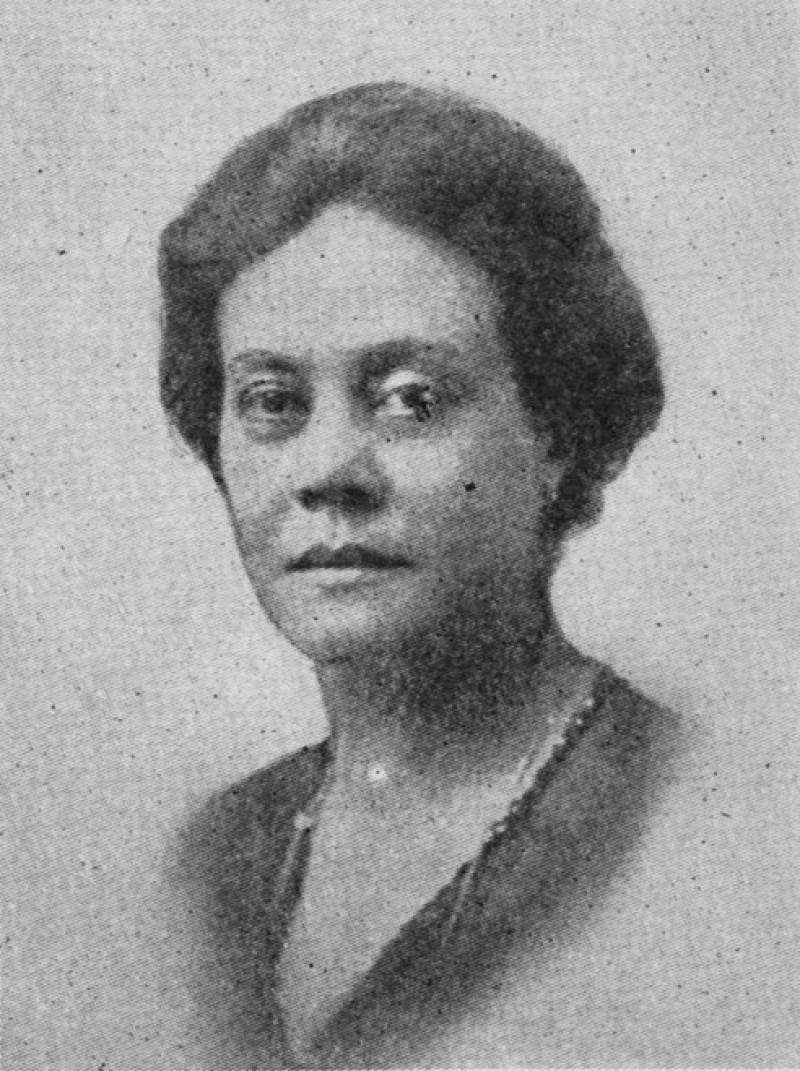
The second in a series of short essays by Anne Boyd Rioux about about women writers in danger of being forgotten. Previously: Constance Fenimore Woolson.
While Alice Dunbar-Nelson (1875-1935) is often discussed alongside other Louisiana writers such as Kate Chopin and George Washington Cable, she is not nearly as well known today as they are. Known for portraying the world of multiracial Creoles of color in New Orleans, the world in which she grew up, Dunbar-Nelson also wrote some of the most compelling and heartbreaking stories about the color line in America.
Born Alice Ruth Moore in 1875 in New Orleans probably to a white seaman and a former slave, Alice and her sister were raised by their mother, who worked as a seamstress. Alice was an excellent student, and at age fifteen she went to Straight University in New Orleans, a historically Black college, where she trained to be a teacher. By the age of seventeen she had begun her teaching career, which would support her for the rest of her life. When Alice was twenty, she and her family moved north and she published her first book, Violets, and Other Tales (1895).
About that time Paul Laurence Dunbar, the most famous Black American writer of the day, began an epistolary courtship with Alice, having seen one of her poems and her picture in the Boston Monthly Review. They corresponded for two years and married in 1898, moving to Washington, D.C. They were a power couple of the Black cultural elite, hailed by some as the African American Robert and Elizabeth Barrett Browning (they too had to elope to evade familial disapproval), and were often pointed to as examples that disproved racist theories of Black people’s inferiority.
Alice and Paul’s tumultuous courtship and marriage are documented in Eleanor Alexander’s book, Lyrics of Sunshine and Shadow: The Tragic Courtship and Marriage of Paul Laurence Dunbar and Alice Ruth Moore. In 1902, Alice left the psychologically and physically abusive Paul, who had tried to kill her in a drunken rage. Paul died in 1906 of tuberculosis, freeing Alice to marry twice more in her life, lastly to the journalist and activist Robert J. Nelson in 1916. Thereafter she was known as Alice Dunbar-Nelson.
In her writing, Alice took a very different path than her first husband. While Paul had gained fame for writing plantation poetry, Alice wrote many stories, such as those in her fabulous collection The Goodness of St. Roque and Other Stories (1899), featuring multiracial Creole characters in New Orleans. She didn’t describe her characters as white or black, but simply described their varying skin tones and coloring. One of her best stories, the oft-anthologized “Sister Josepha” from The Goodness of St. Roque, seems on the surface to be a local-color story full of French patois and the Vieux Carre atmosphere of New Orleans. Close reading, however, reveals it to be the story of an orphan girl, a beauty of unknown parentage and indeterminate racial status, forced to live in a convent to escape the common sexual exploitation of multiracial women.
Some of Dunbar-Nelson’s most powerful writing was never published in her lifetime due to its more overt exploration of racial themes. When she approached the editor of Atlantic Monthly with “The Stones of the Village,” he responded that American audiences had a “‘dislike’ for treatment of the ‘color line.’” Written about 1900, the story depicts Victor Grabert, a light-skinned Louisiana Creole man whose darker-skinned grandmother punished him for playing with “little black and yellow boys.” Victor is educated and later moves to New Orleans, where he “passes” as white and becomes a wealthy lawyer and judge; haunted by his secret identity, he lives in constant fear of exposure. There is evidence that Dunbar-Nelson drew on some of her own experiences in writing this story, less a tragic story about a mixed-race character — of which there were many fictional examples at the time — than an in-depth psychological exploration of the costs of passing.
Through the 1910s and 1920s, Dunbar-Nelson was a teacher, activist, and journalist who was active in the women’s suffrage and anti-lynching movements. She was part of the Harlem Renaissance and wrote numerous essays and newspaper columns. She died in Philadelphia in 1935. Today a handful of her stories can be found in widely available anthologies, but her full body of work has only been published in the very expensive Schomburg Library of Nineteenth-Century Black Women’s Writings, designed for libraries. Scholars are busy recovering Dunbar-Nelson’s work, however, and continue to discover new dimensions to her writing and her great contributions to American thought and literature.

Oh man, I was a teenage (pre Internet) fan of lot of Paul Laurence Dunbar’s work and I am sad to know that he was a jerk.
I also… did not ever consider the possibility that he was straight? So that is new data as well.
Otoh, amazing new author to read!
Hopefully her work gets compiled into a more manageable (and affordable!) volume, but I am pleasantly surprised by how much of it is available online. Also: this is an excellent series that should be used as a guide for teaching in schools. Thank you.
I’m glad you are enjoying the series! Getting these women writers into high school curricula would be probably the best way to ensure that they are known again. Wouldn’t that be great?
Oh wow, read this little excerpt from her first book: https://en.wikisource.org/wiki/Violets_and_Other_…
Just some professional feminism right there, no big deal. And this right after a slightly schmaltzy story about violets. Don’t let her fool you!
And….added to my reading list. That is some first-class feminist musing!
FYI, the kindle version of Violets and Other Tales is FREE on amazon!
She’s not being forgotten! We talked about her a bit in my (high school level) African American history class and some people ended up reciting a couple of her and Paul’s poems during our Black Poetry lesson. Man, that was a great class.
That’s awesome! I try to teach her in my American literature survey classes at the University of New Orleans, especially since she is from New Orleans. And my students never know who she is.
That's awesome! I try to teach her in my American literature survey classes at the University of New Orleans, especially since she is from New Orleans. And my students never know who she is.
I'm glad you are enjoying the series! Getting these women writers into high school curricula would be probably the best way to ensure that they are known again. Wouldn't that be great?
So glad that you wrote about Alice Dunbar-Nelson, Anne! I teach her work regularly, too, and believe that she deserves to be written about more widely. The first of her Schomburg collections is available online, and I’ve linked to it and to other ones here: http://public.wsu.edu/~campbelld/amlit/dnelson.ht…. –Donna Campbell