
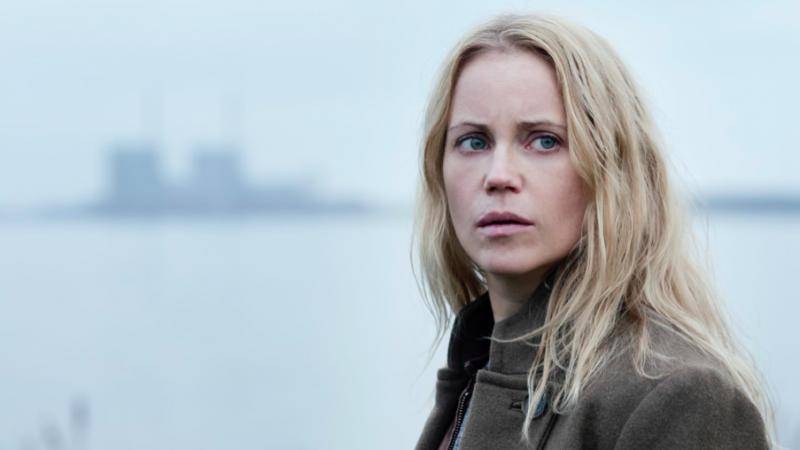
There are gonna be spoilers.
When I found out at the age of 22 that I was not somehow failing at being liked by others, but that a series of horribly well-meant mistakes by my parents, teachers, and pediatricians had kept me from the autism diagnosis I should have gotten when I was eight, the only thing that cheered me up for months was hunting for serial killers in Copenhagen and Malmö.
Specifically, the darkly lit and violence-haunted versions of those cities of The Bridge. Each of The Bridge’s three series so far have followed Swedish and Danish police forces as they join up to solve a series of grizzly and bizarre murders in both countries. (There is also a Mexican-American remake of the same name and a French-British version, The Tunnel. I feel too attached to the original to want to watch them, so I can’t comment on how they might differ.) The series’ focal point is Swedish detective Saga Norén – who, although both the show’s writers and actress Sofia Helin have said they don’t want to give her an official condition, can’t be read as anything other than autistic.
Saga’s autism is evident in the way she stands and speaks and tilts her head when she looks at people. Helin has nailed the autistic way of living in your body – which, for me, means feeling like mine is a nineteenth-century cotton mill and everyone else’s is an automatic car. It’s evident in the way she constantly gets caught in the trip wires of hidden social rules, whether by asking a man she’s just met in a bar “Do you want to have sex?” or saying, when asked if she liked a meal, “No, it wasn’t tasty.” One of the many jarring and thrilling things about watching The Bridge is that I can only intellectually understand why other viewers find these Saga moments funny. The words she says are ones that are in my head, too, even though I’ve learned to stop them from leaving my mouth. The cryptic lyrics of the show’s funereal theme song, “Hollow Talk” by Choir of Young Believers, seem to me to be describing Saga and how she sees trying to get by in a sensorily confusing world – “Trembling noises that come to soon / Spatial movements which seem to you/ Resonating your mask or feud/ Hollow talking and hollow girl.” Every time I hear it and see the familiar sequence of shots across the Øresund Bridge, I feel like I’m coming home.
Saga is the best reflection of myself I’ve ever seen in fiction, but she is me as I know myself to be inside, and not remotely like me as I present to people in my life. I only realised as an adult that not everyone goes about with a mental monologue of Make eye contact…OK, that’s enough, look away…listen to what they’re saying and mentally write your response at the same time so there isn’t a gap in the conversation…now run it over it to try to make sure it’s not rude or weird…. I sometimes think I learned social skills the way a hostage learns to abide by their captor’s rules. I didn’t gain any joy out of constantly watching others to try to work out how I needed to copy them to appear normal. I did it, at primary school and especially at secondary school, because I was trying to minimise the emotional and sometimes physical harm my peers would inflict on me for failing to blend in, even if I never fitted in. It’s a heavy price to pay for being able to have slightly easier trips to the supermarket as an adult, especially when being able to semi-pass as neurotypical doesn’t exactly help me make friends because the effort it takes can make me seem cold and fake.
Saga doesn’t do that. It’s not clear whether her autism manifests in a different form or if she’s just not someone who feels the need to conform, but in her I saw all the parts of myself I’ve suppressed for years acted out. Part of the reason why I love Saga is because, if I want to see another autistic girl or woman (in the “has obvious traits if never given a diagnosis in-story”) in fiction, my only options, besides her, are a character in a novel my friend is writing that’s going to change the world of literature when it’s published and Tina Belcher. Not that I don’t love Tina – I was once a weird girl writing weird fan fiction too (whereas now, of course, I am absolutely not a weird adult who can tell you that the Saga fan fiction is well worth your time if you want to cry). But while fictional reflections of yourself as you are are vital, they aren’t always enough. Sometimes you want to see yourself as you could be in an ideal world.
A white, non-disabled cishet man can walk into any multiplex, any week of the year, and see someone who looks like him with a more muscular jawline righteously gun down the bad guys. No other groups can, and while I can admire some female characters in books and TV shows, they still seem to me like a similar but distinct species. If I want to see an autistic woman who’s tough and fearless, who can suddenly reveal a knowledge of the Sumerian alphabet or sign language to crack the next step in a case, who drives a vintage Porsche, who’s sometimes discouraged but never gives up in her quest to stop the dangerous people — if I want an autistic heroine — my only option is Saga Norén.
I received the autism diagnosis shortly after I’d been accepted onto a place in journalism school, a first step in a career I’d been interested in for ages. Hearing the news was a double-edged sword. On the one hand, my problems with social skills were real and were never going away, and I was free from the constant efforts to willy myself out of them – but on the other hand, my problems with social skills were real and had serious potential to disrupt my life. I wondered if I should cancel the course, if I would ever be capable of succeeding in an extremely people-focused career in which I’d never heard of any autistic person working. I tried Googling “autistic journalist” hoping to find role models and advice, and the top hit was an Onion video in which an autistic journalist reports on a train crash but is only focused on the type of train. My ambitions and my existence were a joke.
Saga is also working in a people-focused job where she conspicuously does not fit in, and yet “Saga Norén, Malmo county police,” as she always introduces herself, makes a success of it. Her colleagues value and respect her and in the end – never without a lot of heartache and awful loss, because The Bridge is a show where very bad things happen to pretty much every character – she defeats the monster. One thing that, I think, stops Saga from being a caricature of autism despite her strongly defined characteristics is that she isn’t set in the mould of the BBC’s Sherlock, whose social obliviousness is treated as a punchline that people forgive because it’s linked to his superhuman intelligence and observation. I believe that one reason why more men are diagnosed with autism than women is not because autism occurs on women less frequently but because the pressure to hide the ways we’re different is stronger – society will accept and forgive many quirks in men, but not women, who are mostly aware from early childhood that we need to put on a show. So it’s deeply refreshing that The Bridge allows a female character to break the social rules without showing it as a disaster or skating over the consequences.
Saga is brilliant and brave, but her capabilities are within the bounds of realism, and they are tempered by the fact that The Bridge is very honest about the areas where she will always struggle. When Rasmus, Saga’s new Danish colleague who doesn’t understand why she doesn’t supply him with praise and thanks, calls her an “over-analytical robot devoid of any emotions,” you see the pain in her face. When asked whether her sister (who she took custody of to protect her from their mother’s Munchausen by proxy) seemed depressed before she killed herself, she replies, “I don’t pick up on signs.”
She’s not and shouldn’t be the sole fictional representative for autistic women, not least because Sofia Helin, despite the production team’s efforts to de-glamourise her by dressing her in the same pair of leather trousers and olive T-shirt all the time, is a very conventionally attractive thin cisgender white blonde woman. Those aren’t negative qualities, of course, but they shouldn’t be used to make Saga’s differences more palatable. We desperately need a fictional portrayal of the diversity of autistic people in the real world, including autistic people of colour, autistic LGBQT people, and autistic people with other disabilities.
But at the same time, Saga’s autism is a strength, particularly in her attitude to policing. The Bridge is a show that’s deeply concerned with what it means to be an ethical and efficient police officer – and, unlike many other shows and real officers, argues that the two are the same. Martin, Saga’s Danish partner in the first two seasons, sometimes resorts to violence; Henrik, her second Danish partner, takes drugs he buys from gangsters to cope with the pain of his wife and daughters’ disappearance; Rasmus carries out his own investigation without authorisation and alters police records to hide it. In another show, one of these men would be a hero or antihero; on The Bridge, their actions are pointless at best and actively harmful at worst.
Saga never resorts to any form of violence or corruption. The rules are all she knows. “He did good, but he didn’t do it right,” she says of Rasmus. It’s something I can relate to. I didn’t use one of the girls’ toilets at my school during my time there, despite the fact that multiple other girls in my year used it, because I’d once heard that it was reserved for sixth form girls. I’ve always thought of my rule-bound attitude as something embarrassing and killjoy, and certainly, obeying the rules other people set without question isn’t always a positive quality. But Saga has turned that attitude to good. She succeeds because of, not in spite of her autism, refusing to take shortcuts and slowly, determinedly working towards the truth.
Another refreshing aspect of Saga’s portrayal — and one that is more true to autism as I know it — is that it doesn’t exclude empathy. Indeed, despite seeming less friendly, sometimes she understands more than the people around her. The fifth episode of the first series is the one that really defines her character. During the episode, Martin cheats on his wife, Mette, and slaps a mentally ill witness when he won’t help them identify the serial killer. It’s Saga who uses the witness’s compassion for a runaway teenager he took in to persuade him to speak. In another episode, she speaks bluntly to Martin’s children’s nanny – saying he and Mette would “get another nanny” if she left – but instead of being left as a joke, it’s later revealed that she disliked the nanny because she realised the nanny had Munchausen’s.
Until society, including the people who produce the works of culture we enjoy, stop being afraid of autism and start accepting it as a fact of life, Saga Norén is the only fictional portrayal I have that gives me hope I can celebrate the strengths the condition gives me, cope with the struggles it causes, and live the life I want on my own terms.

I looove this show. Thank you for this wonderfully written perspective.
This essay is great and now I want to watch the original Bridge so bad.
Oh god this is me. Now I have to watch this show! I make up so many rules in order to navigate life, it sometimes gets in my way.
<3 Saga <3
I’m pleased to know that Saga feels like a true and good portrayal of autism. The Bridge is quick to highlight her strengths and to paint those who don’t ‘get’ her as lacking. She’s a fabulous character, complex but mostly confident she can navigate the world without losing herself.
Here’s to autism become a more common fictional trait, and not as a punchline.
Where could one watch this show, if we missed it the first time?
I watched it on Hulu.
Thanks 🙂 I was having a ton of trouble googling for it due to its common name / multiple versions.
This sounds like something I might actually watch! Now I just have to find somewhere to stream it.
This jumped out at me ” In another show, one of these men would be a hero or antihero; on The Bridge, their actions are pointless at best and actively harmful at worst.”
I can’t guarantee you’ll like it, but I watched the Mexican-American one before the original, and it was a case for me where I actually liked the remake much better (I honestly could only get through about half of the first season of the Swedish one before abandoning it). I haven’t gotten a hold of The Tunnel yet.
Everyone’s different, of course, but I’ve always found that people-focused jobs are fairly quick to navigate if you’ve got a designated role that you don’t have to explain or justify – If you’ve got a badge or a uniform that identifies you, people generally know what to expect from you and it’s much, much easier to script. Even without the visual signifier, a canned introduction goes a long way. Once you’re working toward a purpose, it gets easier. It’s the small talk that vexes.
I do hope we get more women on the spectrum out in the public eye – at this point the vast majority of adult autists I know are women and roughly 0% of them are out about it. Which is a shame, as they’re all capable, complex people, and most are quite successful in what they try to achieve.
This is fantastic. I’ve not seen any iteration of The Bridge, but I am so glad I read this – thank you for writing and sharing it.
Seconding this–I’ll need to go search The Bridge out (think it’s on Channel 4’s on demand service All 4 here in the UK).
The Bridge has definitely moved up my to-watch list after reading this.
It’s evident in the way she constantly gets caught in the trip wires of hidden social rules, whether by asking a man she’s just met in a bar “Do you want to have sex?” or saying, when asked if she liked a meal, “No, it wasn’t tasty.”
When I was about 13, a girl in my class asked if I thought she had lost weight. I took a while to consider it and then said that no, I thought she looked like she had put a bit on. She was hurt; I was confused. I spent most of my school years assuming I was just incapable of making friends properly, and trying to resign myself to that.
I didn’t use one of the girls’ toilets at my school during my time there, despite the fact that multiple other girls in my year used it, because I’d once heard that it was reserved for sixth form girls.
This is also painfully me. My family teased me because I would never leave the top button of my shirt undone, even though everyone else did, because the school uniform policy said not to. I still feel very uncomfortable breaking rules, however minor, and very distressed when I see other people doing so. (Public transport is a minefield.)
I have never received an autism diagnosis, and am wary of self-diagnosis, but it feels more and more fitting the more I learn. Thank you for writing this; I feel less alone.
You are a great writer, and THIS about the Bridge. I watched the US version – which was fantastic for all of the reasons you articulate.
Really looking forward to watching the other editions.
Thank you!
When I read things like this, it spurs me to google how autism presents in women, and it sounds very familiar to me (especially Asperger’s). Who does one contact if they’re an adult wondering if they might have gone undiagnosed? A psychologist? Any tips on what to prepare or how to up the chances of being taken seriously?
This is amazing and I really need to see this show now! Thanks so much for writing it. I *love* this and identify with it enormously: “Make eye contact…OK, that’s enough, look away…”
I’m also curious if other people read Dr. Brenner from Bones as autistic? I get similar vibes from that character.
I was about to post to ask about her. I didn’t watch Bones, so I don’t have an opinion of my own. But I have a memory of reading that she was.
It's also on Netflix in the UK, don't know about other countries.
I think generally the advice is to make an appointment with your doctor first and they should refer you to specialist services. Unfortunately it isn't easy to get an adult diagnosis, especially if you're a woman – I'm in the UK and I just made an appointment with a private clinic near where I lived (at a cost of £1000) instead of going through my doctor after I was told that the only NHS clinic that did adult assessments was over 50 miles away and had a two year waiting list. Obviously that's not an option for everyone. is there an autism charity or helpline in your country (one that supports autistic adults, so probably not autism speaks) that can give you advice?
If you do make an appointment, the advice I've read is to make an appointment just for that (don't try to mix it up with other health concerns) and bring evidence to support your case if you're nervous (for instance, print out a list of autism symptoms and tick all the ones you think apply to you.) Unfortunately, it may help if you can sound reasonable and calm and draw on scientific evidence to avoid getting labelled as mentally ill/ attention seeking. But it depends on your provider's attitude and hopefully you'll get someone understanding and helpful.
That said, I did find the actual autism diagnosis process helpful and reassuring, although unfortunately that may have been because it was private care. The psychiatrists I spoke to were very kind and helpful. The whole process took about five months and three appointments – I had an initial appointment, then I had to fill in a questionnaire (You answer questions like 'I find it hard to concentrate in noisy environments', 'I like to follow a fixed routine', and, bizarrely, 'When I was a child I enjoyed dissecting worms', ranking whether you strongly disagree, disagree, agree or strongly agree' – for the record, I have never dissected worms.) Then I had a longer assessment involving a couple of hours of questions about how I experience emotions, relationships, my childhood, my hobbies etc – that was quite upsetting because I got into being bullied as a child and started crying, but like I said, the psychiatrist was very patient and kind. Then they had an appointment with me and my mother to ask her about my childhood and development – they didn't say what alternatives they offer to people whose parents are dead or estranged, though.
Good luck! Getting an official autism diagnosis is helpful – you can access support services and disability discrimination prevention, and it can be very comforting to have it validated by a medical professional. But please remember that you don't need a diagnosis to self-diagnose – many online autism communities welcome people without an official diagnosis. It's a hard thing to officially define, but I think that if you suspect you have it, then you're probably right. You know yourself best.
Good to learn about this show, thanks!
There is a female autistic character in Douglas Coupland’s 2010 novel “Player One: What Is to Become of Us.”
https://en.wikipedia.org/wiki/Player_One
RIP The Toast
I was also going to suggest Dr. Temperance Brennan from tv’s Bones. According to Wikipedia her character was based on a woman with aspergers, although she is never explicitly labeled that way in the series.
I think the strongest moment of Saga’s emphaty was when Henrik said he’d been imagining his family and Saga asked questions – if Alice was okay with their relationship etc. and did NOT call him crazy. Anyway, great article, I see myself in Saga’s behaviour, we are very alike 🙂
I think the strongest moment of Saga's emphaty was when Henrik said he'd been imagining his family and Saga asked questions – if Alice was okay with their relationship etc. and did NOT call him crazy. Anyway, great article, I see myself in Saga's behaviour, we are very alike 🙂
And you are absolutely right that women aren’t allowed to be weird, different, unique… Not even logical. That’s why there are many of us who don’t have diagnosis. We are taught to be great actresses in this society. I’m sick of this. This society needs more Sagas.
And you are absolutely right that women aren't allowed to be weird, different, unique… Not even logical. That's why there are many of us who don't have diagnosis. We are taught to be great actresses in this society. I'm sick of this. This society needs more Sagas.
my therapist advised my to watch this show, she was like a heroine reminds my of you but are way more socially adapted. and the truth is i’ve learned how to suppres everything just like you saying in your post and now people are even saying to me you dont look like an introvert because apparently i’ve mastered the skill, but deep down i’m exactly like Saga