
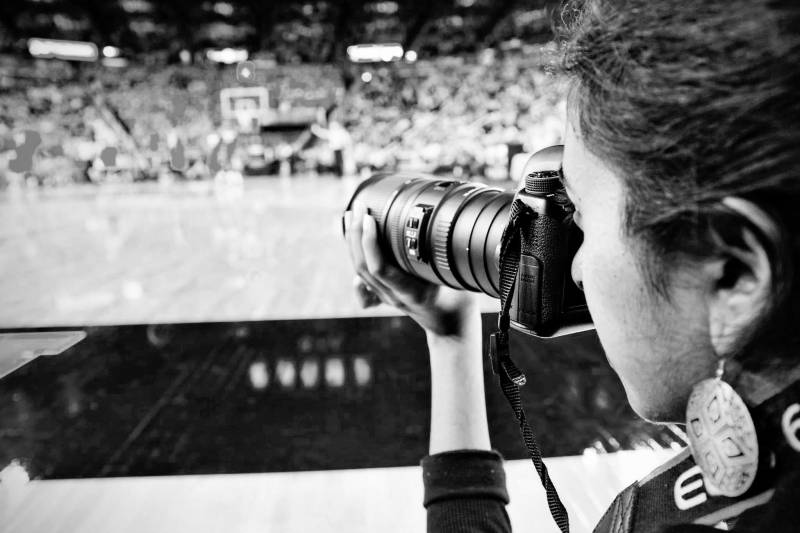
 Photo by Allison Farrand
A photo has a thousand stakes. People respond more viscerally to images than to words; it’s why Nick Ut’s famous photograph of Phan Thi Kim Phuc running naked through the streets after being burned with Napalm helped bring about the end of the Vietnam War. It’s why pictures of Nicole Holder’s bruises at the hands of Greg Hardy caused more outrage than her actual testimony. It’s why an image of a young Black man throwing a police tear gas canister away from a crowd helped America wake up to the revolution in Ferguson, Missouri.
We don’t usually speak in journalism—especially photojournalism—about whether or not we have the right to a story. We just assume we do. Because, by definition, our job is to tell stories. Because we assure ourselves we have good intentions. Because we often do have good intentions. But communities that have seen themselves vilified in newsprint and Twitter timelines are not always going to risk sharing their stories with people they do not know or trust.
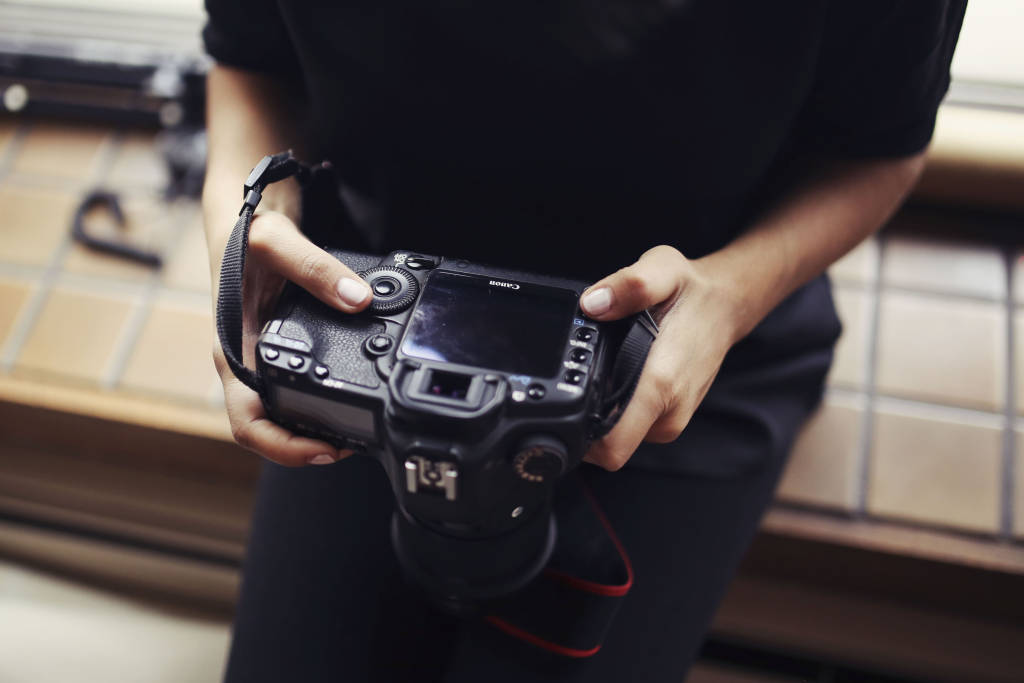 Photo by Teresa Mathew
 When I was a photojournalist at my college newspaper, the phrase “ask for forgiveness, not permission” was the mantra of our photo section. As a college student and an Indian-American woman, I was used to being overlooked and dismissed. So this was my watchword as I inched closer on a football field, maneuvered through crowds to photograph President Obama, and snuck into the dining hall to photograph lunch trays (the life of a college photographer is a mixed bag).
It is a mantra I have thought about a lot over the last few weeks. As the furor over media at Mizzou began to reach a fever pitch, with some journalists angry that protestors were denying them access and activists angry that protesters’ requests for a safe space were being ignored, I finally had to confront an issue that has always been dancing just at the corner of my eye. Tim Tai, a student photographer, cited the First Amendment and his right to photograph as protestors tried to bar him. I do not know what I would have done in his shoes, if the civil rights protesters themselves had demanded I stop taking photos. But I do know that a mantra that works when one is going up against laws set in place by people with power needs caveats when dealing with disenfranchised communities.
Breaking news photography is different from a photo story, the same way a news article is different from a feature. If I am sent out to photograph a breaking story, I might not always have the time or opportunity to explain to people that I am not there to vilify them. News, we are told, is a genre rooted in objectivity. The truth and its dissemination are what matter most. And this means that the need to showcase the news seems to trump the needs of those who are making it.
When I was a photojournalist at my college newspaper, the phrase “ask for forgiveness, not permission” was the mantra.
What happened in Mizzou is different than, say, the Iowa GOP denying The Daily Show access to their Growth and Opportunity Party (an event which gave Iowa caucus-goers the chance to hear Republican candidates speak) because the GOP feared ridicule. At Mizzou, protesters—students—were afraid of death threats and the racist vitriol they had to face in the protest’s aftermath.
Laws leave ample room for interpretation. It’s why both Civil Rights activists and the KKK are protected under the First Amendment. (And yes, a hate group could also protest being photographed. They, too, fight for a belief and have reasons to want to shield their identities.) But journalism will be dead in the water if we can’t identify and respect nuance. Is it really so ridiculous that students protesting racism would want a space where they felt safe? Their being in a public place gives us the legal right to report however we see fit, but the context around the issue makes it so much more complex than what is allowed and what isn’t.
Photojournalism is a beautiful, difficult, incredibly complicated medium, and it can all too easily feel like exploitation. We are extracting something from a source that seems revealing in a way that quotes and references don’t and can’t. Our interpretations don’t feel like interpretations. Photos feel like facts. And, unlike quotes, they can be taken without the subject’s explicit consent if he or she is in a public place.
In 1968, AP photojournalist Eddie Adams photographed General Nguyen Ngoc Loan, a Vietnamese officer, shooting a handcuffed prisoner in the head. Along with the photos of Napalm’s effects, it is one of the images credited with turning Americans against the Vietnamese war. But what you can’t know just from looking at it is that the prisoner was a Vietcong captain responsible for killing unarmed civilians. And Loan would never fully step out of the photo’s shadow; for the rest of his life people would brand him as a villain. In Time, Adams wrote that the photograph had “really messed up [Loan’s] life.” He went on to say: “The general killed the Vietcong; I killed the general with my camera.”
We have no way of knowing the life and the voice a photo will take on once it’s out of our hands. We have no way of knowing what it might change, ruin, or inspire.
I photographed communities of color on Michigan’s campus countless times, and they were always tolerant, if not necessarily thrilled, by media attention. Sometimes I was welcomed by communities that badly wanted their stories to be told.
I shot protests held by the Coalition for Tuition Equality, where undocumented students spoke out about being unable to receive financial aid due to their residential status. I assumed that because they were putting themselves and their words out in a public place, they would be fine with having their photo taken. If one of those students had approached me and asked me not to photograph them, could or should I have said that documenting the event in its entirety was more important than their safety?
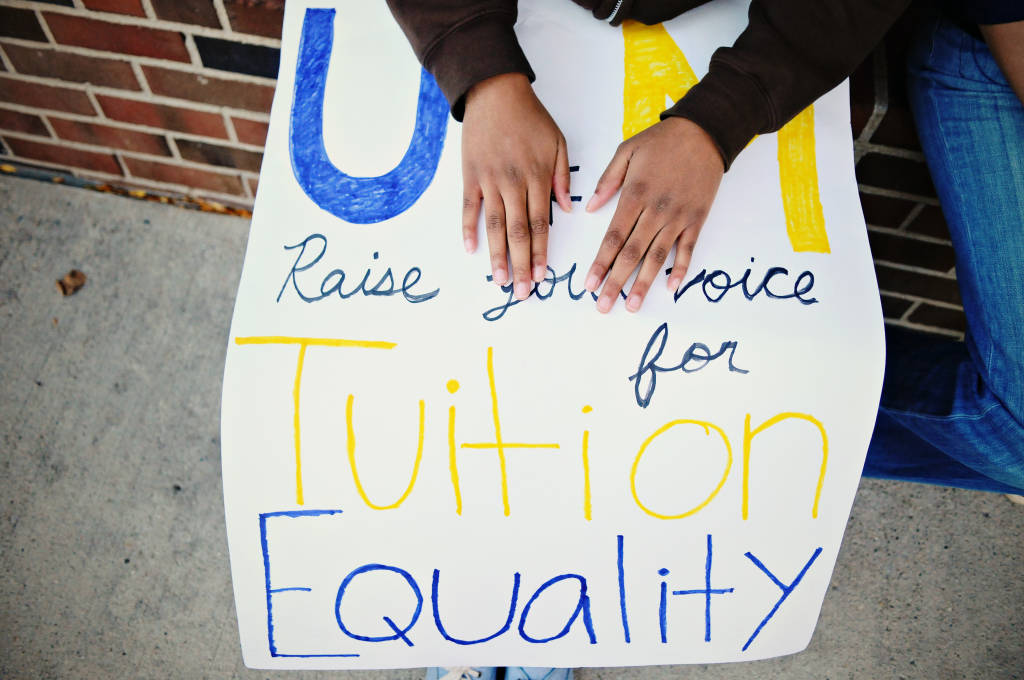 Photo by Teresa Mathew
I was a photo editor at The Michigan Daily when the #BBUM (Being Black at the University of Michigan) Movement took place, when Black students at the University took to Twitter to alert the administration of the challenges of being Black on campus. I sent photographers out to cover demonstrations, and they were never asked to stop. But what if they had been? What would I have done? Told photographers to charge ahead anyway? Told them to see if there were ways to capture the movement without explicitly capturing the faces or identities of specific protestors, two aspects we normally consider crucial to photo coverage? Told them to abandon the assignment? Broad, blanket answers to these questions don’t necessarily exist.
Visuals matter; it is pointless to deny that. We must discuss how to temper potential exploitation with empathy and respect. Journalism requires a strong sense of self, the conviction that you are somehow adding to the conversation instead of detracting from it. With photojournalism, this gets taken one step further: We are profiting off of images of others, often at the expense of their sorrow, their rage, their joy. I have always struggled with the fear that when I raise my camera to eye level, I am exploiting my subjects.
A photograph of Michael Brown’s father crying out in front of his son’s coffin is enough to crack a soul wide open. It is an unvarnished look at reality. It should not let our hearts stay hardened. History books will likely feature it to say this is what happened. This is how it hurt. But in the meantime, in the present, in that moment, it can feel so wrong to click the shutter.
This, in the end, is what everything comes down to: A photograph may be worth a thousand words, may change minds, may help people in the future understand the mistakes of the past. But do those reasons justify my decision to take it? I can’t believe that the answer is as simple as “yes, always.”
It’s a paradox, and I realize that — how can we as journalists bring issues to light if we cannot always write about or photograph them? I don’t have a solution. But by trying to respect and engage in dialogue with people and their communities, by asking these questions of fellow journalists, by examining our own reasons for photographing, we may be able to find some answers.
A photograph may be worth a thousand words, may change minds, may help people in the future understand the mistakes of the past. But do those reasons justify my decision to take it?
After leaving Michigan, I thought I would stick to being a writer. But I love photojournalism; I love the craft, I love the way it drives a straight path from the eye to the heart. I don’t think I can give it up. What I do needs to evolve with what I know, and that applies to more than technical skill. I hope I approach each assignment with empathy, my thoughts turned both to intent and to impact.
As a photojournalist of color, and one who cares deeply about issues surrounding race, it is sometimes hard for me to face the fact that people protesting for a cause I believe in may not want me telling their stories. But why should I blame them? Communities of color — and particularly Black communities — have a right to mistrust the press. The press has a right and obligation to tell stories. These two ideas can exist in the balance, weighted and measured against each individual story’s circumstances.
Trust has to be earned, just as the right to tell a painful and emotionally fraught story has to be earned. The First Amendment may give us the right to speak and the right to photograph, but it does not guarantee us the blood and bone and pain of someone else’s story.

In 1968, AP photojournalist Eddie Adams photographed General Nguyen Ngoc Loan, a Vietnamese officer, shooting a handcuffed prisoner in the head. Along with the photos of Napalm’s effects, it is one of the images credited with turning Americans against the Vietnamese war. But what you can’t know just from looking at it is that the prisoner was a Vietcong captain responsible for killing unarmed civilians. And Loan would never fully step out of the photo’s shadow; for the rest of his life people would brand him as a villain.
I mean, he executed a prisoner of war without a trial, so I’m okay with that branding, frankly. There is some wrangling over whether this was, legally speaking, a violation of the Geneva Conventions — that’s for the lawyers to sort out. It’s clear to me that even if it was within the letter of the law, it’s still a grave moral failure. (And to me, that’s the point of the photograph: you go to war, you better be prepared for shit like this to happen, because it will. There will be brutality on all sides, sometimes without rhyme or reason, you can lessen it but not prevent it, so for fuck’s sake, don’t go to war unless you really, really mean it.)
I confess, this is the kind of thing that pushes me away from protests. There have been examples where I live of people in photojournalist shots and such being identified by far-right/white supremacist/extremist homophobe/etc organizations and then published online with personal info, etc. Some of these people have then been attacked at their houses or places of work. For a long time it never occurred to me that photojournalists didn’t ask permission, at least in photos with one or two clearly identifiable subjects, before using photos. When I found out it was pretty normal, I was very uncomfortable, because when the decision becomes “you can exist and talk and protest in public, but only if you’re willing to run the one in a thousand risk of the internet slapping a target on you back” I think that becomes an unfair price to pay for being involved in public life and politics.
I get the mantra of “if you go into a public place then you know this can happen”, but how do I stay out of public places, realistically? I get the mantra of “if you go to a protest, you know this sort of thing happens and you must be OK with it”, but if that restricts access to political movements for the most vulnerable, it’d sure be nice if someone thought to themselves that perhaps what was literally legal wasn’t always the best guideline.
I mean, I’m trans. I can’t show up at trans protests because I’m scared witless I’ll be identified online- and I say that as someone out IRL. And then people say that if we want change, we should make more noise. It’s exhausting, to be honest.
It’s so depressing… But true. We have a lot to fear – but that fear isn’t the fault of the photographer. That fear is the fault of people who are so far gone that rather than exchange in dialogue, their idea is to try to destroy the lives of the people that oppose them. And we need better laws to address that kind of harassment and viciousness. And police who understand how devastating those kind of cyber attacks can be.
I understand your fear of being outed, that’s totally legitimate. I can only imagine how you feel… Is there a way you could protest without specifically saying “hey I am trans”? Not that you should pretend to not be what you are, but could you just stand with the group and say “I support trans people and think society needs to do so also”? I know that’s not ideal…
And encourage your friends who are not in the same position to protest too? The larger the group, the harder it is to demonize everyone. The problem is that if everyone stays home, those who are trying to sow fear have really, really won.
And of course, we should support and vote for candidates who are willing to be tougher on internet bullies, which will increase all of our safety…
Honestly, I know you mean well, but this comment doesn’t… really appreciate the realities of protesting while trans, I guess. I don’t “pass” as cis, cis people don’t turn out in large quantities to trans gatherings and everyone knows it, and people being outed by extremist groups as supporters also get harassed. I don’t have to put on a t-shirt saying “I’m trans!” to have cis people know there’s something up with me, y’know?
I think… I think we should err on the side of “Take the photo.” I think it’s too dangerous to the availability of truth to start ceasing to take pictures in many cases. The example of the KKK not wanting their pictures taken is a good one, because almost no one gives a shit what they want. The reality is they’re still people – like it or not, they are – and if we defer to one side’s preferences don’t we have an obligation to do the same for the other in what should be a neutral field like journalism?
There are degrees and nuances to be considered, but I think we start from “take the picture”.
I mean, I’d argue that a great deal of journalism isn’t neutral, and that the argument all journalism strives towards that is false. Journalism rarely takes a neutral stance on things widely accepted as heinous- it doesn’t commonly debate whether murder should be legal, or if hate crimes ought to be dismissed in court. It tends to implicitly assume that neutrality incorporates at least a broad understanding of what I suppose could be termed “moral common sense”, and while that can dramatically backfire, it’s also useful to not have to constantly say “but from the perspective of the child murderer, it was all fine”.
That’s an extreme example, but so is contrasting the KKK and black anti-racism protesters. The difference in those circumstances is… the fact we don’t mind if we forego neutrality and treat the KKK and young black protesters differently. Because if we can draw a line anywhere, it’s probably there.
So no, you don’t have to defer to the KKK just because you gave the black protesters a certain amount of space, let’s be frank.
I’d go farther and say that journalism is never neutral or objective. Much of current US media pretends to be, but that’s it. All journalism is a choice in what facts to include, what to leave out. How to report on things like climate change. Is it just assumed to be a thing that is happening? Is it assumed to be fake? Or do you present “both sides” in an effort to be balanced? None of those choices are neutral.
Thank you for exploring this with nuance and allowing the grey areas to exist. I take photos, but not as a journalist, and I am always hesitant to put anyone’s face online without their explicit permission, even if I know only twenty people are likely to see the photo.
I’m not a photojournalist, but as someone who has taken photos to advertise lgbt tech meetup groups and the like, solutions for this kind of thing already exist but aren’t in wide use.
For most of the photos I take, the rule is “ask first, or use photos that the people have taken of themselves and given you permission to use.” The LGBT friendly events that I’ve gone to, where people had the same concerns about being photographed as Ares, often issued color-coded bracelets ahead of time (red: no photo, green: photos are okay) so that the designated photographer would know who to avoid in a group shot.
This essay is, I think, mostly about the ethics of taking CANDID photos that aren’t planned for ahead of time, but can you imagine what it would be like if you could signal whether or not you wanted to be photographed at a basketball game by just putting on a bracelet when you entered the venue? Or if the system was in such common usage that news photographers would go to a protest or a public funeral knowing to watch out for the red badges when they took photos? I’m sure I’m overlooking a lot of clunky aspects, but I’d be down for a universal “no photos” sign that would be culturally respected.
If the photos of an event are limited strictly to the activities of the handful of people who’ve dressed up to be photo models then that’s sort of inescapably removed the candidness, and to a large extent the honesty, of photographing the event. That’s one thing when it’s a promotional photo for some meetup’s page or something (which is already tacitly assumed to be curated, and not a literal representation of a bunch of people spending the whole meetup standing in a room silently grinning at you), and another for journalism which is pretending to some kind of objectivity beyond how the subject group would prefer to be perceived. The news already blindly redistributes press releases enough, y’know?
“If the photos of an event are limited strictly to the activities of the handful of people who’ve dressed up to be photo models then that’s sort of inescapably removed the candidness, and to a large extent the honesty, of photographing the event.”
Even everyone knows what the photo policy is ahead of time, candid photos are still possible.
I’m thinking about this, and it seems…very quixotic. The KKK are all wearing that red band, as are celebrities (and paparazzi will never respect that). In crowd shots at basketball games, would those bracelets even be visible? I think a world where photos only showed people who wanted to be photographed, in moments of their choosing, would be pretty weird, perhaps even dystopian.
I still think there has to be a balance, and a lot of consideration given to different types of events, from protests to funerals to sports events.
“I think a world where photos only showed people who wanted to be photographed, in moments of their choosing, would be pretty weird, perhaps even dystopian.”
The issue that I want to get at here is that EVERYONE is being photographed now, from dictators to a fat girl that happened to be eating a hot dog at the wrong moment. Is there really no way to give regular people more privacy without creating something unworkable?
There could be a way, and we should definitely keep talking about it and exploring options! I didn’t mean to be overly harsh of what you proposed — I said “dystopian” only because the idea of everyone wearing something every day to signal their participation in a universally understood photography rule sounds so alien from our current reality and more like something you’d see in a movie. But that alone shouldn’t disqualify it from consideration.
I think you should take the photo.
What should follow is a dialogue – first with the subject – and then with your editors on any concerns about publishing the image, whether on the grounds of requests of those being photographed or the sensitive nature of the image. With questionable circumstances there should be a conversation happening before the image is run. That’s where one of the issues is now – with the great and terrible presence of the Internet, there’s little distinction between a credible news source and an organization with low/no ethical standards. That and that the news cycle, with the prevalence of social media, has become nothing but “Feed Me, Feed Me, Feed Me,” with sites like the Daily Mail out for whatever gets hits.
The other thing about Mizzou is that, happening on a campus of a university that has a huge journalism school, you’re going to have an abnormally high number of photographers on scene – the problem is, most of them are only in training. They haven’t taken the ethics classes; they might just be out there trying to get something for their class portfolio, and don’t understand the need for sensitivity or how what they’re doing is affecting everyone else trying to document the situation. They need to learn and situations like this are one of the ways they will, but having been a photojournalism student on a college campus (in my day it was the Occupy Wall Street protests) I know how frustrating and overwhelming it can be, working for a newspaper and trying to be ethical while swarms of students with point-and-shoots are just trying to get in on the action. And that was before Vine and Snapchat and all the other things that let someone ‘document’ something.
I’m rambling here because I have a lot of thoughts about this issue. I work for a news wire service, have worked for a few Midwest papers, and have a photojournalism degree. The Post-Dispatch photographer who took the famous Ferguson image is a personal friend and a good man. It’s frustrating for me to hear so many people blaming ‘the media’ when anyone with a smartphone can act as the media.
I guess my summation is, a trained photojournalist – or even someone untrained, but working for the right reasons – will have the ethical background necessary to have a conversation about whether or not a photo should be published (if the subject is willing to have that conversation). You can’t blame “the press” for the actions of wannabe journalists, just like you can’t blame all protestors for the criminal, problematic acts of a few.
So if ethical photojournalists, worried about exploiting their subjects, don’t take the picture – who does that leave to do it? The ones who’ll make whatever truth they want out of it.
Occupy had to struggle constantly to get press coverage from a news media that mostly didn’t give a shit unless there was a rumor someone in the camps might’ve done something disgusting; the kids with smartphones and the local TV guy with the big broadcast camera documenting everything was the point and when nobody else was there with cameras we got out own. The protest was out there to be seen, be heard, and the consensus at every camp I saw or spoke to was that you can’t control how your words and appearance get spun a press we knew to be by default hostile after they’ve shot and interviewed you, and (nice as that might be) it’s not the press’s job to only say nice things about you, but at the march or in the camp you are on the clock as a protestor and it’s your job there to make your words and appearance the best public face they can be – the controvery mostly revolving around what exactly that last bit entailed.
The Mizzou thing, with students at a protest assaulting press/kids with cameras for lending their protest visibility and support (y’know, the reason protests typically exist) is mind-boggling and psychotic and it’s amazing the public coverage has remained as sympathetic as it has. Nine times out of ten the guy getting huffy about his constitutional right to do a thing to you is being an obnoxious asshole, but sometimes being a good reporter means being obnoxious and that doesn’t give you the right to take a public space over a public issue and then silence anyone taking pictures of it because you might not like what they shoot.
But what I saw of the Mizzou coverage seemed to suggest protesters were very much not trying to attract the attention of the press, but rather the school itself, because they were worried about threats that had been made. They objected to the presence of cameras because they worried it’d make people targets of those making the violent threats, but they still wanted to disrupt the goings on of the university to try and force it to deal with their demands.
Issues of assaults aside (as I know little about the circumstances of those), people acting in that way hardly seems unreasonable to me in principle. Not all protests have the same aims, and not all carry the same risks, either. And I wouldn’t call ignoring those concerns “obnoxious” so much as unwilling to address your subjects as individual people rather than an abstract idea for you to photograph, which seems callous when people are concerned for their honest-to-god safety.
It seems to me there’s a difference between trying to control media image and trying to set boundaries when you feel yours aren’t being provided for.
Media attention is an essential ingredient for protests. The oppressing authority (the school board, in this case) would never have given a shit if it was just the protesters expressing their views where no one else could see them or knew about them. Nothing would have ever have changed.
I can’t speak for the Mizzou students or why they didn’t want a reporter around at that moment, but I do know they would never have bothered organizing or creating a hashtag if they really didn’t want to be seen and heard. It completely defeats the purpose.
Also, I think there’s an area in between “addressing subjects as individual people” and “an abstract idea for you to photograph.” The author of the essay did a great job explaining how the photojournalist may also feel emphatically with the subjects, have a mission and a hope to portray what’s happening with the rest of the world. Yes, there may still need to be a need to pause and ask questions and reconsider. But neither side should be painted in black and white.
I’ve been searching and hoping for an article like this one. This was the very first piece of art I ever purchased (as a broke 19-year-old, print number 46 of 85). The First Amendment has always been particularly important and special to me. But that doesn’t mean it’s an on/off switch. There must be considerations for the human beings who are often themselves the stories. Thank you for writing such brilliant and compassionate thoughts about this.
I don’t have a perfect theory or image of how to approach the ethics of photojournalism, but I felt like I should at least share what experiences I’ve had.
I *have* been in a situation where protesters very distinctly did not want to be photographed. I was part of a student group that helped run support services for a BLM solidarity protest on my college campus – a coalition of black students planned the event and asked for support from other students to organize some of the event logistics. This included the creation of a team of volunteers whose role was to talk to/try to deescalate situations with angry people around the protest. That role included asking people outside of the protest to not film or photograph it – a group of black students were handling the media themselves, in light of how many other recent BLM protests had been covered in a way that vilified or misrepresented protesters.
By far the angriest confrontation I dealt with was with an older white man when I asked him to please not film the protest. He told me that he had been filming because he was happy the event was happening and wanted to share it with his friends, but that since I had told him not to film, he did not think he supported it any more. He told me he was going to sue someone, probably me (a 20something in an orange reflective vest with absolutely zero legal authority over him, whose name he did not know), possibly the protesters as a whole, and drew himself up tall over me, asking sneeringly if he was making me uncomfortable. He retreated very quickly when two more deescalation volunteers walked over. Once he was outnumbered, even by college students in orange vests, he wasn’t interested anymore.
After that, I did not tell anyone why I was asking them not to film, that it was a request from the group of black students who organized the protest, that they were pushing back against media patterns that had brought further danger and violence to communities in protest. I just said “Please do not record this event, we have people organizing media coverage.” “Can you please not film, media for this event is being taken care of,” over and over again. As though I didn’t want them to tire out their wrists in pulling out their phones to record it. As though it was a favor to them and not an act of fear, fear that someone was going to take a picture that would bring some new horror into the lives of the protesters, fear that the next old white guy filming on his iPad was going to have a gun or a knife or simply an even deeper fury at being told “no” than the last one.
Thank you so much for sharing this. God, that type of old white men are terrifying, I’m so sorry he went after you like that.
I don’t understand the acceptance of press taking photographs at funerals. Like, at all.
Power matters. Deciding that you shouldn’t publish an identifiable photo of someone if there’s a genuine risk that they’ll be harmed doesn’t seem like a very difficult dilemma to me. The Mizzou protesters are legitimately afraid of retaliation. Trans protesters, the Ferguson protesters and even the KKK also have real reasons to be cautious. I don’t think it’s excusable to publish a picture that exposes someone to actual harm. There might be exceptions (like maybe you managed to take a photo of a politician doing something incredibly wrong that people wouldn’t believe without the picture?) but as a general rule I think it’s fair to say that you should only publish identifiable pictures if the subject has consented explicitly or implicitly, or if the circumstances are neutral. To me, implicit consent wouldn’t be “the subject is outside, doing something”, it would mean that they know they’re being photographed and can choose to leave/hide if they want to.