
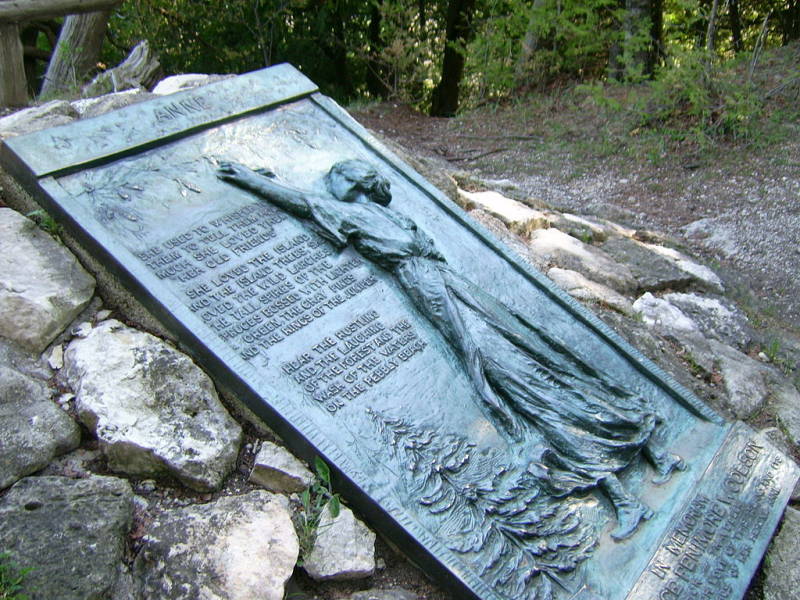
 Anne’s Tablet (1916), by William Ordway Partridge to honor Constance Fenimore Woolson: Mackinac Island, Michigan
This is the first in a series of short essays by Anne Boyd Rioux about women writers in danger of being forgotten.
The academic movement to rediscover women writers was great while it lasted. But today some of the writers that feminist critics rescued from relative obscurity are once again in danger of being forgotten. Exhibit A: Constance Fenimore Woolson (1840-1894), whose stories were republished in 1988 only to go out of print again, and whose story “Miss Grief” was included in college literature anthologies, only to be taken out again.
The two things most people know about Woolson, if they know of her at all, are that she was a friend of Henry James and that she committed suicide in Venice. Sadly, they have probably also heard the erroneous story that she killed herself because James couldn’t return her love. They are rarely aware that she was a famous author in her own right, or that she was respected by critics and viewed as a successor to George Eliot and a peer of James and William Dean Howells. Woolson has become known as a tragic heroine in a story not of her own making, rather than what she really was: a marvelous maker of stories herself.
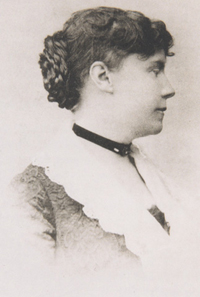 Constance Fenimore Woolson, c. 1887
Woolson grew up in Cleveland and was taught to revere the written word early on. Yet she was also raised to believe that a woman’s name should appear in print on only three occasions: birth, marriage, and death. She didn’t start publishing until the age of twenty-nine, when she had to begin providing for herself and her mother after her father died.
Because she shared a middle name with her famous great-uncle, James Fenimore Cooper, Woolson quickly gained the ear of editors at Harper’s and elsewhere. By the time her first collection, Castle Nowhere: Lake-Country Sketches, was published in 1876, she was widely known as one of America’s most promising writers, a status that did not come without controversy. She once wrote that she had “such a horror of ‘pretty,’ ‘sweet’ writing” that she was willing to risk “a style that was ugly and bitter, provided that it was also strong.” Many critics applauded her efforts to write in a less sentimental style. Others, however, criticized her stark realism and unwillingness to give her stories predictable happy endings.
After moving South with her invalid mother in 1873, Woolson began writing about the Reconstruction South. In stories she collected in Rodman the Keeper: Southern Sketches (1880), she portrayed the resentment of white Southerners toward Northerners who flocked to the South in search of economic opportunity or healthier climates, often with little regard for the suffering the war had wrought. James praised in these stories “a remarkable minuteness of observation and tenderness of feeling on the part of one who evidently did not glance and pass, but lingered and analyzed.”
James’s quote nicely captures Woolson’s strengths as a writer, which won her both critical and popular acclaim. Her most popular work was her first, Anne (1882), the coming-of-age story of an unconventional woman who grows up on Mackinac Island, then is thrust into the world by her father’s death, much as Woolson was. It was so successful that Harper & Brothers gave her an exclusive contract to publish all of her writings thereafter.
Even before Anne was published, Woolson had traveled to Europe, where she would spend the rest of her life. She met James in Florence the spring of 1880, and became close to him while living in England three years later. She lived a peripatetic, independent life, finally settling down in a villa on the hill of Bellosguardo outside of Florence, where she lived from 1886 to 1889 and grew close to a family of artists, to whom James had introduced her. After the breaking up of her home there, Woolson spent three months in Cairo and then settled in England until returning to Italy, this time Venice, for the final year of her life.
Woolson has become known as a tragic heroine in a story not of her own making, rather than what she really was: a marvelous maker of stories herself.
Wooslon wrote four more novels while she was abroad, all set in the United States: For the Major (1883), East Angels (1886), Jupiter Lights (1889), and Horace Chase (1895). Her great theme was the hidden emotional lives of women, which she revealed slowly and often devastatingly. Raised to conceal their feelings behind a placid surface of propriety, women of the genteel classes, such as herself, suffered both physically and emotionally, as Woolson revealed. As she once told a friend, she always told the truth in her fiction, although she never could in real life.
When Woolson jumped or fell from her window in Venice in January 1894, she had been suffering from depression as well as various physical ailments that convinced her she would never be able to write another novel. Unwilling to depend on others, she was ready for death and may have decided to take her own life — no note or will was ever found to confirm the suspicions of James and others that she had. After her death, her reputation rapidly faded. Despite a series of obituaries that hailed her as America’s foremost female writer, she was left out of the literary canon formed at the turn of the twentieth century. She wasn’t alone: as the canon took shape, it was all male, eclipsing the contributions of women writers.
Woolson once wrote to James that the truest form of literature allowed us to experience the emotions of characters who felt and loved deeply. She accomplished as much in her fiction, the majority of which has been out of print for most of the 122 years since her death.

*purrs happily* She is so great. I wish the US did more anthology-style TV series: a lot of her novels and novellas would make good miniseries or one-hour dramas. Her writing is beautiful to read aloud, as well.
I’ve often thought that many of her stories and novellas would make great movies. I like the idea of TV miniseries as well. Are you listening, Masterpiece Theater?
Now I am fantasy-casting and want Patricia Clarkson for Miss Lois in “Anne”.
And who for Anne? A younger Claire Danes would be about right.
Claire Danes has the right openness about her face. it’s a pity Rachel McAdams is just a bit too old, as well.
So did you guys search your local library before or after reading the entire article?
I’ll be stopping at the library on the way home!
after looking up the definition of “peripatetic”
So excited for this essay series! I hope someday soon there’s a nice fat anthology of the work of forgotten women writers. Maybe there already is?
(If any of you Toasties are in Portland, Oregon, check out the Queen of the Night Reading Series, which has eerily similar aims…)
There are certainly fat anthologies of works by women writers, and I could count on one hand the number of writers included who are NOT “forgotten,” if that means not being a household name today. See, for example, the Norton Anthology of Literature by Women, ed. Gilbert & Gubar.
It looks like there are at least few titles at the Internet Archive.
https://archive.org/search.php?query=creator%3A%2…
A wonderful book “Author, Author” by David Lodge is about the life of Henry James. It’s fiction, but based on actual events. Constance Fenimore Wilson is a central character–I knew I’d seen her name before!
And “The Open Door” by Elizabeth Maguire is a good novel about *her*. I also like “The Master” by Colm Tóibín (whose name is pronounced toy-bean, which I only learned due to the generosity of an aunt who took me to see an adaptation of one of his plays.)
My library doesn’t have a thing she’s written. Thank goodness for Project Gutenberg! http://www.gutenberg.org/ebooks/search/?query=Con…
Now I am fantasy-casting and want Patricia Clarkson for Miss Lois in "Anne".
And who for Anne? A younger Claire Danes would be about right.
Claire Danes has the right openness about her face. it's a pity Rachel McAdams is just a bit too old, as well.
Just reading about her last night bc I’m so behind on NYTBRs & thought, gee, that name sounds familiar. Then something of yours was in my FB feed this morning & I figured it was an odd coincidence. Now I wonder if you’re outside my door! Are you? (Also, great piece–I’m definitely curious about her writing now).
Glad to know my efforts to get Woolson’s name out there are having an effect! (Don’t worry, I won’t come knock on your door.)
Glad to know my efforts to get Woolson's name out there are having an effect! (Don't worry, I won't come knock on your door.)
Check out Edith Taylor Pope, friend of Marjorie Kinnan Rawlings and Zora Neale Hurston.
People gather around Anne’s Tablet on Mackinac Island in the summer and read poetry & short stories. It’s a great spot!
That’s amazingly wonderful! Do they know about Woolson, and are they reading her work, do you know? I have seen the tablet. It’s a bit of hike up there, but well worth it.
This is an amazing article, and such wonderful suggestions in the comments, too. 🙂 And I’d like to add Anna Katherine Greene to the list, if you please. One of the earliest detective writers out there (a decade before Conan Doyle’s Sherlock Holmes, for instance), and a bestseller in her day. Fun, exciting and very very forgotten, despite the excellent work of feminist scholars and critics like Catherine Nickerson who have written on her extensively. She should be anthologised along with the finest of ’em in genre fiction, but sadly, that isn’t really the case by and large.
That's amazingly wonderful! Do they know about Woolson, and are they reading her work, do you know? I have seen the tablet. It's a bit of hike up there, but well worth it.
Have you seen this poem about Constance Fenimore Woolson, published in Rattle’s feminist poets issue? http://www.rattle.com/dust-by-katherine-barrett-s…
From 1873 to 1879 Woolson spent winters with her mother in St. Augustine, Florida. During these visits she traveled widely in the South which gave her material for the Rodman the Keeper: Southern Sketches (1880).