
 Image via
I was sitting on the floor in a tucked-away corner the main rotunda of the National Museum of American History, resting against my overstuffed pink-and-blue Patagonia backpack and charging my phone in a working and miraculously unguarded wall outlet I’d found off to the side of the coat check. I’d come to D.C. a day early to teach a workshop and participate in a panel discussion on women in comedy. To keep costs down I was staying with various members of the D.C. improv community, which meant that between hospitalities I was a nomad wandering the Capital with a backpack full of the weekend’s clothes, my computer, handouts for my workshop, and an extra pair of shoes on my back.
I’d spent the morning alone at the Museum of American History, killing time checking out Dorothy’s slippers and Archie Bunker’s chair, and by 11:30 I was done with what I’d come to see and trying to decide between getting lunch or going over to the Holocaust Museum. It was a little early for lunch, but as I knew from past experience, the Holocaust Museum isn’t something you can just pop in to check out like the original Kermit the Frog puppet. There’s one entrance, one exit, and only one path through that takes at least an hour to travel and, based on my one previous experience, the rest of the day to shake.
The last time, the only time I’d been to the Holocaust Museum was when I was pregnant with my first child. We weren’t telling anyone yet, and I wasn’t showing much. My husband and I were chaperoning the tenth-grade trip for the high school where I worked at the time. The buses were separated by gender, and we’d been assigned to the girls’ bus. The trip involved a Julia Stiles movie marathon, traditional bus sing-a-longs, and lots of reminders from me that they needed to stay seated and not cluster in groups of five or six around a single bench. My husband and I were young to be married—twenty-two and twenty-three, respectively—but the rings on our fingers and the life growing inside me created a chasm between us and the thirty girls with whom we shared the trip. He kept his head down and read for most of the ride; I tried to rest and quell the occasional waves of nausea.
Our first stop upon making it to D.C. was the Holocaust Museum, where we were scheduled for a group tour. When you start your tour at the Holocaust Museum, you’re assigned the name of a Holocaust victim—their hometown, their age, when they were taken—as a way to simulate the experience of being there yourself, being targeted. I remember thinking the identity assignment was a smart, thoughtful move.
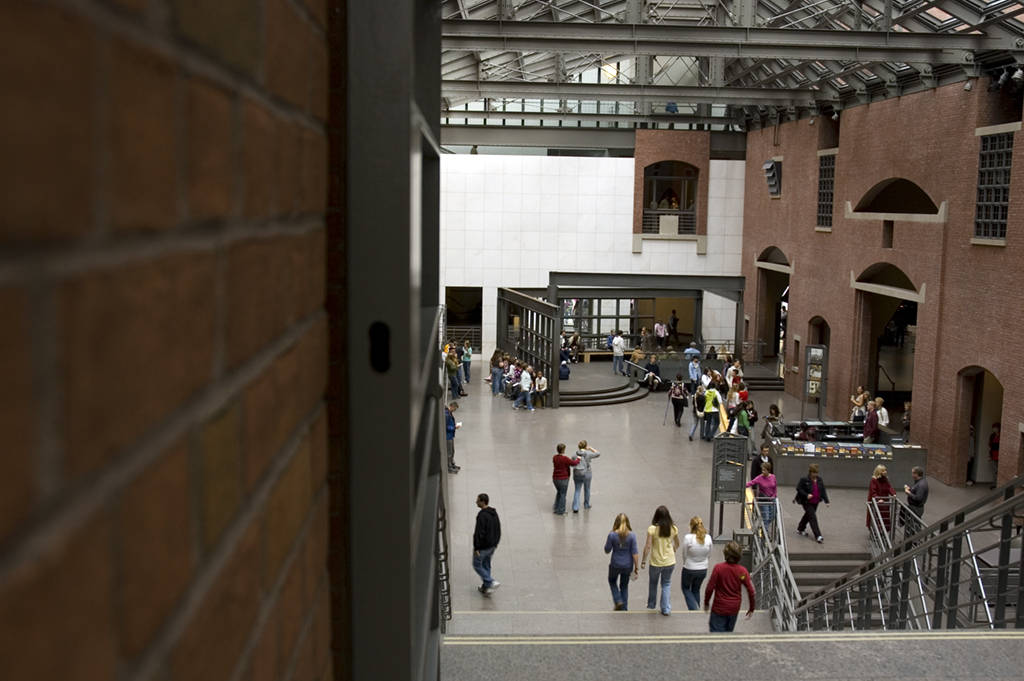 Image via
My chaperone status initially conferred upon me a certain level of detachment regarding the proceedings as we stood in the group tour waiting area. I was here to support and watch over the students, not immerse myself in a personal experience. Watching the kids examine the personal profiles assigned to them, I could see them moving inward, away from the kinetic, social space of the bus and into a quiet, reflective place inside themselves. I taught at a Jewish school, and some of my students had relatives who died in or survived the camps. Those who weren’t personally touched by the events had still spent most of their childhoods hearing stories of survivors, going over timelines of events in Sunday school or Jewish day school.
The first third or so of the museum is about Jewish life in Europe leading up to the war. You start seeing the Jude signs, the boycotts of shops. Then Jewish people begin to be relocated, taken away. Those who stayed, we’re told, didn’t quite know where the others were being taken. They had heard rumors of work camps, even death camps, but most of them didn’t believe their friends and neighbors would be complicit in that sort of thing, and didn’t see what Germany had to gain from getting rid of such a vital part of its workforce and culture. They were wrong, of course, which we know now, but to call them fools would be as unfair as mocking Ptolemy for his earth-centered universe or Lamarck for his theory on inheritance of acquired traits. Nothing they knew at the time suggested any other interpretation of events would be at all reasonable. And every generation underestimates humanity’s capacity for cruelty and indifference.
We were moving through the museum, slowly but on the path laid out for us, when we came upon a cattle car. Not a picture of one. Not a facsimile. A real, honest-to-god, used-to-transport-Jews-to-concentration-camps cattle car. It was right in the middle of the path, so to continue moving through the exhibits, you had to walk through it. “Very smart,” I remember thinking to myself, yet again. “A meaningful way to force people to confront the horrible realities of this historical event.”
That might be what I thought, but what I felt was a sudden and strange paralysis. My body wouldn’t move. I tried to shake it off as something outside of me, an internalization of the response I assumed the curators of the museum had hoped they might elicit, but which I was actually too stoic and cynical to truly experience in earnest. I thought, “I feel frozen right now because that is how I know they want me to feel. It’s not actually how I feel.” I truly believed I was doing it almost as a kind of public performance, and almost became angry with myself for such a blatant and tasteless show of exhibitionism. I tried to step forward.
But I couldn’t move. It felt a bit like how I’ve heard skydivers—even experienced ones—can feel frozen right before jumping. Even when they know they have the skill and experience to jump safely, their bodies sometimes betray them, their minds registering only the distance from the ground, the speed of the fall.
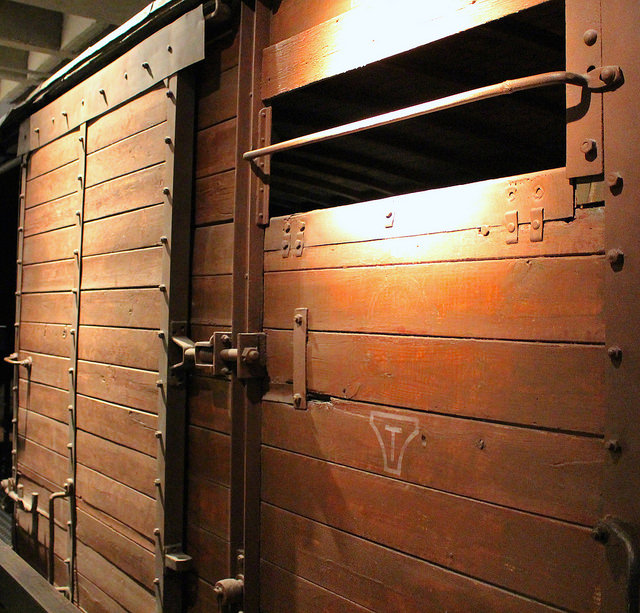 Image via
I felt so foolish. I wasn’t going to be sent to a concentration camp; I knew that. And I didn’t have any family or anyone close to me who’d gone, so there was no personal connection to the moment other than my Jewishness itself, which was never enough to cause this sort of panic before—not like my mother, who often talked of how she was plagued by dreams that her life was the continuation of a young Jewish child’s that was cut short in Bergen-Belsen or Auschwitz. I wasn’t like my mom. I didn’t believe in reincarnation or spirits or ghosts. I didn’t imagine, as she might have, that the spirits of the dead might cling to me once inside the car. It had been cleaned, the wheels and other hardware removed. It was just a box bolted to the floor. An object in space, like so many other objects in space.
I said all this to myself, but I still couldn’t move. Why was this happening to me? I’d made it, untouched, through so many other experiences meant to elicit my extreme sympathy or fear or anxiety. I’m the friend who no one wants to watch The Notebook with because they know I’ll loudly complain how it’s weird to build a house for someone you broke up with years ago while they bawl over Ryan Gosling’s undying love for Rachel McAdams. I was the kid at the haunted house who couldn’t stop thinking about whether the mummies and zombies were union or not while my friends screamed around me in the dark. After seeing Schindler’s List in the theaters when I was sixteen, my general reaction was that it was “pretty solid” and “definitely important” but that the girl in the red coat was “maybe a bit much.” I was always a thinker, not a feeler. So why had this experience caused such an acute reaction in me? Was the museum just an especially well-crafted experience?
I wondered if it wasn’t perhaps the baby growing inside me that had caused such an unexpected reaction. Hormones, I already knew, could make a person feel unlike herself, transposed to an unrecognizable point on the graph of existence. Beyond the hormonal change was the power of a major life transition—I remembered how, in the week after my wedding, food tasted both sweeter and saltier, as though the ceremony had caused some actual and measurable heightening of my senses. Was I a different person than I knew myself to be up until now? Had the life I was cultivating with my own changed me irrevocably? I continued to stand, frozen, at the threshold of the car’s entrance, feeling foolish as I allowed myself to consider the possibility that this barely formed fetus had already begun to control me in such a deep way.
Mostly, though, the way I felt standing there, staring into the train car, was like a frightened animal. Trapped, cornered, afraid for its survival. I could feel my blood entering my heart and rushing out of it again in rhythm with its rapid compressions. I could feel my skin covering my muscles, my muscles grasping at my bones, the whole structure barely holding itself together—and at the same time holding on fiercely to the thing that was growing at its center. I felt a deep fear of death, a deep need to live. That was the feeling that drowned out everything else.
I’ve said so many times since giving birth to two children that nothing makes you feel more like a mammal than gestating a baby inside of you for nine months, giving birth to it, then feeding it milk from your breasts. It’s the most primal experience I can conceive of in my mind, perhaps other than one’s own birth (which one doesn’t remember) and one’s death (which one can’t). But at the beginning of my first pregnancy, I was not yet able to name this particular strangeness. Not until that moment, standing there in the Holocaust Museum in front of a train car originally intended for animals, then used to transport hundreds and hundreds of humans—packed in so tightly, worse than animals, treated as less than alive—women, men, children, babies. Pregnant women, I’m sure, too. Of course, too.
How did they feel as they traveled in these cars, these soon-to-be-mothers? Did they continue to hold out hope that the conditions they found themselves in would be temporary? That they would be treated with dignity, especially them, with their swollen bellies full of the hope of life? Were they grateful that their not-yet-children couldn’t be torn from their arms upon arrival at the camps like the other mothers’ children were, or did seeing the separation of families cause a primal fear to rise in them as well?
At what moment did they know—really know—that neither they nor the child they’d planned on bringing into the world would make it? Did any part of them feel some strange relief at not subjecting another life to the horrors they had seen? How would I have fared in such circumstances? When would I have given up hope? When would I have let go?
 Image via
The religious phase my husband and I went through as newlyweds meant that we neither specifically planned to have children nor did anything to prevent ourselves from doing so, which suited my general outlook on procreation just fine. I never imagined I wouldn’t have children like some of my happily childless friends, but neither can I remember that urgent ache that so many of my other friends report having had, that demand of nature that I create a little version of me in the world. I just figured motherhood was something I would experience eventually, like getting a Master’s degree or traveling to Europe. I didn’t understand, then, that it was something I would become.
The last time I was in this city, I had had no choice but to bring my child with me, inside of me. The second time, I returned alone. Back in D.C. after fourteen years, I felt bracketed on one end by the visceral memory of the first time I felt, with the fullest force, how much motherhood could compel me to behave in ways unforeseen and uninvited by my previous self, and on the other by a decade-and-a-half of living with and for two humans I had created inside me—two humans who now hardly needed me in order to conduct their daily lives, to follow their interests and passions, to live as fully as they can in this imperfect world.
Friends of mine who’ve yet to start their families or who are choosing not to have children at all often remark, with vicarious excitement, that I’ll be “done” with kids when I’m in my early forties, as if it’s something one can be “done” with, something one passes through—as if the self who enters the experience of parenthood is the same self that emerges on the other side. As if there is an “other side” at all.
As I stood there then, facing that cattle car at the threshold of motherhood, I felt myself rooting to the earth like a boulder pressed against a riverbed, fighting the current with nothing but its own full weight. My body and heart knew something at that moment that my mind could not. Tears welled up in my eyes.
“There’s a way around,” said a voice from somewhere beyond my peripheral vision. It came closer. “There’s a way around, Rachel.”
A hand touched my hand. I flinched, then grabbed at it. My husband spoke again. “I guess they figured some people might not want to go through. You can go around. Here,” he said, and he led me around to the left, through a narrow opening in the wall.
As soon as I was safely through, the tears began to pour from my eyes. I still felt so foolish. “I’m sorry,” I said. “I couldn’t go though. I couldn’t…”
“I know. It’s terrible that you had to experience that,” he said. Which we both knew was a ridiculous thing to say, in this place that was built and dedicated to the actual suffering of so many. Even though he meant it. Even though it was true.

This hit me much harder than I expected. I’m not a mother, so I can’t really relate to those aspects. But when I was in high school, I went to Poland with my school choir and we visited Treblinka. I was the only Jewish person in the group, and I remember standing there looking out at all the stones and being just, unable to move and wanting to just sort of sink into the ground. The whole choir sang something, I think the Lord’s Prayer, and I couldn’t sing with them because it felt wrong to me, somehow? I don’t know, I remember thinking it was beautiful, but wrong, so after I sang Mourner’s Kaddish all by myself. And when we went back to the bus after, everyone was just kind of quietly chatting and they all seemed fine, and I just started crying in my seat, until we were far enough away. I just remember being weirdly hurt that no one else seemed affected in the same way.
A Christian prayer seems exactly like the wrong thing to sing at the site of concentration camp, tbh. Take the time to learn an appropriate prayer, or say nothing at all. I’m really sorry that nobody in charge took the initiative to figure this out.
At the time I remember vaguely appreciating it because there was a good thought behind it, and not ALL the people killed at concentration camps were Jewish. But I also remember feeling the same, that it wasn’t really appropriate and it made me a little uncomfortable.
I am very sorry that you had to grieve alone.
Thanks for writing this, Rachel.
Thank you for reading. 🙂
This is absolutely lovely. Thank you so much for sharing.
Beautiful.
The Holocaust Museum is truly outstanding, as both a museum and an experience. Thank you for sharing this with us.
I think that’s about the point I started crying out loud when I visited the Holocaust Museum. I can’t imagine what it would feel like to be contemplating motherhood and standing there.
I’m pretty sure that was my moment too. Although just setting foot inside feels like stepping onto hallowed, haunted ground.
I went to Auschwitz with my family a couple of years ago, as part of a more general find-our-roots trip in Poland, and when I really started crying was when I got to the pile of luggage that people brought with them. I kept thinking of my mother, who that very morning was worrying about whether we’d get hungry on the trip from Krakow to Auschwitz and imagining her trying to keep it together while on the trip to a concentration camp, and I lost it.
Yeah, I haven’t been yet although over 40 members of my family made that one way trip. I always think of my sister when I think about the Holocaust because I always want to protect and look out for her even if she rolls her eyes at me when I try to remind her to put on a seatbelt. Like what would you do? What did our families do?
Adding my voice to the chorus of This Is Amazing and Powerful and Thank You For Sharing.
A Christian prayer seems exactly like the wrong thing to sing at the site of concentration camp, tbh. Take the time to learn an appropriate prayer, or say nothing at all. I'm really sorry that nobody in charge took the initiative to figure this out.
This really resonated with me as a new mom. On a similar topic, I recently read “Born Survivors” by Wendy Holden about three pregnant women who actually managed to survive and give birth to babies who also survived in the midst of the Holocaust. It’s an incredible story regardless, but it especially hit me hard having given birth to my first child last year. I recommend it, though it can be a tough read sometimes.
Thank you for this lovely reflection.
I’m not Jewish nor am I a mother but I reached the end of this piece and found myself crying because so much of it resonated — the post-wedding heightened senses, the general mind-body disconnect that can happen even as I try to “reason away” the emotions I experience. I really appreciated reading this.
I’m pregnant for the first time and have been struggling to put the experience into words – your description of motherhood as a primal experience captures my experience perfectly.
The entire essay is exquisite. Thank you for writing it.
Thank you for writing this, and for putting it up today, to mark this date. I will come back and process it more later (and not publicly cry in this library) but thank you, so much.
I was six or seven when my parents took me to Dachau. We were living in Germany at the time and had rented a summer cottage in Hungary by a lake. My mom taught me to swim that summer. According to my parents, we ended up at Dachau because the car air conditioner broke, there was an enormous traffic jam, and they were worried that my baby sister would overheat, so they decided they would just go to the first major tourist attraction on the route home, which in Germany happened to be a concentration camp. My parents explained everything to me in excruciating detail, like the showers and the barracks, and what happens to the body during starvation. At one point, I think I asked my dad, “So this is where I would live, if I lived back then?” and he said “You? no, you wouldn’t be here,” and I remember feeling a moment of relief, until he said “You’re too little. You’d just be killed instantly.” In a move that remained surprising to only my parents and no one else, I did not take this well. I spent the rest of the afternoon wandering around the museum in a haze, while surely museum docents and curators wondered what kind of people would bring their baby and small child to a concentration camp. The drive home was the first of a lifetime of panic attacks, and that night and I think the night after, I had nightmare so bad that my parents literally had to sedate me to get to sleep and calm down. I remember asking my parents about it recently and they were like “well, we didn’t expect you to take it so badly, but I suppose we should have known better, you were always a sensitive child.” Yes, as a six year old, I was crazy sensitive about the holocaust. Also, that lake in Hungary? It had like a ton of snakes for some reason and I hate snakes. I call that summer The Summer of Nightmares. Seriously, worst vacation ever.
I mean…what the heck kind of reaction did they THINK you’d have? My eyes bugged out just reading it. I visited Dachau on a high school trip to Germany and it was harrowing. Then in Germany a few years ago again, we visited some Holocaust museums/sites. Always horribly emotional to me.
I haven’t been to DC since this museum has been open, but I do hope to see it some day.
Maybe it’s just growing up in a family of Holocaust survivors, but I always knew about it. It’s something I knew from a young age. So to me telling a six year old doesn’t surprise me at all.
I think they grew up with the results of the war very visible in their lives. They grew up in the Soviet Union, which lots more people than any one country in the war, so there were lots of families that had personally experienced that kind of loss, lots of injured and disabled veterans. I think one of my dad’s family friends was a survivor of the camp medical experiments, so they never really got all the information in one swoop like I did.
You know, until you said the ‘sensitive child’ bit, I thought this was a misguided attempt by your parents at instilling some (horrifying) history. Guess not…
Haha no, I’m pretty sure they don’t think that far ahead.
While I firmly believe that visiting a concentration (or internment) camp should be required by law of every human on the planet, perhaps not when said humans are, y’know, in single digits.
Agreed. I saw families with young children touring Auschwitz and I was absolutely horrified. The parents did not seem to be telling the kids about the nature of the place- which was probably better for them- but why bring someone to a concentration camp if it won’t mean anything??
Yeah, I’m glad it’s a requirement for all German school children. I really do wish my parents hadn’t taken me when I was so young, and perhaps if I wasn’t an inquisitive child and didn’t start asking about things, they wouldn’t have told me, but my parents were of the brutal honesty school. Funny story on that, when my mom was pregnant I asked her how the baby was going to come out and she said “through my vagina” and I was like “OK mom, I’m not stupid. A baby is bigger than a vagina, it can’t happen that way. I wasn’t born yesterday!” and my mom kind of just shrugged and was like “alright, I did my part.” So similarly, I started asking my dad questions about where we were because it look unfamiliar and it kind of proceeded from there. I think I noped my way out of confronting the holocaust for a long time, still haven’t been to the Holocaust Museum although I live in DC.
I remember that car, even now years later. I remember the smell of it. It looms in that room like a ghost. Walking through it was one of the hardest things I’ve ever done, and it made history real to me in a visceral way I can’t quite explain, even now years later.
Tangentially, my mom once said that having children was like having a part of your heart walking around in the world without you for the rest of your life.
This was a very powerful piece. Thank you for sharing it.
I…I am haunted by the people who have my last name that are memorialized in the Holocaust Museum in DC and in the Pinkas Synagogue in Prague. My grandfather told me when he was alive that we have Jewish heritage, though his family had converted to Catholicism generations ago and any more information about his family died with him. So I am haunted by these people. Were they my distant cousins? I don’t know, and I’m not sure how to find out.
I’ve been to the Holocaust Museum in DC twice and Yad Vashem once and tbh the DC museum always annoys the crap out of me (I think because it has some areas that are really bad for foot traffic flow? Pet peeve of mine in museums), and also I liked the memorials at Yad Vashem better. It’s nice to come out of there and be able to wander around the Garden of the Righteous and remind yourself that there is some good in the world whereas in DC you’re just back among all the tour groups. I’ve never had a powerful reaction to either museum which feels…wrong to me? I know that I sobbed like a baby the first time I read Anne Frank’s diary and I’m pretty sure I lost it during Schindler’s List and I always expect to freak out at the cattle car but I don’t, so its nice to read about someone else’s feelings and the reaction I never had. Thank you for this.
I didn’t love Yad Vashem, but I also felt the tour I was on was rushed a bit. I really wanted to just go plunk down in the archive.
I once saw a photo of Jewish women who had been stripped naked and lined up next to a pit by German soldiers. One of the women was holding a small child. The child was the same age that my son was at the time I saw the photo. It’s haunted me for years. It’ll haunt me forever. It horrified me so much more, on such a deeper level, than any images or stories from the Holocaust ever had, even when I went to Dachau.
Not to be weird, but was this photo taken in western Ukraine? Because I was reading this book on western Ukraine to connect with my roots to try to alleviate my PPD somewhat (LOL) when my son was a baby and I ran into THAT photo.
Growing up in Israel, the Holocaust is inculcated from a really young age, in what I personally think is a horrible mistake that recreates a national post-trauma (but that’s a whole ‘nother post).
I remember as a child having required reading from school that detailed many of the horrors of the Holocaust, and having nightmares in the night that the Nazis were coming to get me for weeks afterwards. Most of my friends can recount similar experiences. We not so much learned about the Holocaust as imbibed it. As a grad student in the US I had to teach a discussion section about the Holocaust in something like “intro to 20th century Europe”, and it was nearly impossible because for me it’s something I feel, in my gut, not something I can rationally think about and offer insights like I would about the Industrial Revolution.
But now that I’m a mother, this whole thing becomes even more difficult. Not just because of the emotional dimensions described in this beautiful piece – but also because I am raising my son in Israel, and while he’s three year old now, I know that I have a grace period of maybe – maybe – three years before he starts learning about this, or hearing about it, or asking questions on Holocaust Memorial Day…. and that in this country it is impossible to raise a child who doesn’t know what the Holocaust is, not in a sort of vague “this was a very bad thing that happened once”, but in a very real, very visceral, very personal sense. And I don’t want that for him. Not at the age of 6 or 8 or 10. I don’t want him to know at that age how truly awful the world is. I don’t want him to know that people were murdered wholesale just because they were Jewish, like he is. I don’t want him to know that many of those people were his family. And above all, I don’t want him to wake up screaming in the night because the Nazis are coming to get him.
My mother was Israeli-American, and while she was also a self-styled Holocaust educator who did NOT tailor her infodumps to her audience (me, starting in the low single digits), after reading your comment I wonder how much the Israeli part could have been a factor as well. My son is two and a half, and I’m going to do everything I can to make sure that the story of his ancestors who didn’t make it reaches him through an age-appropriate filter so that he doesn’t grow up the way I did. (And on the other side, he has the engineered famine perpetrated on his Soviet nomadic ancestors, and even though that was in the 30’s, it still affects the way my husband and his nationality treat and view food, so…painful history to contend with on all sides.)
I think it might depend on where in America you grow up, but at least in NYC (largest concentration of Jews outside of Israel) the Holocaust for many of us is felt in the same way that you feel it. But I wonder how much of that is having family who are Holocaust survivors. Nothing like having your grandfather, suffering from Alzheimer’s and a Holocaust survivor who then escaped the communists, grab your arm really hard and look into your eyes on the stairs and very urgently tell you “it’s very dangerous outside, we cannot go outside.”
That’s interesting. Although I think the difference is in the formal education, which I assume (based on experiences in California and Boston, although not NYC) is not the same in the US.
First, in Israel we mark Holocaust Memorial Day as a national day of mourning, with a public moment of observance in which sirens sound and everyone stands, and in which all of the television shows etc. are replaced by Holocaust related programming. In addition, the school system starts teaching Holocaust related content at a very young age, schools trips to Yad Vashem are fairly common in junior high and sometimes earlier, and in high-school students are usually taken to trips to the camps, although participation is voluntary due to the high cost of these trips – but often these are considered a central high school experience for many people. When I was 13 or so we were taken by our school to Yad Vashem to be screened the movie that the allies shot when they entered the camp. We’re not talking Schindler’s List or something stylized like that, but the hardcore footage of bodies and starving people etc. etc. that the US soldiers shot when they liberated the camps. I didn’t sleep all night and just lay in the bed shaking and crying after seeing this. I very much doubt that any American school would even consider doing something like that, but it wasn’t considered unusual in Israel.
So here, the experience doesn’t actually depend on having Holocaust survivors in the family. My grandparents all left Poland before the war started (they are ‘survivors’ in the sense that they lost entire families who did not leave, but not in the sense of having physically been there). Many of my friends’ families came to Israel from places like Iran and Iraq and they had no personal family connection to the Holocaust, but they still felt this emotional fear and connection because this was so strongly inculcated through the formal education system.
Which, on the one hand, of course I think the memory of the Holocaust is an important thing. But at the same time, I don’t think this very raw and internalized way of teaching it is the correct way.
Sort of- it depends on what school you’re going to and if it’s your full time school or just for Hebrew school I think.
I was introduced to the full scope (pictures, numbers, so on) of the Holocaust at the age of 7 or 8 in Hebrew school. Probably related, my parents took me out after that and put me back when I had to go back for my Bat Mitzvah. I never saw Schindler’s List- my grandfather said he felt like it just didn’t fully explain what it was like to see your one surviving family member come back weighing 90lbs, and no actor could actually look like what people looked like- the fiction didn’t do the horror justice. I’ve only really seen documentaries, as you’ve said.
Most of the people I know who went to Jewish high schools went to Israel and then the camps in high school and usually to the US Holocaust Museum in middle school. So- again I think it depends on what area you’re in or what school you go to- what you describe doesn’t sound out of the ordinary to me at all. A friend and I were trying to describe to some friends the visceral fear of everyone could possibly turn on us at any moment that ends up instilled in you and they were pretty shocked.
Stunningly intense ! Reminds me of thanking God for giving the rooster the ability to distinguish day and night. Thank you.