
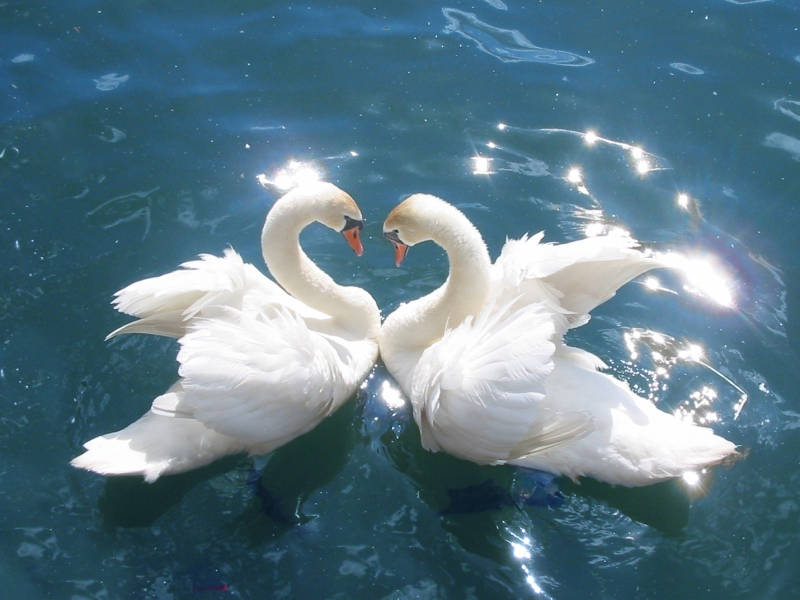
Note: In fact, this is the swansong of Bird of the Month, which has reached its first birthday and is going into retirement (birds age faster than humans.) Thank you to all Toast readers for sharing your bird knowledge, enthusiasm and stories in the comments. I’ve loved reading them. For your perusal, previous Birds of the Month can be found here.
W.B. Yeats first visited Coole Park, the Irish estate owned by his friend Lady Gregory, in 1897. He stayed there regularly over the next couple of decades and in 1916 wrote “The Wild Swans at Coole,” a poem in which the speaker, wandering by a lake in the October twilight, sees that
Upon the brimming water among the stones
Are nine-and-fifty swans.

When he first counted the swans, 19 years ago, he “trod with a lighter tread.” Now, his “heart is sore.” This could be for a number of reasons (World War One, the difficult political situation in Ireland, the recent death of Lady Gregory’s son) but, Yeats being Yeats, it’s a good bet that romantic disappointment is high on the list.
If you are feeling bad about the state of your love life, swans are not the ideal bird to look at. They find their partners young and tend to mate for life. They spend a lot of time gazing into the eyes of their beloveds, touching foreheads gently and preening each other’s feathers.

Eight years later, Yeats considered another aspect of the swan in his sonnet “Leda and the Swan.” This is a retelling of the Greek myth in which Zeus, king of the gods, turns himself into a swan in order to have sex with a young woman named Leda.
A sudden blow: the great wings beating still
Above the staggering girl, her thighs caressed
By the dark webs, her nape caught in his bill,
He holds her helpless breast upon his breast.

Drawing of Leda and the Swan by Maxmilian Pirner (1854-1924)
Leda and the Swan became a popular subject for artists in the Renaissance period, when it was more acceptable to show a woman having sex with a swan than with another man. (As for a woman with a woman/man with a man, no chance.) It continued to be popular over the next four centuries.
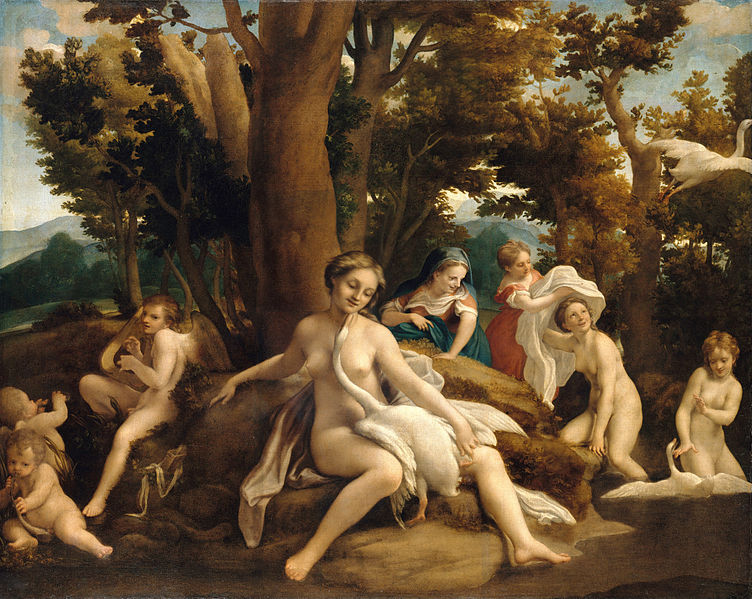
Leda and the Swan by Correggio, c.1532

Leda and the Swan by Giambettino Cignaroli, c.1756
Whereas some Renaissance paintings show the Zeus-swan as docile, even pet-like (see above), Yeats leaves the reader in no doubt as to the bird’s strength and capacity for violence. Swans are very strong. Do not rile one at close quarters, because if you get caught up in its angrily flapping wings you might find yourself with a broken arm. Part of the swan’s strength comes from its size. The largest swan species, the trumpeter swan, is the heaviest bird native to North America.

It rivals the great bustard and the dalmatian pelican as the heaviest bird that can fly. (The male of each of the three has an average weight of about 25lb.)


Great bustards and dalmatian pelicans: rivals of the trumpeter swan
There are between seven and nine species of swan. (It is not always possible to tell what counts as a distinct species, or even whether something is truly a swan. These questions occupy ornithologists and taxonomists, but need not delay us here.)
The most widespread species is the mute swan, which is native to northern Europe and Asia. In the late 19th century it was introduced to North America, where it has lived happily ever since. You can recognise the mute swan from the pronounced black knob at the top of its orange beak.
Most swan species (mute, trumpeter, whooper, tundra, Bewick’s, coscoroba) are entirely white. Australian swans, however, are almost entirely black, while the black-necked swan of South America looks as its name suggests:

Black-necked swan

The black swan of Australia. Note the ruffled feathers on its back, which make it look like it is wearing a flamenco skirt.
The male swan is called a cob and the female a pen. Cob and pen are collaborative as well as monogamous. They work together to build an enormous nest (80 inches across and 20 inches high) and, while the pen sits on the eggs, the cob patrols the area for predators and nuisances, swapping places with his mate when she wants to feed or clean herself. A typical brood size is six, and the cygnets (baby swans) take about six weeks to hatch.

This adorable creature is Hans Christian Andersen’s ugly duckling: the cygnet who grew up believing himself to be a duckling, feeling gawky and out of place until he transformed into a beautiful adult swan. Andersen, who had a difficult youth, called the fairy story “a reflection of my own life,” and later referred to it as his autobiography.
Danny Kaye singing “The Ugly Duckling.” Ignore his reference to the ugly duckling’s feathers as “stubby and brown.” As you can see, cygnets’ feathers are fluffy and grey.
Once the cygnets have hatched, mother and father spend the next five or six months tending to them, guiding them around the water and finding them food.
By this time, the cygnets have grown their first flight feathers and winter is drawing in. For most species, this means it’s time to migrate. The whole family goes together so the young can learn the route and discover the rivers, lakes and marshes along the way where they can rest and feed.
Even so, a cygnet’s first migration, across hundreds or thousands of miles, is a dangerous business, and not all will survive. Those that do will make the trip back home with their parents in spring, and may stay with them for two or three years more until they find a mate.
European fairy tales and folk tales often concern humans who have been turned into swans by a curse or spell. In “The Six Swans,” one of the tales collected by the brothers Grimm, six royal brothers find themselves turned into swans by their wicked stepmother. The only way they can become human again is if their sister remains silent for seven years while sewing six shirts made from plants. She does this without protest.

Illustration for “The Six Swans” by Walter Crane
In Swan Lake, Tchaikovsky’s ballet based on a Russian folk tale, the princess Odette and her companions have been put under a spell by an evil sorcerer, which forces them to spend each day as swans, only returning to human form at night. One evening, a handsome prince sees Odette as she transforms from bird to woman. She tells him she can only be freed by the love of a man who has never loved before (hint: the prince has never loved before.) In some versions, the story ends well; in others, almost everyone dies except for Odette, who remains as a swan.

Scene from Swan Lake
It is curious that there are so many stories about men and women becoming swans. You do not find equivalent stories about other birds. Perhaps this is simply because of the swan’s size. It is easier to imagine a human trapped inside a swan than inside a sparrow; easier, in fact, to imagine the moment of transformation (wings sprouting, feet spreading, nose lengthening into beak.) But perhaps another reason for these stories is that, even though they always portray the transformation as a bad thing, there’s something thrilling in the idea of becoming a swan. Who wouldn’t want to be that graceful, that regal?

Björk at the 2001 Oscars, bringing centuries of fairy tales to life
In a protected environment, swans can live for more than 30 years; in the wild, where they may be harmed by pollution, telephone cables or fishing nets, it’s more like 15. Legend has it that, at the moment of death, the swan breaks its lifelong silence and sings a song of spectacular beauty – hence ‘swansong’, a person’s final performance. The legend is false on two counts: swans are not silent throughout their lives (even the mute swan whistles and snorts), and they do not sing before their death.
So there are no swansongs, but there are songs about swans. You can enjoy some of them here:
Mary Oliver, whose most famous poem is about wild geese, wrote in “The Swan” about the sounds swans make:
Did you hear it, fluting and whistling
A shrill dark music – like the rain pelting the trees – like a waterfall
Knifing down the black ledges?
Beyond the sound of the swan, beyond even the sight of it rising from the river, Oliver senses something else:
And did you feel it, in your heart, how it pertained to everything?
And have you too finally figured out what beauty is for?
And have you changed your life?

Assonance means getting the rhyme wrong.
Last one?!? No!
These have been lovely. Thanks for sharing your passion for birds with us.
I agree. I’m unreasonably sad that this series is ending.
Idle etymology question: Is Giambettino Cignaroli’s name related to swans? That would be cool. I know cigne is French for swan. Anyone know Italian?
I don’t really know Italian but ‘cigno’ is Italian for swan, which may not be etymologically from the same root but sounds similar enough to be rather pleasing! Cigno is also is used to refer to excellent poets and musicians. Verdi was called ‘il cigno di Busseto’, Bellini ‘il signo di Catania’. I don’t know whether visual artists were ever called swans though.
Wow, you know your Italian artists! Exactly the info I was hoping for. Thank you.
You know, everyone always talks about Charlotte’s Web and Stuart Little, and they are both excellent, but my favorite E.B. White was always The Trumpet of the Swan. The trumpeter swan’s name is Louis! CULTURE. And you learn about the evils of ZOOS.
Granted, I did always want to be Different as a child and I haven’t read the book since I was probably ten – anyone care to weigh in on how it holds up?
“K’oh!” said Louis, pleased to be remembered.
I’ve always had a fondness for watercress sandwiches as a result of that book.
Note: I have never actually had a watercress sandwich. I grew some regular cress, though. It was eaten by a groundhog.
I learned the word superficial from that book! I loved it as a kid.
There are swans by the pond where I work (and honestly, in a lot of places around here) and I definitely give them a wide berth. They’re big.
Swans: too much like geese for comfort. They’re very pretty and I love seeing them, especially when there’s a fence between us because I firmly believe all non-duck waterfowl wants to beat my ass.
Geese are ASSHOLES.
My walk home from work involves several pretty parks, which is normally very pleasant, but in the spring they are filled with Canada geese and I am TERRIFIED. I walk briskly and try not to make eye contact with any of them.
An enormous flock of Canada geese lives in the drainage ditches along a grocery store, Target, etc. strip in my town, and they give zero fucks about hanging out in the road or menacing anyone parked too close to their gooselings. There’s also a big store called “Gander Mountain” that opened recently near the goose ponds, which I’m sure is a human store selling human products and not a fortress the geese have occupied to consolidate their power.
I grew up near a park with one male swan whose mate had died. I’m sure I should have been sympathetic to his broken heart and all, but he was such a mean, aggressive fucker. I don’t trust swans now.
I tried to pet a swan once, as a naive, misguided small child. It ate my bracelet and chased me across a park.
Lovely. I can’t remember which version it was, but in the book I had, the princess had to sew her brother’s shirts out of NETTLES.
Oh yeah, and she didn’t finish the sleeve of the last one in time, so the youngest brother had one swan wing instead of an arm.
Yes! But hopefully they were all still pretty grateful. We must have had the same version, or those bits must be common!
Wait wait hang on, so she spent SEVEN YEARS in silence, sewed six shirts OUT OF NETTLES and then when she got to the last one, looked at the very very nearly finished shirt, looked at her brother, looked at the shirt again and went ‘Nahhhhhhh!’
The mental image of this happening makes me laugh and think she’s kind of an awesome character. I realise it’s not how the fairy tale would have been written but shhhhh.
Nameless Sister: Misandry Hero.
There is also the truly magnificent Sevenwaters series by Juliet Marillier, based on that fairy tale. I was absolutely obsessed as a teenager and upon rereading as an adult, remained enamored.
I would love to say an eloquent goodbye to the series, but all I can muster is a giant thanks for saving the swan for your last entry. Swan song. Swan song. SWAN SONG.
I loved this series, and I especially loved this contribution. Swans! I love them! The pond near my last apartment has a mated pair who return each year to lay eggs, and the town blocks off the walkway nearest to their nest so you can still see them, but from enough of a distance that the swans are not disturbed. Possibly to save some small child from being beaten to death by one.
One of my favourite apparently true stories I ever heard was one about how some park-keepers noticed that one of the swan couples to set up nest were gay. Every year the couple would build a nest and they would look sadly at it as they realised that yet again there were to be no eggs for them. But one year, the park-keepers found that another swan couple had abandoned their eggs so they sneaked them into the gay swan couple’s nest. Apparently the couple were very happy and made wonderful, proud parents.
That is incredible, I don’t even care if it’s made up, it’s still true.
Boston has a version of this story, though I don’t know that our lovely lesbian swans have ever raised cygnets: http://www.bostonmagazine.com/news/blog/2013/06/1…
Ouch, they even lay eggs that don’t hatch? Poor things, the keepers need to find them some donor swan sperm or something!
This week, I was started thinking about swans, and I determined that I think they are my patronus, and that I should get a swan tattoo. Not of a pretty one, all floaty and white, but a swan rampant, just huge wings and snaking neck, staring you down. They are so lovely, so caring to each other, so ready to fuck your shit up if you kayak near their nests.
Like this one? (in the Rijksmuseum in Amsterdam, I don’t know anything more about it than that)
Thanks for the image – that is a truly magnificent swan! I love it.
Every spring about 10% of the N. American trumpeter swan population stages (flys in and hangs out eating like mad for some days to about a week before continuing on migration) all together in one spot about an hour’s drive from my town…so amazing…the honking does sound like people blowing really hard on plastic, toy trumpets that are not QUITE in tune. When the staging is in full swing, people in the local cabins/houses can’t really sleep much because with the long days and swans arriving and leaving at all hours and disturbing all the rest, there are swans honking CONSTANTLY pretty much 24/7. There is protected area for them and a nearby viewing station with scopes so they are safe, but can be visited/watched. When they arrive, it is SPRING. They will be flying south soon…too soon…
I’ve loved this series and I’m sad to see it diminish into the west; but thank you for writing it so well for so long.
Thank you for writing this series! I loved it — especially this one.
One story I could never bring myself to finish reading when I was a tiny person was Roald Dahl’s The Swan.
Peter carried the dead swan back to the edge of the lake. He placed it on the ground. Then he stood up and faced the two others. His eyes, still wet with tears, were now blazing with fury. “That was a filthy thing to do!” he shouted. “It was a stupid, pointless act of vandalism! You’re a couple of ignorant idiots! It’s you who ought to be dead instead of the swan! You’re not fit to be alive!”
🙁
Aww, I just got goosebumps from that quote! I remember being really upset by that story as a child. It’s beautiful, though.
This was utterly lovely and managed to be both condensed and meandering and I kept remembering other things connected to the text (The puppet show in Angela Carter’s “The magic toyshop”! The fact that the Russian title for “The swan lake” is one of the things that pop into my head at strange and sometimes inconvenient moments! That time 20 years ago, on horseback in the autumn with a group of swans flying low over our heads, making their eerie noise, when everything was perfect for a moment!). I learnt a few things and I made a tiny, swan themed treasure hunt in my own head.
Anyone seen Slings & Arrows?
“I wanted to throttle a swan. It seemed sensible at the time.”
Slings & Arrows is a beautiful, amazing, perfect show and everyone should watch it.
I saw that film a while ago and loved it, thanks for reminding me of its existance!
I think we are all forgetting the best swansong related poem, by Coleridge:
Swans sing before they die, t’were no bad thing
Should certain people die before they sing!