

Previous installments in this series can be found here. There will be spoilers. “An historian” is a perfectly acceptable Commonwealth convention, haters to the left [side of the road.]
What use was aristocracy in twentieth century Britain? And what, specifically, was the use of a landed aristocracy in a rural, agricultural setting? These questions animate Downton Abbey at the most fundamental level. This week brought them into even sharper relief, as issues of taxes and estate management, which have been simmering in the background all season, finally took center stage.
The majority of people in Britain have lived in cities or large towns since 1851. To be fair, the ‘large towns’ of the 1851 census were not exactly cosmopolitan metropolises, but still, it cannot be denied that Britain urbanized early and thoroughly. The map of Britain and Ireland hanging on the wall above my desk shows the great conurbation of London in the south-east, with a dense network of roads radiating outward; Birmingham in the midlands and Manchester in the north are smaller echoes. The dominance of London and of town life, and the centrality of industry and financial services, had been established facts in Britain since before Violet Crawley, the Dowager Countess of Grantham, was even born.
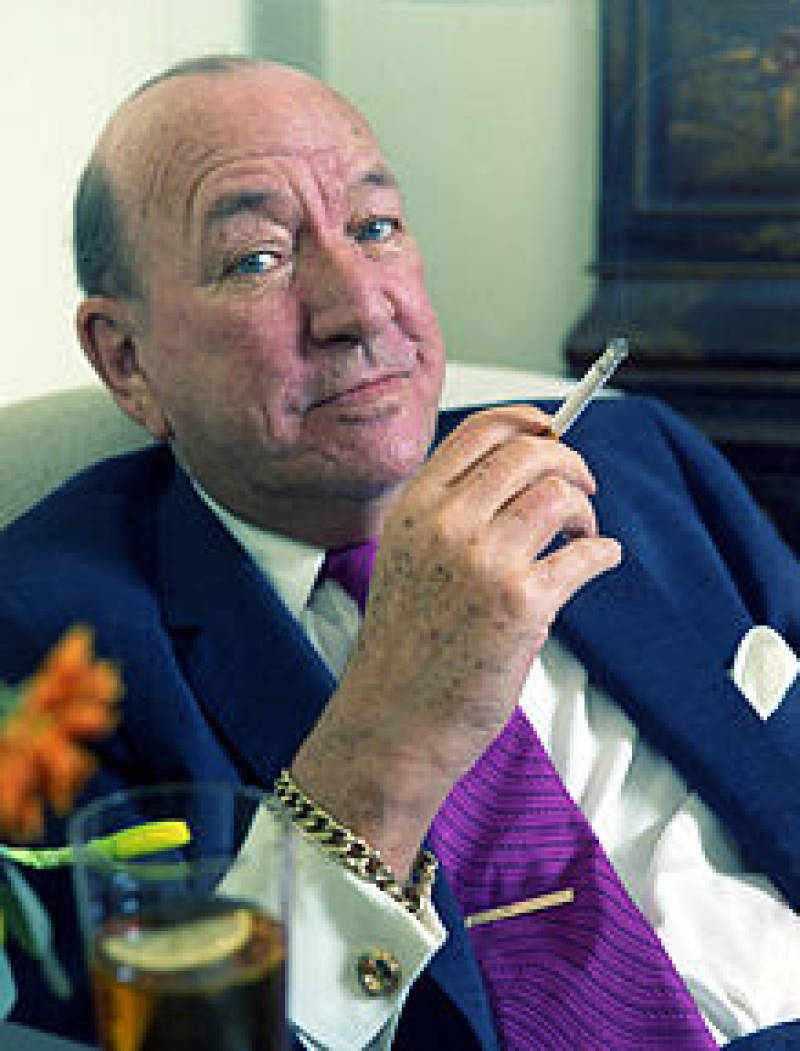
 After World War I, no major political party was interested in bolstering the aristocracy; death duties had doubled over the course of the war, to fifty percent at the highest level, and were increased again in 1925. Matthew might have saved Downton a bit of cash by dying when he did. Noël Coward (pictured, in 1972) satirized the situation in a 1938 poem that begins:
“The Stately Homes of England,
How beautiful they stand,
To prove the upper classes
Have still the upper hand;
Though the fact that they have to be rebuilt
And frequently mortgaged to the hilt
Is inclined to take the gilt
Off the gingerbread,
And certainly damps the fun
Of the eldest son—
But still we won’t be beaten,
We scrimp and scrape and save,
The playing fields of Eton
Have made us frightfully brave—
And though if the Van Dycks have to go
And we pawn the Bechstein Grand
We’ll stand
By the Stately Homes of England.”
Many landowners sold parcels of their estates to former tenants and other buyers, as Lord Grantham has suggested repeatedly. Such sales unsettled the traditional pattern of large estates farmed by long-term tenants such as the Drewes, whose family had been renting and farming part of Downton since the beginning of the nineteenth century. About a quarter of England, some six to eight million acres, was for sale at some point between 1918 and 1921. In 1914, only 11 percent of agricultural land was held by owner-occupiers; by 1927, that figure was 27 percent. Historian Peter Mandler has described the “tremendous psychological impact” of this transition, the “sense of the national inheritance passing, not between generations but between classes.” In reality, Lord Grantham and Lady Mary would probably have had auxiliary holdings which they could have sold off before parceling up the main estate, but the show’s sense of the emotional reality of moment is nonetheless accurate.
Some of this land went to build new homes for members of the middle class fleeing overcrowded cities. Suburbanization was a great fact of interwar life, especially in the southern counties near London. This was the dawn of the era of garden allotments and faux Elizabethan bungalows: the Daily Express coined the pejorative phrase “bungaloid growth” to describe the phenomenon. Alison Light, one of my favorite literary critics, describes “the suburban husband pottering in his herbaceous borders” as a archetypical figure of the era. The population of rural areas grew slightly even as the numbers of people employed in agriculture declined sharply.
Downton Abbey is filmed at Highclere Castle, located in West Berkshire about seventy miles from London and so squarely in the geographical and environmental realm of home counties southern suburbs. The show is set, however, in Yorkshire; the closest town is Ripon, a small cathedral city touched only marginally by the industrialization that remade other areas of northern England. This fictionalized setting allows the show to focus, somewhat nostalgically, on farmers and agriculture rather than commuters and the rise of modern suburban life.
We meet Mr. Drewe at his father’s funeral, where he learns that his father died with the rent badly in arrears. The Drewes’ situation is anomalous; most farmers made unusual profits during the war. Many of them used that surplus to buy up the land being sold off by their former landlords, believing that they would enjoy stability and prosperity as agriculture returned to a mildly profitable norm. Instead, they suffered badly, struggling to meeting obligations to banks. Arable farming suffered a depression in the 1920s and 1930s. Agricultural prices declined slowly but steadily after the repeal (in 1921) of the price-stabilizing Agriculture Act of 1920, while costs rose quickly. Although some respite could be found by turning to livestock, in particular dairying and poultry farming, these were still difficult decades for the small farmer, just as for the landed gentry.
Even so, the transfer of power had been decisively made. The aristocracy would play an increasingly ornamental role, ceding power in county councils and other bodies of rural government to farmers and professionals. The National Farmers Union, which represented farmers rather than landowners, grew in size and influence. As in Ireland, where this process had begun years earlier under the operation of the Land Acts, the large farmer would become the dominant voice of the countryside, rather than patrician landowner.
 What role was left to the aristocrat in this increasingly democratized atmosphere? At a talk I attended at a recent British Studies conference, Laura Nym Mayhall suggested that Lord Peter Wimsey, the famous sleuth created by Dorothy L. Sayers, is one possible solution to this problem. The brilliant younger son, Lord Peter provides an actually useful (if fanciful) service through his crime-solving while also displaying a decorative but reassuring code of gentlemanly honor. Lord Peter is a master of disguises; in Murder Must Advertise, he appears as a middle-class copywriter and a drug dealer with a flair for the dramatic before outing himself as an English aristocrat, inevitably, in a game of cricket. For Mayhall, this shape-shifting encapsulates the interwar uncertainty about the role of the aristocracy. Indeed, as Matt Houlbrook pointed out recently on his excellent blog, the interwar decades saw pervasive concerns about how to tell who was a real aristocrat in a world in which commoners tried to impersonate their social betters and actual gentlemen vacationed in democratic seaside resorts.
Lord Peter Wimsey also famously suffers from shell shock, usually glossed now as a form of PTSD suffered by soldiers in World War I. In Busman’s Honeymoon, his mother explains that his early, acute symptoms manifested as an utter inability to make decisions or give orders. Having ordered his men to their violent deaths during the war, he was no longer able to assert his right to order anything at all without triggering nervous collapse. In my reading this is (among other things) an elegant metaphor for the plight of the aristocracy after the war. Lady Mary and Lord Grantham, unlike Lord Peter, want desperately to assert a power of paternal guidance over the countryside, but in spite of the aid they offer Mr. Drewe, it is really too late. Their moral authority has been permanently compromised; their Stately Homes are becoming the theatrics of power without its substance.
Sources
Jonathan Brown, Agriculture in England: A Survey of Farming, 1870-1947 (Manchester: Manchester University Press, 1987)
Alun Howkins, “Death and Rebirth? English Rural Society, 1920-1940,” in The English Countryside Between the Wars: Regeneration or Decline? Ed. Paul Brassley, Jeremy Burchardt, and Lynne Thompson (Woodbridge, Suffolk: The Boydell Press, 2006)
Alison Light, Forever England: Femininity, Literature and Conservatism between the Wars (London: Routledge, 1991)
Peter Mandler, The Fall and Rise of the Stately Home (New Haven: Yale University Press, 1997)

For those who are as pedantic as I am, “a historian” is what you use if you/your particular dialect of English pronounces the “h” in “historian” (most speakers of American English do.) “An historian” is what you use if you don’t pronounce the “h” (most speakers of non-American English.) In print, they are equally correct; however, saying “an historian” if one is not (a) British or (b) a historian of Britain does risk coming off as slightly pretentious. It is not, however, wrong.
Words! They’re the best thing.
I love/hate that there’s been a comment debating ‘a historian’ vs. ‘an historian’ on (nearly) every article in this series. AMAZING.
I am not debating! They are equally correct! You do you! Ditto appendixes/appendices and indexes/indices. Also I don’t watch Downton Abbey so this is really all I got here, people.
This seems apropos: http://the-toast.net/2014/01/28/you-love-being-th…
I find this fascinating, too. I was brought up in the upper Midwest, but was taught to say “an historian,” and it did always feel a little pretentious to me/didn’t fall nicely on my ears. I was however, taught by truly elderly nuns from a retirement convent, so that may factor into this…
some absurdly large portions of london are still owned by noble families: http://www.flat-living.co.uk/lifestyle/438-who-ow…. it is alien to my american understanding of the world that a farmer would not own their own farm…but a little research showed me that there is a significant portion of farmland rented out in the US too: http://www.ers.usda.gov/media/377487/eib92_2_.pdf (p. 29). i would be interested to see current numbers for the UK to compare with the US.
it is alien to my american understanding of the world that a farmer would not own their own farm
Well, there is a long tradition of sharecropping in the United States! It would be interesting to know, during the long stretch when agriculture was the #1 employer in the U.S., how many people in the agricultural trade farmed their own land, how many were sharecroppers, and how many were agricultural laborers. It’s true that our cultural image of the “ideal” farmer owned their own farm, but I suspect the numbers who really did are smaller than we might expect.
One factor here is the US’s colonial history, and later, governmental tactics to settle the West such as the Homestead Act. In a few colonies, wealthy landowners were given large tracts to oversee directly by the king. In other places, land was parceled out in smaller lots to settlers. I have ancestors in both Michigan and Louisiana who were middle-class landowning farmers, because those states were settled by parceling out land to ordinary people in order to sweeten the pot and get people to live there.
Similarly, the settlement of certain parts of the US was influenced by the desire to open up new farmland to settlement/ownership by ordinary people. So the social forces at work are really different.
My grandfather, who runs a farm that is in many ways a stereotypical family farm, has rented out various pieces of his land over the years and similarly has rented land from other farmers. Sometimes for reasons as simple as “did not feel like dealing with that one spot in that field that always stays muddy longer than all the other spots, and someone was willing to pay me money for it” Or wanting to grow different crops, not having the time/ resources to farm all the land he had at the time, etc. I think at this point more or less all of his land is either rented out or left fallow under some government program.
Ahh, this was excellent! Thank you! Several more questions:
1. Tenancy rights- the leasing in England is very different than here, right? Tenants had long leases- like 60 years, etc? Right? is that a real fact? And there were places where the buildings all belonged to the tenants but the land belonged to the aristocrats? So for Dawes, that’s part of why the whole thing bugs lord Grantham- because his family rented for a long time.
2. Death duties. Only paid on heirs? Tax on property or income or everything?
3. When Lord Grantham said “I’m no Simon Legree”, in reference to evicting the Dawes, am I the only person who was screaming, “OH MY GOD PROBLEMATIC??!” Then pressing my outraged liberal censor button over and over? Also was that anachronistic? How widespread was Uncle Tom’s cabin for the english upperclass?
4. Directly related to #3: Why does Julian Fellows have to be so goddamn heavy handed with the dialogue sometimes? Also see absolutely soppy shit between bates and anna aka, “you are more pure now that you have been burnished to a high gloss by your noble suffering”?
5. I TOTALLY KNEW THAT EDITH’S GUY WAS A TOTAL SCUMBAG
6. I ALSO AM SUSPICIOUS OF BATES. MAYBE HE DID KILL VERA.
The end.
BATES TOTALLY KILLED VERA I REFUSE TO ENTERTAIN ANY OTHER IDEAS
When Mrs. Hughes was all oh, everything’s fine now! And the sky darkened and thunder cracked and Bates sprouted horns and intoned in a terrible voice “NO IT ISN’T”
Uncle Tom’s Cabin was actually shockingly popular in England. Apparently while in its first year of publication it sold 300,000 copies in America, but over a MILLION in Britain. So no, not anachronistic. Wildly wildly popular in Britain for a variety of reasons, and “Simon Legree” would have entered popular parlance long before the 20s.
Fine, still pretty tone deaf and heavy handed, but I will give historical accuracy points. Robert loses several points for going to the “well I’m not hitler!” end of things.
Yes but tone deaf and heavy handed on the part of Lord Grantham or the part of the writers? I’d chalk it up to the former, which is … not unprecedented
I’m voting writers! I AM AND YOU CAN’T STOP ME. I don’t think they knowingly went, “all 7 people who get this reference are also going to wince at how obtuse L.G. is. If they wanted that they’d call more attention to it with a skeptical Mary eyebrow or something.
It is generous of you to go that way, does your head get tired from wearing your halo all day? 🙂
That’s interesting! I wonder why it was so popular.
According to the wiki page, it was a sort of national anger at the US, in a sort of “omg read this book you will NOT beLIEVE what Americans do, get rid of your Americans they are revolting” type of way. But also I imagine it was due to chafing ideas about social strata in Britain vs. the US. http://en.wikipedia.org/wiki/Uncle_Tom's_Cab…
1. Yes, tenancy of land could be for very long terms. In Ireland they advocated for the “three f’s”, fair rent, free sale, and fixity of tenure. Fixity of tenure meant basically that you couldn’t evict someone who was paying rent. More generally, it was very common throughout the 19th century for most people to rent rather than own. So many well-off families would rent a family home for very long periods of time. So for Lord Grantham this is breaking a decades-old tenancy.
2. Paid on the transfer of assets above a certain value after a death.
3. What aravisthequeen said!
4. Agree.
5. Disagree! I am holding out hope for Gregson.
6. Maybe Peter & Harriet can come investigate his crimes in the final season.
5. Sorry butwe have a lot of theories around here:
5.a. Are we even sure there’s a crazy ex? That’s a very standard man excuse. What if there is some kind of evil crazy wife that gregson ruined who shows back up?
5.b. Gregson knows a lot of dirty poker tricks and didn’t he sign over his buisness to Edith? What if he’s in crazy debt and on the run for the revenge seeking brother of the crazy wife (a la Jane Eyre) so he seduces Edith, leaves her holding the debts, and hightails it out to germany and parts further off? 5.c. Meanwhile poor Edie is pregnant after her sexy nacht, and we’re going to have a very very heavy handed 1920s abortion/adoption storyline?
5.d. Does anything ever work out for Edith? See?
6. I really loved the Whimsey-Vane 2002 BBC one I wish they’d done it for Busmans Honeymood too. A really excellent Whimsey Vane remake on HBO/BBC would make my soul sing.
“Never trust anything that can think for itself if you can’t see where it keeps its crazy wife.”
Exactly, you definitely have the right end of this stick (y wicket) old girl.
6. Yes, I totally do not trust Bates, or anybody with such constant smarmy and holier-than-thou pronouncements, BUT, my best guess is the writers kind of don’t know he’s coming off this way/haven’t really thought through his character that much? Maybe? I don’t know!
I think we will come to find he DID kill Vera, but somehow it will all have been a terrible accident, so we’re still supposed to like him.
DON’T LIKE HIM. WON’T LIKE HIM.
Re. 1. I’m a British person who bought a flat last year and while short-term renting is as you’d expect we also still have the concept of a leasehold purchase. Basically, I own my flat for the next 110 years, but not the land on which it stands! If the freeholder, (the person who owns the land), ever decides to sell the land I get first refusal and I can extend the length of the lease once it drops below a certain threshold.
The contract for the property has a bunch of restrictions imposed by the freeholder. She lives in the flat downstairs so one of the rules is that the living room has to be carpeted to reduce noise!
SEE! That’s what I’m talking about!
The carpet thing happens here in the US too – several friends in NY had that, with x percentage of a hardwood floor required to be covered.
BUNGALOID GROWTH
I am AMAZED that the Daily Express was ever capable of such fabulous verbal dexterity, considering that nowadays every article it prints is entirely made up of the words ‘Diana’, ‘benefits’, ‘Killer storm’ and ‘Madeleine McCann’ repeated over and over again.
This series is amazing, and Lord Peter references can only bring it to even greater heights. Maybe one of the Granthams should consider becoming an investigator.
clearly lady edith is ripe for a new career, now that her publisher fellow is AWOL…maybe her first assignment can be unmasking bates as a murderer.
this will free anna from the shackles of her abusive marriage, and they can go into business together. this will also have the effect of stealing lady mary’s favorite maid away from her, which will honor the spirit of mary’s and edith’s terrible sibling relationship…
I GOT SO EXCITED WHEN THERE WAS A REFERENCE TO PETER WIMSEY. It was uncontrollable glee.
NOT Lord Grantham, he is terrible at everything.
Question for people currently watching: I haven’t been able to summon the will to watch this season since I tripped over a spoiler in an unrelated Guardian article last year, a sidebar link that actually contained the words, “ANNA BATES IS RAPED.” These ~An Historian~ pieces are making me miss the series, though. Is there enough going on to make going back in worthwhile, or are viewers just on autopilot by now?
I’d say I’m watching 15% on autopilot, 35% liking Mary again, 20% hate-watching, and 30% costumes.
35% barf and 30% visuals is probably too much meh for me, but I’ve always liked Mary. I don’t know. Thanks, though. 🙁
I only watched seasons one and two, but god I love Michelle Dockery as Mary. And also as Susan in “Hogfather”. I love her voice.
1. Good. Stop there, never advance. You will be a happier person.
2. Yesss, she is so sparkly and her voice is so luminous and soft. I love how clearly she telegraphs as Mary, too. I don’t think the character would’ve stood up to development as well with a less talented actress. (I may or may not relate deeply to being trapped in an accidentally bitchy persona with a reluctantly gooey center, though. Some projection may be involved here.)
Reasons I’m still watching
1.Kitchenmaid love quadrangle
2. Random Carson backstory
3. Running subtheme of Mrs Patmore versus the singularity- so far an electric whisk, a refrigerator and sewing machine. What’s next? Electric toasters? Electric WASHTUBS? The complete breakdown of society?!
4. Return of DarkBates.
5. Mid season hints of Thomas schemes (not enough, but some hints)
6. Cora seems like she’s on serious happy drugs.
7. Old Mosely tries to kick the football yet again. I’m hoping after one of these hilarious “oh mosely!” moments, he just hangs himself in carson’s wine room, and it’s wierd and dark and never properly addressed. Alternate site of hanging- Lady Violet’s front room, turns out he took the paper knife.
RUNNING SUBTHEME OF MRS PATMORE VERSUS THE SINGULARITY
OH I BET MOSLEY TOOK THE PAPER KNIFE! THAT’S AWESOME!
“Sorry, Mosley, you shoulda said yes when I first offered the job” (Carson turns away; Carson smug face glowing) The Best.
If he did he did it by accident, while drunk, while being seen by 3 key witnesses. DAMNIT MOSELY GET IT TOGETHER!
I’m actually pretty sure this is a Lady Violet misplacing it, Isobel painfully smug moment. Or the mean butler who was mean to Mosely took it, so that karma is avenged.
#2 is of great interest to me.
DarkBates, though, I dunno. Honestly, my problem isn’t that I can’t handle a rape subplot, it’s that I finished season 3 with bone-deep Batesodrama fatigue. That couple desperately needed to be gently shelved for a half-season at least, but no, INSTEAD they chose to take sweet, long-suffering, already-bordering-on-caricature Anna and officially make her a saint through sexual fucking martyrdom. It’s gross and I hate it.
All that said, I would totally watch Mrs. Patmore Versus the Singularity as a spinoff.
When he was happy in episode 1 of season 4 it was TERRIBLE. I also find the Bateses boring, but I would like to see him go on an evil rampage, and go out in a blaze of glory, finally brought down by lord grantham with a hunting rifle, who strides over, shakes his head, and says, “it was a damn shame bates, a damn shame.” And then they’re like, “of course you can stay on Anna, and help Mrs. Patmore and Carson fight these terrible babbage counting machines!
If this were LiveJournal I would friend you so hard right now.
I’ll consider myself friended then!
I just have a lot of thoughts about television if there are british accents, costumes or soapy subplots. I also like murder. OOH BETTER ONE. BATES kills valet rapingham, frames mosley, using the silver paper knife from the king of sweden, hangs him in drawing room of lady violet’s house as a warning to all the other servants. Is sitting in the terrible swivel chair that scares lady violet in the dark, waiting, just waiting, for lord grantham.
Robert: “Bates, I hate to have to do this.”
Bates: “I know my lord. I see you hating it, and it only makes you more noble and pure in my eyes.”
Robert: Damn it Bates, I’m no Simon Legree! But surely you must see that this subplot and it’s horrid tortured lines must come to an end.
Bates: Do it sir.
Robert: BANG!
Bates: DEAD
Robert: breaks rifle, “It was a damn shame. A damn shame. He has such a way with buttons.”
This is my new favorite fanfiction.
MORE Lord Peter, please.
Yes please
always
I’ve never even watched Downton, but I love this series! So much fun.
This is a lovely lovely article, especially the last line about “Stately Homes are becoming the theatrics of power without its substance.” But I really just want to repeat the word conurbation over and over again.
CONURBATION! CONURBATION! CONURBATION!
1. Good. Stop there, never advance. You will be a happier person.
2. Yesss, she is so sparkly and her voice is so luminous and soft. I love how clearly she telegraphs as Mary, too. I don't think the character would've stood up to development as well with a less talented actress. (I may or may not relate deeply to being trapped in an accidentally bitchy persona with a reluctantly gooey center, though. Some projection may be involved here.)
#2 is of great interest to me.
DarkBates, though, I dunno. Honestly, my problem isn't that I can't handle a rape subplot, it's that I finished season 3 with bone-deep Batesodrama fatigue. That couple desperately needed to be gently shelved for a half-season at least, but no, INSTEAD they chose to take sweet, long-suffering, already-bordering-on-caricature Anna and officially make her a saint through sexual fucking martyrdom. It's gross and I hate it.
All that said, I would totally watch Mrs. Patmore Versus the Singularity as a spinoff.
If this were LiveJournal I would friend you so hard right now.
This is my new favorite fanfiction.
I am always posting comments weeks late because reasons, so I usually don’t, but I had to say that reading this literally gave me chills? Because I am a massive, massive nerd. And the difficulties of the small farmer + suburban/urban growth + technological advances that mean more people can be fed with less actual human labour + Tolkienesque nostalgia for the passing of a way of life that was unsustainable in the long term + the expansion of the middle class = the resultant changes, good and bad both, to the economic and ecological landscape, and how not all bad things are unequivocally bad for everyone, but vice versa for the good things, and …wow, I articulated that really badly. Because it’s basically a master’s thesis that I tried to fit into one paragraph? But I’m pretty sure it’s been written already, I just have to find it. And then write an article for the Toast about it? Because I can’t be the only one fascinated by misbegotten nostalgia, yeah? Okay, done ending sentences with question marks because I have to go to class.