
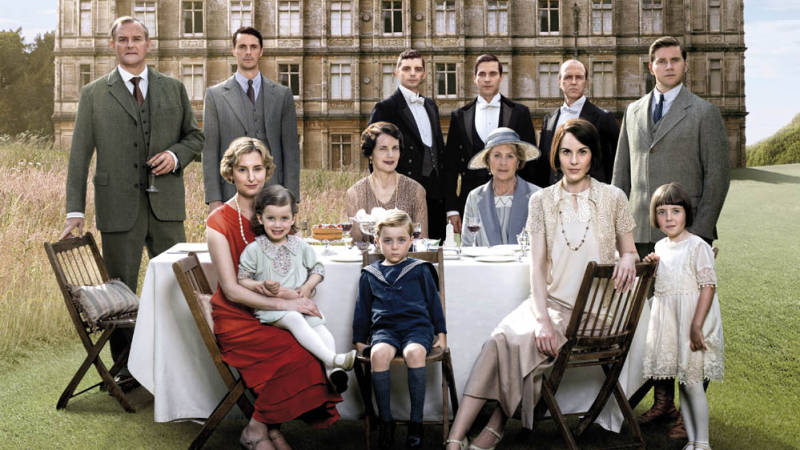
Season 6, Episode 9 – Series Finale
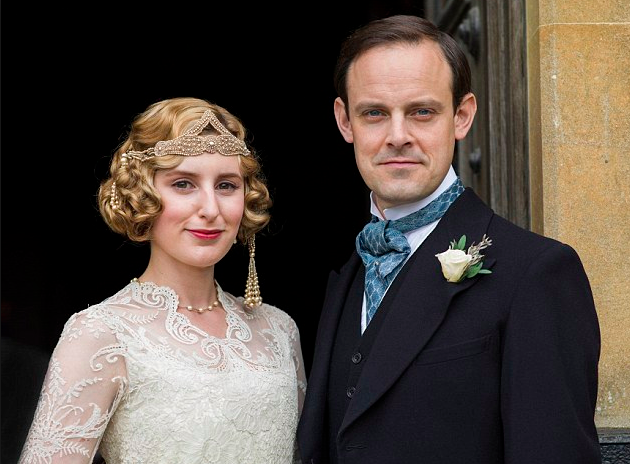
In the very last episode of Downton Abbey, finally, the dark horses got a chance to shine. I’ve always been a fan of Lady Edith, and I was beyond delighted to see her and suitor Bertie Pelham face up to their fears and emerge stronger and happier for it. The birth of a child out of wedlock was a serious issue for a woman in 1925. Since the final column surely wouldn’t be complete without a Dorothy L. Sayers reference, I’ll point out that, in similar circumstances, she kept the existence of her son secret from her entire family and nearly all of her friends, though she did tell the man she later married. I wish that Lord Grantham didn’t need Edith to become a marchioness in order to earn his words of praise, but I’m glad that she finally got to feel the love and happiness that have been so often denied her.
Speaking of Sayers: Julian Fellowes is obviously a fan of interwar detective novels, having written a very funny pastiche in Gosford Park. Downton, too, has had its mystery-fiction moments, notably the recurrent question of whether Mr. Bates has or has not murdered anyone (his wife in the early seasons, the man who assaulted Anna more recently). The Bates family get their idyllic happy ending, but what was up with Lord Merton’s evil son and daughter-in-law? Surely we’re meant to conclude that they were killing him with chronic arsenic poisoning, which can masquerade as pernicious anemia. Thank heavens for Isobel Crawley, saving the day again.
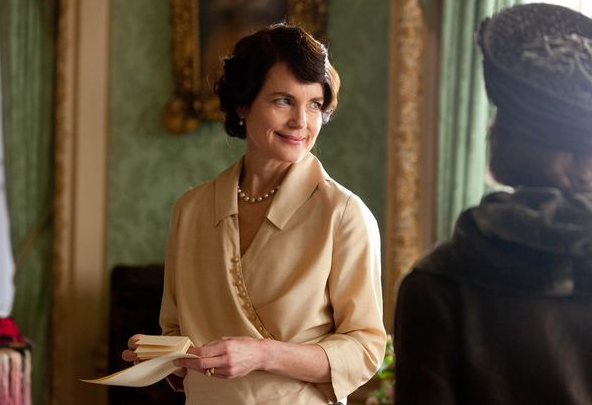
Three weddings, no funerals: Downton Abbey, after a grim spate of blood-letting in seasons 3 and 4, gave us a poignant set of classic happy endings and proved itself to be comedy rather than tragedy. Only Carson is left with a mixed blessing: a pension (once again, the Crawleys are their own personal welfare state), a loving spouse, and a place to live, but the gall of seeing his place taken by none other than Thomas Barrow. Barrow, meanwhile, has grown “from boy to man” and takes on his new role graciously. Violet, too, is gracious at last, having recognized that Cora also has a core of steel competence. For a show that kept announcing change, what’s striking about the new order coming into view at the end of the episode is how much the underlying structures will remain the same, even as the personnel shifts.
So what lies ahead? Historians are not notably good at fortune-telling; our preference, after all, is for what’s dead and buried. But I’d like to celebrate the end of this international phenomenon with a stab at “Watching Downton Abbey with an Psychic.” Their storylines might be neatly tied up, but as the camera pulled away from the New Year’s celebrations and the snowy Abbey, we knew that the Crawleys and their servants were heading into 1926 and a raft of new dramas – just without us to watch them. The next two decades will bring economic depression, another world war, and another set of social transformations; what follows is my fantasy about how our favorite characters might fare.
1945
The ivy in the planters is dead, but the door still swings smoothly on its hinges. It admits a young woman, in her twenties but looking younger with her messy hair, cardigan, and sensible shoes. Although Sybbie tries to dress politely when she visits her aunt, there’s nothing, of course, that will quite meet Mary’s approval. Nothing does, these days. Anna lets her in and shows her, quietly, to the one of the few rooms still heated on the ground floor: the library, where Aunt Mary sits, ramrod straight, staring out of the floor-to-ceiling windows at an incomprehensible world.
Downton Abbey began with drama about entail, the legal structure that mandated that the Downton estate and the title of Earl of Grantham be passed down to the next male heir. In 1925, the Law of Property Act changed things. Although I still doubt it would have been quite so impossible for Lord Grantham to alter the entail back in 1912, the 1925 act explicitly empowered him to bar the entail. In other words, he could end the requirement that the heir had to be male and instead pass along the estate in the normal way, via a will. He could not have altered the inheritance of his title, however – a situation that apparently kept Julian Fellowes’s own wife from inheriting her uncle’s title.
On the other hand, he could have chosen to do nothing, and the entail would have persisted. Although you could argue that it only “matters” if little George Crawley were to die, I imagine that Lady Mary would have found a way to convince her father to change the terms of inheritance so that she would get the property outright in the end. By 1945, Lord Grantham would have been about eighty, but I don’t see him living that long: all that port and rich dinners and stress have already taken their toll. He dies of a heart attack in the mid-1930s, leaving Lady Mary to inherit Downton – though the town house, I think, goes to Lady Edith, who always preferred London anyway.
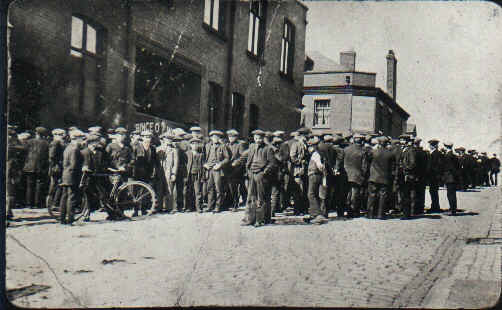 Tyldesley miners outside the Miners’ Hall during the 1926 strike
In May 1926, Britain experienced a general strike. Coal miners, facing a decrease in their wages, went on strike to the slogan: “Not a penny off the pay, not a minute on the day.” Somewhat reluctantly, the Trades Union Congress agreed to call a general strike, with workers in transportation and other industries joining the miners. (Domestic servants were not unionized.) The government was well-prepared for this contingency. They organized networks of volunteer strike-breakers, many of them young people from the middle and upper classes who saw the whole thing as a lark. It was raw class conflict turned into spectacle, and it ended with the humiliating defeat of the unions.
In my imagination, the general strike breaks up the détente at Downton Abbey. I see Lady Mary, grimly driving an omnibus through Thirsk, insisting, over Carson’s pained objections, that we simply must carry on. The scales fall from Tom Branson’s eyes: he and the Crawleys will never, truly, be on the same side. Although he keeps a low profile during the strike, he knows it’s time to make a move. He sets up his garage on the corner of the estate and moves into a cozy little adjoining house with his daughter, Sybbie. Daisy, too, is outraged, and I imagine that she’ll make more of a fuss about it. Perhaps, finally, she’ll say too much: but even if she stops working in the big house, I imagine that she and Andy will keep on at Yew Tree Farm…for the time being, anyway.
The Great Depression that struck the world from 1929 affected Britain profoundly, though not as disastrously as it hit other countries. Trade fell and output fell, unemployment rose. The effects of the depression were extremely variable, though. In Oxford and Coventry, where manufacturing of cars and planes was getting established, unemployment was down to a mere 5% by 1934, while Jarrow on Tyneside, the most famous emblem of this period’s suffering, saw a sustained rate of nearly 70%. Thirsk – and hence Downton – is closer to Jarrow than to Coventry, but the village economy is agricultural rather than industrial, which will lessen the blow. As for the Crawleys: the last thing they needed, of course, was another hit to their investment portfolio. But if Lady Mary took my advice and diversified with holdings in automobile companies, I think they’ll make it to the other side, though with an even smaller staff and having sold off a few more family treasures.
While the depression fostered extremism in other countries – the rise of fascism in Italy and Germany, the raging Spanish civil war – Britain escaped the worst social turmoil. There was a fascist movement in Britain. Led by Oswald Mosley (no relation to our Molesley), the British Union of Fascists or blackshirts propagated a fascist ideology centered on anti-Semitism. In October 1936, an effort to generate mass support backfired. The blackshirts went to demonstrate in the predominantly Jewish East End of London, but were thoroughly routed by anti-fascists and the police in what became known as the Battle of Cable Street, and the movement never really recovered.
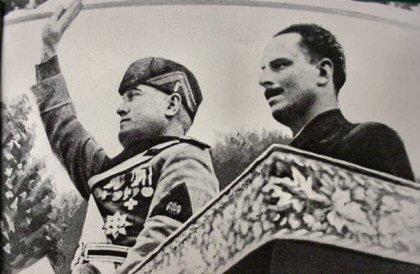 Benito Mussolini (left) with Oswald Mosley during Mosley’s visit to Italy in 1936.
Still, fascism remained fashionable for certain people, particularly within the aristocracy. I see Lady Mary being attracted to this sort of thing: the need of the people for a strong leader, the appeal of trains running on time, large numbers of athletic men all dressed alike and marching in formation. After the birth of their daughter, she and Henry Talbot will drift apart, tacitly accepting each other’s lovers and dalliances and realizing that, after all, they never really had anything to say to one another.
Lady Mary’s flirtation with the far right will only deepen the divide between her and Lady Edith, who, as Bertie Pelham’s wife, has finally come into her own as a patron of literature and art. Perhaps Leonard and Virginia Woolf become friends and mentors, and Beatrice and Sydney Webb: they talk politics and art and beauty. Little Marigold, joined by a reasonable number of younger siblings, grows up in a slightly chaotic but always warm and charming household, where painters come for a weekend and stay for a month to finish that modernist landscape painting, and where debates about politics and truth never threaten the steady, loving bond between her parents. She’ll become an artist, maybe studying painting at the Slade School or sculpture at St. Martin’s. (I’d like to think that Lady Edith tracks down the Drewes and makes amends, but even I can recognize when a fantasy is getting out of hand.) I see Bertie and Edith helping to fund the Left Book Club, founded in 1936 to fight fascism, and holding discussions groups in their gracious parlor with plenty of tea and biscuits.
More adventurous leftists traveled, in the late 1930s, to fight fascism in person in Spain during the Spanish Civil War (1936-39). About 4,000 Britons volunteered to join one of the International Brigades that fought on the republican side against Franco. Some were well-educated intellectuals: most famously, George Orwell, who recorded his experience in Homage to Catalonia. But most were working-class radicals who saw fighting in Spain as a way to stop fascism in Europe.
After ten years at Yew Tree Farm, Daisy and Andy, who I think married quickly in the spring of 1926, get restless. The truth is that neither a quiet farming existence nor heterosexual monogamy is enough for them. Andy did think Thomas Barrow was a little attractive all those years ago, but he didn’t know what to do with those feelings, any more than he knew how to admit he couldn’t read. And when Mrs. Patmore reacted with alarm at Andy’s question, “Does she like men?” It was because, deep down, she knew that Daisy, too, was more bisexual than straight. After years of marriage to Daisy, Andy’s not only reading pig-farming manuals; he’s also reading William Blake and Karl Marx. He suggests to Daisy that they start going to political meetings, first in Thirsk and soon in York, and before long they’re both chafing at the yoke of daily life as staid married pig-farmers. I imagine a stint volunteering in Spain as the start of a full reawakening for them both, with a future involving non-monogamy, radical politics, and a whole lot more fun.
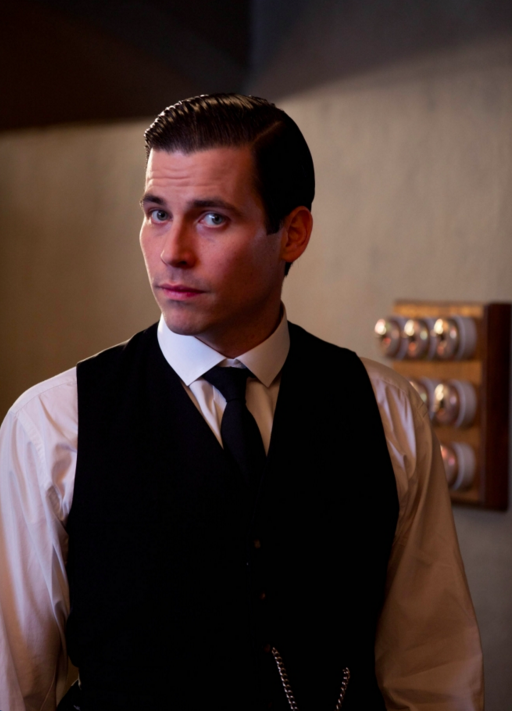
Speaking of Thomas Barrow: let’s give him a solid five or so years as head butler at Downton, maybe even a bit more. As Robert and Cora age, he becomes Lady Mary’s right-hand-man: a little bit ruthless, a little bit cruel, but also mellowed by the experience of sinking so low and then finally achieving a stable position. His new self-confidence and his new power combine to lead him, at last, into visiting the gay nightclubs and cafes of interwar London. To Mary’s never-ending dismay, he quits his position at Downton sometime during the depression to open a cinema in suburban London with his lover. Only Anna remains utterly reliable and faithful, though after the death of John Bates in mysterious circumstances, she’s a trifle abstracted.
When World War II begins, George Crawley is just 18. Sybbie is already at Somerville College, Oxford; he is due to follow her (Oriel, perhaps?). But when war is declared, he doesn’t wait to be conscripted but immediately enlists in the Royal Air Force, every inch the glamorous fighter pilot. He is one of those about whom Winston Churchill will say: “Never in the field of human conflict was so much owed by so many to so few.” While his mother protects Downton, George protects Britain.
Sybbie sits on the faded divan. Her aunts have paid for her medical training, and she’s grateful to them both, though it’s more fun to visit Aunt Edith, with all the little cousins and their friends underfoot and interesting characters wandering through the galleries and gardens of Brancaster. Downton must have been like that too, she supposes, when her mother was young; once again she tries, and fails, to imagine her mother in “scandalous bloomers,” her father in chauffeur’s livery. It seems like another planet.
“And how is your father?” asks Aunt Mary, her old-fashioned voice cultured and polite.
“He’s well, thank you. He’s been living in the London house – Aunt Edith’s London house – ever since Lord Beveridge got him the job at the Ministry of Health. It’s quite exciting really – papa says that everything will change for the people once the new health system is up and running.”
“What on earth can Tom have to do at the Ministry of Health? I shouldn’t have thought that a garage-owner had much to offer on that point.”
Sybbie takes another biscuit before she answers. She knows, because her father has told her, that Aunt Mary doesn’t really mean it when she says these things.
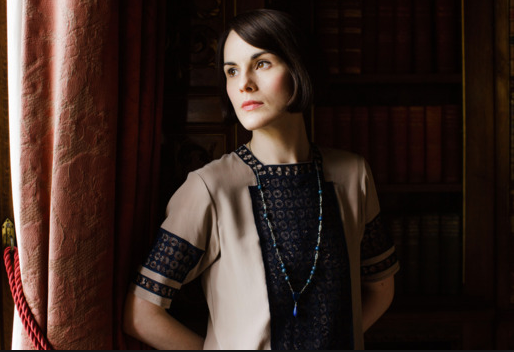
“I think it was his experience in the York municipal government, Aunt Mary. And his work with grandmamma at the hospital.”
Mary picks a stray thread from her skirt. “Well, in any case, of course you’re proud of him, dear. It must be quite cozy for all you down there in London these days. You, and Edith, and Tom, and…I suppose…”
Sybbie feels generous and bold. “Yes, Aunt Mary, we see quite a bit of George, too. And he brings Albert, and sometimes we invite Mr. Barrow and Mr. Litchfield, too, when they can get away from the cinema. Did you know that Mr. Barrow got an award for bravery, Aunt Mary? It was for saving those children who in the theatre when the V-1 bomb hit it last January.”
“I don’t want to talk about that now, Sybbie. People are prosecuted for that – for that sort of thing. In time George will come to his senses and marry a woman. Let us not talk of it until then.”
Anna has come back in, nearly noiselessly. She interrupts the heavy silence that follows Mary’s outburst.
“Isn’t that nice, Miss Sybil. To think of Mr. Barrow and our George still being friends after all these years. My lady, we must make that trip to London some day soon.”
Mary looks out of the window, across the wide lawn. In the distance some child – is it Anna’s youngest? Or Mrs. Baxter’s change-of-life child? – some gangly child is fashioning a bridge across the eighteenth-century ha-ha.
“Yes, Anna. I suppose we must.”
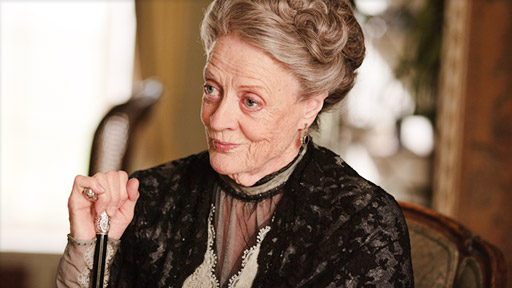
And there ends my brief foray into fiction. I’d love to know what you think about where the characters of Downton Abbey ended up, in 1926 and beyond. Quite correctly, Fellowes gave Violet the last word, and so will I: “We’re going forward to the future, not back into the past. If only we had the choice!”
Source
Robert Megarry et al., The Law of Real Property (2012)

This was so sweet, Mo! I’ve really enjoyed reading this series, and I’m glad to see you having some particular fun with this last one.
Dang, but you really do hate Mary, though!
Mary is infinitely hateable. (Note: the autocorrect kept wanting to change hateable to hittable. Hmm.)
I just started re-watching and was surprised at how much I disliked Mary, who is pragmatic enough to marry Carlisle (well, almost) but not pragmatic enough to wear fewer diamonds.
I am deeply in favor of Daisy’s reinvention as a radical leftist bisexual adventuress! She was clearly never satisfied by life at Downton and it is high time she gets to break free.
also I am excited for Edith and her awesome intellectual life & lovely kind husband.
It definitely checks out. I think Daisy is going through adolescence at roughly a 1/10th pace – in 13 years, she works up the nerve to give herself a haircut and start high school. If she was 12 and a scullery maid in 1912, she’s made it to about 14 by 1926. By 1945, she’ll be about 16, definitely time for that kind of jump.
She’s 23 now.
I said it on twitter, but I’ll repeat it here: I just want to see The Continuing Adventures of Anna Smith-Bates, In Which Nothing Bad Happens and Everything Is Okay.
Sort of like “The Hobbit, but just with food.” I will take this.
In my headcanon, Mary and Anna will be those two spinster living in the dower house surely they have never been to Lady Tangiers! (They are perfect)
Look I’m not gonna lie I would not at all be opposed to one of Mary’s affairs being with Tom. Let’s be real, she had WAY more chemistry with him in this last season than she did with Henry, oy vey.
I was 100% convinced until the penultimate episode that this season’s end would have Mary and Tom getting married.
SAME! And I was extra disappointed just because of how gross the handling of Mary/Henry was, like, she very clearly didn’t want to marry him and basically got forced into it??? Blech. They never should have let Matthew’s actor leave and his character die.
SERIOUSLY THOUGH I was fully hoping/expecting Mary and Tom to wind up boning in the backseat of a car at the new garage until I gave up at the ending credits. I saw it when it when it aired in Britain, so the ensuing months have allowed me to erase everything that actually happened and make this canon.
Nooooo, Tom’s been married to Sybil, the sweetest Crawley of all. He could never settle for MARY. But I did like their relationship at the end. He really did seem like an older and wiser brother to her. Ugh, Mary.
Plus the ending was pushing him towards Edith’s editor. That will work out well for them living in Edith’s London house.
I don’t think it was Edith’s editor at the wedding party; it was the village girl from the political meeting who let Tom take the empty seat next to her.
All the yes for Barrow finally getting out of Downton and meeting a nice guy.
Am I terrible? As much as I love Mr. Bates, I laughed aloud to learn that he died in “mysterious circumstances.”
Thank you for giving Edith and Marigold such a wonderful future, and for being so true to Mary’s character and Branson’s potential.
That bit of fiction was infinitely more enjoyable than that saccharine pile of horse poop that was the series finale.
HOLY CRAP YES. This is exactly what I needed to read and I am bookmarking it for future reading forever.
George considered entering a marriage of convenience with Lydia, an artist friend he met through Marigold, but decides against it. The next in line, Cousin Gordon, is a good sort of egg if a bit boffiny and has two sons. He might not want to be part of the H of L, but he’d be a net improvement to the old mausoleum in any case.
I love hearing your thoughts about Edith and Bertie! I disagree about Mary though. I can’t see her sliding toward fascism, what with Rose married to a Jewish man. It feels like you’ve turned her into Violet with her comments at the end, which also don’t really ring true for me. Mary is a big snob and hates to not get her own way, but she’s not a terrible person.
If Edith can be forgiven for her past errors (mailing the Turkish ambassador, anyone?) then I think Mary can too, especially given how much they both try to mend their relationship in the final episodes.
NEVER FORGIVE EDITH. ALWAYS FORGIVE MARY. I AM A CARSON!
My image of George after service in the RAF is informed by Claud in Cold Comfort Farm: “He had seen his friends die in anguish in the wars. For him, the whole rest of his life was an amusing game which no man of taste and intelligence could bring himself to take seriously.”
This is wonderful. What a lovely epilogue.
What’s next, Mo? Can we have “Watching Peaky Blinders with an Historian”? “Call the Midwife…”?
Here for Call the Midwife!!!
ME too!!! At least the ones based on the memoirs; It’s kind gone off the rails since they’ve ventured into made-up material. But I love the first seasons…
I love Chummy so much.
Also also also I just realized, EEEE, it’s the era when James Herriot was vet in Thirsk! He could be Daisy and Andy’s vet (if they keep with pigs)!
I loved those books and I loved that show, and when I finally got to Yorkshire I looked around so hard for the animals. I was obviously in the wrong part of Yorkshire. All I saw was a magpie.
Aww, that’s a shame. Yorkshire is chock full of animals and beauty.
Also I bet both Edith and Mary will open up their houses for evacuated children during the Blitz, and Marigold will be a Land Girl.
(Also, has anyone read the Connie Willis Oxford Time Travel books? I keep thinking about Blackout / All Clear.)
Yes! Though honestly, I keep thinking about Narnia. Who wouldn’t be surprised to find a magic wardrobe hidden in one of Downton’s many extra rooms?
Oh yes! A wardrobe filled with all those luxurious furs and coats that no one wears anymore.
Maybe in Lady Sybil’s old room, which they have left untouched for all these years.
That makes more sense – I mean, do you really think Lady Mary (and Cora, who’s surely still alive at this point) would have stopped wearing furs?
Just the ones that had gone out of fashion, though maybe they would have them remade into more fashionable styles then.
I always thought fur coats were the kind of fashion that remained relatively stable throughout the years, but what do I know? Perhaps the maids had taken to storing the very old furs (or maybe Robert’s? Men wore furs back then, right? At least in, like, Russia, right?) in that wardrobe. Or maybe it was a dress-up wardrobe for Sybbie and Marigold and an eventual female baby!Talbot, full of old furs and worn out shoes and out-of-style gowns.
I don’t know either, but I imagine the style of coat would change with other fashions.
Ah ha, here’s a thing!
http://www.fashionintime.org/furs-fashion-early-t…
So this comment is bound to be slightly bullshitty, as I haven’t actually *watched* Downton since season…3?…but have read both this series and Go Fug Yourself’s recaps assiduously, and I feel like Toasties are the people who can confirm or disabuse me of my problems with the way Fellowes tied everything up.
About Mary: does anyone else have a problem with the fact that an unapologetically bitchy, occasionally (frequently?) unlikeable female character, who had goals that were extremely clear if problematic and pursued them relentlessly, ends up getting her comeuppance by marrying someone of a lower class than a) her sister or b) the man her sister marries, and whom she has to be talked into marrying because she’s Afraid To Love, Afraid To Feel? I keep getting shades of _The Philadelphia Story_ (which I adore, against my principles).
Second, by making Edith, Unwed Mother, Working Woman the overall winner/secret hero of the show, does Fellowes not get to come across all progressive after having spent 6 seasons making characters who were actually interested in systemic remedies for injustice either a) reform (domesticated Branson) or b) be extremely unsympathetic (::cough Sarah Bunting cough::)? It’s just reminiscent of the worst moments of White Feminism (TM) in which the white ladies get to do what they want so hurray, prejudice is over!
Apparently I have a lot of feelings about a show I don’t watch…
I think the one thing that Downton really has going for it is that it is so nonsensical and so thematically incoherent that it’s hard to keep any reading of Mary or Edith’s fates coherent.
I think you’re right about Fellowes attempting to take plaudits for progressivism he doesn’t deserve, but that’s been the case from the beginning. The lie at the heart of Downton from the start is that progress (“change”) is inevitable, and the Crawleys are the benevolent midwives helping to bring it about gracefully before fading and going into the West like the elves in Lord of the Rings.
In the world of Downton everybody gets their salvation handed to them with a Crawley benefaction at every stage. Characters who are themselves Crawleys get their blessing from a Crawley higher up the ladder. There’s no need for systemic remedies – in fact, they don’t actually exist. Shut down the scene, and pan to some fields.
As for Mary though – the best I can do is that Fellowes wanted a wedding scene with Michelle Dockery and Matthew Goode. So he plotted his way in its general direction and then just sort of shrugged and smashed various-shaped pegs into various-shaped holes until everything was more or less cobbled together. All of his romances turn extraordinarily horrible at some point or other – look how brutally he undid six seasons of beautiful development with Carson and Hughes in two post-marriage scenes.
I don’t think by the end Mary’s goals *were* all that clear, or that the narrative stayed consistent about why she was or wasn’t into Henry Talbot. It was just a hodgepodge of cliché’s and nonsense said in a persuasive tone of voice.
Mo, do you know about feeding babies back then? Like, would Mary have breast-fed George, or hire a wet nurse? I assume Sybbie and Marigold had wet nurses. But when Mary told Anna that Baby Bates could stay in the nursery when Anna comes back to work, I suddenly wondered how that is going to work. Because even if posh people hired wet-nurses, I doubt a servant would.
Actually I just found some info here. Baby Bates (and Marigold and Sybbie) could have been bottle fed with cows milk, evaporated milk or formula. (I did not know that Horlicks Malted Milk was made as baby formula!)
http://www.ncbi.nlm.nih.gov/pmc/articles/PMC26840…
Loved this but you’re wrong about Mary–she turns out exactly like Violet.
I love that if Sybbie goes on to be a doctor that puts her at the right age and in the right profession to fit into the world of Call the Midwife!
Wouldn’t Edith, as marchioness, have to give up actively running the magazine? Surely a lady of that rank would have a lot of duties—socially, on her estate, accompanying her husband to things, etc. And her editor would have to quit her job if she ended up marrying Tom. As far as I know, married women above a certain class just didn’t work. *Couldn’t* work/were forced to quit, depending on the job. Bertie is totally lovely, but I think that Edith would have been better off living in London with Marigold, building a publishing empire, hanging out on the fringes of the bohemian set, and being generally fabulous.
Fellowes has said he’s open to a follow-up movie, so I hope he reads this!
Couples I was hoping for:
– Mary and Tom. They’re best friends!
– Edith and her editor – Edith has physically not smiled with anyone the way she smiled with her. <3
i totally agree with the Mary /Tom idea, she seems to love and respect him more than most people and he is able to handle her moods and nastiness quite well. But the chemistry? I looked for it and it just wasn’t there, what do you think?
If you like this, you should hear my scandalous thoughts about Amy March, the best March sister and how Laurie is just barely good enough for her!
What a great epilogue – thank you! I do take issue with Lady Mary’s outcome, though. While she was a keeper of order and hierarchy, she also matured so much during the series. Rather than your suggested path, I would far prefer to see that Mary was recruited by Lady Stella Reading to form and oversee the Women’s Royal Voluntary Service for Air Raid Precaution in 1938. The WRVS was launched by the Home Office and run by a group of aristocratic ladies of Mary’s age. They organized volunteers to staff air raid shelters, fight fires, patrol streets during raids, provide food, clothing and housing for the displaced, and oversee a wide variety of what they called “welfare services” and what we would now see as a social services safety net. The organization was patriotic, hierarchical and bent on preserving the traditional order of things while also offering an actual service (in lieu of a more typical noblesse oblige approach). Based on what happened at Downton during WWI, and with Cora’s influence, it isn’t a stretch at all to see Lady Mary on the Board of the WRVS.
A friend with direct knowledge of these things notes that the historian omits one essential factor here – inheritance taxes, which would have had a major effect on their futures. It seems some canny owners incorporated their estates to get round the worst (for them) effects.
Also, she asks: “Why are all the female cast members who played servants missing from the final Downton photo ? Are they all in the South Pacific, enjoying their wealth at last ?”
Do share!
I can imagine Mary admiring Diana Mitford/Guinness/Mosley enormously.
Edith suffers a lot from narrative-relative morality. When they need the usually-fairly-awful characters to seem progressive by comparison, she's brought in to be temporarily worse than them. The same thing happens to Carson a lot. (And occasionally to Robert to boost Violet or Mary.)
I was rewatching 4×04 yesterday – the one where Rose brings a jazz band to Downton for Robert's birthday. There's a bit where Edith says something snobby and Violet shuts her down.
>>But, Granny, is it really…suitable that Rose has brought this man here?
>>Oh, my dear, we country-dwellers must beware of being provincial.
And Edith's left looking like the awful (and kind racist) one. Except, hold on a second. That kind of comment is exactly the sort of snobbing and being awful that Violet, Robert, and Mary engage in *all the time*.
I think Edith must live in a constant state of confusion over whether she's meant to be a horrendous bigot or not in order to fit in with her family. The very same people who constantly get away with that sort of thing themselves then use her as the scapegoat the odd time they want to be progressive. (OMG, Edith. Setting the tenant farmers on fire is so last Tuesday.)