

So often, the most important events in our lives happen by chance. Maybe you take an Econ class at 10am instead of at 3pm and meet your future spouse. Maybe you miss a flight, but then sit next to a person who changes your life on the new flight. I might not have met my husband at our freshman orientation weekend if my best friend hadn’t talked me into going. It was a similar happy accident that led me to finding my service dog, Belle Starr, this past February.
I didn’t know I needed a service dog, but I did.
We were snowed in and my husband just happened to turn on Dogs with Jobs on Netflix. (This is a good show to watch if you like to cry and also like dogs.) The very first one we watched featured a Bernese Mountain dog who had been trained to pull a boy’s wheelchair to school and complete other tasks in his service. Then we saw a Golden Retriever watch over a woman who suffered from seizures. “I need a service dog!” I told my husband, only half-joking. I am disabled; I thought having a service dog to help me pick things up from the floor, assist with my balance, and get help should I fall would be very helpful indeed.
Not long after watching that episode, I received a copy of Neurology Now magazine containing an article about service dogs by Natalie Pompilio:
Besides fetching items or opening doors, therapy and service dogs that work with people with MS can also be taught to turn on lights, pull wheelchairs, and provide support for people who feel unsteady on their feet, says Rosalind Kalb, PhD, vice president, Healthcare Information and Resources, for the National Multiple Sclerosis Society. “For people whose balance is poor, the biggest benefit is the comfort and reassurance about safety,” she says. “And as with all pets, the dogs help people feel less isolated and alone.”
As I read the article, I felt like the universe was sending me a message. Why shouldn’t I have a dog to help me?
My neurologist once chided me for resisting things that would make my life easier. When she signed the DMV form for a handicapped parking permit two years after I became disabled, she said, “You don’t have to be a stoic, you know. You don’t get extra points for suffering.”
For a while I resisted the idea of getting a service dog. Was I handicapped enough? My eminently rational husband pointed out there was no prescribed severity of handicappedness to get a service dog. Unspoken between us was the guarantee that my disease would progress (there is no cure) and the likelihood of me becoming progressively more handicapped. A service dog would not only make my life easier, but happier as well. Why not?
When I started to study service dogs, I learned that dogs have always had jobs. There is a whole category at the Westminster Dog Show for Working Dogs. The earliest depiction of a guide dog is in a mural (from A.D. 79) of a dog leading a blind man in Pompeii. After that there are occasional references to guide dogs in history and literature. The earliest handbook on how to train a guide dog was published in 1819.
But what surprised me the most is that it took thousands of years for us to realize dogs’ full potential as helpers. It wasn’t until the 1920s that people began seriously training guide dogs, primarily due to the plethora of veterans blinded by the use of mustard gas in WWI. Demand for trained guide dogs became so great there was a shortage. When the German Shepherd Dog Foundation was established in 1923, their school developed many of the guide dog training techniques still used today.
We are all familiar with seeing eye dogs, but only relatively recently were dogs trained to do more than guide people who are blind or visually impaired. Dogs can be trained to turn on lights, open doors, remind people to take their medicine on time, warn people about seizures and other medical emergencies, call for help, help children stay out of dangerous situations, and complete many other tasks. Here is one example from the Neurology Now article:
The aptly named golden retriever was bred and trained by 4 Paws for Ability, a nonprofit agency in Xenia, OH. When Hunter has a seizure, Specht says Angel barks to alert nearby adults before cuddling with “her boy” to comfort him. Because Hunter has trouble walking, Angel knows to walk slowly by his side so he can hold her vest for stability. Hunter, now 5, is in kindergarten, and Angel lies beside his desk each day. Specht can sleep at night, knowing Angel’s on watch.
These dogs are such good caretakers they remind me of J.M. Barrie’s Nana. We laughed at the thought of a dog nursemaid in Peter Pan, but there are dogs trained to act as real-life Nanas now.
My husband was immediately in favor of getting a service dog for me, and together we began searching for a likely candidate. As there is high demand, a limited supply of trained dogs, and long waiting lists, we decided to get a puppy and train her ourselves. It takes many years to get a trained dog — why not have the fun of raising one from a puppy?
The Americans with Disabilities Act allows you to train your own service dog. But every state has different requirements, and the process is unregulated. Many disabled people do not have the resources I do, and there needs to be a better way. The definition of a “service dog” can be confusing for some; people often confuse service animals with therapy animals, comfort animals, and others. The Americans with Disabilities Act provides protections for a very specific kind of dog:
Service Animal Defined by Title II and Title III of the ADA. A service animal means any dog that is individually trained to do work or perform tasks for the benefit of an individual with a disability, including a physical, sensory, psychiatric, intellectual, or other mental disability.
The most popular breeds of dogs for service work are Labrador Retrievers, German Shepherds, and Golden Retrievers because of their reliability, but many other kinds of dogs would work; there are no breed restrictions. Demand is high for good puppies from reputable breeders. I wanted a dog from a good family with a proven reputation, since we would be investing a lot of time and money in training her. We started looking for Golden Retrievers, mainly because Jim had met a neighbor of ours with beautiful, well-trained Goldens. Jim had written to some well-regarded breeders, but they all had long waiting lists — and then fate or my guardian angel intervened, and one of the breeders contacted us due to a cancellation. By chance, she would be in nearby Maryland just a couple days before my birthday. Jim went to meet her, and Belle Starr came home with him.

Goldens are so beautiful that at first you might not see how intelligent they are. When TV producers want to tug on our heartstrings with cute puppies, what do they get? Golden Retrievers. When Jim brought Belle home and gave her to me, it was love at first sight.
When we had dogs before we just gave them basic training, but we knew Belle would need much more than that to do her job. Take even a cursory look at modern dog training methods and you’ll see that dog training might be the only subject more controversial than child rearing. There are the Monks of New Skete, Cesar Milan, the dog clicker people, various sensible British women, and hundreds of others, and each has a different method.
I read every book I could find on the subject, and discovered a surprising fact: there were hardly any books by or about someone like me. There are basic and advanced dog training books, but I could only find one book written by a disabled person who had trained their own dog. Feeling like pioneers, Jim and I made up a plan for Belle’s training based on our research and what we learned talking to professionals. We would model our plan on the schedule of professional service dog trainers, which meant that for Belle’s first year we would focus on obedience training and good manners, only more so.
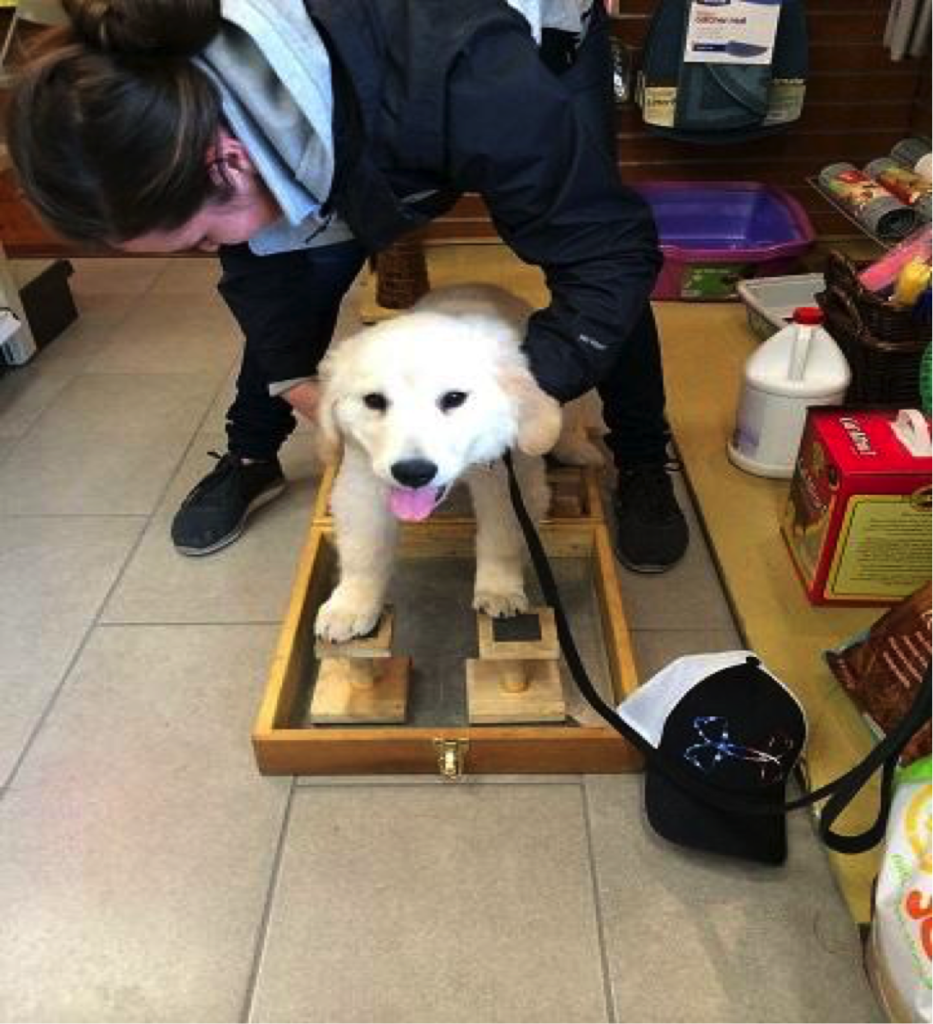 Belle beginning her “stacking” training, part of becoming a balance dog.
A good service dog has to like people and be undaunted in public, so we began by taking Belle out and around with us after the vet gave us the all-clear. She took the puppy class at the Old Town School for Dogs and passed with flying colors. When Belle’s trainer remarked on her intelligence, good manners, and confidence, I was just as proud as when my actual children won awards at school (of course MY dog would be the Hermione of dogs!). Belle’s trainer stressed that we needed to let Belle learn to use her own good judgment in a variety of situations.
Now we take her everywhere so she will get used to noise, crowds, and city streets. She loved meeting the kids at nearby Mount Vernon, and has thus far shown no fear of cannons, thunderstorms, boat rides, livestock, cats, or other dogs. Belle is already great at carrying things, picking up dropped keys, and fetching shoes, but when it comes to slippers she doesn’t like to give them back. (She’s only five months old though, so we will work on this.) This summer Belle will take more obedience classes, and after that we’ll get a more specialized trainer to build on her obedience training and help her learn to do more complicated tasks.
Before I was disabled, I never thought much about how difficult it is for disabled people to navigate the abled world. The ramps on sidewalks and automatic doors make life easier for everyone, not just people like me, but we could do so much more. There are still many places I can’t go; many older buildings have areas that have never been retrofitted for disabled access. I often worry about being in a high-rise in an emergency. How would I walk down flights of stairs without an elevator? The challenges will never go away entirely, but I do worry less now that I have my own service dog. I’m very happy that Belle is in my life, and I look forward to our partnership as we both learn together.
Training service dogs is expensive; it takes several years of specialized training after basic obedience classes. As this isn’t covered by Social Security disability benefits, most disabled people would find it difficult or impossible to buy and train a service dog. Dogs are also expensive, with vet care, proper food, and other costs. I am the rare disabled person who has a full-time job; the majority of disabled people would have trouble supporting the very dog that would make their lives easier.
Disability can be socially isolating. A dog can help people get out in the world, work, be independent, and pursue the lives they want to lead. Yet it seems as if the people who need a dog the most are the people who cannot afford one — I’ve seen several GoFundMe sites requesting help in obtaining a service dog. It’s incredibly inefficient that we leave this important work to a patchwork of charities, and force disabled people without the means to bear the costs of finding and keeping a service dog. I’ll be writing my senators and representative about this issue, and Belle and I hope we can inspire others to do the same.

Additional Reading:
Service Dogs and the Americans with Disabilities Act
International Guide Dog Federation: A History of Guide Dogs

Further proof that Dogs with Jobs is the absolute best show on Netflix. Congrats on your puppy, she’s gorgeous and seems like a great partner for you!!
Congratulations and best wishes to all of you! What an amazing process. Thank you for sharing your story with us. I wish you all the best in your efforts to help more people get service dogs.
BELLE.
So many perfect dogs in the world!
Aw, Kathi, this is so lovely. I’ve been enjoying Belle’s journey via Instagram and Twitter for a while and knowing the backstory makes the photos all the sweeter.
Wonderful article! I didn’t even know it was an option to train your own service dog!
“You Don’t Get Extra Points For Suffering”- I feel like I should cross-stitch this onto a pillow.
I’m so glad I mentioned that. So many people don’t know what”s in the ADA
Toasties can follow Belle on Instagram under mshuntingcreek, and on twitter @kathiatte
She is a wonderful companion, and in addition to being a service dog she’ll be trained as a therapy dog as well
what additional training do dogs need to be therapy dogs as opposed to service dogs?
here is guide to nomenclature :https://petpartners.org/learn/terminology/?gclid=CjwKEAjwqJ67BRCzzJ7Hy-LYlFYSJABwp9PGGqYFVOxWI0LJrk_7n9QGar2x3SOz3UgYRXWN5lTZTxoCC4Pw_wcB
therapy dogs are trained to give loving and calming support to sick and distressed people. They are trained to be calm, friendly and gentle. Belle is already good at these things
What an eminently snorgable little fluffwump. On a more serious note, I am very glad you have her in your life, and share your hope that it will become easier for other disabled persons to benefit from service dogs.
“My eminently rational husband pointed out there was no prescribed severity of handicappedness to get a service dog.”
More people need to point this out, my boyfriend’s Fox-news-grouch dad saw a thing (I’m guessing e-mail forward) about how REAL service dogs wear a specific kind of vest and anyone whose dog doesn’t have the special vest is FAKING IT (why you would want to, I don’t know?). Anyway he delights in pointing out fakers and I have not been able to convince him that this is absolute bullshit.
It’s also pretty easy to get one of those vests, so technically ANY DOG COULD BE A FAKER but probably 99% of them are not so come on, grouch man.
Belle does not have a vest yet. Vests are not required under the law. I’ll get one for her after she completes her obedience classes this summer.
Why on earth would people worry about “fake” service dogs? This is a nonexistent problem,like voter fraud
I think the concern is that people will get a “fake” vest so they can take their poorly-trained not-a-service-dog into places that ban pets, and then people will have to deal with poorly-trained non-service dogs in places they shouldn’t be like, say, the grocery store.
I googled “fake service dog” to see if that would tell me anything about how common a problem this actually is, but the search results seem to just be articles about all the reasons why fake service dogs are a terrible idea, plus an ad headed “Take Your Dog Anywhere – How To Make Your Dog A Service Dog”. :/
Conclusion: probably more common than voter fraud, hopefully not common enough to actually be worth worrying about.
More common than voter fraud is like saying more common than getting hit by lighting while square dancing!
A facebook friend was contemplating getting some sort of vest for her dog, and (thankfully) the overwhelming response was NO NO NO, leave that to people who need them, not because you just want to take your dog shopping with you. And also karma will get you back on that one.
It’s a non-existent problem that unfortunately is manifesting in legislation. The new legislation in my jurisdiction provides for a $2000 fine for a “fake” – ie an non-certified service dog “masquerading” as a certified dog. But certification is difficult and expensive and takes time, especially for non-vision related disabilities. And while human rights legislation does protect people using non-certified dogs, it is unclear to what extent.
It’s so frustrating.
I wouldn’t say non-existant. I’ve definitely dealt with poorly trained dogs that growl at diners in restaurants or jump on people. As with any dog, the problem is usually with the owner. It does seem like the legislation would be more efficient if it focused on the owner rather than the animal. I.e. you have a medical issue, therefore you can have a service animal. Is that not how ADA already works? Any accommodation you need should be available? I don’t know your jurisdiction, but if you’re in the US, ADA should be the overruling document.
I’m not in the US – I’m in BC, Canada.
Dogs themselves are not certified under the legislation, actually – that was imprecise. Dog-handler teams are certified. The owner has to have a disability, and the dog has to provide services to assist the person with a disability. The dog is also tested for “public readiness”.
The certification test, however, tests for behaviours that many dogs do not need – it’s still very vision-disability specific. Some behaviours tested for are actually counter-productive. If your dog provides anxiety interruption, the dog has to be able to interrupt you.
Jumping and growling is not acceptable, and as service dogs become more ubiquitous, I suppose there do have to be ways to regulate. However, it seems to me better resources available for training dogs would be a more efficient use of resources.
My grandpa is actually the one with the fake vest pretending his rottweiler is a service dog so he can take her places that would otherwise not allow the “bully breeds.” Specifically motels, I suspect–they’re on the road a lot. He’s stickin it to the maaaan!
But yeah, he probably got the idea from that forward, like a good Fox news grouch.
Much like the underestimation of golden retrievers, this piece is so full of adorable that at first some might not see how important it is.
This is a wonderful article and very timely for me. My mother has MS and we recently had a rather terrifying scare where she lost balance and fell on some concrete. She got a nasty head wound and some stitches, but no concussion or other more serious injury. I was there when it happened so she got help immediately. If she’d been alone? She could have lain on the ground for hours bleeding. When I texted my brother what happened his response (after learning that she was indeed alright) was ‘so it was just one of mom’s yearly nearly serious injuries?’ It’s getting to a point where I just want to wrap her in blankets and pillows and never let her out of my/my family’s eyesight. Which I cannot do obviously.
My mom also has a lot of self-confidence issues and losing the use of her body has exacerbated them where she’s reluctant to use her walker (when she really should) and was very VERY upset at the suggestion that she should get something like an emergency button to push and automatically call 911 in such situations. She likes dogs though so I will be passing this article on to her.
I’m so glad you were there to help your mom!I feel better about being alone now that I have Belle because she’s going to be trained to get help if I fall
On that note, you mentioned in the article that you used some of your research to devise a training schedule. Any books/websites you found particularly helpful?
We are working with a trainer who specializes in service dog training. There are links in the Neurology Now piece cited above, and we consulted these books as well: https://www.amazon.com/gp/product/0965621669/ref=… and https://www.rover.com/blog/become-service-dog/
Thank you!!
This was so good and so thoughtful. I am now doubly sad about losing The Toast because I want more updates!
I worked a few years back for a nonprofit dedicated to spreading technology accessibility, so I often fall into the trap of not thinking that physical accessibility is still a primary issue. Thanks so much for this.
You can follow Belle and me on twitter at @kathilatte and on instagram at mshuntingcreek
Oh I done did that 🙂
“When Hunter has a seizure, Specht says Angel barks to alert nearby adults before cuddling with “her boy” to comfort him.”
[bursts into tears]
What a wonderful piece and Belle Starr is such a good dog. Given the lack of training books for and by people with disabilities, would you ever consider writing one of your own?
I’m keeping detailed notes and I’d like to do just that.
Wonderful! I was going to ask/suggest the same thing.
I think we need to have a Toastie meet-up with Belle. To help socialize her.
I VOLUNTEER AS TRIBUTE
This is a good puppy, and I am so happy that you are able to have a good puppy who will help you in your life 😀
I don’t mean to be intrusive here, but can I ask what does your disability entail?
But anyways what a wonderful, lovely, good and faithful dog you have. You will have a great friend and a great helper for years to come. I wish both of you well in all your endeavors.
Heya– so, your curiosity is certainly natural, but as a person with a disability that is rare and hard to explain, I recommend that in general, if a person you don’t know well is vague about their disability, you don’t ask this question. They very likely don’t want to get into it and it’s a great relief to not have to explain it to everyone you talk to. What we need to know is already in the article: she has trouble with balance and picking things up, and her disability will progress, AND she has the most adorable helper dog in the universe. (I certainly agree with your last paragraph.)
I knew I shouldn’t have asked this question and I profusely apologize it. I guess I’ll need to refresh myself on disability etiquette, this was gauche in the extreme. I am terribly sorry, Kathleen.
I have definitely asked ruder questions in my life, do not despair
This is a beautiful story – I am so happy that you have your Belle.
Have you thought about writing a book or blog about your experiences training and certifying her?
I might -I’m keeping detailed notes
I gotta tell my cats that they’re in training as MS cats. They’ll blink at me superciliously but I think this is an important next step for Disability Animals. Right??
My cats are very helpful, but they are more in the “comfort animal” category.
One of my college students had migraines that were almost completely debilitating. She was able to go to school because she had a service dog that would bark 15 minutes before her next headache would start. This would give her the time to take her medicine. It was INCREDIBLE. It happened one time in class. One bark, that was it. Gave her just enough time. Service dogs rock.
What an amazing dog! Everyone who needs one should be able to have one
They can smell serotonin, apparently??? Amazing.
Please give your puppy an extra chin rub from me!
(Also, if I were you, I would be singing this at every opportunity: https://www.youtube.com/watch?v=4sSR7uFP8xs)
Oh, what a good puppy! May you have many years enjoying each other’s company. I know she will do her job proudly.
A facebook friend was contemplating getting some sort of vest for her dog, and (thankfully) the overwhelming response was NO NO NO, leave that to people who need them, not because you just want to take your dog shopping with you. And also karma will get you back on that one.
Unfortunately I have a fairly rich relative that has a registered service dog that is a "fake." The pup is cute and well behaved, and my uncle didn't want to pay more money for her to fly with them. This is the same uncle that routinely forgets that I don't want to hear about The Fair Tax or the problems of the very well off.
Wonderful! I was going to ask/suggest the same thing.