
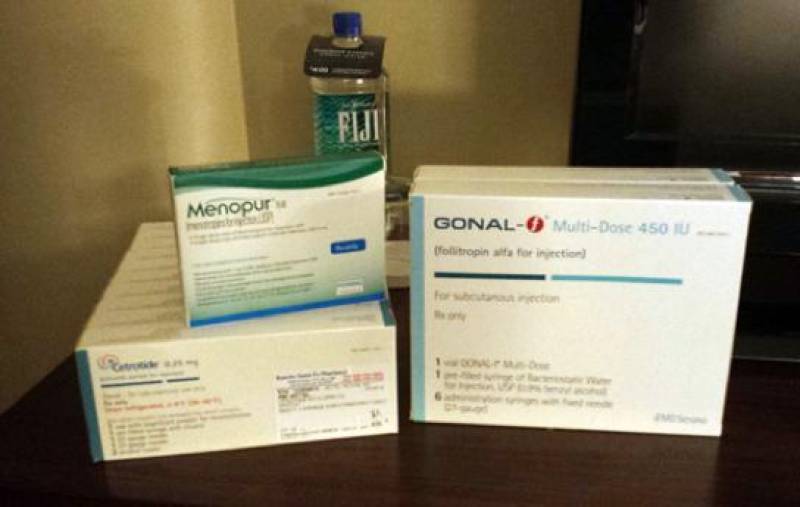
 a cocktail of medications and syringes
My desire to donate my eggs came from my desire not to use them for myself. I didn’t want kids. Asians don’t donate as often as other women, but there are Asian couples out there who want children and can’t have them. I was a healthy, young, college-educated woman in my early 20s. Why not get compensated for helping someone else start a family?
But the application process was a process. The application itself had eugenic qualities, I noticed as I filled it out. I was supposed to note my skin color as “fair,” “medium,” “olive/light brown,” “dark brown,” “ebony,” “freckled” or “rosy.” I was asked if I would be comfortable taking an IQ test, what my philosophy on life was, what my goals were and if I had achieved them. I was asked what talents ran in my family, and whether I was ever in any gifted and talented programs. I answered each question to the best of my ability, and sent in flattering pictures of myself as well as a copy of my college transcript.
The next step was to wait for a match. In the meantime, I connected with We Are Egg Donors, a donor advocacy resource forum where several hundred women shared their experiences and collective knowledge. There were many women like me, who were starting this process for the first time. There were women who had chosen to donate up to eight times. There were women concerned about Ovarian Hyperstimulation Syndrome (OHSS), one possible and serious result of taking fertility medications, with an increased risk as the dosages increase. Of those who had experienced health issues, they couldn’t say for certain if their problems were related to the repeated use of fertility medications. Why? Because there isn’t adequate research.

There were women who had scheduled back-to-back donations, only having recently recovered from a previous cycle. There were women who had decided to stop after their third or fourth donation, but found themselves feeling guilty when they were matched again, worried about letting down another couple that the agency said “needed” them.
One of the most disturbing things I noticed was that doctors would tell some women their ovaries were “overachievers,” using the word jokingly after retrieving more eggs than the recommended 12-15. The use of this language was suspect, first because it was so widely used among many different clinic doctors, and second because it put such a positive spin on having fertility drugs forcibly stimulate a woman’s ovaries to produce more eggs than they should. Ovaries aren’t designed to “overachieve.” The “overachieving” was artificial. The doctors did not note: “You produced more eggs than typical, so if you decide to donate next time, we’ll lower your dosage so you won’t be at risk for OHSS.” Instead, donors were congratulated for their hard work. Some, to their dismay, experienced similar or increased dosages in their next cycle.
In egg donor databases, you will see head shots of young women with carefully groomed hair, bright smiles, and white teeth. Alongside each potential donor is her age, location, height, and any other notable information. Prospective parents may feel like they are browsing a dating website.
 Ads target college-aged women who may have just graduated with loans to pay back. Officially, donors don’t get paid for their eggs (that would be illegal, silly!). So they get compensated for their time, and their pain and suffering. This doesn’t explain the disparity between those whose eggs are more desired (Asian women, Jewish women, redheads, Ivy League alums, gorgeous people, etc., etc.), and whose are “run of the mill.”
Clinics and agencies often use feel-good and altruistic language. As a donor, even if you are not feeling wholly altruistic, you will act accordingly, knowing what’s expected of you. I found myself answering each application question with the kind of thoughtful and upbeat attitude found only in the most successful of job interviews. In my meeting with the psychologist (part of the process is a psychological evaluation and genetic screening), I dressed business casual to impress, but after I signed the contract I wore my snapback, t-shirts, and sports bras. When asked about whether I wanted to disclose my sexuality, I declined, for fear of not being chosen. As a potential donor, I had an acute sense of when the stakes were higher or lower.
If you apply to be an egg donor, you will be asked quite often why you want to donate. Sperm banks often emphasize compensation when reaching out to donors. While egg donors are also presented with tempting compensation, most will also encounter discussions in which they have to prove that they are not entirely in it to get paid.
Sometimes the desire to help may come into conflict with the desire to self-advocate. You don’t want to feel like a difficult donor. When I stuck to my guns about my compensation, my agency said, “We’re not in the business of trying to just take money from parents.” It was a subtle accusation, but I couldn’t shake the idea that that’s exactly the business they were in. My agency would be making a lot of money off my body from a couple that could afford to pay the fee.
I asked a lot of questions throughout the process. What was my follicle count; how high were my estradiol levels; would I be taking cabergoline to mitigate OHSS symptoms? I compared notes with other donors, relieved to find that my own numbers were conservative. In the end, I wasn’t so afraid of the drugs. I was more afraid of being lied to.
 a cocktail of medications and syringes
This is how I gave myself shots. I went into the clinic and a woman explained to me in a sing-song voice (so as to show how fun it is) how to mix your drugs in the tiny provided bottle, and how to measure 225 IUs into a syringe, and how to get all the air bubbles out. Needles didn’t make me particularly anxious, but I’d never poked myself before, and yeah, I was nervous. At home the next evening, I read the instructions over and over and then mimicked the demonstration. I pinched the fat in my lower abdomen, just underneath and a few inches left or right of the belly button, and poked. It really didn’t feel like much.
My breasts got bigger, which is par for the course when on hormones. It always happened when I was on birth control, and it’s the last thing I maybe still dislike about my body, and of which male affirmations only make me feel more despairing. Leading up to the days of retrieval, I felt bloated and uncomfortable, and could walk at about the same pace as my grandmother. The injection sites got bruised. Damn, I was sick of it.
Though nervous, I was relieved when my retrieval date finally arrived. The doctor told me the anesthesia would work in ten seconds, and I didn’t even get a chance to start counting. In the end, the clinic retrieved 12 eggs. The next day, another donor shared that her clinic had retrieved a drastic 52 eggs from her — three and a half times the recommended amount. Floods of support and tips rushed in for her, and I found myself thinking of her during my own recovery.
 Picture taken from one of the author’s ultrasounds shows her right ovary and the follicles growing on it, looking like a wasp’s nest
Every egg donor is different, has different motivations, and is willing to take different calculated risks. Several of the donors at We Are Egg Donors made connections with the intended parents, and personally saw an experienced the difference they made. Others felt cast off and unsupported.
I never met the intended parents who got my eggs. I’m happy if they’re happy, but I didn’t feel like a “hero” the way many agencies or clinics will often tell donors they will. I felt like I was giving away something I didn’t particularly need, and receiving something in return. I learned to exercise self-advocacy. But still, I participated in a transaction I was critical of the whole time. I signed the contract, and stayed the course, out of some abstract feeling of commitment and obligation, like people clinging to a marriage they don’t believe in.
Would I donate my eggs again? Doubtful. I saw what happens when an industry is almost entirely unregulated. You can do your research, take precautions, self-advocate, and even come out with an optimal experience, as I did. But to me the process will always feel exploitative, too.
At this age, my body feels resilient, but the money doesn’t seem worth the possible and expensive health complications faced by many repeat donors, whose collective knowledge highlights some shady business practices, manipulation, and a lack of transparency. The promise of being well compensated to help others achieve their dreams is sweet, but not even the fine print can give you the full picture.

Thank you for sharing this story. I donated as a known donor for one couple last year, so my experience was very different in some ways, but I definitely recognized that feeling of wanting to measure up, like a job applicant. And I think your observations of how egg donation is treated differently from sperm donation are right on the money. Again, I have to field those questions a little differently because I am friends with the parents and will continue to be involved in their life and their daughter’s life, but there’s definitely a cultural connotation of you’re giving away your future children with eggs that I’m pretty sure men don’t hear as much.
Donating was a strange experience in that it really throws light on some of the weird undercurrents of how we medicalize and place value on women’s bodies, to be sure. But I had a pretty easy time of it physically and feel that I would do it again anonymously and for money in a heartbeat if I could. But perhaps that’s easy for me to say because it’s not an option–I’m several years too old by most clinic standards.
It’s funny because I thought I was very resolute in my decision (and I think overall I still am), however, after losing my job in November, I did have a bit of a crisis, since I’m a graduate student, and it flitted in my mind to donate again over Winter Break. Eventually, I thought it best not to commit to such a big decision during a moment of panic, and I’m really glad that I didn’t choose to donate again.
Thank you for writing this! I’ve been considering egg donation for a while, since I might be going back to school at some point and the supplemental income would be nice, but I know basically nothing about what is involved. This didn’t really put me at ease– I had no idea about the fertility drugs. I thought they just… took the eggs that were already there.
The “eugenics” quality does make me even more uneasy, though. In my college’s daily paper, there would regularly be ads looking for a blonde-haired, blue-eyed Ivy Leaguer to donate. I suppose I understand wanting a child to look like your child, but is that really the main criteria you put in your ad? Not… no family history of heart disease, liver failure, dementia?
Definitely with you on the weird eugenics thing. It’s sobering to realize that I could be a desirable commodity as a relatively able-bodied pale woman with a PhD…but then once we start getting to the fat asthmatic Hispanic clinically depressed thing, and the family history of heart disease and dementia and diabetes, my market value plummets. Ew.
I actually used my compensation to pay for grad school. The money is definitely really tempting. I don’t place a value judgment on the decision to donate or not to donate, but I do think the carrot at the end of that stick is a particularly juicy one, and the process itself is opaque for a reason. If you’re thinking about it, my advice is to connect with We Are Egg Donors. I credit them so much to helping me make an informed decision.
This was so interesting & readable. I’ve never heard about the process before.
It sounds like something I could have done once before stopping, as well, though when I was young enough I’d have been pretty darn squeamish about the needles. (Who am I kidding? I’m squeamish now.)
The community of knowledge exchange and support for donors seems like a vital and underserved resource.
They are AMAZING. I don’t think I would have done it without them, and then I think I would have backed out. When you’re going at it alone, you really don’t have a frame of reference for what’s “okay” or “typical.”
I always found the education aspect very, very strange of donor processes (both sperm and eggs). I thought it was widely acknowledged that a family’s income, geographic location, and whether the parents went to college are better predictors for a child’s educational opportunities than something genetically hereditary. To me, looking at such factors seems to misunderstand the process.
The application literally assumes that everything is genetic (because that’s all the parents have to go on). It’s really goofy.
One aspect of egg donation that also sort of blows my mind is that, if it works, it means there might be a child with my genetics walking around in the world. A friend who donated checked the box for clinic to notify her if her eggs eventually produce a child, but she could have just as easily checked the box to never know and never let the kid know. It’s such a personal and complex decision; I wonder how most donors come down. Did you read any forums that talked about it?
My clinic said they couldn’t tell me about success or lack thereof.
I did have to check a “future contact” option. Basically a box that said if the laws change (because as it stands, it’s not an option on any end), would I (a) try to find the person who resulted from my egg and contact them, (b) not try to contact them but be willing to receive contact from them if they so desire, or (c) neither. I chose (b) both times I did it.
I donated eggs seven times. The federally-mandated maximum is actually six, but the last time was for a medical research study, so it didn’t count. And yes, I did it because of student loans, and because I knew that as a healthy young white Ivy-educated woman, my genes would probably be popular, and because I was never going to use my eggs and figured someone else might want them.
My experience was pretty different from yours – I didn’t connect with any other donors (in fact I’ve never talked to anyone else who’s donated), I was never told how many eggs were retrieved, the application process was very straightforward and businesslike, and I did disclose my sexuality. I don’t know what information prospective parents received about me or how I was chosen. I donated through a clinic affiliated with my university, not through an agency. The most interesting thing to me was how the technology changed across the three-ish years between my first and last donations – I went from having to give myself shots every day for weeks to just getting shots every other day for a couple weeks in the clinic. The process also became less unpleasant physically. I must have been a pretty successful candidate to have been chosen so many times, but I don’t remember any comments about it from the medical staff, other than some jokes about how often I was there after they started recognizing me.
I’m interested to read other experiences – like I said, I really have nothing to compare mine to!
Several women in the We Are Egg Donors group donated more than 6 times. That is the federally mandated maximum, but because it’s not regulated, it’s easy to get around. The maximum payment is about $10K, but I asked for more, and that was easy to get around with the right agency and specific wording in the contract. So there were several ways the unregulated process worked for me, but it made me question the processes on the other side. Just something to think about.
I guess it’s probably naive of me, but I was much more comfortable working with this particular fertility clinic because of its affiliation with a large women’s health center at a respected university. I don’t think I would have donated through a for-profit agency. Maybe it’s not any different, but it felt like it to me. Also, there was no possibility of negotiating my compensation – it was a flat rate for every donor. I absolutely think more regulation would be very helpful to both donors and recipients, but I’m still pretty comfortable with my decision.
I’m poking around the We Are Egg Donors site now and it’s fascinating – thank you for the link!
I don’t know if it’s naive to choose a clinic associated with a university, but I actually donated through a respected clinic, and the agency simply represented me. The agency was what allowed me to advocate for myself, it provided me a lawyer to represent me when I signed the contract. The agency ALSO was out to get paid, and that’s something I didn’t forget either. I think it’s def up to the donor on how they want to go about it because not all clinics and not all agencies are created equal.
I’m definitely interested in finding a clinic where I can go in for shot injections, rather than by myself daily. What was you situation? How did you choose a clinic?
I have considered donating eggs because I don’t know whether I ever want to have kids, but I find the idea of having a kid out there with my DNA weirdly comforting. But ack, the idea of injecting myself over and over again is scary. but not quite as scary as the idea that the people overseeing my medical care wouldn’t have my best interests at heart. I am very timid in some ways, and I know I would have a lot of trouble saying “no” to someone in a white lab coat telling me to do something I think isn’t healthy for me.
If only I had testicles!
I’m going to try not to absolutely spam this thread with personal anecdotes, but I can address some of your concerns! Needle-wise, I had a similar experience to Ari: I was very, very nervous the first time, but after that it was NBD. All of my shots but one were subcutaneous, which means you don’t have to aim for a vein or anything, and it typically didn’t hurt although I got some temporary bruise-like coloring on my belly. The final shot is intramuscular and in the hip/butt area; I had a similar shot for an antibiotic long ago before Zpacs. These sometimes hurt but mine did not.
As far as care, I saw very little of doctors during my process, but I had one nurse who was responsible giving me instructions throughout. She was great, very kind and informative. The doctors only came in to do my ultrasounds, and it was actually a different doctor almost every time because I was coming in far more frequently than any of them had rounds, but they all took care to introduce themselves, talk to me, ask me how I was feeling, etc. The one male doctor I had asked if it was okay for him to do my ultrasound, which was nice.
Now, obviously that is an experience that will vary wildly from place to place. I mention it because in my city there are multiple clinics that do IVF, and the expecting parents and I were choosy about which one we went to; we made calls, asked our doctors for recommendations, spoke with clinic staff. If you’re thinking about donating you can certainly make inquiries into donor care and experience.
I'm going to try not to absolutely spam this thread with personal anecdotes, but I can address some of your concerns! Needle-wise, I had a similar experience to Ari: I was very, very nervous the first time, but after that it was NBD. All of my shots but one were subcutaneous, which means you don't have to aim for a vein or anything, and it typically didn't hurt although I got some temporary bruise-like coloring on my belly. The final shot is intramuscular and in the hip/butt area; I had a similar shot for an antibiotic long ago before Zpacs. These sometimes hurt but mine did not.
As far as care, I saw very little of doctors during my process, but I had one nurse who was responsible giving me instructions throughout. She was great, very kind and informative. The doctors only came in to do my ultrasounds, and it was actually a different doctor almost every time because I was coming in far more frequently than any of them had rounds, but they all took care to introduce themselves, talk to me, ask me how I was feeling, etc. The one male doctor I had asked if it was okay for him to do my ultrasound, which was nice.
Now, obviously that is an experience that will vary wildly from place to place. I mention it because in my city there are multiple clinics that do IVF, and the expecting parents and I were choosy about which one we went to; we made calls, asked our doctors for recommendations, spoke with clinic staff. If you're thinking about donating you can certainly make inquiries into donor care and experience.
I don't know if it's naive to choose a clinic associated with a university, but I actually donated through a respected clinic, and the agency simply represented me. The agency was what allowed me to advocate for myself, it provided me a lawyer to represent me when I signed the contract. The agency ALSO was out to get paid, and that's something I didn't forget either. I think it's def up to the donor on how they want to go about it because not all clinics and not all agencies are created equal.
I considered donating my eggs when I was in college, in the late 1980s. I’ve never had children and never intended to. On the whole, I think it’s better for my body that I didn’t. I shudder to think what the techniques would have been like twenty-five, thirty years ago.
True, but on the other hand they make literally several thousand less for the pleasure.
I did it 15 years ago and didn’t have a single problem, nor was there anything about the process that made me uncomfortable. They seriously look at photos now? The clinic where I did it (twice) was double-blind, I had no idea who the recipients were and they only knew my “stats” on paper, certainly not my face. Yikes!
I considered donating eggs as a younger, less financially secure person with student loans, but after a brief investigation I was way too skeeved out by the borderline eugenics aspect of it. That being said, I’m still paying off those fucking loans a decade later so… six of one, you know?
Sigh…..thousands you say? Sperm donors get $35-50 dollars. As the author states, she asked for, and got more than $10,000 for her donation. So yes, men have it simple, but get compensated based on that.
Imagine going through what the author states about the paper work for $35. Why bother?
Soooooooo http://robincook.com/book-display.php?isbn13=9780…