
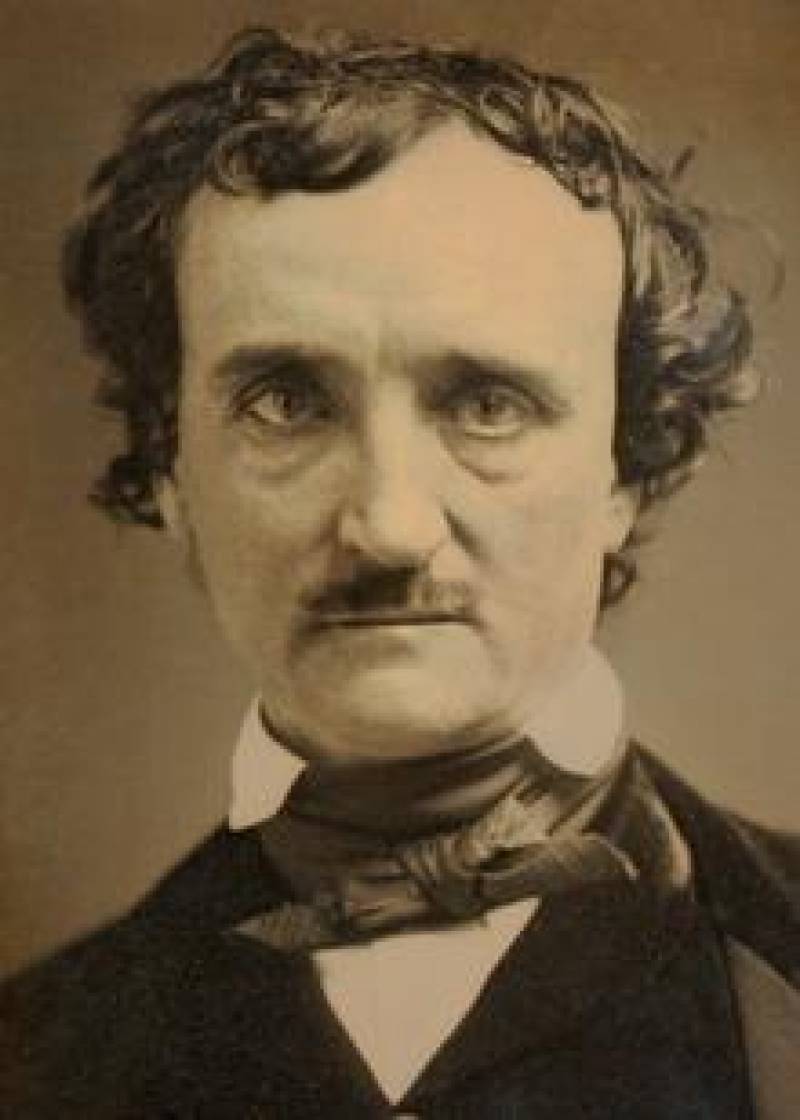
 Edgar Allan Poe was born in Boston, but he perpetually and publicly air-wanked over the city, denouncing it and its literati. As thanks, Boston has so far only commemorated his birth by placing a small plaque on the side of a Boloco, the regional burrito chain whose downtown franchise sits two blocks north of Poe’s now-demolished childhood home. Boloco’s guacamole is very good; there are—I’m pretty sure—no dismembered bodies buried under the floorboards. The staff is currently not required to speak in trochaic octameter, but I may soon start a Twitter campaign to convince them otherwise. #TrochaicTaco
I moved to Boston from New York, after a brief post-collegiate stint in the house where I grew up. There are plenty of differences between Boston and New York City—obvious ones, like seeing little red socks everywhere instead of a million interlocking NYs, and less obvious ones, like Judaism’s presence in a town whose culinary tradition is so heavily centered on shellfish versus one so bagel-centric. But the most surprising difference I found was the contrast between New York and Boston’s love for its past and present inhabitants.
Boston loves its residents. Bostonians brag about other Bostonians in a way I’ve never heard New Yorkers brag about other New Yorkers. And maybe the pride is a size thing, being smaller than New York; the chances of prominent cultural figures coming from here are slimmer, sure (though the city did educate eight American presidents and 20 Supreme Court Justices), and Boston, as a result, has this contagious feeling of can you believe the kid made it out there? People don’t go to Boston to make it big: they leave it. Or maybe Boston, whose arts scene is generally overlooked on the national scale, is desperate to make sure other Americans know we’re just as capable of contributing (you’re welcome for New Kids on the Block.) Whatever it is, I can’t recall anyone ever sidling up to me in Manhattan and saying “You know Laura Linney’s from here, right?”
In Boston, though, we make sure people know who’s one of us (I consider myself a Bostonian now, in love with the city in ways I didn’t think I ever would be, although I did wear a Yankees hat while canoeing down the river Charles last week): who grew up riding our Green Line trains (Conan O’Brien) and who drunkenly wandered around Allston (Aerosmith). We’re proud of our brothers Wahlberg and Affleck, proud of Matt Damon, proud of the Carrell-Krasinski-Novak-Kaling Office quartet, and proud of writers like Louisa May Alcott (who wasn’t even born here!) and Henry Wadsworth Longfellow (whose hometown is now technically in Maine). We’re not, however, proud of Edgar Allan Poe, and lay as little claim to him as we can.
 Poe, of course, is nearly synonymous with Baltimore in the American literary schema, and frequently criticized his New England brethren, once declaring “Their hotels are bad. Their pumpkin pies are delicious. Their poetry is not so good.” He wrote anonymous (yet poorly-veiled) plagiarism accusations aimed at the beloved Longfellow, and saw Bostonians and Cantabrigians as pretentious and empty. After an 1845 poem recitation in Boston, Poe took to The Broadway Journal to air his grievances with his audience, writing:
Still, with their vile ingratitude staring us in the eyes, it could scarcely be supposed that we would put ourselves to the trouble of composing for the Bostonians anything in the shape of an original poem. We did not. We had a poem (of about 500 lines) lying by us…that we considered would answer sufficiently well for an audience of Transcendentalists. That we gave them — it was the best that we had — for the price — and it did answer remarkably well…We do not, ourselves, think the poem a remarkably good one: — it is not sufficiently transcendental. Still it did well enough for the Boston audience — who evinced characteristic discrimination in understanding, and especially applauding, all those knotty passages which we ourselves have not yet been able to understand.
Poe left Massachusetts in the early 1800s and died in 1849, but his contempt for Boston was not forgotten. Historians map his birthplace at what was then known as 62 Carver Street, an address located in the modern Theater District. In the late 1950s, the home—a three story brick house—was knocked down, and at some point Carver Street became Charles Street South and number 62 became a vacant lot which now stores what appears to be large-scale industrial machinery, for what I think is a nearby power plant. Across the street and down an alley is Jacque’s Cabaret, a bar where my friend regularly performs as a drag queen named Katya.
The Boloco that is now Poe’s Boston home is at the intersection of Charles Street South and Boylston Street, two and a half blocks away from the house where he was born. Boloco isn’t spooky in the Poe sense of the word, but spooky in the ways that most fast-food places are, in how it presents food without acknowledging where it comes from, and in the fact that its customers pay as much for it as the person who prepared it probably makes in an hour. Boloco sits half a block uphill from Hermes and the Four Seasons Hotel, faces the large homeless community in the Boston Common, and shares sidewalk space with Emerson College. The Blue Man Group performs two blocks south.
I’ve never seen any Poe-ian murderers or ravens in Boloco, but once when I was there I saw a be-UGGed drunk girl puke into a cup.
Edgar Allan Poe isn’t, perhaps, so different from that drunk girl, more likely than not a college student whose time here is only temporary. Each year, come August, Boston and Cambridge play host to a combined 250,000 higher-ed students; there are hordes of bright minds and casual fuck-ups who flock to the city on the hill for its renowned public and private universities and spend their college years taking a proverbial dump on it, posting links to The Onion’s “Pretty Cute Watching Boston Residents Play Daily Game Of ‘Big City’” on Facebook and complaining to their friends back home about it’s early-closing Ts and the state’s somewhat puritanical drinking laws. Many of them take off after graduation, back home to New York or LA or Teaching for America in other parts of the country, and never return.
But these students, however fleeting their time here, are shaped by Boston—even if opposingly—because how could you not be shaped by a place where you spent four of your youngest years? Poe was shaped by Boston, too, regardless of his brief life here (he returned to the area as a young man in the Army, stationed at Fort Independence); New England breeds a certain kind of writer, writers like Poe and Stephen King and HP Lovecraft, the kind who grow up next door to cemeteries with 300 year old corpses, who go on field trips to a town best known for the hangings of accused witches, and whose imaginations flourish in dark, sad winters and dense forests. (There’s a reason Jason Brown titled his short story collection Why The Devil Chose New England for His Work.)
Poe is more of a Bostonian than he liked to think, not in spite of but because of his criticism of the place, because of his keen awareness of the oft-commented upon socio-economic differences that still plague Boston today. His primary complaint was that the city was home to transcendentalist writers and academics (Frogpondians, he named them, in reference to Boston’s famous landmark) who preached morals that he felt contrasted with their exclusive social status. Paul Lewis, an English professor and Poe expert, wrote about this criticism in a 2011 Boston Globe, explaining that “he called our writers ‘Frogpondians,’ perhaps because he regarded them as so many croakers who used literature not to delight and move readers, but to argue and preach — as well as to enrich one another. In his 1845 essay ‘American Poetry,’ Poe railed against ‘the machinations of coteries in Boston’ that had been conspiring with ‘leading booksellers’ and publishers to provide newspaper editors with positive reviews of local writers.”
Modern Boston isn’t terribly dissimilar to the one Poe so loathed. This year, it has the fourth largest income gap of U.S. cities between the rich and poor, a gap made even wider when you consider the stake that Boston has in education and research. Consider the looming shadow and far reach of financial giants like Harvard, MIT and BU, and you’ll realize that to be in in Boston is not just to have money but to also be in some way affiliated with one of its schools. Economic disparity—in particular, his own lifelong poverty—infuriated Poe two centuries ago, and he frequently lobbed literary and personal criticism at Frogpondians like Longfellow, James Lowell and Ralph Waldo Emerson, all far more financially successful and in possession of enviable academic credits.
Though he despised the Boston writing scene, Poe—with his locally published works, ongoing feuds and frequently printed criticisms and rebuttals—was, for better or worse, a member of Boston’s literary circle. His first poetry collection, the unsuccessful Tamarlane and Other Poems, was published there in 1827 and credited only to “A Bostonian.” “The Tell-Tale Heart” made its debut in a Boston magazine almost twenty years later.
Did he self-identify as a Bostonian for Tamarlane’s publication as an act of pride? Did the book’s failure prompt his life-long public shaming of Boston? Or did he anticipate the book’s failure, and credit it to a Bostonian so as not to be embarrassed back home in Baltimore? We might not ever know for sure, but his many return trips up north and his willingness to engage with town’s literati point to the possibility that Poe hated the idea of Boston—its reputation, its elitism—more so than the actual city itself.
Boston, on the contrary, likes the idea of Poe more than the actual guy; his work is, of course, still taught and respected here, but his home has been destroyed and even fawning retrospectives, like “The Raven in the Frog Pond” (an exhibit held five years ago at the Public Library), present his disdain as in good fun but still uncalled for, unprovoked, and sour.
Our grudge (I say our, because this is my home now, this wonderfully walkable city!) is beginning to fade, though—Boloco’s strip of sidewalk was dubbed (without much ceremony) Edgar Allan Poe Square on his 200th birthday, and in October of this year, a life size sculpture of the author will be placed there by the Edgar Allan Poe Foundation of Boston. Drunk college students—those young burrito-eaters— will soon be able to enjoy their Mexican food in the presence of a literary giant; perhaps, like Poe himself, they will eventually come back to Boston, will come back home.

I think Poe was a bit too louche for Boston to want to lay claim to him properly. Gangsters or mafiosos? No problem. Years of opiate use? Ehhhh, the East Village can have him.
I’m sorry, I think you mean THE BRONX!
Once I commented on Facebook about how in high school you were either an Affleck Girl or a Damon Girl (I went to girls’ school), and one of my classmates came back with “I don’t remember it that way. I think we all loved our Boston boys equally” so yes to all of that.
Full disclosure, Early Teen Samantha was an Affleck Girl but then I grew up and became a Damon Girl because I stopped being an idiot.
Dittoooo.
As someone who misses Boston but is more than happy to criticize it, and who loves Poe, this was a great read.
I think, ultimately, that Onion article is not far off. While it’s true we’re insulted that anyone doesn’t consider us a “real” city, at the same time, the place has a very small-town feel. That’s why we’re so proud to boast “John Krasinski went to my high school!” and “my mom works with Matty Damon’s mom” (the latter being a true thing Mr. B_Ham can say). It’s like any small town, really–there’s a mix of vicarious glee at the Boston sons and daughters who have gained celebrity and straight-up pride to live in a city that’s produced so much talent.
That’s what I think, anyway. If you don’t agree with me, you can go fuck y’self.
You wicked pissah!
[I could’ve stopped myself but I didn’t really want to. ^^;]
OMG. Mr. Ada did go to high school with John Krasinski. I think he played the trombone once for a musical that Krasinksi was in. Perhaps it was Oklahoma!?
I don’t know how it is I’m so unsure of the details–I’ve heard this story on more than one occasion.
I think it’s a mix of pride and taking the piss out of them sometimes, also in that small(ish) town way. I think there’s like a subset of Boston celebs where the response is, with affection, “Damn right, he’s from Boston. What an asshole.”
(I for one can’t hear talk of a Wahlberg without saying something like, “That Marky Mark, my friend so-and-so’s grandma in Dorchester says he was a real hooligan.” Apparently I’m 76-years-old.)
“New England breeds a certain kind of writer, writers like Poe and Stephen King and HP Lovecraft, the kind who grow up next door to cemeteries with 300 year old corpses, who go on field trips to a town best known for the hangings of accused witches, and whose imaginations flourish in dark, sad winters and dense forests.”
This is my literary first cup of hot, morning coffee on a dank, fall morning: so, so good.
Wonderful writing, enjoyed it immensely!
May I protest the claim about the mere commemorative plaque! Boston installed its very own Poe statue this month, after a little citizen nerd activism, and it is awesome: http://www.bostonglobe.com/metro/2014/10/05/everm…
You can blame me for any timeliness issues, as she wrote this months ago and our scheduling queue is like a Westeros Winter!
I’m with Poe: Longfellow is pretty terrible.
Also, the new Poe statue is weird:
Gonna have to go see this thing when I go back for Thanksgiving.
Same. I know that corner well (my parents live nearby) and I feel like that statue is probably very incongruous. This delights me.
I love that his facial expression is ” :-/ “
I love that the bags under his eyes (?) make him appear to be wearing either aviator sunglasses or WWI Flying Ace goggles.
Virginia loves Edgar! UVA brags that he was a student there. He was expelled for excessive drinking, which has to mean that it was REALLY excessive, knowing how much men drank in those olden days of no clean water and plentiful beer.
And how much they still drink, for that matter. I miss the “campus bookstore” (not affiliated with the university) which sold the “Dropout” t-shirts with Poe’s portrait on them.
This was great and definitely rings true to my sense of Boston as a fairly recent transplant (3 years!).
Also, because Poe and because it is indeed “deep in the lonesome October,” everybody should listen to Jeff Buckley reciting “Ulalume”: https://www.youtube.com/watch?v=G54Xqyx0Tbo
The weirdest part is that it seems to have been inspired by the intro to the 1995 Goosebumps anthology series.
Compare: R.L. Stine, swathed in a high-collared black coat, stalks up on an unsuspecting seaside town. His briefcase falls open, and papers spew out into the wind, followed by a dark, soaring apparition in the shape of a raven letter ‘G.’
That can’t be accidental!
Love Boston, love this article, but I especially love the Poe plaque. I only lived in Boston for a couple of years, but you’ve captured everything I loved about it so, so well! The Poe plaque was my favorite thing to show out-of-town visitors. I’m not even sure why I loved it so much!
I’ve lived in Providence and Boston both, now, and I think there’s a pretty direct analogy between the “feel’ of each city and the respective horror of Lovecraft and Poe. Not quite sure how to phrase it. While Boston has its shadowy corners and trappings of Gothic horror, Providence is just a… creepy goddamn city. There are exponentially more weird fungi in Providence. There’s all the plaster body parts. There’s a ubiquitous tagger who tags as “R’lyeh.”
God, I miss Providence. So I’m glad to see Boston embracing its weird son a little closer, lately.
Providence is so delightfully witchy this time of year.
This seems like a good place to note that I saw the most Masshole car ever yesterday. Sox vanity plates and a bumper sticker that read “GFY.”
Beautiful. I miss that shit.
Now I want to call someone a Frogpondian.
I’m not a native Bostonian (-ienne), but I’ve been here nearly a decade now and it’s my forever-home (married a legit Boston townie, bought a condo, Red Sox season tickets, etc). Totally spot-on characterization of the city. However, can we talk a minute about the students? Because I hate them so hard. SO HARD. They just come in and wreck shit up, and it makes me so mad- this is a COMMUNITY, jerkoffs, not your little playground to wreck! I may be a little sensitive to this topic, as I live within a mile of 9 different colleges, and am tired of finding trees broken (seriously, why would you do that to trees??) and half-empty Bud Light cans in my front yard.
My parents live near the Common, which means Suffolk and Emerson are both right there, and every September is a goddamn nightmare. Summer is all peaceful with so many of them gone, and then there’s the massive influx and the new crop of freshmen stumbling around being incompetent and getting in the way. I know they can’t help it, it’s what college freshmen do, but it still pisses me off. HOW CAN YOU NOT KNOW YOU’RE AT BOYLSTON, THERE ARE LIKE 600 SIGNS.
Yeah, I live right off the Common and you can always tell when the students are back in town for the fall because there’s vomit all over the sidewalk on Sunday morning.
Canada would NEVER DO THIS (intentionally.) #CanCon
I love all Toasties from Boston (really, you’re all great), but I really hate the hyper-parochial Bostonian hometown pride stuff. I feel like BOSTON PRIDE is almost always a very specific type of Boston. Namely, a white Boston. Like Frogpondians or Southie-dwellers, but never Roxbury, you know? Basically, the Red Sox suck, is what I’m trying to say.
With you 100% (except I don’t care about the Sox one way or another). Boston racism is intense and deeply rooted.
#notallbostonians, I know, but…
Yeah, Boston is super segregated and racist and I agree that the townie pride I mostly see projected is very white–I suspect having something to do with greater mobility among the white population. Like, I don’t actually see the same kind of townie pride coming from the lower-class whites who don’t leave, except for baseball. The phenomenon is excellently encapsulated by the narration of a profile of Chris Evans I read once (okay more than once), which emphasized his Bostonian-ness even though he’s from a Very Nice Suburb and insisted on referring to his apartment as being located in “an industrial wasteland” next to “the Combat Zone,” even though the neighborhood in question hasn’t been called the Combat Zone in decades and there is nothing industrial-wasteland-esque about its surroundings. THE BANKING DISTRICT IS RIGHT THERE, FOR CRYING OUT LOUD. There’s a way that Boston is mythologized by and about the people who are only peripherally of it–middle-class white people, often from the suburbs, who no longer live there.
I always feel sad and conflicted about this because I love Boston and I love being from the area, but…it is a troubled city, man. I’ve been watching Chinatown lose ground to gentrification for the last several years and it’s terrible–not just for ~cultural~ reasons but also because it means losing a bunch of low-income housing in the heart of the city.
I mean, to be fair, this has very little to do with Poe. It just gets my hackles up.
I met a black guy at work who was born, raised, and hopes to eventually settle down with his beautiful Cambodian-American wife and their wonderful son in Dorchester and all he could talk about was how much better Boston was than Baltimore. I loved/hated his pride in Boston at the expense of Baltimore, and was very perplexed at his insistence that Boston was better w/r/t to race than Baltimore, even though I don’t want to discount his experience. [For the record, I think they both blow and my husband feels like Boston is less friendly if you’re black.]
Maybe it’s because he’s 24 (to my 30)? I really don’t know. But he grew up being babysat by a Nepalese family and made his social circle in Dorchester sound like a magical collection of Nepalese, SE Asian, and black 20-somethings and all I could do when talking to him was just look confusedly with a “sure, dude.” Seriously, he actually wondered to me “I wonder why Boston has a reputation for being racist..”
My only experiences in Boston were from being a [grad] student in Cambridge/Somerville for two years (and my husband’s POV comes from visiting me), so what do I know? I just tried to chalk this all up to him being away from Boston for too long and missing home.
I never even bother to take those quizzes on Facebook about “In What City Should You Live?” because I *know*.
Sometimes I call another city “cosmopolitan.” It is not a compliment.
Oooh-oooh-oooh! When asked to contribute to the Mass Charitable Eye and Ear Infirmary, Isabella Stewart Gardner refused on the grounds that there was neither a charitable eye nor a charitable ear in Massachusetts, so such an institution would serve no need.
Oh god I love this so hard.
Classic Poe.
I CAN’T BELIEVE YOU WITH YOUR YANKEES CAP
HOW DID NOBODY TOSS IT INTO THE RIVER
THIS.
Seriously, this is a town with a baseball merchandise inventory that is clearly one-third “FUCK THE YANKEES,” how do you survive?
Frankly you can’t call yourself a Bostonian and do this kind of foolish behavior. Or as my grandma would say in her Mainer accent, “Just becauhse tha cat has huh kittens in the ohvan don’t make ’em biscuits.”
Jesus, this.
AND ALSO TAKE YOUR DAMN BACKPACKS OFF DURING RUSH HOUR.
I live in Boston, and have, as I get into my thirties, been becoming more and more of a grumpy middle-aged lady. The other day on the T I broke the “no talking” rule to say to your Standard Model Dudebro that there’d be more room for all of us if he took off his backpack and put it on the floor.
He was all “…no, I’m fine.”
And I said “You are hitting people in the face,” all enunciated because clearly you need every word pronounced since you’re Willfully Not Getting It, and then I was amazed that my mom had managed to throw her voice clear up to Quincy.
I live in Boston and you are my hero. Oblivious backpack-wearers on the T are the worst. Dudebros backpack is level with my face; I don’t think I can reiterate how much I feel this comment, down to the core of my being.
I like you.
I encounter a ton of giant backpacks en route to Northeastern on the E line, and it’s infuriating.
THIS.
Seriously, this is a town with a baseball merchandise inventory that is clearly one-third "FUCK THE YANKEES," how do you survive?
Oh god I love this so hard.
My only issue with this is the classification of Boloco as Mexican #notallburritos
Is this a good place to say that, while I respect that it boosted morale for some people and I don’t want to take away anything that people are using to get through a problem, I personally feel rather cringy about the whole “Boston Strong” thing? Partly because West, TX also suffered a devastating disaster the same week and didn’t get anything like the same amount of money and attention, partly because it’s a ripoff of the title of a Gwyneth Paltrow clinker that was a ripoff of an army slogan, partly because you couldn’t turn on the local news for about a year and a half without hearing it and it just seemed like such a platform for using victims of terrorism to sell soap.
I mean, I *am* from one of the little towns outside the city, so I could be speaking out of turn and please tell me if I am.
It’s absolutely not just you! Most of my friends and I live and work around where everything went down and we grit our teeth every time we hear it. It was fine for the first couple of weeks, but then sports teams started using it (dudes, you are a bunch of really rich guys getting paid to throw and hit balls) and then it started being used for advertising, and still is to this day.
And I am really proud of the way the city responded (except after Tsarnaev was found and a bunch of people, mostly college students, marched out onto the Common wrapped in American flags they just…had, I guess, and started chanting “USA! USA!” That was off-putting.), but honestly, people are people, and while New Englanders are a stubborn and contrary bunch with a certain, “Fuck that. I’ll show you!” attitude, I think people in any city or town would have reached out to those who needed help.
Is this a good place to say that, while I respect that it boosted morale for some people and I don't want to take away anything that people are using to get through a problem, I personally feel rather cringy about the whole "Boston Strong" thing? Partly because West, TX also suffered a devastating disaster the same week and didn't get anything like the same amount of money and attention, partly because it's a ripoff of the title of a Gwyneth Paltrow clinker that was a ripoff of an army slogan, partly because you couldn't turn on the local news for about a year and a half without hearing it and it just seemed like such a platform for using victims of terrorism to sell soap.
I mean, I *am* from one of the little towns outside the city, so I could be speaking out of turn and please tell me if I am.
This is a wonderful article and rings a bit true to me, although I’m not yet a Bostonian, only living here since July for library science grad school. It’s interesting to me, after spending four years of undergrad in Philadelphia, and moving (almost directly) to Boston, I’m following some sort of reverse path of a few famous Boston-born people who are more associated with other cities–Poe, and Benjamin Franklin. There’s one house still standing in Philadelphia of the few Poe lived in when he was a resident of the city, and I went there when I took an entire seminar on Poe and Science (very good class!). It’s interesting what survives from history, and what doesn’t; it generally depends on the enthusiasm for historical preservation of the era. That this one Philly house that Poe briefly lived in still stands, but Poe’s childhood home doesn’t, it’s sad but a fact of history. I pass that Boloco quite a bit (although I’ve only eaten in the one on School Street; a+ Buffalo chicken burrito), and now there’s the (kind of strange, but still nice to see) statue there. It always takes me a minute to remember, when walking on my way to Macy’s or such, that this is where one of my favorite authors lived. But I always feel it, eventually.
This is a wonderful article and rings a bit true to me, although I'm not yet a Bostonian, only living here since July for library science grad school. It's interesting to me, after spending four years of undergrad in Philadelphia, and moving (almost directly) to Boston, I'm following some sort of reverse path of a few famous Boston-born people who are more associated with other cities–Poe, and Benjamin Franklin. There's one house still standing in Philadelphia of the few Poe lived in when he was a resident of the city, and I went there when I took an entire seminar on Poe and Science (very good class!). It's interesting what survives from history, and what doesn't; it generally depends on the enthusiasm for historical preservation of the era. That this one Philly house that Poe briefly lived in still stands, but Poe's childhood home doesn't, it's sad but a fact of history. I pass that Boloco quite a bit (although I've only eaten in the one on School Street; a+ Buffalo chicken burrito), and now there's the (kind of strange, but still nice to see) statue there. It always takes me a minute to remember, when walking on my way to Macy's or such, that this is where one of my favorite authors lived. But I always feel it, eventually.