
Mindy Hung’s previous work for The Toast can be found here.
When a woman is famous, the focus is often on her body—her butt, her post-baby body, if and with whom she’s doing it. Recent romance novels provide an interesting space to explore women, fame, and notoriety, not only because of how often the arcs of these books play out over headlines, but also because they offer a way for these narratives to be critiqued or rewritten. A bad girl vamps across the tabloids before settling down with a handsome partner, finding happiness through international aid work and/or children? It’s a romance novel and it’s Angelina Jolie and Kim Kardashian. Media strategy, after all, is about formulating the kind of classic story that our culture craves. Having a story is one way for a famous woman to move from being treated as a collection of forgettable body parts to be plundered and distributed, to being seen as a person.
Today, we’ll look at narratives of fame within narratives: We’ll examine how a selection of romance heroines cope when their bodies become the subject of conversation and speculation, and how they separate—or don’t separate—their private and public lives.
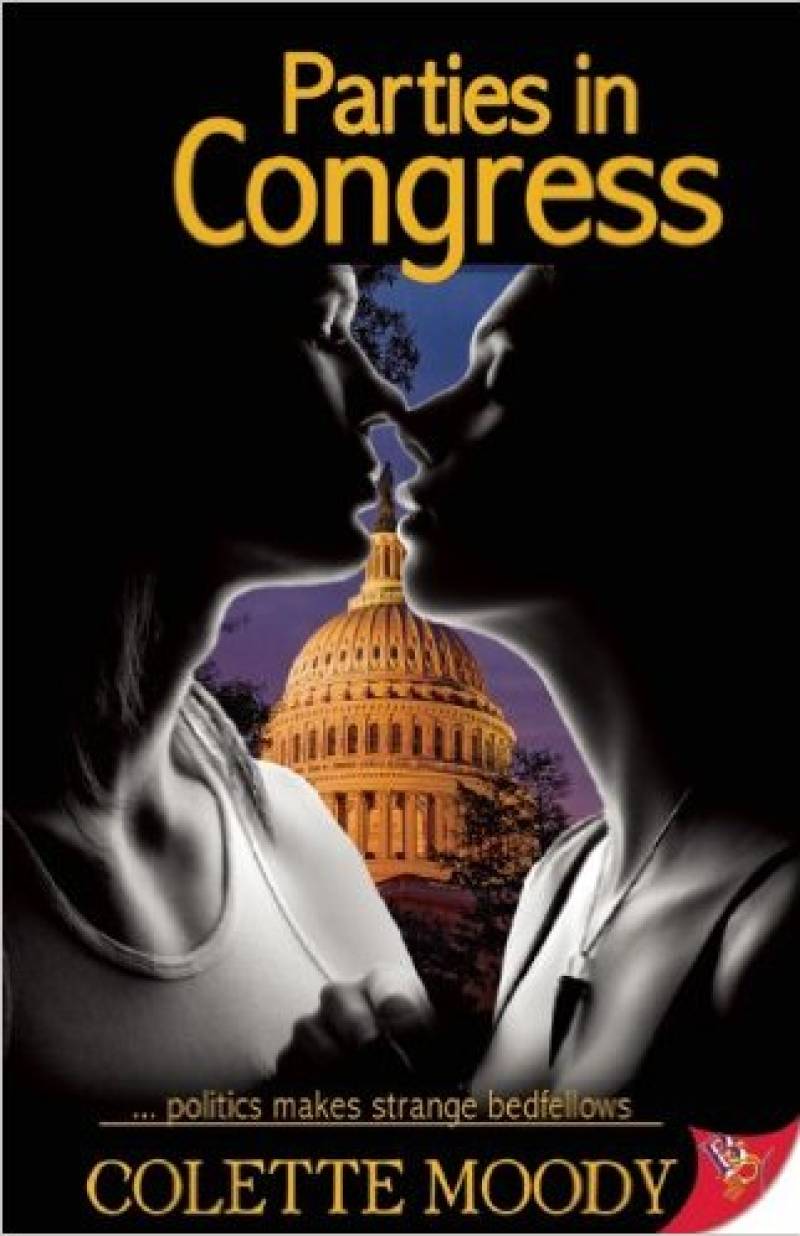
 Parties in Congress, Colette Moody
In this female/female contemporary romance, Bijal Rao, centrist-Republican, Indian American campaign worker, meets out, Democratic politician Colleen O’Bannon for the first time while on assignment to film an appearance by the incumbent congresswoman. The two make sparks like flint and tinder, but their love cannot be because of little things like, you know, political gulfs and possible ethical breaches.
Colleen O’Bannon is basically someone’s white liberal dream candidate: she’s attractive, savvy but not cynical, and she comes across as authentic. You guys, she lost her partner to an anti-abortion bomber! And she has not been linked with anyone since that tragedy.
But as Bijal tells Colleen, the fact O’Bannon isn’t actively dating likely helps her appear appropriate as a leader. Colleen reacts:
“Are you implying I’m a more palatable lesbian when I’m single?”
“Exactly,” Bijal said, pouring herself another whiskey. “You’re kind of like an unloaded gun—an antique one with a fancy pearl handle.”
With attraction simmering between them, however, the question is whether Bijal will be the sex bullet.
Moody makes an important point about the Catch-22 faced by out political candidates; disclosure makes their orientation part of the public record and leaves their private lives open to attack by opponents. But at the same time, it forces them to muzzle any hint of their sexuality.
Of course, if the candidate in question is Colleen O’Bannon, it’s pretty clear that she’s far more competent than her rivals, even while she’s in the throes of attraction. It also helps that Parties in Congress contains many eloquent set pieces for Colleen. Indeed, Bijal is almost the only Republican who comes off well, and even she bumbles frequently. While tailing the congresswoman, for example, Bijal loses her target because she’s hungry and goes to the drive-thru for a quesadilla. (Bijal, girl, I feel you.)
In the end, however, the book’s main strength lies in its characters’ awareness of the parts they play and the agile banter with which they dissect those same parts. The subject matter might earn it comparisons with The West Wing if that show also featured hot motorcycle-driving lesbians who told fisting jokes and could laugh at themselves. Scratch that—it’s nothing like the fucking West Wing, and thank goodness for that.
 Romancing the Duke, Tessa Dare
In Tessa Dare’s Regency historical, destitute Izzy Goodnight travels to the crumbling castle she has inherited from her godfather only to find it still occupied by its previous owner, the blind, scarred Ransom Vane, Duke of Rothbury. The duke has been in hiding since his legendary jilting and the subsequent duel that resulted in the loss of much of his eyesight. During their real estate dispute, cantankerous Ransom and desperate Izzy resolve to occupy the property together.
But Ransom, who has been busy fightin’, cussin’, and rakin’, does not know that Izzy isn’t just any plucky girl trying to make it in a harsh world. Her father, Sir Henry Goodnight, was the author of a rabidly popular serial—The Goodnight Tales—which featured an idealized and perpetually 12-year-old Izzy listening breathlessly to stories of a far-off land named Moranglia. Sir Henry’s death strands the series’ characters, Cressida and Ulric, in a cliffhanger. Fans always try wrest the ending from Izzy, and they also inevitably shoehorn her into her fictional role despite the fact that she’s 26 instead of 12, and not blonde or pretty like her namesake heroine.
The goodwill and fame Izzy engenders is deeply dependent on her being always girlish, virginal, and listening. Sir Henry’s fan club—the Moranglians—produces circulars, gatherings, and tournaments. They also converge on Izzy at least once a year to perform in her honor. What they don’t want is for Izzy to be “a grown woman with her own sets of likes and dislikes, dreams and desires.” Izzy thinks, “The truth of her childhood didn’t match what was printed in the magazines. But if she ever let it slip—oh, how people resented her for it. They looked at her as if she’d just ripped the wings off the Last True Fairy in England.”
But Izzy’s disillusionment with her role increases after the death of her spendthrift father—after she’s been left starving. “No one thought to inquire after her well-being. They all worried over Cressida locked in her tower, and her beloved Ulric hanging by three fingers from the parapet.”
From Romancing the Duke’s satire of the mercilessness of a certain kind of fandom, one gleans a lesson on the tangible power of stories. Dare’s last series was set in a resort town called Spindle Cove, a kind of Regency period version of Star’s Hollow, which shared many of that town’s charms and annoying twee-nesses. In this book, Dare finds a sympathetic balance between quirk and commentary. Stories have power—Izzy has power. And her resolution only comes when she learns to redirect the energies of her fans in order to orchestrate an ending that works for her.
 Wild Child, Molly O’Keefe
In contrast to Izzy Goodnight’s professional virgin, heroine Monica Appleby of Molly O’Keefe’s contemporary romance has made her career off her sexuality. As a youngster, she starred in a reality show with her mother. She is also famous for writing a memoir about her life as a rock star groupie.
She returns to Bishop, Arkansas, to investigate and write a book about the murder of her father. But Jackson Davies, the young, hunky mayor, has decided to enter beleaguered Bishop in a morning show contest in order to boost the town’s ailing economy. He doesn’t want Bishop’s reputation clouded by the sexual miasma emanating from Monica’s potent woman bits—even though he finds her bits very compelling. Indeed, the feelings of their bits are mutual—for a while:
“Oh God, you… you feel so good. You’re so… good,” he moaned, shuddering in her hands, his pleasure filling the air with a humming electricity that hit her skin…and stopped.
Just stopped.
And all that pleasure, all that desire that she’d felt one goddamn second ago was behind ice. Locked away. Her brain holding the key.
Jackson senses Monica’s withdrawal and soon learns that despite her image, she hasn’t actually enjoyed the sex she’s had with other people. She has been faking her desire and enjoyment: her private life is a performance because that’s what she’s been rewarded for from an early age.
O’Keefe writes some of the most emotionally complex stories in the genre (disclosure: I follow and have chatted with her on Twitter) and Wild Child is a nuanced exploration of reputations—both good and bad—and how much power they have over one’s self-image. For Monica, whose life has been spent in the spotlight, keeping things to herself ultimately doesn’t prove as powerful as having things for herself.
 The Iron Duke, Meljean Brook
In Meljean Brook’s 1800s steampunk novel, an alternate England is slowly recovering after years of rule by technologically advanced Mongolians known as the Horde. Much of the populace has been infected with nanoagents, which strengthen subjects and aid healing — but also leave them susceptible to control via radio signal, culminating in mass rapes called Frenzies. (Warning to potential readers: Brook explores consent.) Capable and determined police inspector Mina Wentworth, whose dark hair and sharp-cut eyes and cheekbones point to the fact that she is the product of a Frenzy, is sent to examine a body dumped on the estate of Rhys Trahaerne, the Duke of Anglesey. Rhys, an imposing former pirate captain who received his title after bringing down the radio control tower thus driving the Horde from England, is also known as the Iron Duke. His skeleton may also be composed of metal. He has a very heavy—erm—tread.
Merely entering the orbit of the storied Iron Duke for this investigation spikes public interest in Mina, or rather in her non-European features. Until now, her strategy for dealing with the hostility has been to keep her head down, work hard, and employ a bodyguard, but every day Mina is subject to derision: she is called a jade whore, and people spit on her—or worse. When Rhys defends Mina early on, her attacker concludes that she’s his trophy: “I see,” the man tells Rhys approvingly, “You’re still giving it to the Horde…”
Despite attraction between Mina and Rhys, the message for her is clear: the Iron Duke would reap all the benefits of being her lover, but she would suffer all the consequences of being his fucktoy. And those consequences are tangible: her supervisor informs her that she’d be fired—her notoriety would make it difficult to perform her job—and she would not be able to help support her genteelly impoverished family.
And then there are the caricatures:
Mina stared at the drawing. “I—Well. They have the scale all wrong. If I stood next to Trahaearn’s statue, I would not come up to his knee, let along my mouth to his—”
“Yes.”
Sickness rose in her throat. She couldn’t swallow it down. “And to hold a picket sign thus, I would have to clench my buttocks very hard, I think…”
…
She held out her hand for the flyer, but Mina couldn’t stop looking, even when the drawing blurred and splattered with tears. It was the ugliest thing she’d ever seen. And it was of her.
Brook paints a London bristling with press and pamphleteers eager for fresh stories. As the investigation uncovers a larger conspiracy, Mina and Rhys are soon speeding across continents in airships, arguing, and—yes—snogging on deck. But Mina will not consent to a relationship beyond the time that they are in transit and safe from the London public. Rhys, on the other hand, is pretty clueless about why she can’t simply live with him and be cocooned by his love, his wealth, and his enormous ferrous frame. He doesn’t worry about his own reception in the world—he’s a rich white man and he doesn’t have to…until he meets Mina.
There may be a certain amount of wish fulfillment in watching a rich white guy come to understand his massive privilege through love of a woman of color. (But enough about my fantasies.) However, in the not-so-dissimilar world we live in, where women—especially Asian women—are often perceived as nothing more than sexual trophies, it is the realism of Mina’s struggle that is especially striking.
 Bollywood and the Beast, Suleikha Snyder
Rocky Varma, heroine of Suleikha Snyder’s contemporary romance, is an outspoken starlet who earns the ire of the cast of her latest movie when she drops too many truth bombs during what is supposed to be a benign chat show interview. Rocky’s mother is white and her father is Indian. She grew up in Chicago. Despite her and her father’s careful attempt at image management—dressing in modest clothing, always arriving early for calls—she understands the futility of trying to change her image. “Everyone assumed she was just an empty-headed, half-gori bimbo who’d do kissing scenes when a born-and-bred desi girl wouldn’t.”
Rocky’s frankness about her status makes her persona non grata with most of her castmates, so during shooting she’s taken to staying in the dark, atmospheric house—the haveli—of her co-star Ashraf Khan. But in the haveli also resides Ashraf’s brother, Taj Khan, a former action hero who hasn’t been seen for 10 years following a horrific on-set accident.
Yes, title seems like a giveaway—some scars are indeed kissed in this book—but Rocky is no passive beauty whose salt tears gently cleanse old wounds like some sort of hippie disinfectant. She is a self-aware heroine who is well-versed in tropes and arcs, and she’s not afraid to step back and comment on the story-ness of her story. At one point, she notes, “With just one small gesture, just a few embittered words, Kamal was an open book. A romance novel, actually. She could totally relate.” At another, she makes this observation of her mother: “Sometimes, [she] seemed to think she lived in a Harlequin sheik romance instead of reality.”
Snyder, who is also a pop culture journalist, is well-versed in the ways of both press and genre. (Disclosure: I follow and have chatted with Snyder on Twitter.) Almost everyone in this book is an actor, and this is very much a book about following scripts and playing for the cameras.
Even Taj, who let’s remember hasn’t been photographed for 10 frickin’ years, assumes the role of a wounded beast while preserving the mystique of his last screen appearance. He won’t even go out for his favorite street food. (His housekeeper makes it at home. I DOUBT IT’S THE SAME, TAJ.) Taj is trapped in his persona—and his house—and that is intensely frustrating for the woman he loves. “The story doesn’t apply…even if you are a beast,” Rocky tells Taj, at one point.
That is Rocky’s strength, perhaps: when she needs to, she refuses the labels, rumors, and stories. Despite being considered an “empty-headed half-gori bimbo,” she is an actor in both senses of the word: she performs her script in front of the camera, sure, but she also looks at the choices in front of her and takes her own action.
Questions for Discussion:
- Who is your favorite public figure and what’s their story?
- Who is a famous person who you feel you really know and why is it that you feel you know them?
- Who do we hate nowadays, anyway? Is it Ed Sheeran?
- Who was your crush when you were a teen? AND
- Did you ever dream about what it would be like if you met? (Mine was John Malkovich, and our meet-cute involved feeding him homemade dumplings. I was a weird kid.)

MINDY. SEX BULLET.
Oh man I was just about to make literally that exact comment.
I can’t wait to read these!
ROMANCING THE DUUUUUUUKE
I love that book so damn much. Historical romance + fandom = MY CATNIP
I am now going to think about this article in contrast with my mother’s novels and see how her heroines compare – I loved this so much.
Celebrity I feel I know too much about: Rob Brydon, tiny Welsh comedian, whose autobiography hit so close to home for me that I actually bought the audiobook version as well.
FANS OF MINDY and/or ROMANCES: Mindy is also covering the 2015 RWA conference for The Toast — look for her writeup soon.
YESSSSSSSSSSSSSSSSSSSSS
Wasn’t “an imposing former pirate captain” a character mentioned in the Korean dramas? I think there was a Pirate King
Pretty sure there’s ALWAYS a Pirate King somewhere in romance/drama. The fact that we don’t have them IRL is just proof that we don’t live in a just world.
MELJEAN BROOK, Meljean Brook is so great. I love all of her books, every last one. If anyone knows more authors who write romance like she does – acknowledged consent, diversity of race and sexuality, great characters, different storylines over series, and an interesting world – TELL ME NOWWWW.
Same! I like Zoe Archer’s books too and they have a similar ambiance to Meljean, especially in the Blades of the Rose set. They’re all hetero-couplings, but they have some racial diversity, enthusiastic consent/respect of boundaries, and I found the characters very compelling.
I second the Zoe Archer. Also, Jeannie Lin has a steampunk series out now–the Gunpowder Chronicles (and she does great historicals).
Nalini Singh’s Psy-Changeling books for every point except diversity of sexuality. And a lot of her books have alpha male heroes (like literally, they are the alphas of their changeling (were-animal) packs) so the consent isn’t quite as clearly demarcated as in Meljean Brook’s books? With the exception I guess of the novella that explicitly deals with the issue of consent and how that works when it’s muddied by the wolf pack structure and ingrained submission to the alpha wolf and other dominants.
Also, I second Zoe Archer’s Blades of the Rose.
I will check out Zoe Archer for sure!
I actually tried out Nalini Singh, but yeah, the alpha-male things freaked me out. I got a couple of books in to a character to hadn’t been sensitized to touch, and the dude kept touching her (which made her pass out), even after she said, “Do not touch me like that, I do not respond well to it, stop it now.” It was played off as though he was helping her, but without her consent it felt increasingly terrible instead of increasingly romantic, and I put it down and haven’t picked up another one of those since. Maybe I should try again?
I think that was the second one in the series? At least that’s the only one where I can remember something like that happening. Yeah the power dynamics and the alphaness can be a bit off-putting in certain books, but I really like the last few books in the series (if you don’t mind skipping ahead in the political intrigue plot). The most recent one, which only came out last month, reverses the roles a bit and makes the woman the one who’s fiercely possessive, emotionally dangerous, and afraid of losing control of her powers. (It also has a bit of the public figure romance discussed above… “Oh, you don’t want the media to see you being followed by bodyguards? Okay, I guess I’ll just have to walk around holding your hand so the cameras think I’m only your girlfriend!”)
And the short stories tend to be quite good and much lighter!
I don’t think there’s anyone writing quite like Meljean.
I second the Zoe Archer rec.
Shelly Laurenston’s shifter books hit a lot of the items on your list, except for diversity in sexuality. And there are a lot of alpha males, and the world building, and the tone in general, is much lighter than in the Iron Seas books.
Cathy Pegeau has an SFR series that has both m/f and f/f pairings, but i don’t remember much racial diversity.
Lyn Gala’s SFR also has a range of sexual and racial diversity – I found the world building to be kind of hit or miss. The Claimings series has a m/m pairing with a human male and purple lizard like alien and it is much, much better than that description makes it sound. The Turbulence series has a wide range of sexualities (including some that are unique to her universe – it’s pretty interesting) and again some of the world building was fantastic and some of it was kind of hand-wavey. And the second book has an American Indians in Space sub-plot that made me really uncomfortable (as a white reader). ymmv.
And more urban fantasy than romance, but Charles deLint also has a fairly diverse range of characters and excellent world building and interesting story telling, especially in his Newford series.
Apparently I was just waiting for someone to ask me this question!
This is so full of great information! Thank you!
You’re welcome! And one more thought – Marjorie Liu’s Dirk and Steele series – I think it hits everything but diversity in sexuality.
Seconding Zoe Archer and Jeannie Lin, Also Nalini Singh is my jam.
I like this, but perhaps fewer white people?
My teenage crush was Orlando Bloom and I had elaborate plans for how to eventually meet him.
Oh my God Orlando Bloom. Printed so many pics of him my senior year of high school. Though really it was Legolas for whom my heart beat wildly.
I admit, i’m kinda terrified to meet my celebrity crush in person. Mainly because I know it’s probably not going to live up to my expectations and destroy my illusions of that person. Thus I shall admire Daniel Henney from far away.
Also on a romance novel note, i just want to say that never judge a lady by her cover by Sarah MacClean was everything that I hoped for.
One of these days I’m totally gonna write If Daniel Henney Were Your Boyfriend. IT’S GOING TO HAPPEN.
Speaking of celebrity crushes! I really want to interview John Cho someday, but I am afraid to even ask because I’m worried he’ll figure out I’m the gal who wrote If John Cho Were Your boyfriend.
PLEASE MAKE IT HAPPEN. I will send you cookies.
I WILL I PROMISE
when I need cheering up sometimes I look at his Instagram
I second the Zoe Archer. Also, Jeannie Lin has a steampunk series out now–the Gunpowder Chronicles (and she does great historicals).
I don't think there's anyone writing quite like Meljean.
I second the Zoe Archer rec.
Shelly Laurenston's shifter books hit a lot of the items on your list, except for diversity in sexuality. And there are a lot of alpha males, and the world building, and the tone in general, is much lighter than in the Iron Seas books.
Cathy Pegeau has an SFR series that has both m/f and f/f pairings, but i don't remember much racial diversity.
Lyn Gala's SFR also has a range of sexual and racial diversity – I found the world building to be kind of hit or miss. The Claimings series has a m/m pairing with a human male and purple lizard like alien and it is much, much better than that description makes it sound. The Turbulence series has a wide range of sexualities (including some that are unique to her universe – it's pretty interesting) and again some of the world building was fantastic and some of it was kind of hand-wavey. And the second book has an American Indians in Space sub-plot that made me really uncomfortable (as a white reader). ymmv.
And more urban fantasy than romance, but Charles deLint also has a fairly diverse range of characters and excellent world building and interesting story telling, especially in his Newford series.
Apparently I was just waiting for someone to ask me this question!
“West Wing With Lesbians But Not Really West Wing” is all I want in life. Like, the kind of book I would see myself reading in the Mirror of Erised (23 years old is not too old for Harry Potter references!).
I’m not a steampunk person, but Meljean Brook is worth genre-busting any/every day.
I never did much celebrity crushing (nose always firmly in books) but my college BF’s sister was obsessed with River Phoenix. So every time we spent the weekend at his house, I slept in the sister’s room, surrounded by numerous posters of the man. I had literal dreams (rather than fantasies) about hanging out with River Phoenix thanks to those posters looming over my head. (He died after our breakup. I could just imagine the poor girl’s grief.)
I am so thrilled to see romance novels recommended on The Toast. I’ll have to look into all of these! And I’m seconding all the love for Meljean Brook. Everything in The Iron Seas series has been delightful, and I also love her earlier series, The Guardians, although it doesn’t have as many queer protagonists.
I am so thrilled to see romance novels recommended on The Toast. I'll have to look into all of these! And I'm seconding all the love for Meljean Brook. Everything in The Iron Seas series has been delightful, and I also love her earlier series, The Guardians, although it doesn't have as many queer protagonists.
You're welcome! And one more thought – Marjorie Liu's Dirk and Steele series – I think it hits everything but diversity in sexuality.