
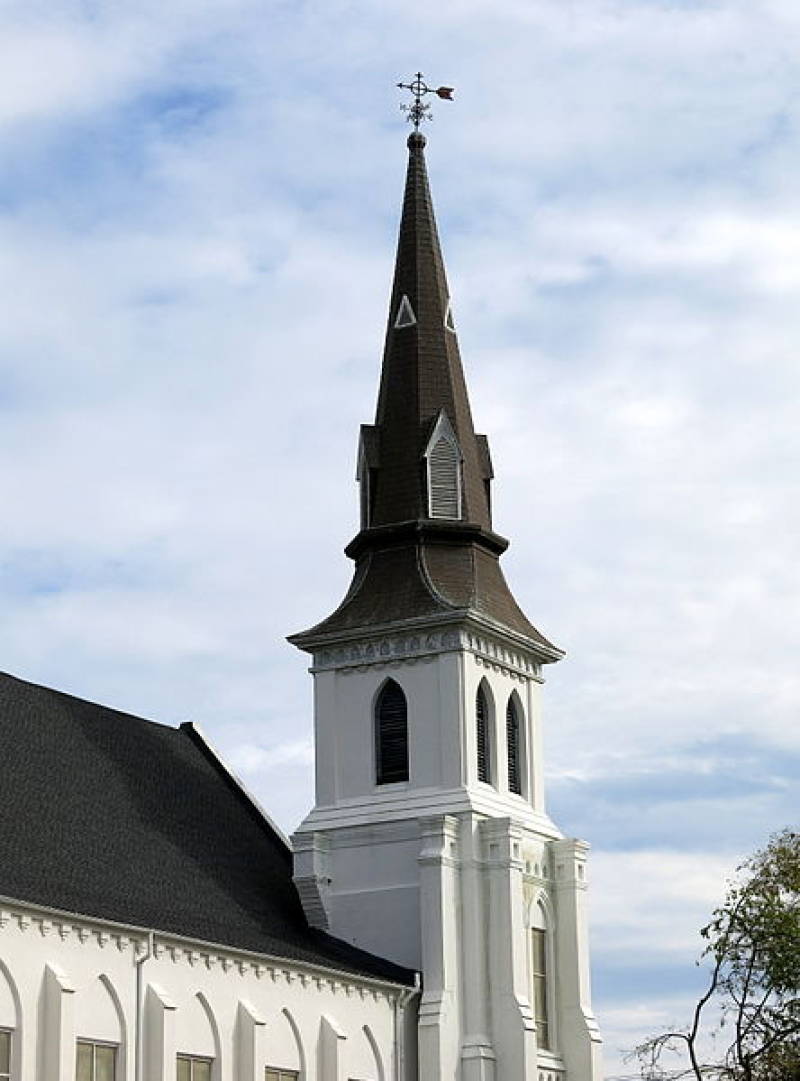
Every Sunday afternoon for two or three years, my parents took a long drive across town—across the mid-sized Canadian city of Winnipeg—to attend Chinese church.
We were guests in the building, renters. The hymnals and Bibles of the church’s own congregation stayed in the pews. Every week, an usher hauled in the church’s box of books, with the name of our church written in marker across the pages of the text block. He distributed them at the beginning of services and took them back to be stashed in the trunk of a car for another week.
Sometimes I suspected we were guests in Christianity, too.
It wasn’t that I thought my God was a different God from that of my white friends. But even when I was small, I knew my relationship to religion was different from theirs—mine seemed removed. I knew it was different specifically because I was of Asian descent.
And because I never really felt part of it, it was easier—no, it was almost a relief—to realize later in life that I was an atheist.
***
I call it Chinese church because the composition of parishioners wasn’t determined by the category of Christian you were.
My parents were Presbyterian (not the dour Scottish kind), but we attended Mennonite services (the non-horse and buggy kind).
It was easier to call it Chinese church, rather than decide what kind of Christians we were. It was easier to call it Chinese church even though many of the parishioners weren’t, strictly speaking, Chinese.
There were students from the mainland, yes, but the rest were from the Philippines, Malaysia, and Singapore. And there were a couple of families, like mine, with roots in Taiwan. We were called a Chinese church, but we were a disparate group.
The preacher conducted services in Cantonese with a Mandarin translator. On special occasions, there would be English translation, with three speakers crowding the pulpit. This meant that getting through a single sermon took a long time. My grandparents, who lived with us, didn’t understand Mandarin or Cantonese (or English) were silent and patient, stirring only when hymns were sung. I understood maybe half of the Mandarin. We spoke Taiwanese at home. Most of the preaching seemed to be about salvation.
But Chinese church it was, as if we were a uniform group of black-haired heads bent over pews. Never mind that we were hardly all black-haired or uniform. The United By Diaspora Chinese Not Really Mennonite Church of Greater Winnipeg might have been a more accurate—if unwieldy—name for it.
I didn’t recognize differences when I was a kid, but for those who attended, the twists and leaps and elisions that had them all worshiping in the same place caused tensions. And those tensions were why my parents left a few years later.
***
But the story of my relationship to Christianity is also the story of my relationship with my dad. Growing up, we were close. We were both sloppy to the great annoyance of my mother. We were handy with languages and musically inclined. And my dad was the one who would listen to my doubts.
My dad had a true bass voice. In his youth in 1960s Taiwan, he was popular on the church singing circuit. Even in Canada, he remained semi-famous among church people, often invited to sing and to conduct. Sometimes I was his accompanist.
Religion and music were the main themes of my dad’s youth. My dad’s grandfather was a minister. My uncle, Jerome, is also a minister. My family were ethnic Taiwanese and Christian (Wiki says they currently make up about 5% of the island’s population). The Presbyterian Church was loosely associated with Taiwan independence, the opposition in a country ruled by the Kuomintang—the party that fled China after Mao took over. When they identified as Christian, they were saying that they were in the minority on ethnic, religious, and political fronts in a country under martial law.
My dad was introduced to my mother, “a good church-going girl,” through his voice teacher, her cousin. My mother’s father, who died earlier this year, knew of the words and all of the tenor parts of every song in the hymnal. We gathered regularly around the piano at home for hymns in glorious 3-part harmony. It was then that I could believe God was real. The only dissonance came from the fact that we were singing in different languages, a result of the different occupations under which we’d grown up.
My dad wasn’t a guest in the church, so technically, neither was I.
***
I was desperate to be a good, Christian kid. I never thought that I had the luxury of misbehaving. There weren’t a lot of East Asian people in our neighborhood and at my school at the time. I was visible. I knew I would never get away with anything and my wish to be accepted went hand in hand with my desire to be invisible.
At church summer camp—I may have been ten?—we watched a short movie. The dialogue was in English, but all of the actors were of Asian descent. A man befriended a woman and a boy and tried to introduce them to Christianity. There was some sexual tension—or maybe I just want to imagine charged-yet-somehow-pure banter about salvation. After much walking and talking, the kid triggered a rock slide and the man leaped to shelter the child with his body. In a long sequence, they both went tumbling down a hill, white boulders and rocks crashing over them. At the hospital, the man was pronounced dead, having sacrificed himself for the boy. The kid and woman hugged and the woman decided to convert to Christianity so that the man’s death would not be in vain.
The. Fucking. End.
The teacher handed out blank paper and told us to write down what we thought of the movie.
I wrote nothing.
This should have been something that I could have done. I loved assignments. I loved teachers. I craved positive attention. Like I said, I was a desperately well-behaved child. I even knew that I get away with, Something-something dying so that another could live.
But I couldn’t.
Earlier, we’d learned what a hypocrite was. I was young, but I understood the concept because that’s what I was. Every prayer I made to God was riddled with frustration. I didn’t pray to God asking for help believing in him. But I knew my life would be easier if I could shut my questions down, because then, at least, I would know where I belonged. Things would be easier for me if I could join the whole history of my family struggling against the tide to keep to their religious convictions.
The only thing I was certain of was this: there was some essential element missing in me. If judgment came, everyone would know. Perhaps they knew even then. No matter how good I seemed I would never be loved. I would never experience grace.
Well at the time, I thought it was something lacking in me. Now, maybe I wonder if it wasn’t me—if there was something lacking in the system.
I left my sheet blank, maybe because I didn’t want to lie and pretend that I was a better person than I was. Or maybe I thought that diving into a rockslide was not a good choice for anyone, Christian or not. Over the years, I have thought a lot about that movie. The first image I recall is of the man tumbling down the hill, his jacket billowing, white rocks flying down with him. I wonder about that scene, if they used a dummy, if those white rocks were papier mâché. I wondered about the budget because this was the 80s and film was expensive. Was it a student project? Was it made in North America? I think it was. I think it was aimed at Asian people who wanted to see Christians who looked like them.
***
When I was a kid and a teenager, I was close to my dad partly because he was the only other person in my family who was comfortable with admitting that he struggled with faith.
Notably, my dad had not felt a calling, despite the fact that it was my grandfather’s wish that his eldest son become a minister. He decided to move to North America to attend graduate school to become a social worker. My grandfather disowned him. I think of this sometimes, how hard it must have been to defy his family, his father’s wishes, to move to another continent on his own.
He told me he was much more religious when he was younger. I asked why. “I was terrified,” he said in Taiwanese. In English he added, “of hellfire.”
***
My dad told me to think for myself. He handed me age-inappropriate books and let me puzzle them out. Ivanhoe. Persuasion. Madame Bovary. The Collected Writings of Oscar Wilde. He let me challenge him even though the way he’d been raised, children—especially girl children—were not supposed to ask questions.
Sometimes, he was invited to sing. One of the pieces he sang often was “Honour and Arms” from George Friederic Handel’s oratorio, Samson, based on Milton’s Samson Agonistes. I’d help my dad practice, stumbling through a piano arrangement that was too big for my hands and far beyond my ability.
He made me work, but he was open to the questions I didn’t dare ask anyone else. Why are they always asking me to take Jesus into my heart? We’re going to church aren’t we? Why the repetition? Week after week, it was the same thing: You are a sinner. Be saved.
I asked him, “Why are they trying to convert the converted?”
I guess my real question for him was, “Why are you putting up with this?”
But it was the easier question that hurt him. Once, I wanted to know why it was so hard for me to learn alto harmonies. How did bass parts come so naturally to him? He looked anguished. “I should have taken you to church more to learn hymns,” he said.
***
My parents had stopped going to Chinese church at that point. Despite our lack of attendance, we prayed before meals. We prayed in restaurants. We sang.
We started going to Knox United when I was in my early teens. Knox was part of the United Church of Canada—a church formed of a mix of protestant denominations and the second largest Christian denomination in Canada after Roman Catholicism. We went to the English services, which were held in a spare 100-year old building fitted with an enormous organ. My grandparents, who understood Japanese due to that country’s occupation of Taiwan before World War II, attended Japanese services offered in Knox’s second small chapel.
The English-language congregation was small, white, and mostly elderly. They huddled together in the middle of that huge room. The choir was tepid and only men ever seemed to get solos. It was all presided over by a handsome, snowy-haired minister. He told stories and jokes. He spoke with the ease of a person who never worried about belief or conversion.
In many ways, it was a better fit for us. My parents went from being uncomfortable with people they thought they should have had things in common with to being uncomfortable with people they didn’t relate to—didn’t have to relate to—at all. And Knox conformed to my childish idea of what church ought to look like.
A few times, there would be a joint gathering with the Japanese congregation. Results were mixed.
“Why don’t you attend the other services?” a white woman asked us.
“Oh, my parents know the language but we’re not Japanese,” my mom explained. “We speak Chinese.”
The woman frowned. “What’s the difference?”
The contradictions keep piling up, don’t they? I liked attending Knox because they didn’t harp on salvation—even though with all my doubts, I probably needed it.
I also liked it because it seemed less about fire and brimstone—more cerebral, liberal. But we started attending not long after the horrors of the United Church’s involvement in the Native residential school system came to light. So while I was enjoying the seeming inclusiveness of the United Church of Canada, I was ignoring the fact that they had only thirty years before been active in the oppression and even attempted cultural genocide of the First Nations people.
The things I realize now.
***
I said my relationship with Christianity linked to my relationship with my dad. Right now that relationship is not at its best.
We live thousands of miles apart: he in Vancouver where he and my mom can and do attend a Taiwanese church. I, in New York where I can. And don’t.
When I first came here for graduate school, cousins took me to the huge Taiwanese church in Elmhurst, Queens. There were three services every Sunday: one in Mandarin, one in English, and one in Taiwanese. It was filled to the brim with people who should have been like me: second or third generation Taiwanese-North American kids who were more comfortable in English. The pastor for the services I attended was a white man whose parents had been missionaries. I went once or twice.
My dad is happy with his place, though. Services are conducted in Taiwanese. The choir is pretty good and he’s glad not to be singing and not conducting.
When the family was adrift—when he was adrift—I felt close to him. But my dad is not a guest in the church. He has always believed, even while he was looking for his home. My dad experiences that make him what he is. Mine make me different.
My dad has theories—I forget that he always loved conspiracy theories—from close reading of The Da Vinci Code, from a long ago remark by a member of the local Masonic temple, from a series of lectures from a Taiwanese minister that he listens to on his laptop. He forwards me a lot of email. A lot. Most of it is pictures of sunsets, golf jokes. (He doesn’t play golf.) Some of it is about God. Two or three have contained offensive content about the supposed Muslim population explosion in Europe.
In person I tell him that I found the email about Muslims terrible and wrong. I remind myself that he is the one who told me about race and acceptance and belief, that he is older and frailer now and he has had his life yanked out from underneath him too many times. That he was raised under a regime that made conspiracy real.
I tell him not to forward me anything more. He apologizes for the anti-Muslim email. But he also yells that he is angry that I don’t seem to want his emails, that I don’t want to learn anything anymore. That I don’t want to learn from him.
The unfairness of his fury hits me so hard that something that has already been cracking breaks wide open.
He still forwards sunsets and golf jokes. I mark some of it as spam.
***
I was reluctant to identify as an atheist until recently. My young daughter had begun asking questions about death and the afterlife. I explained a few different theories about what happens after the body perishes. She asked me if I believed in God, and I said told her hesitantly that I did not. It was probably the first time I admitted it out loud.
She says she believes and I, as my father once did, decided to let her figure it out on her own.
I would love to say that my atheism comes from a logical place. But I am not more logical than people who do hold spiritual beliefs. Maybe I know less. What I do know is that my atheism is personal. That it is, in the most fundamental sense, about absence.
As I write this, I am listening to different YouTube versions of “Honour and Arms.” I’m hunting for someone who sounds like my dad. (The piece is written for a bass. All of these people, he’d probably say disgustedly, are baritones.) There is one accompanist who sounds like me—meaning he or she stumbles over the scales and arpeggios.
I remember every word, every frill and fillip, every measure where my hand was not wide enough and my technique not good enough. What I didn’t remember—what I should have realized given the bombastic lyrics—is that “Honour and Arms” isn’t sung by Samson at all, but by Harapha of Gath, the giant who leads a blinded Samson out for display. This changes the meaning entirely for me. Now I can’t unsee it.

MINDY. I already yelled about this on Twitter but I felt this one deep in my chest. Thank you so much for sharing your struggles with us. <3
This piece is so wonderful and I love it. Thank you for writing it, Mindy.
<3
This is, expectedly, fantastic and makes me think a lot about my parents’ faith vs. my relative lack. It’s not something we really talk about, though I was also the persistent kid with lots of questions. I don’t particularly want to go to Church, nor take my family (my wife is not Christian at all), but sometimes I miss the community of a Church and feel sad that my son won’t grow up in that environment.
I feel the same way. I grew up in the church, but stopped attending sometime in college; I’m more agnostic now, and my husband would never willingly attend church. But I feel like my daughter is missing out on a cultural experience by not attending church at all. No Vacation Bible School, no church choir, no church camp, etc. She’s also missing out on a lot of beliefs and values that we don’t support and wouldn’t want her to absorb, so it’s better this way, but it still makes me sad.
I feel that too; missing terribly a community that I didn’t want to belong to any more. Even missing the things I hated about it.
My kid was invited to a birthday party this summer. We didn’t know the parents or anyone there, but there was so much food, and there were so many people–not just the hosts–talking to us, making sure we were welcome, inviting us to eat, keeping an eye on the kids.
It felt really familiar to me and I didn’t know why. It struck me later that the main reason they knew each other and that they had these roles was likely because of church. So yeah, I miss it, too.
Yeah and I also wonder how much stuff I’ll have to explain later because he’ll never attend Sunday School. “Oh, that boat with the animals? That’s Noah’s Ark. Why did he build a boat full of animals? Well, long ago there were these beings call the Nephilim and they…”
I grew up in an atheist household (in the US) and you tend to absorb most of those stories anyway, though there were definitely other Christian or Biblical references that flew over my head for a long time.
I did once (when I was around 4 or 5) sleep over at a friend’s house who were apparently very religious and had pictures of Jesus all over. These portraits terrified me to the point I had to go home early.
Oh, Mindy, this is so good! Hugs to you.
Thanks! And thanks to everyone who has commented. It was hard to write.
I came by my atheism naturally, since my interfaith parents were both (temporarily) disowned by their families for marrying each other – it made it easy for them to adopt cultural but not religious practices from both their families as they raised theirs. It’s been interesting raising a kid with a faith (but not his brother), and fitting Judaism back into my life in a less secular way.
I’m always intrigued by stories of people who came to atheism via a break with family and tradition. My husband just shrugged and stopped going to Mass as a teen, but his dad had stopped before him, so his mum’s ongoing displeasure about it didn’t hold a lot of weight (until her youngest grandson declared his intention to study for his bar mitzvah, but that’s another story.) You’ve given such context and weight and emotion to your journey, and the ways it mixed with and clashed with your dad, and I appreciate your sharing your journey here.
Also, “United By Diaspora Chinese Not Really Mennonite Church of Greater Winnipeg” made me snort-laugh. And I’m intimidated by your linguistic & musical skills.
Mindy, this is beautiful.
I especially like, “the luxury of misbehaving.”, which should strike a chord with every immigrant and outsider. Girls don’t get that luxury. Immigrant kids don’t get that luxury.
Thank you for sharing this, Mindy. Your writing articulates a lot of the discomfort I grew up with in the church as well as on the small conservative bible college campus where my family lived (until I moved across the country for college). I am still coming to terms with where I have landed in the aftermath and perhaps that never ends…
“What I do know is that my atheism is personal. That it is, in the most fundamental sense, about absence.”
This is so insightful. I was talking recently with my partner,a fellow raised-Catholic atheist about the process of losing faith, and they described it as a sad experience because they felt they were losing their relationship with God. Whereas for me, it wasn’t sad exactly, because I didn’t really have the sense of God being close to me or having a special interest in me. Even when I believed as a child, God felt like a cold, judgemental Other whose possible anger must be placated, never a friend. So losing faith was more about losing fear. There was a definite link between the different parenting styles my partner and I experienced and how we perceived God.
Excellent article, enjoyed it a lot.
This is SO GOOD, just, the way every single issue touched on is nuanced and complicated and doesn’t get neatly wrapped up BUT the whole thing still comes together beautifully.
Such a beautifully-written piece about a complex and broad-yet-personal topic. I loved reading it. Thank you.
I posted a comment but it got messed up… Just thank you for sharing Mindy.
I was intrigued by your Diaspora experience of Christianism – and I can relate to the poignant journey of a child questioning her religious experience to the adult solution (atheism for you, pragmatic agnosticism for me).
It’s a personal triumph against the homogenizing discipline of organized religion (and its political role) but there’s also something a little wistful about how one’s relationship to that occupies such a huge developmental space of ruminative habits and memories – of family, of music, of reflection.
As someone who participated in the church I was raised in primarily through music (and then left the religion altogether, to my mother’s continued dismay) this wonderful piece really resonated with me.
So well written and profound. I really felt for your and your parents’ experience, your relationship with your dad. Thank you for sharing.
Ah – I’m having such an emotional reaction to your piece. You’ve brilliantly illuminated the gap between the possibility and reality in faith communities – in community building, and in theology, faith and nurturing. And the fragile complexity of choice and faith, within the historic/current realities of churches and their participation in violence and oppression and abuse and our families and culture and…
Just way more thoughts and feelings than I can manage to put into words today.
Thank you.
All of this goes for me as well, thank you Mindy.
Mindy, thanks for writing this. I was raised as an atheist, by one atheist and one raised-Catholic-but-never-talks-about-feelings-or-church-so-who-knows.
To the others of you in the comments worried about raising kids without a church community – you and they will be fine! I have never once been sad to miss out on the constant churchiness and social events that my Christian peers had to deal with growing up. Just find friends and interests you like and everything will be fine.
Oh Mindy, this is so beautiful. Thank you for writing it.
This is so well thought out and so well written. Thank you for writing this.
so beautifully&generously written, mindy! as a wpger&vancouverite i quickly visualized located moments of a cdn mosaic&tension. as a human, w your family. you can't help but have a sense of honor in reading this intricate&courageous journey. stepping back, w the inclusion of the comments, i'm also surprised&troubled by the approach to the theme of Christianity&what is falsely equated as Christianity/ism. the piece&some comments actually doesn't speak about Christianity when using the term. while these sometimes overlap, there are distinctions btwn Christianity, church, faith, spirituality, etc. that deserve a substantive degree of accuracy (just as we would desire for reflection about feminism, or gender/sex, etc.). my apology for this particular critique, however, it can't go without mentioning&encouraging for the future. pls.
Oh there is so much in here that I relate to. If there weren’t hymns in church I never would have lasted as long as I did. (At BYU there is such a hymn fandom that every Sunday kids gather in one of the tunnels under a road on campus to sing them. I am not joking. It is called Tunnel Singing and I went almost every week when I was a freshman.) And I remember those prayers and wanting to know it was true but also being scared that I never would.
Such a beautiful piece.
Many people who do Sacred Harp singing are not religious at all — dunno if that would interest you. https://en.wikipedia.org/wiki/Sacred_Harp
Tunnel Singing sounds quite cool, actually.
This brought back my journey from an evangelical upbringing to the ardent agnostic I am today:
Me at 6: Why was Jesus a boy and not a girl?
Sunday School teacher: Because society at the time wouldn’t have listened to a girl.
Me: But didn’t God make society?
Sunday School Teacher: …
Me at 14, nervously: Is having an eating disorder a sin?
Sunday School Teacher, a RN: Yes.
My mother yelling, after finding me at 16 cutting myself: You need to get your relationship right with God!
Each of those moments left me heartbroken and confused. I was told religion is what I needed to be whole, but every time I asked for help in some around about way, I was left a bit more exposed. I was a good kid, a perfectionist, a straight-A, Ivy Leaguer. But because I do not subscribe to my parents’ belief system, there will always be that sad gulf between us.
But I still listen to hymns on Sundays.
Thank you for sharing!
Thank you for giving us the historical context along with your personal journey which at times mirrored mine. I miss the community of church but it was strange to want to attend service every Sunday but not really understand the meaning of the services except for the great meals, companionship, sports activities etc. Sometimes I contemplate indulging in church again for my children so that they have a safe environment to grow up in. Would that be so bad?
Mindy,
Thank you for sharing. I still proclaim and hold onto my Christian faith but do admit that I wrnt through tremendous disappointments with them. Some of us Taiwanese refuse to attend churches that keep calling Taiwanese Chinese and Chinese Americans (downplaying Taiwanese identity). Others are western churches, but care more about Chinese missions (that appeal to PRC and ROC’ers). Many missionaries in TW, had to abide by ROC martial law… and the hypocrisy hurts me when these folks will still give accolades to Chiang Kaishek and ROC, despite White Terror and 228, oppression of Taiwanese people, and the stagnation in Taiwanese culture until recently. It is an inconvenient truth, and these people proclaim to be Christian.