
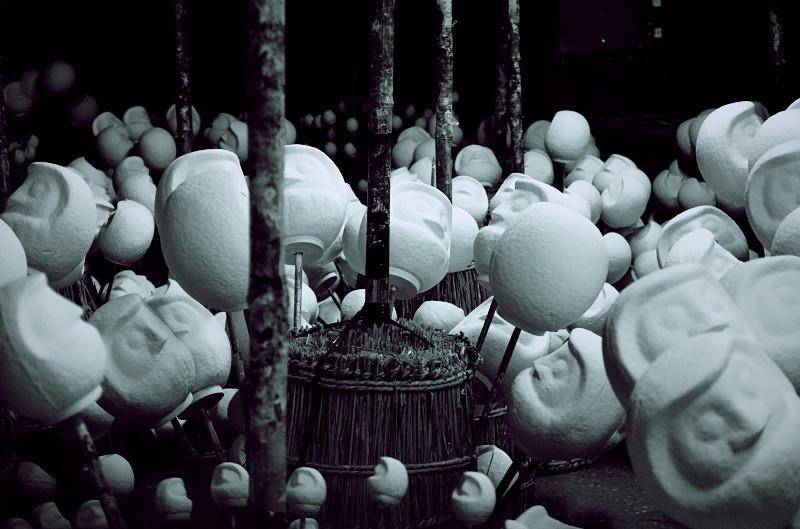
 Photo from a Daruma doll workshop, taken by the author.
Three summers ago, I was walking in Seattle’s International District with an Asian friend when a middle-aged man came up and asked us if we were lost. He was round-shouldered and slightly paunchy, with thin, fair hair combed over a balding, egg-shaped head. In truth, my friend and I were a little off-course, but as the man kept asking us where we were headed and offering to show us the way, I started to feel uncomfortable and told him we were fine.
But he didn’t leave us alone. He walked ahead of us, looking back and constantly repeating his offers to show us the way, stressing that he was a nice guy, a good guy, that he had no ill intentions. When we continued to keep our distance, the man grew angry. “You’re so rude!” he shouted. “I’m just trying to be friendly. I have nothing against your people! I’ve been to your country and talked to your people. I know about your people. I’ve always treated them well!”
He stormed off, thankfully, without bothering us any more. But long after he was gone I kept thinking of the way he had said your people. Who, exactly, did he think were my people?
A few weeks ago I was waiting on a bench in a post office in Japan when the elderly Japanese gentleman sitting next to me suddenly turned around and spoke. From the torrent of Japanese that followed I was able to pick out the words “What are all these foreigners doing here?” He indicated a little cluster of four or five young adults—all fair-skinned, blonde, and speaking English.
I smiled nervously, let out an embarrassed chuckle, and said, in hesitant Japanese, “Actually, I’m a foreigner, too.”
Immediately the old man’s expression changed from one of confiding trust to one of surprise. He turned to his wife, who was sitting next to him, and muttered something in a not-so-low tone of voice that I didn’t understand. But I caught the words “surprised” and “foreigner,” and flushed.
Since moving to a relatively rural prefecture in Japan to teach English, I’ve often been mistaken for or passed as a Japanese person, and perhaps this is no surprise: I’m Asian, with black hair, monolids, and brown irises. I have also studied the language for six years, have a taste for Japanese street fashion, and did my undergraduate thesis on Japanese postwar literature. Though not fluent, I can sustain a basic conversation for at least a few minutes. But I’m not Japanese—my nationality is American, my ethnicity Chinese, and my feelings, when I am taken for a Japanese person, are conflicted to say the least.
The man at the post office assumed he knew who “my people” were, and he’s not the only one. There are plenty of others who think I am Japanese until I open my mouth: the restaurant server who waited expectantly for my order when I could barely read the menu; the pharmacist who asked me a series of rapid-fire questions about my eyes when I was looking for eye drops; the guy at the gas station who spewed instructions while I stood with my equally confused Caucasian friend. Every time it happens, I give a sort of confused “huh?” and an embarrassed smile, and whoever is talking to me will start and stare before resorting to the gesticulation and slow speech many use when trying to explain things to someone who doesn’t speak their language. Every time it happens, I feel a wall spring up between us. It’s like when you see your friend on the street and go over to say hi, drop an in-joke, chat about your day—only after tapping your friend on the back, you find yourself facing a total stranger. In this case, I’m the stranger.
One of my friends here in Japan, a tall white girl from Michigan, says that everywhere she goes she knows people stare at her and wonder what she’s going to do. Once we went to a middle-school track meet on a mountain, where she was the only “foreign-looking” person around. While walking with her, I noticed people turning their heads as we passed. As we were cheering for the runners, my friend admitted she felt like she was being too loud and making a bad impression. But she also had a resigned what can you do? attitude about it, accustomed as she was to standing out.
While it can’t be comfortable for my non-Asian foreigner friends to always feel like they are on display, if you’re always stared at then I suppose you get used to the stares. If you slip up when speaking the language or commit a social faux pas, you have something of a free pass: “she’s not from here, she doesn’t know.” (The term we use is gaijin smash.[1])
But if, like me, sometimes you’re stared at and sometimes you’re not, then you never know which reaction to expect. Navigating this country, I often don’t know what role I’m supposed to fill. I’m suspended between two worlds—not quite foreign enough to be completely foreign, but obviously not Japanese. So I am constantly on the alert, playing it by ear: am I passing this time, or have I given myself away already?
When I’m able to pass during a social interaction without giving away my foreignness, I often feel a sense of triumph. I’ve successfully paid for groceries, interacted with cashiers, asked strangers for directions and store clerks for clothes in another size, chatted about a Japanese author I like with a librarian. That I am able to pass as a native during these interactions is a testament to the effort I put into learning the language, customs, and culture; it is at least partly a validation of my hard work. But I often wonder if my “successful” interactions are in fact successful, or if the hiccups in my sentences and my clunky speech patterns give me away and whoever I’m talking to is just too polite to comment. Usually throughout these conversations I’ll be on tenterhooks, afraid that any second I’ll slip up, my difference will be recognized, and my interlocutor will recognize me for what I am—an imposter.
Just a week ago in a hair salon, I thought I had been carrying on a decent conversation with the hairdresser when he asked me, in that super-casual tone people use when trying to pry, “So, did you just move here? Where are you from?” “America,” I muttered, and he nodded, unsurprised. What had given me away? I didn’t feel confident enough to make conversation the rest of the session; this is, in fact, how I feel a lot of the time in Japan.
What does it mean to belong, or to be “foreign”? I’m finding that it’s not just a matter of linguistics or how long you’ve lived somewhere. To be native to a place implies not only fluency in the language, but also a shared set of experiences and a shared environment. No matter how much I read about Japan, how closely I study the language, or how long I live here, as a foreigner I will never “belong” to Japan in the same way as someone who was born here, went to school here, grew to adulthood here. Even if I spent twenty years here, a difference would still exist.
Though my appearance allows me to fit in while in Asia, in America it singles me out. While I sometimes consider myself to be an invisible foreigner in Japan, in America, it is my nativity that is invisible; if the guy in Seattle is any indication, a lot of people think that my place of birth is not the sole determining factor of where I am “from.” For them, my origin goes back further than me—it goes to where my parents were born, and my parents’ parents.
Living in America, I felt foreign, too. Whereas in Japan people first speak Japanese to me, in America taxi drivers ask me where I’m from as their opening gambit, and strangers will sometimes greet me with Ni hao or Konnichiwa or Annyeonghaseyo. From the first, I am set apart.
It’s not just a matter of greetings. During my freshman year of college, I took a seminar on the classics of political thought. Within the first few weeks, I remember feeling distinctly panicked when it became clear that most of my fellow students were far ahead of me. They had grown up in households filled with Western books, media, and culture. Maybe they were handed books by their parents or talked politics over the dinner table. Maybe they read Harry Potter or Tolkien with their families, or had dads who showed them Star Wars or classic Bogart movies. I remember one classmate telling me how she discussed Marx and Locke with her family, and another who said he was reading Kundera because his mother recommended it. My classmates knew about popular websites and blogs and got The New York Times delivered. But I’d never read or talked about any of these things with my parents—we got no magazines delivered, and any books I read I had found on my own. At the student activities fair, two campus publications explained their differences by comparing one to The New Yorker and the other to The New York Times. But I didn’t know the difference, so I just chose one at random.
I said before that I feel a lack of confidence in Japan, but in college I also felt backwards and behind. Whenever someone made an offhand reference to a musician I didn’t know or a TV series I hadn’t seen or some childhood book I hadn’t read—one they just assumed was in the common cultural collective—my mind would scramble trying to figure out the reference. I would clam up, afraid I’d say something wrong. My classmates had the easy confidence that comes with long exposure to the types of things we talked about and learned in class. But I didn’t share their background, and I didn’t have their confidence.
“My people” are those who, like me, grew up in the half-light of overlapping identities, at the margins. If I have a true home, it is in this gray space between boundaries.
If being native involves sharing a certain set of experiences, values, and cultural customs, then I am still foreign to much of America: I can think of many TV series I never watched, political events I didn’t know about, music I didn’t listen to, family values that differed from that of my white peers. In college I always felt like I was playing catch-up, trying to stuff in all the stuff I didn’t consume when I was younger—an imposter, who could be exposed at any moment.
Yet at the same time I realize that the word “imposter” implies that being foreign is something that must be kept secret, something to be ashamed of. That sense of shame makes no sense. I cannot help my environment, my upbringing, or my blood: these things are not things I should be ashamed of, things I should hide.
At first, when I first came to Japan, the tacit assumption of strangers that I did belong was rather intoxicating. By pretending I was at home here, maybe I would actually feel at home: I could feel as if I’d finally been taken in somewhere special, warm—taken in by a whole people. But as much as I like it here, if someone asked me now if I want to pass as Japanese, I would say that I don’t, not really. Likewise, if someone asked if I ever wish I had been born white, in a generations-old white American family, rather than a first-generation Asian American, I would say no.
It is hard to be always doubting myself, to doubt my belonging. I’m tired of feeling like I halfway fit in and halfway don’t. I’m tired of waiting for the other pin to drop, walking on a wire trying to pretend my halfway status is a whole one. Feeling foreign means feeling like an outsider. Feeling foreign means feeling lonely.
Edward Said writes: “Exile is strangely compelling to think about but terrible to experience. It is the unhealable rift forced between a human being and a native place, between the self and its true home: its essential sadness can never be surmounted.” I initially found this quote in an essay by James Wood, an expat Briton who has now lived and taught in America for two decades. Analyzing this notion of a “true home,” Wood suggests that some people might not have one, or that perhaps for those people the notion of a true home exists only in imagination or memory. As an emigrant, Wood wonders whether voluntary homelessness (rather than forced, as in exile) “means that home can’t have been very ‘true’ after all.”
I am neither exile nor emigrant. I can return to America whenever I wish. I could, if I liked, return to my parents’ homeland and try to understand my roots there. But I have been there, and I didn’t find peace, or the sense of belonging I’ve been chasing. The conflation of my birth, environment, upbringing, and profession have forced me into this category of perpetually “foreign.” I was born in America, my family is Chinese, and I live and work in Japan. “My people” are those who, like me, grew up in the half-light of overlapping identities, at the margins. If I have a true home, it is in this gray space between boundaries.
But recognizing that now doesn’t have to be a source of embarrassment. In some ways, embracing this fluid identity brings me a great deal of freedom. As time passed in Japan, I added Japanese decorations to my walls, English books to my shelves, and started referring to my apartment here as “home.” And for now, it is. Tied to nowhere, I can make a place to live anywhere. I may not truly belong here, but I can do my not-belonging here just as well as anywhere else.
[1] Gaijin means foreigner; lit. “outside person”

I love this piece, and as a fellow UChicago alum, I recognized a lot of my experiences, both as an insider and as an outsider in different ways.
Yeah the whole “academic background” that comes with some kids to the UofC is pretty breathtaking. (In an appalling, upperclass prep-school kinda way, but still, impressive) I was worried enough that I accumulated a pile of Great Works to catch up on before my first year. Fortunately, I was too lazy–there was Ayn Rand in that pile.
I’m confused what the second newspaper was tho…the Shady Dealer?!
I remember the New York Times versus New Yorker magazine comparison being made, I can’t remember who did it though. I’m guessing it was a lit mag reference.
My friends ran The Shady Dealer!
Alas, but how long ago…
most likely either south side weekly or midway review
Another UChicago alumna here. I came to the college as a first-generation traditional college student. This also rings true for me.
I didn’t expect to find myself nodding along through most of the article. As a Russian woman without much of an accent (anymore) in English, I pass enough in the US that I’m supposed to fit in, and the ways that I don’t seem to multiply and yet get harder to pinpoint the longer I stay here.
A Russian friend who is a long-time London resident and I were discussing this recently. We came up with a name: NFEF, pronounced ‘nnn-fuff’. Not Foreign Enough to be Foreign…. but not a real local either. We should create an international Toastie chapter.
That’s perfect!
What a fantastic essay. Thank you, Angela, and thank you, Toast, for publishing this kick-ass content that had me nodding my head with emphatic joy like a hyper puppy all the way through! As a TCK, albeit of Caucasian descent and therefore unable to speak to personal experiences of racism (and boy did that encounter with the old man sound terrible – I’m sorry), I strongly identify. I particularly love “If I have a true home, it is in this gray space between boundaries.” And the way you recount feeling culturally disconnected in college is beautiful too. It’s so easy to feel like an outsider when you grew up speaking another language and another culture at home, yet are automatically expected to have picked up all the cultural codes of the host country outside the home.
“I said before that I feel a lack of confidence in Japan, but in college I also felt backwards and behind. Whenever someone made an offhand reference to a musician I didn’t know or a TV series I hadn’t seen or some childhood book I hadn’t read—one they just assumed was in the common cultural collective—my mind would scramble trying to figure out the reference. I would clam up, afraid I’d say something wrong. My classmates had the easy confidence that comes with long exposure to the types of things we talked about and learned in class. But I didn’t share their background, and I didn’t have their confidence.” <— YES.
On a different note, on being an “invisible immigrant”: as I mentioned, I’m white, but also experienced some surprise and disbelief in China, where I lived for several years, when out and about with my Chinese-American boo: the radical configuration of white woman and Asian-looking-but-also-a-foreigner-what man caused a lot of double takes. It happened in other countries in Asia with him as well and while it started out funny, it soon became really unnerving. The funny thing is the reactions you get in the West aren’t so different.
TL;DR Thanks for the fantastic, incisive essay. Gray space 4 lyfe; intercultural Toasties ftw.
This is my experience almost exactly! I’m Chinese-Australian and am currently finishing up a year learning Chinese in Shanghai. Australia feels like home to me, but I’ve learnt to expect some people to treat me differently, even in the most benign, well-meaning ways. Meanwhile in China, I’ve never been able to speak with confidence because I assume (often rightly, I think) that local Chinese hold me to a higher standard than other foreigners who look foreign. I’ve actually been asked by a lady working at a hostel why my Chinese was worse than my white friends’. It’s good to know that I’m not the only one who feels awkward about this.
Thank you, thank you, thank you. There are so many things I hate about the internet, but one of my favorite developments is that, for the very first time, I’ve found really great stuff that speaks *directly* to my experience. This is one of those examples.
I’m Filipino, born in New York, raised at an American school in Hong Kong, and now I live in Oregon. America’s perception of Asians (namely, calling billions of people “Asians” and then forgetting that non-East Asians exist) means that I often hop between being an “spokesperson” for both Filipinos and Chinese people despite feeling a little awkward about fully identifying myself with either “group.”
I’ve felt very short blips of hope that this “gray-area” identity could, in fact, make a home here in the US. The last time I felt that intensely was when I watched Hamilton (no joke). The other times I feel that way are when I see essays like this that remind me I’m not the only one. (And honestly, some of the video content that Buzzfeed Yellow has come up with has the same effect, e.g. “Asian moms and their kids imitate each other.” ) I’m glad to see so many other people identifying with this essay as well.
Do any of you all feel an intense amount of pressure or anxiety as to where you might “make your home” someday? I’m still in my mid-twenties, and it stresses me out a fair bit. I feel the beginnings of what might be considered “roots” starting to take hold here in Oregon, and it makes me feel solid and settled. But I’m also afraid of losing everything else if I stay here for too long.
I’m in my early 30s, married, looking to buy a house, and my answer is: yes. I’ve only lived in the US (and frankly, in MD for the most part), so although in many ways MD is my home, it’s never felt quite right, like an itchy sweater. There are so many things I enjoy about it, quite possibly out of habit and routine, but I do feel like I occupy a place that is regularly glossed over and ignored. It doesn’t help that I have lived more in the Baltimore metro, which is less diverse than the DC metro.
To add to this, I’m in an interracial marriage, so, I think a lot about where our potential kids could grow up, how they may be perceived and how they will thrive in different environments. I don’t think there’s ever going to be a perfect “place” for me–I’m not convinced there is for anyone, so I’ve begun to lower my expectations a bit. “Home” and “roots” are literally the home I make with my husband, the moments I share with some (not all of my cousins), the warm fuzzy feeling of familiarity that comes along when spending time with a some small circle of friends or discovering more people that feel a bit bicultural, whether by race, ethnicity, or interest subculture. Sometimes someone will make a comment that will pop that bubble, but it’s ok more often now.
Also, there’s a group of progressive Asians/Pacific Islander folks i’ve begun spending time with on a regular basis so that’s helpful. I’m the only Viet person there so they don’t quite know my story, but I don’t know theirs either.
Loved this piece. It raises a lot of interesting questions about what it feels like to be a foreigner.
When I was teaching English in a Spanish town, I stuck out (I’m blonde and blue-eyed) and was very aware of my status as a “guiri” (the stereotype of American or British tourist with my coloring). No matter how good my Castellano accent, I would never be mistaken for Spanish. Though it can wear on you to be seen so clearly as a foreigner, I accepted it. Plus, I got a pass when I made mistakes in Spanish since they expected so little of me to begin with.
I had an Asian-American friend who I imagine dealt with different things. People always called her “Chino” because, to many Spaniards, anyone who looks remotely Asian is designated as Chinese. In fact, they actually call convenience stores Chinos since many are run by Chinese immigrants to Spain. From what I heard, a lot of the black teachers had it worse in terms of racist behavior.
I’m half-Japanese, half-Chinese, raised in America… I get where you’re coming from. I speak Japanese passably and am planning on moving back pretty soon, but since my mother got my eyelids and nose “did” when I was a teenager I still look somewhat “other” to other Asians. It’s kind of awkward socially sometimes because when I tell people I’m half, they accept my slip-ups and mistakes, but it comes with their pity for being “only” half.
On the other hand, I know that if I went back to Singapore or JB, I’d be out of place in the same way you are in Japan because I don’t speak any Chinese beyond a sprinkling in the context of Singlish.
And yet, the way I am treated for being “foreign” in Asian environments is so much less pushy and hostile than I am treated for being Asian in America that I can’t bring myself to keep living in Seattle. (I thought a city with a huge Asian population would solve things. What actually happened is that I get more invasive questions and sexual harassment, but at least there are other Asians around who commiserate with me.)
Honestly, I am scarred enough by growing up half that it was a factor in my decision not to have children. I do not want to pass my mixed-race-ness on, because it is hell to live with and I can’t in good conscience inflict that on a child.
Slightly off topic, but where else in the US have you lived other than Seattle? I’m part-asian, born and raised in Hawaii, ended up in the northeast for college and was very unpleasantly surprised to find that I was misinformed about the worst bits of American racism confining themselves to the south. I have been considering moving to Washington/Oregon for grad school, in large part because I thought it might be better there. But, if I’m wrong about that too, and Seattle is worse than where I currently am, then maybe I should just stay in the northeast.
Grew up in California (Los Angeles, then near Irvine, so heavily Asian areas), then moved to Florida (I advise against it), followed by Norfolk (I really, really, really advise against it). I have to say that Seattle is the best place I’ve lived. It is just still not as good as how I fit in Tokyo. My main guideline is don’t go anywhere where there are lots of old white veterans!
That said, catcalling has gotten dramatically worse in Seattle lately. I am pissed as hell about it but there’s not much I can do beyond waving my pepper spray and telling people “I AM NOT AFRAID TO ESCALATE THIS SITUATION!”
Thank you! It’s good to hear that Seattle is better than California, since the times I’ve visited, I felt weirdly out of place there in a way I haven’t felt anywhere else, despite the larger Asian population. And I will definitely be steering clear of Florida and Virginia!
Beautifully written. Thank you.
Thank you so much for this piece. This is exactly how I feel when visiting family in Taiwan – that sense of I look like everyone around me but something is subtly off and I don’t quite belong. The cultural uncanny valley. And it’s exactly how I feel trying to live as an Asian-American who grew up in a superwhite area and then moved to the US west coast – I can’t relate to AAs around me who have always been among their peers, but also what is Degrassi? And Heathers? And Mean Girls?
This is so much of my life as a Filipina-American woman (born in America, moved six times around the country, then went to Indonesia for two years for a Fulbright grant). I’ve never felt like I’ve completely fit in anywhere. Living in Indonesia, as much as I love and miss it now while I’m in the Midwest, only underscored how American I am, even though coming back here only made me realize that I’ll never be “American” enough, either. It’s hard.
Why "should" she feel bad? If I were asking that I'd have phrased it: What about that feels bad to you?
"Should" implies that there's a right and a wrong way to feel about it. The reality is that she feels bad. What do you imagine might be the cause of that?
My guess – based on my own experiences – is that it's clear from what she says about the feeling of a wall springing up between her and the other person when they suddenly realize she's not Japanese. Their reaction abruptly classes her as "foreign" whereas before they felt she was a local, and were reacting towards her from a place that says they share the same understanding, the same point of reference, the same belonging that goes with being fellow locals. And then suddenly they have placed her outside the circle. She no longer belongs, and they no longer relate to her in the same way.
Can you imagine that someone starts talking to you as if you belong together, as if there's every expectation of mutual understanding, and all the feelings of connection that might evoke for you? And then suddenly they look surprised, halt or recoil slightly, you can see them re-adjusting, and then they speak to you as if you no longer belong (there; with them.) They speak to you as they would an outsider. That's the feeling, I think, that feels bad.
If they spoke to you as an outsider from the first, in a way that's clearer. If they saw her as a foreigner from the start, there would be no misunderstanding. There isn't that first sense of being approached as if you belong (together, in that place, from that place.) Suddenly losing that feeling is jolting. If you have that feeling over and over again, it really brings home this sense of otherness, of disconnection, of the difficulty of connecting.
At least that has been the case for me.
Oh man oh man, I had a really hard time reading this because in many ways, I think the experiences described are funhouse mirror reflections of so many of my experiences, and some of them super dead on but for different reasons. And I shudder, because I think I got the brighter version of many of these experiences, and I’m beginning to think that growing up in New Mexico has a great deal to do with it. I, too, missed all sorts of pop culture references, but in a place where (as a black friend of mine calls it, with glee) “whiteness is toppled”, I think it mattered way less. That feeling of “am I passing, am I not passing” is also deeply familiar, but located in my queer experience more than my race/ethnic experiences…though there was that one terrible summer where I felt like the only fat chinese american kid in all of Taiwan that was deeply unpleasant.
But most of all, I hear that cry of not belonging in the country of my birth and I hear an echo in me. I am sad to hear your cry. I am sad to hear that echo. And the strange thing is that oddly, I deep down do feel like I belong here, and I wonder why that is.
Thank you for writing this beautiful piece.
Thank you for writing this.
One of the joys of the internet for me has been finding a community online of other third culture people who share and can relate to the richness, complexity and challenges of being in that grey space between boundaries. I read what others describe – what you have so beautifully written – and I think, “Yes! That’s what it’s like! That’s exactly it… Aha, I know that feeling.” And I feel understanding, and I feel understood, in a place that can sometimes be lonely and melancholy.
To be accurate, a Japanese person is never gaijin. The word gaijin is used explicitly and exclusively as “non-Japanese”. Once you realize that, you’ll fully get the mentality.
Relating so hard. At this point I feel like I have a wardrobe of acceptable personas that I throw on and wear for different situations. I do “generic white British man” best since I’ve spent the most time there, but that’s not where I grew up – 15 years of living there and it feels like an effective disguise, but that’s it. There’s also “working class Welsh”, “passably Belgian”, “straight dude in precarious work situations”, “empowered gay man” and, most recently, “charmingly befuddled fish-out-of-water Brit” in South Africa. My accent changes on a dime but it never quite finds what it’s going for. People think I’m taking the piss.
I’d like nothing more than to find my own community of indeterminately-accented, slightly Americanised, internet reliant Third Culture kids so we can all hang out and be slightly off-kilter together
Angela, feeling this so hard so real! I’m a Chinese-Malaysian living and working here in Japan and so much of this rings true. The last two lines in particular are how I also feel about living in Japan — not belonging in Malaysia, or anywhere in particular, so it may as well be this little place. As they say here 住めば都, right? Japan needs more ‘gaijin’/non-Japanese narratives that don’t just centre the very visible white experience, and I’m really glad you wrote this. Thanks.
Angela, feeling this so hard so real! I'm a Chinese-Malaysian living and working here in Japan and so much of this rings true. The last two lines in particular are how I also feel about living in Japan — not belonging in Malaysia, or anywhere in particular, so it may as well be this little place. As they say here 住めば都, right? Japan needs more 'gaijin'/non-Japanese narratives that don't just centre the very visible white experience, and I'm really glad you wrote this. Thanks.