

Ophelia, John William Waterhouse, 1894.
B.N. Harrison’s previous work for The Toast can be found here.
When I was nineteen, I made an astonishing discovery that was going to revolutionize the field of Shakespeare scholarship: Ophelia is the unsung hero of Hamlet. I was so certain that I understood Ophelia better than anyone else who had written about her in the last 400 years that I wrote a purely elective research paper about my theory. It wasn’t for a class; I didn’t even get extra credit. All I got was ten hours of being crammed into a van next to the dean of the Honors College on a trip to Whitewater, Wisconsin, so I could spread the good news about Ophelia to five bored and sleepy strangers during a Sunday morning presentation at the National Conference for Undergraduate Research.
Edgar Allen Poe, Natalie Merchant, Sofia Coppola, Ingmar Bergman, Sylvia Plath: what do they all have in common? If you’re me in 2001, the answer is Ophelia. Everywhere I looked, I seemed to glimpse her in poetry, art, music, and films. In my eyes, she was the most startlingly original character of Shakespeare’s most popular play. But my fervor was as much of a stumbling block as an inspiration in my efforts to do her justice. The paper I presented at the conference fell far short of my aims. My advisor called it “fascinatingly close to being convincing”, which was as much as to say that I had failed to convince.
The problem was that I saw myself in Ophelia, and my passion to explain her was equally a passion to understand my place in the world as woman, a writer, and a person with mental illness. At nineteen, I had thoroughly internalized the idea that to be a great writer, I had to overcome the handicap of being female, and develop a voice that was “universal”—that is, a voice unencumbered by any of my lived experiences that weren’t easily relatable to the experiences of the men in my writing classes. (I would specify “white men”, but we were all white. It was that kind of school, and at nineteen, I was the kind of white person who barely even noticed.) But as much as I wanted to compete on the level of the boys, I couldn’t fake their enthusiasm for Hemingway or Faulkner or Cormac McCarthy.
I found a precedent for girls like me in the work of confessional poets Sylvia Plath and Anne Sexton. They represented a respectable compromise between “real literature” and my irrepressible tendency to let the personal creep into my writing. I related intensely to the ferocity and focus in their work, but I soon felt the hinges of a trap closing around me. To identify with Plath and Sexton was to take up the mantle of the mad female poet, madness being what they were chiefly remembered for. Hemingway’s suicide was just a footnote to his biography; Plath and Sexton’s suicides defined them. I wanted more for myself, as a person and an artist. But there were a limited number of luminaries that a young writer in a university English department could safely emulate and still be considered mature and serious about their craft. Plath and Sexton had blazed a trail I felt I could follow. So I began to grapple with women’s “madness”, as both a personal and a literary conceit, trying to discover why it both allured and repelled me.
My unsettling devotion to Shakespeare was born from a slightly different set of interests. I started college fresh from an abrupt and traumatizing de-conversion experience, following eighteen years of devout belief in Christianity. Atheism had descended on me almost overnight, sweeping the cathedral of my mind bare of its enshrined occupant, but leaving the structure intact. I was ripe for acquiring a new idolatry. As it happens, the field of Shakespeare scholarship is full of borderline mystics who consider Shakespeare’s time on earth an event little short of a messianic visitation. No greater writer will ever exist, or ever need to exist, because everything important that can be observed about the human condition is depicted in the body of Shakespeare’s work. Confronted with evidence to the contrary, like the misogyny of Taming of the Shrew or the anti-Semitism of The Merchant of Venice, these critics will react a bit like a serious scientist who believes in intelligent design, folding the fabric of reality around their need to keep believing in Shakespeare as the apotheosis of literature. I’m not mocking those people. I fell under the same spell. Honestly, deep in my heart, a very small part of me still believes Shakespeare was everything Harold Bloom said he was. It’s the same part that still slightly hopes I’ll go to Heaven when I die.
My Unified Theory of Ophelia germinated in the intersection between the twin literary obsessions that defined the first half of my college career. (The second half was more defined by my turning twenty-one and discovering red wine.) One afternoon, early in the fall semester of 2001, I was sitting in the university center, reading Plath while eating a Chick-fil-A sandwich, when the following lines from “Tulips” caught my eye:
I watched my teaset, my bureaus of linen, my books
Sink out of sight, and the water went over my head.
I am a nun now, I have never been so pure.
I didn’t want any flowers, I only wanted
To lie with my hands turned up and be utterly empty.
How free it is, you have no idea how free—
The peacefulness is so big it dazes you…
 I wonder if you can see Ophelia in those lines as clearly as I could that day thirteen years ago? Granted, my making the association was undoubtedly speeded along by the fact that I had a giant poster of John Everett Millais’ painting of Ophelia hanging on the wall behind my desk in my dorm room. My interest in the Pre-Raphaelites had started in high school, before Ophelia meant anything special to me; the fact that I collected art of dead girls was just a coincidence of my temperament. In any case, the Millais painting was what I pictured when I pictured Ophelia, and in that painting, she’s floating with her hands turned up, dead eyes open and staring. “Tulips” is an autobiographical poem about Plath’s stay in a hospital after an appendectomy, but I didn’t know that at the time. I assumed she was describing her stay in McLean Hospital, the psychiatric institution famous for treating people like Plath, Sexton, Robert Lowell, and David Foster Wallace. Between the references to flowers, nuns, and drowning—and most importantly, the big red stamp of MADNESS superimposed on everything Plath has ever written—I was convinced I was seeing a conscious allusion to Ophelia.
For an undergraduate poetry analysis paper, such an assumption doesn’t push things too far. It’s even a bit clever. But what followed is the surest proof that, despite my teenage ambitions of getting a Ph.D., I don’t really think the right way for academia. I make huge intuitive leaps and am too lazy to back them up with meticulous research. Once I’d spotted Ophelia in “Tulips”, I started seeing her everywhere. She was on the cover of the soundtrack to Sofia Coppola’s 1999 film The Virgin Suicides. She was in each of Poe’s stories about beautiful women who died young. Ingmar Bergman’s The Virgin Spring invoked her through imagery. Psychologist Mary Piper and musician Natalie Merchant both treated Ophelia as an essential archetype of women’s experience. She seemed to haunt the consciousness of western art and literature; and the reason was easily understood if you accepted the basic premise of Shakespeare’s divine powers. In Ophelia, he had given shape and voice to a new and incredibly important idea. She might as well be a goddess from classical mythology, so enduring was her influence.
Unfortunately, the paper I wrote on this subject wasn’t so much a piece of research, or even analysis, as it was an overly-excited Tumblr post written a decade before the advent of its proper medium. I can’t even really reconstruct my hypothesis at this point. I don’t think it was very coherent, though to be fair, it isn’t easy to be coherent when you’re nineteen and trying to make sense of misogyny for the first time.
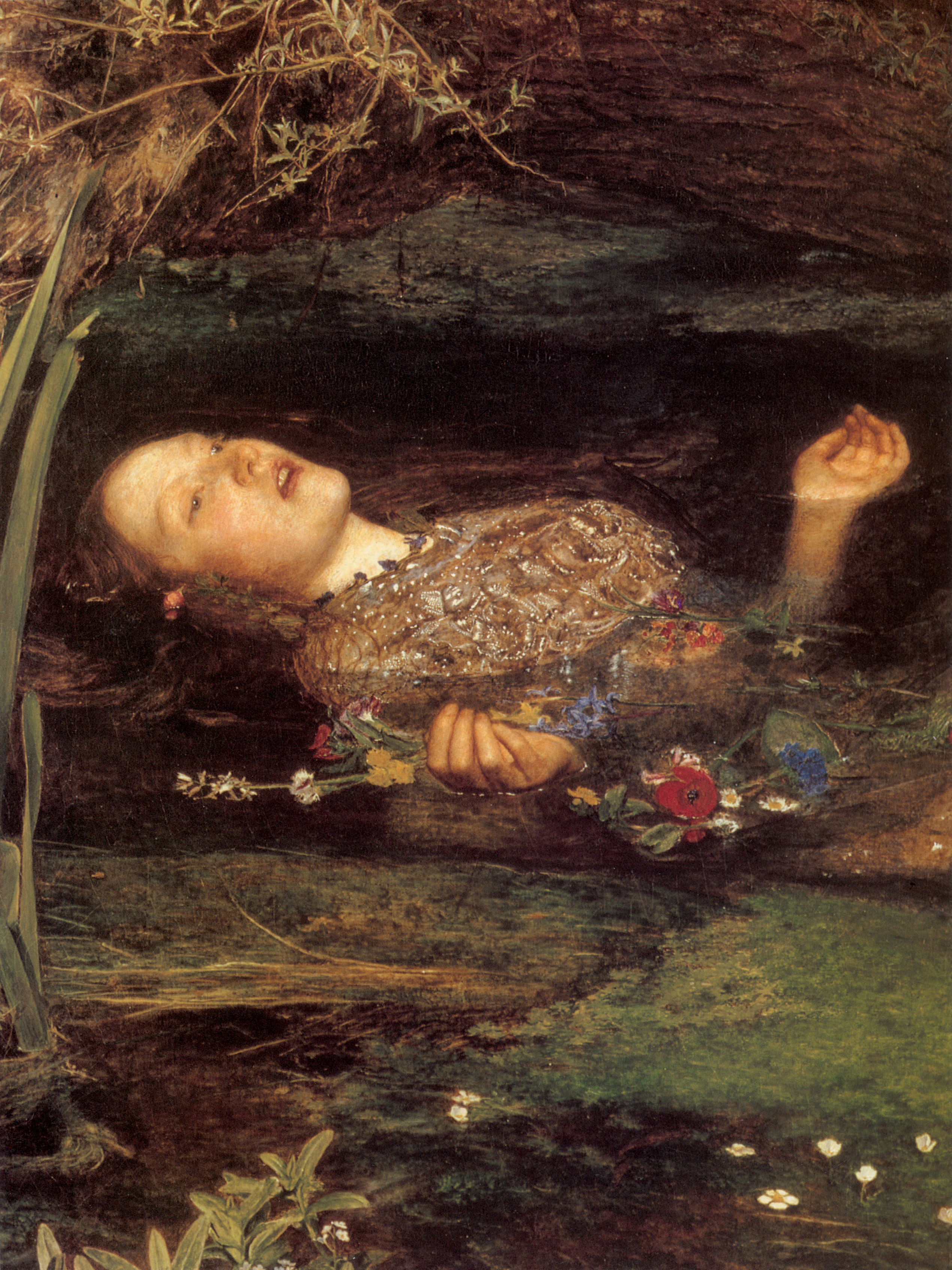
Detail from Ophelia, John Everett Millais, 1851-52.
The title of my paper was “The Aesthetics of Female Suffering”, which owed a great deal to Poe’s line from “The Philosophy of Composition”, in which he states that “the death…of a beautiful woman is unquestionably the most poetical topic in the world.” I was trying to make sense of the different ways men and women related to Ophelia. Women seemed to invoke her like a patron saint; men seemed mostly interested in fetishizing her flowery, waterlogged corpse. I tried to argue that Ophelia resonated because Shakespeare had made an extraordinary discovery in writing her, though I had trouble articulating the nature of that discovery. I didn’t want to admit that it could be something as simple as recognizing that emotionally unstable teenage girls are human beings. It would be depressingly close to admitting that a male writer would have to be as gifted as Shakespeare in order to come to a conclusion like that.
About a year ago, I made a post on Tumblr that went viral: it was a photo set of eight portraits of Ophelia, with text from the play. I’d never had a post go viral before, and it reminded me that I wasn’t just imagining things back in the days when I was seeing the face of Ophelia in my breakfast cereal. She is incredibly popular, and she resonates with people in a powerful way. I think it may be for the same reason that I reacted to her so intensely: she explodes the incredibly harmful myth of the melodramatic teenage girl.
When Ophelia appears onstage in Act IV, scene V, singing little songs and handing out imaginary flowers, she temporarily upsets the entire power dynamic of the Elsinore court. When I picture that scene, I always imagine Gertrude, Claudius, Laertes, and Horatio sharing a stunned look, all of them thinking the same thing: “We fucked up. We fucked up bad.” It might be the only moment of group self-awareness in the whole play. Not even the grossest old Victorian dinosaur of a critic tries to pretend that Ophelia is making a big deal out of nothing. Her madness and death is plainly the direct result of the alternating tyranny and neglect of the men in her life. She’s proof that adolescent girls don’t just go out of their minds for the fun of it. They’re driven there by people in their lives who should have known better. I think Shakespeare probably understood that better than most people do today.
Back when I was still wrestling with my imagined destiny as a writer stamped in the mold of Plath and Sexton, I felt a huge ambivalence; I sensed that in donning the mantel of the mad female poet, I would become something that was easily dismissed. But if I wrote what I wanted to write, there was no escaping the label. At the same time, I felt an intense attraction to women’s writing about mental illness. They wrote the kind of words that could burn the page they were inscribed on. The insipid male darlings of the literary establishment were limp as windsocks on a still day compared to them.
I don’t think I quite managed to make this connection when I was in college, but it’s perfectly clear to me now what Ophelia and the confessional poets have in common. It isn’t that their madness makes them powerful—mental illness doesn’t make you anything but sick—but when they find their voice and articulate the experience of their madness, they become devastatingly powerful. That is why I both longed and feared to walk in their footsteps. At nineteen, the idea that the more powerful a woman becomes, the harder society will work to dismiss her, was a paradox I couldn’t quite wrap my head around. But it accounts beautifully for why Ophelia means so much to so many people, and why critics of Hamlet have ignored her so studiously over the centuries. A girl like Ophelia, abused, abandoned, and stripped of options, is supposed to fade away quietly. But why should she? What has she got to lose? No one has more power to terrify than a person who is desperate enough to embrace madness and death. Just ask any young woman who has ever had to deal with people’s reactions to her self-harm, or her eating disorder.
A few years ago I did a line-by-line analysis of Hamlet on my old LiveJournal, and when I came to Ophelia’s first scene, it struck me that her first line in the play is a question that no one answers. Not so in her final scene. When she is interrupted, she interrupts right back. Laertes watches her sing and dance and name the properties of flowers, and observes that “she turns to favor and to prettiness.” Would Ophelia resonate the way she does if Shakespeare hadn’t turned her death into a beautiful picture, adorned with images of flowers and streaming hair and billowing gowns? In Reviving Ophelia, Mary Pipher describes anorexia as an attempt to wrestle bodily autonomy back from a society with punishing standards for women’s bodies: “You want me to be thin? Fine. I’ll be as thin as I want, and you can’t stop me.” Ophelia uses the outward forms of beauty and femininity to articulate her devastating grief, and in doing so, transforms herself from an object that is pleasant to look upon, into a person with a story that condemns and reproaches. She embarrasses, horrifies, and discomfits onlookers. She is impossible to dismiss; the only way to avoid confronting the indictment in her words is to turn your back on her completely.
Anne Sexton found that her confessional poetry about her struggles with mental illness produced similar embarrassment and distaste in her writing teachers. She responded by writing the poem “For John, Who Begs Me Not to Enquire Further”:
And if you turn away
because there is no lesson here
I will hold my awkward bowl,
with all its cracked stars shining
like a complicated lie,
and fasten a new skin around it
as if I were dressing an orange
or a strange sun.
It’s not romanticizing mental illness to feel that the poetry or art or songs that you manage to produce in spite of it is a triumph of Herculean proportions. There is a special beauty and power and strangeness in the testimonies of survivors. And Ophelia was a survivor up to the moment she died.

Ophelia, John William Waterhouse, 1910.
In 2001, my dormitory walls were plastered with art prints of every Ophelia painting I could get my hands on. For Christmas that year, my roommate gave me a gift bag containing a small Tupperware container full of water. Floating in the water was a little doll with red hair and a long dress, unmistakably reminiscent of the Millais print that hung over my desk. Doll Ophelia was later transferred to a larger bowl, where she floated serenely atop my bookcase for the rest of the school year. I still have her, though I’ve since let her dry out and retire to the shelf with my other dolls.
I no longer worry that having a distinctive personal voice as a female writer will make people dismiss me. The path I chose for my career means I don’t have to worry that much about being measured against the standards of people who dehumanize me. As a student, frustration and a sense of urgency drove me to write a fifteen page research paper, not for a grade, but because I thought it needed to be written. Nowadays, I no longer have to go to such extremes to make myself heard when I want to speak in defense of young girls. I don’t have to be Ophelia anymore; I left Elsinore, and I’ve never looked back.
In my opinion, the most tragic thing about Ophelia is that she didn’t have that option. When I think of her now, I like to picture her in the life she could have had, far away from the royal court, in the company of people who valued and respected her, with a garden of her own. It’s full of rosemary, pansies, columbines, daisies, and violets—hundreds of violets—not one of them withered.
Tags: b.n. harrison, literary obsessions, mental illness, ophelia, shakespeare, writing
Related Posts
 Performing Shakespeare on a Cruise Ship
 Multiple-Choice Reading Quiz Answers Actually Selected by Students in Classes I Taught as a T.A.
 How To Tell If You Are In A Shakespearean Comedy
 After Amy Tan: An Asian American Literature Roundtable
 The Resurrection of the Body: On Family, Mental Illness, and Grief
 Charm School

I don’t really know how to put it into words, but I thought this was fascinating. I love the way it captures that feeling of, “oh, I’ve just discovered and fallen in love with [thing]–now [thing] is in EVERYTHING EVER.”
I was at that NCUR conference!
oh wow, I hope you were not at my panel because it was a disaster. on the other hand, if you were, then we’ve definitely met, because there were only like 5 people.
One of my lasting grudges from college is the fact that i had a women’s studies paper rejected from NCUR for being “more of a meditation than a research paper” or something like that. In retrospect it’s probably best that I didn’t have to defend it in front of an audience?
Ugh this is amazing. Feminism! Shakespeare! Atheism! The patriarchy in regards to the Western canon! It’s got it all!!! But really I just loved this – any exploration of learning and growing and living as a woman is interesting, for me this one especially so because it hits on so many things that are dear to my heart.
Oh adolescence, pre-internet daze. I now have words for those feelings I had while reading Taming of the Shrew. Sure there was some humor but why can’t he just leave her the fuck alone? Does she have to accept this? Do I have to accept this? No and no, teenage self. Keep on shrewing.
“Keep on shrewing” is my new mantra.
SHREWS GONNA SHREW
This is simply phenomenal! Your observations are so spot on and, as a fellow Pre-Raphaelite fan (as many of us are), I salute you.
I was similarly Shakespeare obsessed as a teen, and Ophelia resonated with me with a similar set of revelations. To me it seemed like the overall interpretation/criticism of the character was wrong, and sure I was in high school and not a literary critic but so many men seemed to see her as tragic and innocent and essentially fluffy. They didn’t seem to get the spark or the power. This bothered me enough to compose a long poem, most of which was probably not good and happily forgotten, but there was a bit that went “enmeshed in these ideals/a veil of innocence/like thick tulle/so stiff there’s little left of you” so, there’s that.
I also re-wrote a good chunk of Hamlet where she poisons everyone and leaves, as a literary response journal entry. I was a fun high schooler.
I totally support this Hamlet fanfiction!
I love the idea of rewriting Hamlet. When I was in high school, I rewrote the end of Tess of the d’Urbervilles because I was enraged. Fanfiction before I knew what it was…
When I read Hamlet as a hs senior I was persuaded that Ophelia was brave because she killed herself and Hamlet just talked about killing himself but didn’t go through with it. I think that says a lot more about me as a teenager than the play itself.
“My advisor called it ‘fascinatingly close to being convincing'”.
I have to start working this phrase into all my legal arguments at work.
Hemingway’s suicide was just a footnote to his biography; Plath and Sexton’s suicides defined them.
Thank you! Mention that Ariel was the first book of poetry you bought and people glance surreptitiously at your wrists. Meanwhile dude writers in the south rhapsodize about Hemmingway and no one questions their gun ownership.
Hellllllp I love this article so much
I’m currently teaching an undergraduate class in confessional poetry, and it is startling to see how vivid and real Plath and Sexton are for my students, especially women students. They have not lost any of their power (while, I would argue, their male counterparts have).
I always thought it was funny that all these great revered male poets wrote about how delicate trees made them feel and shit, and everyone thought that female poets sucked because they wanted to write about gross stuff like their actual lives.
If you like Ophelia, this essay feels mandatory. http://www.wordriot.org/wordpress/wp-content/uplo… It’s FANTASTIC! As was this article, naturally. 🙂
Wow, this is beautiful! Thank you for writing it. This seems like blasphemy to say now, but I’ve never really found Ophelia extremely interesting before now, despite being a Shakespeare-loving English major. But this hit me in the heart AND hits my love of literary analysis.
I also had completely forgotten that Hemmingway committed suicide, and I am outraged at the unfairness.
This is really fantastic. Flashbacks to my college days included. Thank you for sharing this!!!
So not only did I identify strongly with your early college self, but my early college self perked up when you mentioned the withered violets. My username is taken from another lady poet’s novel, HERmione by H.D., and I put together this whole gallery of flowers with quotes from it when I was studying it in college and I didn’t think of Ophelia ohmygod I have to go reread that book again.
Edited because I was so excited to read the book again, I forgot to finish my comment. And to add a link to the gallery if you want proof of my nerdiness: https://flic.kr/y/c1thHP
oh man. those are beautiful! and i am mad I didn’t know about that book. I liked H.D. a lot in college and i would have been delighted to draw a tenuous connection between her and Ophelia.
I would have wholeheartedly agreed that it wasn’t tenuous and would have nodded my head knowingly and pointed to Ezra Pound and Eliot and the other modernists who were all about referencing Shakespeare (“Eliot views himself as Polonius in The Lovesong of J. Alfred Prufrock, after all” she said sagely) so it’s TOTALLY PLAUSIBLE that HD was redefining her youthful self and her failed relationship with Ezra Pound and failing out of college and no one understanding her through the lens of Ophelia, the flower-woman that her family had failed. Definitely going to go read the book again now, I meant to reread it for flower imagery to counteract the winter greys anyways.
My first Boyfriend of Significance decided to break up with me by asking me to read the “Get thee to a nunnery” scene with him.
that is. I am not even sure what to do with that, but if you had reported him to the police for plotting murder afterwards, I don’t think anyone could blame you.
though he did spend a fair amount of time in his room hating his stepdad, plotting murder would have been a bit ambitious for him. Luckily I had options other than killing myself in front of him.
… what the… what????
That. Last. Paragraph. Really the whole essay was just amazingly good and thanks for writing it.
*blinks away tears*
A few years ago I did a line-by-line analysis of Hamlet on my old LiveJournal
hahaha ok but, like, this was seven years ago and every cell in my body has replaced itself since then so I take no responsibility http://cesario.livejournal.com/329803.html
THANK YOU! I’m outta here (again, GOD I can’t believe how much time I’m having to spend DOING MY JOB lately), but I look forward to reading this tomorrow.
I binge read this entire thing in one sitting and it was amazing. It made me remember why I love Shakespeare so much. Thank you so much!
Thank you for writing this essay–everything in here is giving me nostalgic feelings. But this bit especially:
“Unfortunately, the paper I wrote on this subject wasn’t so much a piece of research, or even analysis, as it was an overly-excited Tumblr post written a decade before the advent of its proper medium. I can’t even really reconstruct my hypothesis at this point. I don’t think it was very coherent, though to be fair, it isn’t easy to be coherent when you’re nineteen and trying to make sense of misogyny for the first time.”
This was pretty much every paper I wrote in college, culminating in a massive, typo-ridden rant (i.e., undergraduate thesis) on gender politics in Sailor Moon. I had so much enthusiasm back then, and found it intoxicating to be able to apply literary theory to my personal obsessions (and get good grades for it!), but I don’t think I really knew how to construct a good argument, nor did I truly understand the value of proofreading, until well after graduation.
Oh man I identify with this too. I wrote an essay about gender politics in The Divine Comedy that has been lost through time and the steady erosion of changing file formats (fortunately). I don’t even remember what I argued, but I was pissed about patriarchy.
Argh, yes! Like, not Sailor Moon in particular, but that sort of wide eyed response to seeing Big Ideas embodied in the world around you! And then YOU have to draw people’s attention to it, or no one will ever knooow! Especially feminist stuff, because 15 years ago it felt like there was a good chance you really were the first person who ever noticed how feminist X text really was.
I am so utterly, pathetically grateful for the internet, I can’t tell you.
Valentine de Villefort was the one that made me angry enough to write papers like that. She ruined the whole book.
I saw the Millais painting in an exhibit on art and nature in Berlin in 2004 and I spent at least half an hour staring at it. It has an odd luminescent quality that gave me a very powerful urge to climb into the painting.
That’s because of the wet white ground! It’s a technique used in many, even most, Pre-Raphaelite paintings, and it gives that unmistakeable luminescent quality.
http://myfrencheasel.blogspot.com/2011/08/pre-rap…
This was just staggeringly beautiful. As a life long Hamlet fan, this so perfectly illuminated the confusing feelings I’d always had about Ophelia. Thank you for writing it and thank you Toast for existing so we can feast on wonderful pieces like this.
Man, this article brought back memories. I wish for you, that instead of being at a small liberal arts college surrounded by dudes who loved Cormac McCarthy, you had attended my small, private _womens’_ liberal arts college, where the professors were experts at coaching bright women through grappling with misogyny for the first time, and where our legendary Shakespeare scholar would have dug into her desk drawer that was stuffed with nothing by identical red pens (refreshed at the beginning of every semester) and said brightly, “but you don’t have a thesis!” And then underscored and scratched your essay and argued with you until you spit one out in a fit of exasperation. Would your life be better or worse now if you’d had that experience? I have no idea, but if I could I would give said experience to everyone who wanted it, and a few people who don’t. It was transformative.
I loved this article same as everyone else, and it reminds me of why I love to study literature, and why I love the Toast. Thank you!
Oh man I was not at a small liberal arts college at ALL, hahaha, sorry if I gave that hilariously mistaken impression. I went to a tiny, poorly funded state university in the south–in the Appalachian mountains, no less. But I too wish I could have had the experience of a women’s college, maybe as a refugee exchange student or something.
…huh. I think I just projected what little you did say about your school and made it as much like mine as would fit the words you used…sometimes, when someone says “college” to me I go back to mine mentally, and the way this essay examined that tendency we first learn to recognize in college of making things our own maybe exacerbated my mistake?
You would have been quite welcome among us. We had a lake to jump in and a lot of empty building space. My school is now coed, sadly, and has there by lost whatever pretension to uniqueness it ever had.
Oh man I was not at a small liberal arts college at ALL, hahaha, sorry if I gave that hilariously mistaken impression. I went to a tiny, poorly funded state university in the south–in the Appalachian mountains, no less. But I too wish I could have had the experience of a women's college, maybe as a refugee exchange student or something.
I am fighting the urge to send this to my old Plath-obsessed English teacher who valiantly tried to teach me Plath (and Hamlet!) when I was 17 and 100% allergic to poetry. (Sorry Mel! And sorry I refused to hand in drafts of any of my essays. And for writing my major comparative project on two completely random unrelated books, that was stupid.)
12 years later, I suspect that Plath’s work would resonate with me a lot more, so I might have to give it another try.
Beautiful essay! Thank you :).
In addition to writing fiction about teenage girls and blog posts about media, memory, and survival, you`d make an excellent psychoanalyst (particularly of the Jungian variety)… just saying as a convert from publishing to social work (who still writes on the side).
It’s not romanticizing mental illness to feel that the poetry or art or songs that you manage to produce in spite of it is a triumph of Herculean proportions. There is a special beauty and power and strangeness in the testimonies of survivors.
This.
Well I can only say that reading this was quite the experience. I have been obsessed with Ophelia for a decade, I have been reading and writing on her for a decade, and never could I figure out why I was so interested in her – as it turns out, you have just accidentally solved that mystery for me. Thank you for a rare moment of epic, Joycean epiphany.
And, if this was to make you interested in anything I wrote on the subject, here’s a paper I wrote during my Undegraduate:
https://nottsaesthetes.wordpress.com/2013/11/27/j…
This is wonderful. I admit to never having really gotten the motivation for Ophelia’s mental instability until recently. The best “production” of Hamlet I ever saw was a student-directed single scene, the nunnery scene, for directing class. Claudius and Polonius had hidden themselves “above,” (on the balcony) for their eavesdropping. Hamlet was very physical with Ophelia, pinning her to the stage and nearly raping her. At the height of that commotion, Polonius steps out from behind the balcony curtain to look down at Hamlet and Ophelia. Hamlet’s back is to him, but Ophelia, pinned down and struggling, sees her father. Their eyes lock for a long moment as she pleads silently for help, and Polonius…steps back behind the curtain. That is the moment she loses her stability, and it’s crystal clear why. [Edit: And for me, it completely rewrites her mad speech because, for her, THIS is the moment that Polonius dies. He dies as her guardian and protector, and his actual death gets mixed up in her mind with this moment.]
“She’s proof that adolescent girls don’t just go out of their minds for the fun of it. They’re driven there by people in their lives who should have known better.”
THANK YOU.
I hope you recognize the absolutely heroic level of insight and courage it took you to figure this out. Everything in our culture is weighted towards obscuring it, and virtually no one acknowledges it – the people who are complicit in driving young women mad won’t do it, and the women they drive mad usually can’t. Realizing it, and then having that realization validated by an external source, is vindicating in a way that few things short of divine revelation can be. No wonder you were so besotted.
Really, this is such a wonderful post. I’m grateful to you for writing it and to the Toast for sharing it.
I was just thinking, “Woah, this is really interesting and lovely,” and wittering about Portia vs. Ophelia as models of female power, and then I realized I USED TO READ YOUR LIVEJOURNAL. Religiously. You were literally the first blog I read whose author I didn’t know personally.
God, I love the internet.
omg hilarious
I miss LiveJournal so much. Tumblr just isn’t an adequate substitute.
Ophelia is resurrected as a badass protagonist in the ‘Choose Your Own Adventure Hamlet’ book! Which works exactly as it sounds. I got mine from Amazon for Christmas. Yes I am a Shakespeare geek and trying to write a research paper on it…just because I can..I love this post and think you should seek out Shakespeareacademia and crush the form to your will 😉
Brilliant. Reminded me of this really incredible new composition called “Let Me Tell You” commissioned by badass Canadian soprano Barbara Hannigan. The text takes every word given to Ophelia by Shakespeare and reorders them to retell the story from her own perspective. I won’t say more- you should watch her interview! https://www.youtube.com/watch?v=IxKkRWTiWDo
I am similarly obsessed with the myth of Persephone, which I have written twice and acted once, and now I want to write it a third time and incorporate some of this thinking. In the myth it’s Persephone’s mother who goes mad, but the two goddesses are sometimes conceived as two aspects of a single entity…
My Persephone feelings are totally wrapped up in my Ophelia feelings. I had a bit in this that I took out where I waxed a little TOO eloquent about Ophelia’s significance, and how she was like a demigod, an avatar of Persephone, and also Delirium of the Endless is totally modeled on her.
Rossetti’s Proserpine painting of Jane Morris is hanging over my bookshelf as we speak.
My Persephone feelings are totally wrapped up in my Ophelia feelings. I had a bit in this that I took out where I waxed a little TOO eloquent about Ophelia's significance, and how she was like a demigod, an avatar of Persephone, and also Delirium of the Endless is totally modeled on her.
Rossetti's Proserpine painting of Jane Morris is hanging over my bookshelf as we speak.
You know what, though? I actually will stake out ground here, and say no, my madness does make me strong, not just sick. My mental illness is not only crippling but also uplifting. I see the world better for it, it helps and hurts in similar measures. It is not uncomplicated sickness but rather a part of me that cannot be denied, and that society has tried to deny. Men are allowed madness (and for that matter, extreme idiosyncrasy that somehow is never labeled mental illness) as part of their genius. I should be allowed the same.
Your ponderings are key however executed amazingly well. Imagine tailing you and graph your site structure make.
I am absolutely floored by this piece. Ophelia has been very much my patron saint as I’ve been ill. I did an assignment in art school last year relating her to that very excerpt of Plath’s Tulips.