
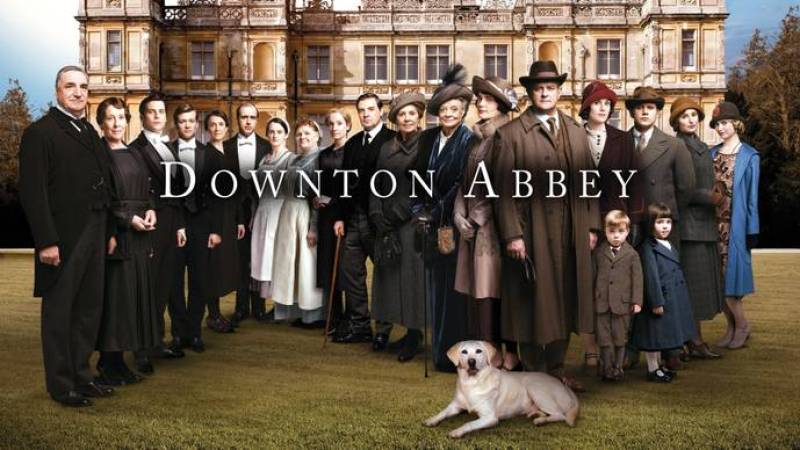
Previous installments can be found here. There will be spoilers. “An historian” is a perfectly acceptable Commonwealth convention, haters to the left [side of the road].
 Lady Rose, blonde, pink, and charming, is the embodiment of the “English rose” ideal. In Sybil’s absence, she’s also become Downton’s main force of multiculturalism. Last season, she enjoyed a flirtation with Jack Ross, the black American jazz singer. But that relationship was a leap too far, apparently. This season, she’s linked instead with a wealthy, fair, handsome Englishman endowed with only one vector of difference: he’s Jewish.
Atticus Aldridge’s family came to England from Russia in the mid-nineteenth century, fleeing waves of pogroms there against Jews. They joined a religious community with a long history in England. In 1290, Edward I expelled the Jews of England, a group which had dwindled to about two thousand in the face of rising persecution. At the urging of radical Puritans who believed that the conversion of Jews was linked to ultimate redemption, Jews were allowed to resettle in England beginning in 1656.
By the middle of the eighteenth century, about seven to eight thousand Jews lived in England, mainly London; they were largely descendants of Ashkenazi immigrants from elsewhere in Europe. They worked mainly as traders, peddlers, and shopkeepers. Historian Todd Endelman offers an evocative catalogue of the wares associated with them: “oranges and lemons, spectacles, costume jewelry, sponges, dried rhubarb, lead pencils, inexpensive framed pictures” in London, and in the countryside, “shoe buckles, watches, watch chains, rings, snuff boxes, crystal buttons, shirt buckles.” Charles Dickens twisted this context to draw the anti-Semitic portrait of Fagin, the fence and pick-pocket chief of Oliver Twist (1838).
 Benjamin Disraeli
Yet the nineteenth century saw the transformation of the English Jewish population, which became increasingly middle-class and socially respectable. Some successful families converted in order to continue their social ascent. Benjamin Disraeli is the most famous example: after a dispute with his synagogue, Disraeli’s father left the faith, and Benjamin himself converted to Anglicanism at twelve. He went on, of course, to become Queen Victoria’s favorite prime minister, the architect of the modern Conservative Party, and a prolific novelist. Despite all that, his opponents used stereotypes about Jews against him throughout his career.
Atticus’s family would have fit in well in this bourgeois scene. But they would have been exceptions. In general, the waves of immigration from Russia and Eastern Europe opened a schism in the English Jewish community, between the well-off families who had become fully English and the new migrants, impoverished and, from the point of view of mainstream England, doubly foreign. The arrival of 120,000 to 150,000 Eastern European Jews between 1881 and 1914 utterly changed the demographics the English Jewish community, sparking new patterns of anti-Semitism and xenophobia as well as new restrictions on immigration.
Lord and Lady Sinderby, Atticus’s parents, are prominent, wealthy, and well-connected, both within the Jewish community and beyond it. Yet as they make clear to Lord Grantham, prejudice still comes as no surprise. In interwar England, Jews faced membership bans at golf, tennis, and motor clubs as well as overt discrimination by restaurants, hotels, schools, and employers. Offensive stock characters populate the literature of the period: there’s hardly a Dorothy Sayers novel without a walk-on greedy Jewish moneylender. When Leonard Woolf proposed to Virginia Stephens in 1912, she cited his religion as an obstacle, though he was as wholly English as Atticus Aldridge. In 1930, Virginia Woolf remembered her feelings: “How I hated marrying a Jew—how I hated their nasal voices, and their oriental jewellery, and their noses and wattles—what a snob I was.” Rose’s calm acceptance is startling set beside this frank admission of prejudice.
Still, discrimination and hate are never the only relevant contexts. Lord and Lady Sinderby want to expand beyond London and Manchester and establish themselves in the heart of English county life. It’s true that, as usual, the denizens of Downton are amazingly tolerant, eliding the realities of contemporary anti-Semitism. But this is not pure anachronism. Remember that Rose met Atticus while helping non-Jewish, aristocratic Russian refugees from the Bolshevik Revolution, not poor Jewish refugees from pogroms and war. Their link is class; religion is incidental. The Crawleys might well have accepted the Aldridges, leaders of the Jewish community, even while flinching from lower-class Jewish residents of the East end. There is a long tradition, in Britain, of managing diversity through a process of co-optation into the larger structures of hierarchy.
 North London synagogue, 1885
David Feldman describes this as a tradition of “conservative pluralism.” Far from being radically xenophobic or narrowly homogenizing, the British establishment has, over the last two centuries, consistently placed pluralism at the heart of its legislative approach to minorities. Restrictions on Catholic participation in government were ended in 1829, while Jews were long exempt from bans on working on Sunday as long as they observed their own Sabbath. The second example suggests what’s conservative about this: diversity is acceptable as long as it fits into larger patterns of tradition and deference. In a terrific article, Feldman uses the more recent example of the consistent accommodations made for Sikhs to wear turbans on the job, in spite of union opposition, dress and safety codes, and so on. Why? To a significant degree, in order to support conservative elements within the Sikh community itself, while contributing to a social system based around conservative community leadership of all sorts. Feldman concludes: “In this way the politics of multiculturalism as it is practised in the UK is doubly conservative. It buttresses the position of an otherwise beleaguered Anglican establishment and at the same time it buttresses the position of religious hierarchies and their religious identities within minority communities.”
The appalling behavior of Lord Merton’s sons underscores this point. Larry picks on the family’s “strange in-laws,” citing the Irish Tom Branson as well as Atticus Aldridge, but Isobel Crawley is the real target of his ire. This makes sense for personal reasons, but it’s also consistent with a conservative pluralism willing to tolerate differences of ethnicity and creed as long as they do not undermine the working of the hierarchical order.
Sources
Todd M. Endelman, The Jews of Britain, 1656 to 2000 (Berkeley, 2002)
David Feldman, “Why the English Like Turbans: Multicultural Politics in British History,” in Feldman and Lawrence, Structures and Transformations in Modern British History (Cambridge, 2011)
Lara Trubowitz, “Acting like an Alien: ‘Civil’ Antisemitism, the Rhetoricized Jew, and Early Twentieth-Century British Immigration Law,” in Bar-Yosef and Valman, ‘The Jew’ in Late-Victorian and Edwardian Culture Between the East End and East Africa (Houndmills, 2009)

I love Rose’s naive inclusivity. “Some people are anti-Semitic? How odd! We’re all just, like, people, y’know? We go to clubs and have dinner parties and enjoy a good steeplechase now and then, I don’t see why anybody should be silly and prejudiced about it, Mother.”
Also, Cousin Violet is our new misandry heroine.
Yes! She’s just privileged enough to have no idea why anyone would ever be mean or prejudiced and it’s adorable. Lady Rose has really become a favorite of mine this year, because she’s so different from all the rest of them–she hasn’t been touched by the kind of hurt and pain that the rest of the Granthams/Crawleys have, so she’s very sweet-puppy like. And despite the best efforts of her mother, she’s a genuinely kind person.
She just seems more real than a lot of the other Upstairs People. Robert is a casual bigot, except when he’s not, Cora welcomes everybody but has no real opinions, personality, or storyline of her own (except for being an A+ Mom), Edith is an unfortunate middle child who appears to be hated by the universe, Cousin Violet is Maggie Smith, etc. Rose, however, is a sweetly earnest Flower Child, who floats through life on a cloud of privilege and good intentions. She wouldn’t actually attend an Occupy Wall Street protest, but she’d ask a lot of sweet, frustrating questions about how anybody could be so mean, and if there hadn’t been just a series of misunderstandings.
Isis :(((((((((
Let’s all take a moment and appreciate that Robert seems more emotional about his dog’s cancer than about his daughter’s heartbreak, ongoing emotional breakdown, and disappearance.
Did anyone else take the scene in which Robert shares the sad news about Isis while Edith attempts to wrangle permission to bring her secret daughter into the house to be heavily implying that Marigold wouldn’t have made it into the Downton nursery if Robert hadn’t been distracted by the dog?
This is true. Man, Robert’s useless. Which is, of course, why men don’t have rights.
Robert is a British Man. He is UNABLE to relate to his daughter’s heartbreak. He can however relate to his dog’s cancer because it hurts HIM.
Robert’s allowed to care about the dog.
Absolutely, and I personally would be heartbroken about the dog. It’s just that he should probably try to show as much concern for his daughter.
Well, of course he “should,” but I get the very distinct impression that Robert tries to stiff-upper-lip, Upstairs his way through life while actually being a fairly emotional human, and Isis is/was a safe outlet for him to express feelings at/about. Should he show more concern for Edith, absolutely, no question about it.
My point was exactly that, in fact. His aristocratic emotional constipation keeps him from going to pieces over his daughter’s breakdown, but he can’t quite contain his grief over his beloved dog. His priorities are lousy, is my point. Because he is both Rich and a Man.
I mean, it’s also related to his control over his universe. He’s supposed to be able to protect his dog, as it’s absolutely his. He’s supposed to protect his daughter, but I think he recognizes Edith’s agency at least a little, and thus this doesn’t make him feel quite as helpless.
Also, Isis 🙁 🙁 🙁 🙁 She’s a good dog.
The reason she left is just reinforced.
Have we already talked about how odd the sneaking-in of Cora’s Jewish father is? I’m not an expert on Judaism/anti-Semitism in late nineteenth/early-twentieth century England, but it seems to me that it would have come up before now. (I’m assuming the decision wasn’t made before “Levinson” was selected as her maiden name one or two seasons ago.) Could her Americaness have shielded her from being perceived as a double outsider? How ahistorical is it for the Crawleys’ Jewishness to simply not come up?
There’s so much about the Crawleys’ social position that seems odd to me. In Cora’s case, it was clear from the conversation that she was raised Christian, so that plus the overwhelming fact of being American new money probably overshadowed her father’s religion.
But the fact is that the Crawleys lead incredibly quiet, retired lives given their apparent position as a leading county family. Why is this? If this were real life, I’d be tempted to speculate that they are, in fact, cut off from the best society by Cora’s background, Robert’s lack of facility with money, and so on. In other words, I’d say they talk a good game but are really marginal within the upper class.
But this is a TV show, and I think that really the makers just want to make the most of Highclere Castle as a set. See, for instance, the bizarre decision to hold the dinner introducing Isobel to Lord Merton’s sons at… Downton. If it doesn’t happen at the Downton dinner table, it doesn’t happen!
All of which is to say, I don’t think the writers of the show have any interest in working out the real ramifications of Cora’s father’s religion.
This type of situation is referenced in Edith Wharton’s ‘House of Mirth’, where she makes it clear that Jewish merchants were growing ever more powerful in American society in the late 19th century. The Jewish character in that book is not really practicing — it’s just sort of known that he is Jewish. He’s not interested in finding a Jewish wife — he’s interested in finding a wife who will help open the doors of old NY society. So, if that’s what Cora’s father did, he likely didn’t care about raising the kids Jewish, and she probably doesn’t identify that way at all. I would guess that in English society, they would care much more about what religion the husband is than the wife, given the deep gender disparities in power & consequence.
Also, it was a thing to import a rich American heiress to refill the great house coffers at the time Cora and Robert were getting married. Consuelo Vanderbilt is the most famous example: http://en.wikipedia.org/wiki/Consuelo_Vanderbilt. Everyone knew why aristocratic men were marrying women like Cora, and probably didn’t care that much about their backgrounds as long as they behaved themselves and assimilated.
Unfortunately, I think that your point about the Downton Dinner Table is correct. I would agree that the writers are just clueless, and not that they are making a subtle point about the Crawley’s standing in Yorkshire society.
I think Cora is supposed to be based on Lady Curzon (born Mary Leiter in Chicago). Jennie Churchill is another famous example. The dollar princess thing is easy to overestimate – American and European rich people mixed in the same social circles so it’s not surprising some of them married each other. Some dollar princesses married ‘sterling princes’ (i.e. rich middle-class men) and there were also marriages between rich middle-class British women and rich American men. But the dollar princess idea crystallised a lot of fears in Britain at the time that the aristocracy was in terminal decline and had to be supported by these socially-dubious women.
I think the fact that her mother isn’t Jewish is key. Judaism is matrilineal and Cora was raised some sort of Christian, so she’s not “really” Jewish – she has no connection to Jewish religious practice and her daughters are even further removed from being Jewish. This is, of course, a 21st century understanding of the circumstance and I’m not sure it holds up in the same way in 1920s England. I’ll be interested to see how the issue of Jewish identity plays out against the background of rising anti-Semitism in Europe.
If Rose does marry Atticus, she is almost certainly going to have to convert, or she’ll at least be pressured to. Unlike Cora’s father, it seems like Atticus’ father is observant, so Jewish grandchildren are going to be important to him.
A historian BECAUSE THIS IS AMERICA DAMNIT
Seriously, though, I’d avoided watching this show and now I must because of your excellent analysis! So thank you.
Blame Canada! 🙂
So, the U.S. won the war of 1812, right?
I love this series of posts so much.
+1
Dorothy L Sayers’ depiction of Jewish characters is so weird (well, not for the time, but looking at it now). The Jewish characters are usually very stereotypical and often figures of fun, but at the same time she treats them reasonably sympathetically – Sir Reuben Levy is definitely admirable, and his murder is awful (as is his murderer), and his daughter ends up marrying one of Lord Peter’s friends. I doubt Sayers would have thought of her work as anti-Semitic, but the stereotypes make for uncomfortable reading.
I was just thinking about this yesterday! I wrote my dissertation on Sayers and Christie, and the social boundaries that their novels enforced. I’m also a Jew who has to contend with an AWFUL LOT when it comes to British literature, so, basically, I’ve given this some thought.
Sayers was accused of anti-Semitism even while she was alive– I was trying to find a quote about this, and Wikipedia was the first thing to pop up. In 1936, a translator of Whose Body? wanted ‘soften the blows against the Jews’ in the novel, and Sayers responded that she thought the Jews were the only people who came off well.
And… okay. I can see what she was trying to do. Here’s the thing: mystery novelists must rely on archetypes for their characters. Christie did it better than anyone (and I won’t go into her racism now), but Sayers mostly used it for comic effect, which is where you get all her lay preachers and spinsters and cooks. And lots of these were fairly offensive, but there’s a massive difference between parodying those of your own, majority race/ethnicity/religion/social standing, and parodying another, less powerful one, as Jews were in the 1920s and 30s. Also, many of the statements made are from individual characters, not the author. And I would argue (although have not done this research) that Sayers, who was living with a Russian Jewish writer at the time of her first few novels, was attempting to write his identity into the stories, though not particularly well. (He also left her and served as the model for Philip Boyes, if we’re going to relate all of the Wimsey characters to real people in Sayers’ life, which is a separate question).
But dating someone of a different race (and I’d argue that Jews in the 1920s were seen as a race) doesn’t make one not racist. Nor does treating a character as different but sympathetic. Sayers also wrote an essay for J. J. Lynx’s book ‘The Future of Jews in England’, published in 1945, but her essay wasn’t included, and nobody quite seems to know why– the only proofs seem to be at Wheaton College in Illinois. It could well be that it was just very offensive. I can’t find any sources that know.
Which is to say: I don’t want to have a problem with Sayers’ anti-Semitism, in the same way that I can give EM Forster a lot of credit for really trying to not be racist in A Passage to India. I love Dorothy Sayers, and Strong Poison is closer to my heart than almost any other novel. And perhaps it’s giving Sayers too much credit, but I’m still pleased to see Jewish characters in novels from that time, because often they’re just not there at all. I guess my point is: Sayers (and her contemporaries) absolutely have flaws that need study and thought, but I’d much rather that the characters are there than not.
This was… much, much longer than I was expecting, apologies.
Please don’t apologize, this is really interesting. Is your dissertation available on-line anywhere? As a long-time Agatha Christie fan, who’s very aware of her flaws, I would love to read an in-depth analysis along these lines. Joan Acocella, in a piece on Christie a few years ago in the New Yorker, argues that Christie’s stereotypes were deliberate, and intended satirically, but I think it’s much more complicated, and interesting, than that.
My dissertation is available nowhere, partially because it was a Master’s one, not a PhD, and partially because it was kind of a muddle, which I suppose is what I get for working and desperately scrambling for a visa at the same time that I tried to write it. It was also more specific. I wrote about a few of Christie’s 1920s novels, and Strong Poison/Gaudy Night/Busman’s Honeymoon, and looked at marriages and engagements in each of them, and what that said about the shifting lines of social boundaries: what was acceptable and what wasn’t.
In that context, Christie’s actually very liberal, as is Sayers. Both of them had weird relationship histories for the time, and their characters’ lives tend to reflect that.
The best critique I can recommend is Alison Light’s ‘Forever England: Femininity, Literature and Conservatism Between the Wars’.
Thanks Harriet. I read a number of things by Alison Light when she was with Feminist Review, in the 80s. I particularly remember her articles on Rebecca and on Margaret Irwin’s Young Bess, both of which were excellent. I don’t recall having read anything by her about Christie, though. I’ll have to look for the book. Thanks for the rec.
Alison Light is the best! Her recent books “Common People” and “Mrs Woolf & the Servants” are not at all about Christie but are also worth reading.
(and I won’t go into her racism now)
Oh go on, I remember one book where an Italian was dismissed as a suspect because the victim was poisoned and an Italian murderer would only use an emotional, passionate method like stabbing.
Briefly, because man, at 2 AM I should either be sleeping, working on my mystery novel, or applying to law school, but I couldn’t help it, this has been bugging me:
Okay. Christie had this idea that anyone could commit murder– Poirot says it a lot, but so do some other characters– so long as they had the right motivation. So, some people would kill for money, or love, or to protect their reputation or the life of someone else. Generally, in her novels, most characters have a secret that they’re hiding that gives them that motivation, and thus makes them a suspect. That’s what makes her novels so great: every ordinary, archetypal character has secret motivations, and it legitimises them as characters, making the ‘Anyone’ more real and interesting. HOWEVER, the ‘Anyone’ is only drawn from (upper-)middle classes, white, usually British world of the characters.
This is partially because Christie was bored with the idea that the foreigner was always a suspect, much in the same way that the butler, nor any of the other servants, commit the murders (unless they aren’t real servants, but a middle-class person in disguise). The ascribed motives of the ‘other’, which is anyone NQOCD (‘Not Quite Our Class, Dear’), are usually too one-dimensional to work in a murder– the idea that continental Europeans murder out of passion, without a motive, or that servants are always murdering for small amounts of money.
In discounting these motives, one could argue (and I am prepared to, to an extent) that Christie was overturning stereotypes, making the really terrifying places in Britain to be drawing rooms and middle-class holiday destinations. On the other hand, by discounting anyone ‘other’ as a suspect, Christie takes them out of the ‘anyone’ who can commit a murder– they suddenly lack the humanity she gives to her suspects, and stop being real people.
It’s not that Christie goes out of her way to be racist, it’s that neither her characters nor narrator notice people outside of the white-British-middle-class world in which they exist, but it’s to the extent that no one else appears at all. For them, as well, the likelihood for Christie that they could have a complex motive seems nonexistent. When characters in Christie are overtly, rudely racist, however, it serves to make them look bad.
I’m pretty sure I’m forgetting things here, but that’s the, er, summary.
This is so great. I’d love to know your thoughts about Murder on the Orient Express in particular–it seems to be that there’s so much dismantling of stereotypes going on in that novel, in exactly the way you’re describing here.
Murder on the Orient Express is a funny example, because of course everyone has the same motive. It’s also hard because the real murder took place years before, and the whole novel is a sort of secondary trial: the usual rules don’t usually apply, especially when it comes to the suspect. It has more ties with America that Christie really knows what to do with, since it’s based so closely on the Lindburgh baby. But, much like some fractions, if there’s a common factor we can just divide and discount it completely. Which means that I’m tempted to ignore the real motive, and look at everyone’s other secrets instead, at least at first, and the funny thing is that those barely exist.
When you take that out, I’m not sure how much the class structure is dismantled: the servants from the original murder are still serving in some capacity. Americans, because there are so many of them, get slightly more defined than they usually are, but just wind up being British with goofy expressions. The Swedish missionary and the Russian aristocrats function in similar ways: to diversify the people to the point that it’s absurd for everyone to know each other, or for there to be a coincidence. What singles out Murder on the Orient Express is the idea of a collective motive, a single secret that everyone can agree on. The characters are flatter than Christie’s tend to be, because they are not defined by individual grievances, but by a collective one that they all know. Instead of their stereotypes hiding a more complex inner life, as happens so often in the novels, their stereotypes are them: ordinary, stereotypical people using their collective ordinariness to blend in, and their joint venture to justify a murder that none would commit by themselves.
That all makes sense. I love the idea of ‘factoring out’ the murder motive. I think what struck me as destabilizing in Murder on the Orient Express is how, for the first three-quarters of the book, you think Christie is just writing these stereotypes: the talkative American woman, the passionate, slick Italian salesman, the repressive English governess, the aloof Russian aristocrat, the dense German servant, and so on. And then she just tears all of that right down.
I pulled it up to look at it today, but haven’t actually looked at it in a while. You’re right– the stereotypes are so clear there. I think what interests me about that is that they are those people, just with this other plan that they have– that’s why they’re there, that’s why they’re interesting in the narrative.
If it had an earlier publishing date, I’d want to make a stretch and say that their collective grief echoes the grief of wartime, but I won’t because 1934 is not the ’20s! Not everything is neat like that. (Although she does make the general personal, and I have such a fascination with the novels about the murder of an individual in a wartime setting.)
Two corrections to your excellent historical summar. First, the Jewish population in England prior to the mass immigrations beginning in the early 1880’s did not, as you suggest, consist “largely [of] descendants of Ashkenazi immigrants from elsewhere in Europe.” To the contrary, they were primarily Sephardic (often referred to popularly as “Portuguese” Jews). Including, of course, the Disraeli family; Moses Montefiore (whose family was Italian but was Sephardic in origin), etc. Second, Jews immigrating in the mid-19th century were not generally fleeing waves of pogroms, but immigrated for the most part for economic reasons. With a few exceptions (such as the Hep-Hep riots in Southern Germany, the Damascus pogrom in 1840, etc.), the waves of pogroms began in the early 1880’s, not before.
Much appreciated. The Ashkenazi point is drawn from Endelman’s book (pp. 41-2). He estimates that by 1720, Ashkenazim outnumbered Sephardim (the original resettlement population), and their numerical dominance only grew from there. But, this is not my field, and perhaps this is a more contentious assertion than I realized. And, agreed entirely that most Jewish migration to Britain was economic in the 19th century. Aldridge’s family’s backstory involves fleeing persecution in Odessa in the mid-nineteenth century, which the show glosses as pogroms in an earlier episode. But here again they’re exceptions.
My dissertation is available nowhere, partially because it was a Master's one, not a PhD, and partially because it was kind of a muddle, which I suppose is what I get for working and desperately scrambling for a visa at the same time that I tried to write it. It was also more specific. I wrote about a few of Christie's 1920s novels, and Strong Poison/Gaudy Night/Busman's Honeymoon, and looked at marriages and engagements in each of them, and what that said about the shifting lines of social boundaries: what was acceptable and what wasn't.
In that context, Christie's actually very liberal, as is Sayers. Both of them had weird relationship histories for the time, and their characters' lives tend to reflect that.
The best critique I can recommend is Alison Light's 'Forever England: Femininity, Literature and Conservatism Between the Wars'.
Briefly, because man, at 2 AM I should either be sleeping, working on my mystery novel, or applying to law school, but I couldn't help it, this has been bugging me:
Okay. Christie had this idea that anyone could commit murder– Poirot says it a lot, but so do some other characters– so long as they had the right motivation. So, some people would kill for money, or love, or to protect their reputation or the life of someone else. Generally, in her novels, most characters have a secret that they're hiding that gives them that motivation, and thus makes them a suspect. That's what makes her novels so great: every ordinary, archetypal character has secret motivations, and it legitimises them as characters, making the 'Anyone' more real and interesting. HOWEVER, the 'Anyone' is only drawn from (upper-)middle classes, white, usually British world of the characters.
This is partially because Christie was bored with the idea that the foreigner was always a suspect, much in the same way that the butler, nor any of the other servants, commit the murders (unless they aren't real servants, but a middle-class person in disguise). The ascribed motives of the 'other', which is anyone NQOCD ('Not Quite Our Class, Dear'), are usually too one-dimensional to work in a murder– the idea that continental Europeans murder out of passion, without a motive, or that servants are always murdering for small amounts of money.
In discounting these motives, one could argue (and I am prepared to, to an extent) that Christie was overturning stereotypes, making the really terrifying places in Britain to be drawing rooms and middle-class holiday destinations. On the other hand, by discounting anyone 'other' as a suspect, Christie takes them out of the 'anyone' who can commit a murder– they suddenly lack the humanity she gives to her suspects, and stop being real people.
It's not that Christie goes out of her way to be racist, it's that neither her characters nor narrator notice people outside of the white-British-middle-class world in which they exist, but it's to the extent that no one else appears at all. For them, as well, the likelihood for Christie that they could have a complex motive seems nonexistent. When characters in Christie are overtly, rudely racist, however, it serves to make them look bad.
I'm pretty sure I'm forgetting things here, but that's the, er, summary.
Murder on the Orient Express is a funny example, because of course everyone has the same motive. It's also hard because the real murder took place years before, and the whole novel is a sort of secondary trial: the usual rules don't usually apply, especially when it comes to the suspect. It has more ties with America that Christie really knows what to do with, since it's based so closely on the Lindburgh baby. But, much like some fractions, if there's a common factor we can just divide and discount it completely. Which means that I'm tempted to ignore the real motive, and look at everyone's other secrets instead, at least at first, and the funny thing is that those barely exist.
When you take that out, I'm not sure how much the class structure is dismantled: the servants from the original murder are still serving in some capacity. Americans, because there are so many of them, get slightly more defined than they usually are, but just wind up being British with goofy expressions. The Swedish missionary and the Russian aristocrats function in similar ways: to diversify the people to the point that it's absurd for everyone to know each other, or for there to be a coincidence. What singles out Murder on the Orient Express is the idea of a collective motive, a single secret that everyone can agree on. The characters are flatter than Christie's tend to be, because they are not defined by individual grievances, but by a collective one that they all know. Instead of their stereotypes hiding a more complex inner life, as happens so often in the novels, their stereotypes are them: ordinary, stereotypical people using their collective ordinariness to blend in, and their joint venture to justify a murder that none would commit by themselves.
I pulled it up to look at it today, but haven't actually looked at it in a while. You're right– the stereotypes are so clear there. I think what interests me about that is that they are those people, just with this other plan that they have– that's why they're there, that's why they're interesting in the narrative.
If it had an earlier publishing date, I'd want to make a stretch and say that their collective grief echoes the grief of wartime, but I won't because 1934 is not the '20s! Not everything is neat like that. (Although she does make the general personal, and I have such a fascination with the novels about the murder of an individual in a wartime setting.)