
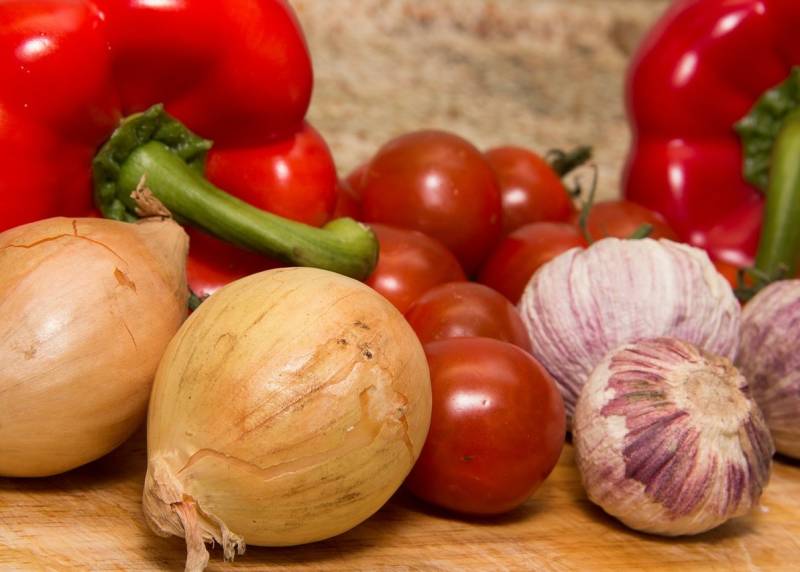
My mother is a sweet, humble woman until you get her to speak of Cuban food. To her, a Cuban immigrant, cooking is as much a part of the soul as any religious experience; a more logical way of approaching Transubstantiation, perhaps, though we are not at all religious. Had the Catholic Church been founded by Cubans, the wafer would be replaced by pastelitos guayaba, the wine with a cafecito. She calls the sofrito the Holy Trinity of Cuban cooking: the bell pepper, the onion, and the garlic. Combine these with olive oil, let them simmer, let the onion skin uncurl and loosen, let the pepper seep and soften, let the crushed garlic’s juices spread and join them all.
It is difficult to mention Cuba without discussing politics, whether directly or indirectly or handling questions as though the mention of being Cuban makes you a representative of the entire culture. (Yes, my family is Cuban; no, I am not a Republican; yes, I have opinions about the embargo.) So really, food is much easier to deal with. It’s an act of giving and love, as it is throughout many cultures.
But for my mother, cooking Cuban food is an act of remembering we are alive, this carrying of a culture that we are far away from; first the country, then the exile community in Miami where she grew up. For my mother and me, cooking is an act of giving yourself and sharing the culture you love to others.
I often wonder if this is why my mother is so picky about Cuban food being “right.” It’s not just the authenticity of the food. It’s the very real message in this food and its preparation: I’m alive; I remember.
One day, a Cuban restaurant opens in downtown Durham. The walls are the same sunset-yellow as my mother’s kitchen, the windows big and welcoming. A stereo plays the music of Mozart and Schubert but with Cuban musicians who add elements of salsa to the originals. And the food. The food is delicious, a pleasure. I purchase pastelitos guayaba and a café con leche (later, I purchase several pastelitos guayabas for my co-workers to show them what pastelitos are and to have them taste what I enjoy so much). I have never eaten one outside of Miami, or one that my relatives carried in a box on a flight from Miami. In that moment I taste the crispy, light and buttery dough, the thick guava paste. I remember my family, the gatherings that occurred late into the night, the card games of Continental at the dinner table, of the multiple conversations occurring at once and my attempts to follow them all like crossed fishing lines from sticks to water. The food is memory. I can still feel the sticky crust under my fingernails, the warm guava paste on the roof of my mouth.
Cuban cuisine is, perhaps, the strongest link I have to my culture. I speak very little Spanish (I’ve only recently been able to communicate effectively in English without sputtering over myself, mumbling, or leaving uncomfortable silences; wandering and unfinished sentences), though I understand Spanish better than I speak it. What I cook is the link to that culture, a sense of giving something to friends that overrides my vocal clumsiness, my social awkwardness and tendency to drift off or think of something and laugh in the midst of a conversation I was supposed to be listening to, or my panic attacks in which I cancel all plans and feel guilty for being so susceptible. It has only been in my late twenties and early thirties that I’ve had intense conversations with people, become close friends with people, and accepted who I am.
I’ve prepared food for my friends: the flan with raspberries and brewing cafecitos at the MFA program I attended, introducing friends to the rituals and preparations of coffee, the way you always offer it to a visitor—the way I have seen my mother and relatives offer coffee to visitors—the thick, melted sugar snug on the rim of the ceramic cup as we toast. The ropa vieja I shared with my patient and understanding roommate; my words messy and uncoordinated while the smell of garlic and simmering tomato sauce lingered in the kitchen. The congri for those I miss so dearly now: the poets, the journalists, the novelists.
I live with my mother in Durham because I can’t afford to live elsewhere. I live with her because she knows and understands my history of self-destruction. She knows that I carry every mistake, slight or significant or imagined, with me and judge myself without any inkling of forgiveness. Forgiveness and love are for others. My brain tells me this often, that I am here for others and not myself because there is no practical reason for me to exist at all. She has stayed awake with me for more nights than I can remember, even well into adulthood, in order to guide me off ledges I’ve created in my head.
About the raspberries.
I added them to the flan recipe handed down from my grandmother who hated cooking. The tartness of the raspberries is a wonderful contrast to the sweetness of the melted sugar. My mother, however, was reluctant to try this variation—to her, I’m still the daughter who mistakenly read 1 1/2 cups of water for a Betty Crocker chocolate cake as 11/2.
She has been hesitant to accept my other amenities to her Cuban food, especially the ropa vieja, the Cuban national dish that translates as “old clothes” due to its shredded appearance. I don’t shred the steak. For me, the cost is such that I would prefer to eat it in chopped sections than wafer-thin shreds. The pepper and onions are a thicker cut than necessary. I sometimes eat the meal as a soup rather than with rice, thereby adding more red wine, more tomato paste and sauce than is necessary. The meal is supposed to go with rice.
Also, there is the example of how I use the sofrito, the trinity of the onion, pepper, and garlic. Combine this with olive oil, and you can make anything. After my stint of working in a deli in the Midwest, I added Polish sausages and kielbasa to the meal, or used turkey sausage and added a bit of apple cider to de-glaze the onions and create a rich sauce.
My mom doesn’t tell me outright her opinion of these changes, but I get a hint whenever I offer to make dinner: she suggests she prepare it, despite any protests on my part.
I decide to take my mother to the new Cuban restaurant. She eats croquettes and a drinks a cafecito; we devour the Cuban bread. My mother eats the food and I ask what she thinks. She wonders if something is withheld, that the spices are not as profound as they should be.
My mother asks the owner’s wife about the food, and I remember how the wife asks when my mother arrived to this country. 1964, my mother says, knowing and assertive; it’s a year she speaks of in piecemeal memory: rifle pointed at her head, one suitcase for a family of six. The owner’s wife nods, says My husband left in the ’90s. The spices you know of—like saffron—were just not available. or too expensive for a food ration card. To him, an onion was a spice. This is the type of food he grew up with, the food he knows.
And I think: This is authentic Cuban food.
When I drive us home from the Cuban restaurant, my mother is silent. No doubt the reality has hit my mother that the culture she once knew is gone, several generations gone, in fact. Not just the locations of schools or shops, but all the way down to the preparation of food. All she has of Cuba are photographs and a teacup.
I don’t know what the changes to the new relations between Cuba and the U.S. will do. I do know that each time someone says they’re excited to finally get Cuban cigars and rum, to visit the country before the United States ruins it and all the old buildings become Starbucks, I cringe. I simply hope these changes will allow Cubans to eat without ration cards, to dissent, to create art without fear of imprisonment.
I think of the shop owner and wonder if in twenty years he will feel the same way as my mother, that the Cuba he knew will be gone, too. The Cuba that my mother remembers. The Cuba where one day I will see where my parents and grandparents lived, where my relatives are buried, all of whom lived in very different Cubas from the previous generation.
I wonder: if we define our Cubanness through cuisine, how do we reconcile these legitimate and different viewpoints within this diaspora and reunification? Perhaps it is in the act itself that can remain despite the strong divide: the knowledge of being alive, of affirming it, of sharing, of loving.
And that is authentic.

I keep coming back and re-reading this – it’s beautiful. Thank you so much for sharing with us.
I grew up in Cuba, well, in Guantanamo Bay as a Navy brat (ages 6-11). I never quite understood the politics behind why I was there, or why I couldn’t travel, but the one facet of Cuban culture I was exposed to was the food. Every Friday like clockwork my family would go to the Cuban Club and chase chickens around, watch an I Love Lucy DVD we brought from home, or press flowers underneath the plastic tablecloths.
Reading this back I can almost taste the fatty, chewy bread and thick wholesome spice, and the custardy flan we would get as a treat every fourth of july. Gorgeous.
Wonderful, truly 😀
The part about the husband leaving in the 90’s, and how authenticity changes and is relative, was beautifully included. What is Cuba going to be like in 5 years?
Excellent writing.
Authenticity is always a moving target, isn’t it?
Yes! This exact observation set me free from so much angst.
Anytime I hear someone say something about wanting to visit Cuba “before everything changes,” it’s all I can do not to smack them upside the head and remind them it’s an actual country filled with actual people, and not a goddamn theme park.
This was lovely, and now I also have a massive craving to hit up my local Cuban joint.
OMG. And hello, it’s been changing… the whole time.
And if you mean before it changes politically… well hello, it’s been changing THE WHOLE TIME. You think there were Varadero resorts in the 70’s?
OMG, are you me?
Granted, I’m only media Cubana, and my favorite pastelitos are the coconut ones (though guava and cheese is a closer runner-up), but my Spanish is crummy and I live a life far removed from the culture of my grandparents. I rejected their politics, and I got my religion from the Protestant side. I have a rosary in my jewelry box anyway, though, because I brought it home from the Vatican for my grandmother when I studied abroad in college. I received it back when she died.
My grandparents are gone now. All I have is the recipes, the black beans, the flan I grew up making with my abuela (PSA: she cooked lime peels in with the caramel and removed them before assembling the flan to bring a tart/bitter edge to the sweetness). I make them to remember; I am the keeper of family recipes. I sprinkle a little chopped cilantro over the shrimp Creole. “That’s really good,” my dad says between bites. “Your grandma never used it, but it’s good.”
Your writing is beautiful, and thank you for putting this experience of Cubanness into words.
Oh, I’m gonna recommend the lime peel idea to my wife (she is Cuban and makes flan fairly often. We have also done with rum or coconut).
She gets grief from her mom for using ham hocks in her black beans.
This was such an interesting and wonderful piece. I recently had the luck to visit Cuba as part of an authorized program for US grad students. One of the most fascinating parts was getting to speak to Cuban business owners about the experience of running a business and making a living in a Communist state. Restaurant owners told us about their monthly trips to Miami now that travel restrictions are looser–they go with empty suitcases and bring them back full of spices. The system of warehouses that exists in Capitalist countries to sustain businesses like restaurants is simply non-existent in Cuba currently, not to mention the US-imposed international regulations on shipping anything there. But we also visited the brand new state-of-the-art port in the new special economic zone, for which the government is currently accepting proposals from an international community to co-develop businesses. Things are changing in Cuba and the people I spoke to are very hopeful the changes will be permanent this time, which hopefully means the food that the author’s parents knew won’t be lost forever in their homeland.
This was such a gorgeous piece, Ana! So happy to be able to see this on The Toast. (P.S. Was I the roommate?!)
Another media-Cubana (located in NC also) weighing in to say what a lovely piece this is. My Anglo husband is the cook around here and we’re trying to keep the Cuban recipes going. We do lechón on the 24th of Dec–in fact, he’s getting ready to write an article about it for Our State Magazine. When it comes out, I’ll jump back on here and link to it. Thanks for a great look at what it is to be second-generation and trying to stay connected!