
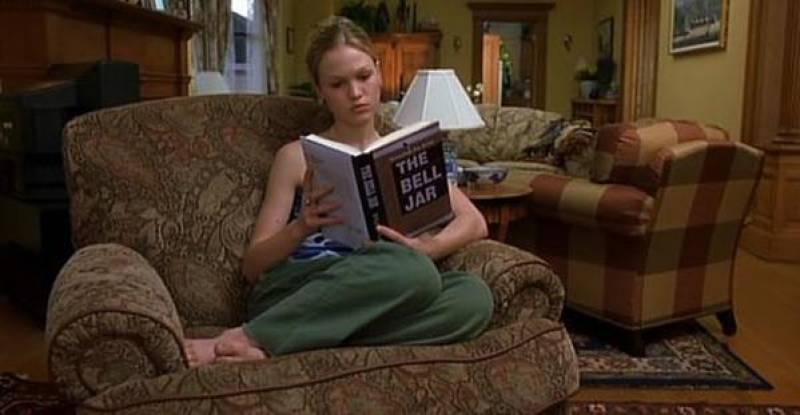
I’m going to go ahead and say nobody has ever had a problem with the straight plot of a story. We are willing to suspend our collective disbelief to the point where it’s not the existence of Hunger Games themselves that don’t make sense, it’s whether a teenager is in love with one teenager or another teenager or neither teenager that makes us confused and angry. That has nothing to do with plot and everything to do with storytelling. Give us context and we will argue with it, but give us a straight story and we’ll live happily.
This is why every book should be replaced by its Wikipedia plot summary.
I discovered this after watching some show in which they make a joke about The Cider House Rules and abortion, and despite having definitely paid rapt attention to a summer camp production of the play, I remembered no such plot. The Wikipedia page takes five paragraphs to explain everything and uses phrases like “traumatic misadventure with a prostitute” and “She eventually becomes an electrician and takes a female lover, Lorna.” In five paragraphs we see exactly how Homer turns from naive moralist to reluctant abortionist. How long did it take John Irving?
Do not make me decipher your intent. Do not assume allegorical common ground. Do not make me pay attention to your god damn motif. Tell don’t show, like Wikipedia.
There are books I could never fully love because I thought the characters were too stupid for their own good, books that gave me the literary equivalent of “don’t run up the stairs!” Wuthering Heights, perfect example. Instead of the infuriating back and forth over why Catherine and Heathcliff can’t just get over themselves and be together, it’s put plainly. “Catherine confesses to Nelly that Edgar has proposed and she has accepted, although her love for Edgar is not comparable to her love for Heathcliff, whom she cannot marry because of his low social status and lack of education.” Boom, easy. It’s 1845 or something, marriage is not for love.
You may think me joyless, but you know what’s really joyless? Reading a story that could have been 300 pages shorter if Heathcliff and Cathy just freakin’ talked to each other. Wikipedia summaries get rid of all that. There is no arguing with a plot; it is as close as we come to fact in fiction. When reading the Hunger Games you can yell at the uncaring pages for days over whether you think Katniss should choose Peeta or Gale or be mad at Gale for being a jerk or Peeta for being boring. On Wikipedia, you do not get to argue about anything because that’s just what happened.
Do not give me options. Do not give me a way to disagree with you. Just tell me what is and move on.

“Show don’t tell, like Wikipedia.”
But… Wikipedia is telling! That’s why you like it, I thought.
Yeah, Wikipedia is pretty much the definition of telling instead of showing. Instead of beautifully illustrating the main theme with various detailed scenes, it says, “The main theme of the book is the loss of innocence.” Or whatever.
THESE ARE NOT THE TYPOS YOU’RE LOOKING FOR
She said ‘tell, don’t show.’
It’s been changed–see Jaya’s comment above yours.
“This could have been 300 pages shorted if the characters just talked to each other” is frustrating in fiction, but it is SO MUCH MORE FRUSTRATING in plays. I read and see a ton of plays, and I just CANNOT with 15-20 minute scenes in which characters talk at each other, talk around each other, do everything except actually communicate. It just feels like delay being substituted for drama. I realize that people talk past each other in real life all the time. I do not think this is an excuse. I’m not saying that everything needs to be a Kushner or Stoppard play, but at least give me some engagement.
But Wilde is still OK, right? Otherwise there wouldn’t be any play at all.
oh, this stuff is perfect when played for laughs. Ask me to take it seriously, though, and I’ll just want to yell “YOU ARE MISUNDERSTANDING EACH OTHER” at everyone involved.
Wilde? 100% okay.
OLEANNA by David Mamet? ON NOTICE. (I mean, also for the thick air of misogyny. But mostly because if either of the characters let the other finish a sentence, the play would be five minutes long and SO MUCH BETTER.)
See also every superhero comic where “good” super teams fight each other because of a misunderstanding.
I raise this banner the highest a banner can be raised, and submit that many feelings-related discussions should be so regulated.
Gandalf confronts the Balrog, but in their struggle, both fall into a deep chasm.
Wikipedia’s plot summary makes this scene sound like a poorly staged intervention.
Just imagine if it had worked, though. Balrog and Gandalf hug it out, Balrog really wants to make amends, Balrog helps them walk the Ring into Mordor–who’s going to stop them? Shelob? FOOTSTOMP, SCRATCH ONE SPIDER–and sinks the Ring into Mount Doom outside the three-point line, a little showoffy but hey, gets the job done. Balrog comes back to the Shire, flicks Saruman out of there like a stray booger, settles down and puts out a nice line of handcrafted soap.
I fail at geek for being kind of “. . .eh?” on LOTR but I would watch that forever. And I don’t even like Intervention the show!
I switched to Safari just now, purely so this page would load properly and I could thumbs-up your brilliant, brilliant comment
I love Wikipedia synopses. I read them furiously for all chick lit books and rom coms I don’t actually feel like reading or watching but sorry I WANNA KNOW WHAT HAPPENS IN SOMETHING BORROWED, OK?
And terrible looking horror movies! Where the end will NOT shock me, but dammit, after seeing the trailer eleventy times I just want to know what the demon’s damage is already.
Yes! I love to read Wikipedia plots of movies I never want to see. It’s weird.
Between Wikipedia plot summaries and the movie trailers feature on Hulu, I have been able to stay up to date on all the latest movies (for small talk purposes) while still keeping all my free time for things I actually enjoy.
Just yesterday I read the Wikipedia summary to Paper Towns, because the movie preview makes it look like half an interesting mystery and half a tired coming of age tale with a generic pixie dream girl, and my goodness, there were a lot more dead catfish than the preview led me to believe.
Great, Wikipedia, now that I know exactly how the dead fish were distributed, what’s even the point of reading the novel?
Green’s intention in Paper Towns is to skewer the idea of the MPDG. There’s certainly discussion to be had about the degree to which he succeeds in the text, and how well that transfers to the screen (i haven’t seen it and probably won’t for a while)…. But when trailers came out, he got a bunch of questions wondering if the movie had totally reversed the book, and his point was that, well, it’s sort of bad form to spoil the entire movie in the trailer.
So there is probably less MPDG than the preview led you to believe as well.
“MPDG, now with 100% less MP, 100% more dead catfish”
Garden State would be much better with dead catfish.
Manic Pixie Dead Catfish certainly has a ring to it…
I’m really confused and I’ve tried googling to no avail.
What do you mean by dead catfish? Is this a trope or meme, or a plot point in Paper Towns? I’ve never heard of this as a shorthand for something, and I cannot for the life of me parse what you mean.
The book (and movie) Paper Towns features a scene with a dead catfish. Everything’s gonna be ok!
Thank you! I
Like, literally the first third of the book as far as I can tell is MPDG breaking into the homes and cars of her enemies and leaving dead catfish, it’s not slang or anything.
No, see, the whole damn point of Cathy and Heathcliffe’s story is that they are both horrible, poorly raised hot messes who are constitutionally incapable of being practical, and these are the exact traits that will doom their bloodlines to wither into nothingness.
Weirdly, I usually hate books about hot messes who could just solve their problems by talking, but for some reason I love Wuthering Heights. I think it’s that the book just does not hold back with the grave-robbing and the puppy-hanging and general horribleness. A lot of people hate it because there seems to be this idea that Heathcliff is supposed to be romantic rather than terrifying, but I just can’t believe Bronte didn’t know exactly what she was doing.
Depressing true fact: early reviewers described Wuthering Heights as a portrait of human evil, until they found out that ‘Ellis Bell’ was a lady.
Well, that right there explains a lot.
in which case it MUST be a lady portraying her DREAM ROMANCE, and not still an incisive portrait of human evil, and how familial alcoholism & bad decisions will ruin everything possibly for generations.
If it had ever been explained to me as a ‘portrait of human evil’, I may have felt slightly differently about it. As is, I hate it I hate it I hate it.
This has been a whole day of me complaining about classic literature I don’t like, apparently.
I hate it too! But I still watched Tom Hardy’s version, cause I can’t not watch him in anything
The Brontes were voracious readers and writers and they frequently read each other’s work; you cannot convince me that Elizabeth didn’t hear Charlotte mooning over a proto-Rochester and go “but what if he were so horrible that it was impossible to forgive or change him?”
I don’t see how you can get past the dream sequence early on in Wuthering Heights and not come away with the understanding that it’s basically a horror novel. By the end of the book I firmly believed that if Cathy and Heathcliff had stayed together, the result would have been some sort of nightmarish 19th Century equivalent of Natural Born Killers or something.
Heathcliff’s bloodline withers. Young Cathy is the better, saner version of Cathy so she thrives, if you call marrying first one cousin, and then waiting for him to die, and then marrying your other cousin ‘thriving.’ I really wish she could go meet some other people, though. Not cousins.
Well that sounds like a book I have no need to read. Thanks for the explanation, I no longer feel obligated to care about my lack of Bronte experience.
Also, she wore a white dress and danced in a room full of mist: https://www.youtube.com/watch?v=-1pMMIe4hb4
Or possibly she wore a red dress and danced on a hillside: https://www.youtube.com/watch?v=Fk-4lXLM34g
It’s a major literary controversy.
That song is so pretty until you read the book and realise what scene it’s alluding to.
As much as I love complaining about how more characters need to talk to each other in fiction, I think Cathy and Heathcliffe have way, WAY more problems than can be solved by something as suburban as “talking”. Dude hanged a puppy for fun, for god’s sake. 😛
Ok, talking PLUS extensive therapy!
I was SO FUCKING DONE when Catherine SULKED HERSELF TO DEATH. I have never forgiven this book. Even if its dual framing device is kind of neat.
GOD, those people. I just CANNOT.
(I have a lot of feelings about Wuthering Heights, probably because I was reading it for school and thus couldn’t simply throw the book at a far wall partway through.)
I do this with horror movies, since I don’t like jump scares or excessive gore, but am often either intrigued by the plot from the trailer (which I probably covered my eyes through) or just want the cultural context (for things like Friday the 13th or Evil Dead).
Horror movies… kind of need context, though. You get clinical descriptions of every murder (“Jack is killed when an arrow is forced through his neck from underneath the bed” “Marcie is killed when someone slams a felling axe through her face”) but rarely the lead-up– were they stalked beforehand, or was it an open confrontation? Are there supernatural forces at work or are they vanilla murders? Have we gotten any clues as to who the killer is, yet? Or do we already know who it is?
I do this with horror movies ALL THE TIME, just to see what the twist is or what that one especially gross/terrifying scene is that everyone is making reference to.
This is how I feel about a lot of movies now. “Is it worth it to spend $12 to see [hot actor] in this? No, I’ll just wait for the Tumblr GIFsets to come out…”
My favorite is when it’s in the “supernatural thriller” category and they make matter of fact statements like “The professor examines the ticket stubs and explains that the drawing is a symbol of Blurulb, a Mesopotamian demon who kills softball teams before taking the pitcher to hell to eat her soul.” Okay!
I watched the entirety of Cabin in the Woods while simultaneously reading the Wikipedia page so I would know when to cover my eyes… It made it a lot better.
You don’t know how happy it makes me that I’m not the only one who does this! My friends think I’m totally crazy. I once made one of my friends watch a scene from the Walking Dead and describe it to me over the phone because I read a recap of the episode and couldn’t quite picture *how* the person’s face was ripped off.
“Writing long books is a laborious and impoverishing act of foolishness: expanding in five hundred pages an idea that could be perfectly explained in a few minutes. A better procedure is to pretend that those books already exist and to offer a summary, a commentary.” (Borges)
Might get some fire for this one, but I definitely wish Dickens’s novels were Wikipedia summaries. The plots are so good! The themes are still present! I just don’t need an entire chapter of a monseigneur running over peasants, thank you.
Well yes, but this is what happens when you get paid per word. Hell, I do the same thing every NaNoWriMo. “Hrm, need about 500 more words…let’s describe ALL THE THINGS!”
Wikipedia is especially valuable for Italian operas, which have more plot twists and misunderstandings than any novels I’ve ever struggled through. And everyone is singing in Italian, so…
Profoundly applies to literally all of the Shakespeare plays for high school students and college students who are clearly not English majors (myself included guiltily) to read past Shakespeare’s beautifully elegant yet unnecessarily, intelligently BS-esque language.*
*Disclaimer: I love Shakespeare, so please don’t hate me so much.
Counterpoint: Teachers need to emphasize the dick and fart jokes that are all over Shakespeare, because once I realized that’s what was going on the plays became SO MUCH BETTER
Also, I think that Wiki plot summary applies to movies.
Like save 1.5-3 hours worth your life, lol.
Instead of “watching a movie” with your sig other at home, you and your sig other probably can just read through a few Wiki movie plot summaries together in 15 minutes then do what you guys really feel like doing.
#asif
That song is so pretty until you read the book and realise what scene it's alluding to.
Like, literally the first third of the book as far as I can tell is MPDG breaking into the homes and cars of her enemies and leaving dead catfish, it's not slang or anything.
Two words: ether addiction
Counterpoint: Teachers need to emphasize the dick and fart jokes that are all over Shakespeare, because once I realized that's what was going on the plays became SO MUCH BETTER
I was SO FUCKING DONE when Catherine SULKED HERSELF TO DEATH. I have never forgiven this book. Even if its dual framing device is kind of neat.
GOD, those people. I just CANNOT.
(I have a lot of feelings about Wuthering Heights, probably because I was reading it for school and thus couldn't simply throw the book at a far wall partway through.)
I need to comment on this months old article to say: YES 100% YES I AGREE SO HEARTILY
I had to stop reading Wuthering Heights about halfway through when I realized the only way I could enjoy the book would be if the next chapter was “They all fall into a tiger trap and die.”