
This fall I’m embarking on my first-ever “Write Like a Girl” Workshop, working with students aged 10 to 14 to determine what exactly “being a girl” means and helping them bring their myriad experiences, hopes, dreams, and frustrations into their writing. I’m hoping to teach the next generation of of quirky, out-of-place kids that they can “girl” however they want — there’s no canon worth bothering about. We’ll read Ophelia Speaks and Body Outlaws and I Am Malala and talk about street harassment and dress codes and Beyoncé.
I also teach college writing classes with an emphasis on representation, giving my freshmen a chance to seek out and examine books, films, and TV shows that portray people just like them — or don’t. I try to hasten them toward the important realization that if they don’t see themselves represented, if they grew up being asked to identify with characters with whom they had nothing in common, it is not a shortcoming on their part. Movements like DiversifyYA, the influence of Shonda Rhimes in television, and the debut of comic book superheroes like Ms. Marvel all help me make the case that people representing themselves and those like them is the best way to achieve more diversity in what we read and watch and hear. I have no gift for writing fiction, but I do know how to lead these girls and young women on a search for themselves on the page. I’ve been on this mission for years, because when I was a kid, I had no idea where I fit.
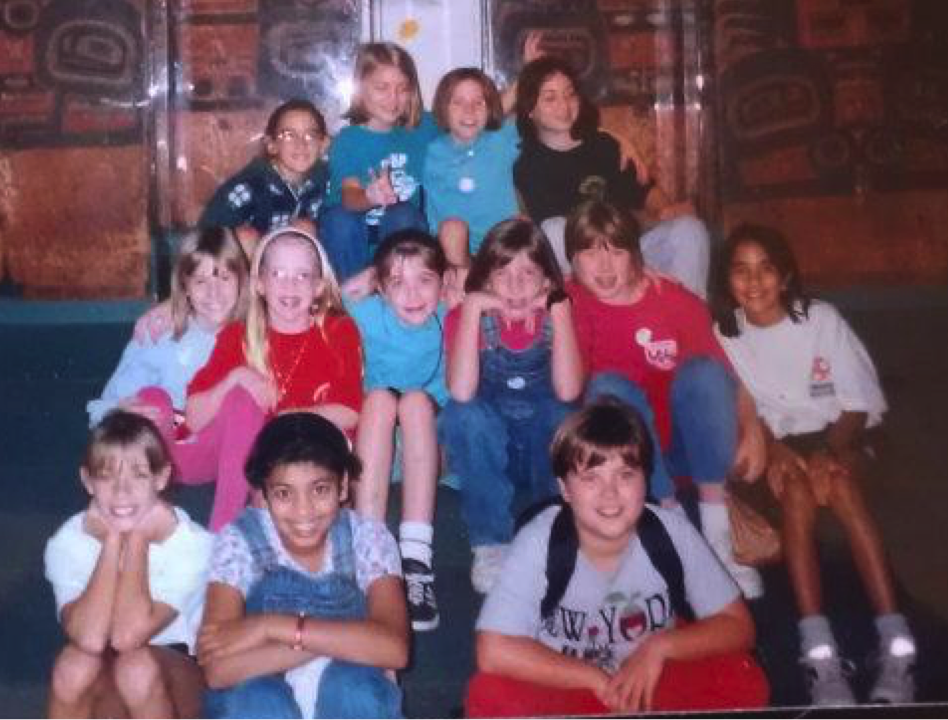 Miranda (front row, right), 1995.
 While there was plenty I could learn from Anne Shirley or Harriet the Spy, I always longed to read about an actual tomboy like me – no long braids, no puffed sleeves, no growing up into a swan after an ugly duckling childhood. Finding a story like that would have given me one way to understand and explain who I was, and perhaps spared me a great deal of trouble. As a young reader, I always wanted a role model who didn’t grow out of her awkward phrase, who didn’t eventually find that it all just fell into place – because I wasn’t sure it ever would for me. I was looking for a character who could assure me I was not a lone weirdo with unique and unsolvable problems. I wanted to know there were other kids who found the potpourri of boy/girl behavior messaging in books utterly bewildering.
Then I found my mom’s vintage copy of Honestly Katie John, in which a young girl with short hair and no grace to speak of grapples with femininity and tomboyishness in her small town. I felt reassured that my struggle wasn’t new; it wasn’t outlandish; it wasn’t wrong. If girls like Katie John and me had existed in 1972, surely they were still out there somewhere. This is what girls who aren’t “girly girls” have done since time immemorial — we’ve tried to find our own way.
Since the age of ten my favorite book has been Jane Eyre, which has as much to tell me about modern adolescence as a raven does a writing desk. It felt normal to me, then, that so many of my literary favorites came from books to which I could not personally relate. It was even encouraging, maybe, that books about girls who looked and dressed and spoke nothing like me could offer helpful examples of how to “girl” properly. Thanks to Anne of Green Gables, Girl of the Limberlost, Beverly Cleary, E.L. Koenigsberg, and Judy Blume, I knew I was “allowed” to be bookish, capital-R Romantic, chatty, nosy, curious, fearful, occasionally bossy; to prefer the outdoors (though I didn’t, particularly); to make mistakes often and embarrass myself. But I was more like the awkward love child of Nancy Drew’s sidekicks, George Fayne and Bess Marvin, who didn’t seem to be troubled by things like skirts or perpetually saying the wrong thing or having no common ground with their peers.
I was frequently mistaken for a boy when I was younger, which didn’t bother me — but I noticed that didn’t happen to the girls in my favorite books. No matter how hard I studied literary girlhood, I could never seem to remember its lessons in the clutch. I could never put together a becoming outfit or remember to brush my hair or make sure it hadn’t all flown away from its meager ponytail. What should have been charming notes to the boys I liked came across more like hostage demands. At lunch I read by myself, and afterwards played basketball with the boys (with unfeminine aggression!) instead of perching nimbly on the monkey bars with the other girls.
All my life I suppose I’ve felt a kind of yearning for androgyny. I caught brief glimpses of the girl I wished to be in Scout Finch’s skinned knees, Jo March’s russet boots, Margaret Thursday’s Little Lord Fauntleroy panache. But judging by the books that filled my backpack and stacked up on my nightstand, girls like me just didn’t exist. I was the chubby red-faced angry third-grader on the playground trying to catch up to the bullies singing “1-800-97-Jenny” or calling me “Randy Savage” (my mother’s family is Cherokee and Choctaw, for which I was mocked on the playground).
If nurture — and my mother’s influence — did have the power to triumph over nature, I would have been a model citizen of girly-girl nation. But in first grade I announced to my mother that I wasn’t wearing frilly dresses with big bows anymore. In fourth grade I proudly came home from KidCutz with the bowl cut that launched a thousand battles. My mother wanted to sweep my bangs becomingly to the side; I wanted to get out of the shower, dry off, and be done with it. As I batted her hands away from my forehead for the hundredth time, she finally snapped, “But it doesn’t look good.”
I remember disappointment and defiance warring in my brain as I looked in the mirror. The bangs hanging straw-straight looked totally normal to me — and exactly like every other mushroom-cut in my class — but clearly my mother’s more advanced feminine sensibilities could tell they were all wrong. “I don’t look good?” I thought, wounded. I knew how the other girls at school looked — cute, coordinated, slender, well groomed. But knew I wasn’t like them. Their bodies didn’t seem like foreign casings. Their skirts and tights and sweaters didn’t seem to be choking or suffocating them.
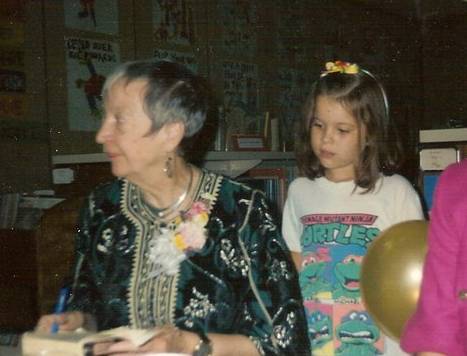 A young Miranda about to meet Madeleine L’Engle.
Gender just seemed so mysterious at the time, and still does, honestly. As a child I was desperate to find a proper literary heroine, who of course had to have spunk and a touch of rebelliousness, but in my case would have felt the same cocktail of corrosive feelings I did — guilt, humiliation, awkwardness, social ineptitude — and possessed the unenviable ability to say the wrong thing at the wrong time and look bad in clothes.
Perhaps hoping to steer me back to the less confusing end of the gender presentation pond, my mother gave me her old copy of Stories to Live By, a late-1960s anthology of short fiction from the Girl Scouts magazine. Stories to Live By was an Aesop’s Fables for the modern teen, in a fictional golden era when all the girls wore dresses and all the boys called their fathers “sir.” There was no mention of the Civil Rights Movement in its pages, no hint of an impending Summer of Love, no Stonewall — in fact, no politics of any kind. It was also a Bechdel Test nightmare — the girls only talked to each other about boys, clothes to impress the boys, or money to buy makeup to attract the boys. Nobody was queer, or overweight (unless they were about to learn to “reduce”), or doubted they’d ever find their place in the world. Most of the stories in this utopia of 10-cent Cokes and sock-hops were about going steady, breaking up, caring too much about appearances, or “being true to yourself” (which actually meant conforming). They weren’t all frivolous — one was about segregated train cars; another about a terminally ill sister — but aside from a few money woes, some crash diets, and an ethical quandary or two, every single story featured a dance, a date, a budding romance, and a town full of white people.
According to this bland assortment of models for budding womanhood, my own impulsiveness, lack of grace, and short temper would never have made it. Still, I avidly read Stories to Live By cover to cover, over and over. It did have something to offer me besides an amusing snapshot of outdated mainstream mores: a template to riff on; a set of ingredients for the baked good known as adulthood; a more traveled road from which to diverge. I might not do any of the things these rosy-eyed damsels did, like outgrow my awkwardness, but I could fall in love and have a makeover and perhaps a date. That would have to do.
Luckily for me, the queer kids started to come out of the closet in middle school — encouraged, perhaps, by awareness of gay teachers for the first time — so right as I hit my early teens, I started to see people in real life I would have found very reassuring in childhood literature. I had also made the move from reading buttoned-down 1960s YA and literary classics to reading contemporary fantasy written by kickass women like Tamora Pierce and Mercedes Lackey — their women characters were beautiful, sure, and they were also warriors, mages, bards, teachers, partnered, unpartnered, gay, straight, poly. They were sexually liberated and witty. Instead of finding representation, I embraced escapism: Alanna the Lioness abandoned needlepoint for knighthood; Kerown of By the Sword had love, magic abilities, a horse-like Companion, and fought like a demon on the battlefield; Rune of The Bardic Voices trilogy was boyish and musically talented and grew up to be adopted by a traveling band of musicians. It didn’t matter that all the external factors were different, because these women felt lonely, out of place, wrong somehow, until they discovered their people. I could relate to that.
As I aged into the teen rom-com demographic, however, the search for self in the books I read was replaced with a desire to see myself in movies. I drank the rom-com Kool-aid and focused only on the sense of joy and completion every heroine felt when she finally had the love of some adoring boy. I lost myself, and it showed in the guys I dated.
It was breaking out of the heteronormative dating binary in my twenties that finally made me understand how many kinds of women there are. I met dapper-as-hell lesbians who rocked vests and button-downs and tailored slacks, sleek femmes with blowouts and elegant accessories, big girls with killer taste in prints and cat’s-eye glasses, gender-queer folks whose presentation was as fluid as it was fashionable, and other women who just…were. Themselves.
At the time I read The Girl With The Dragon Tattoo series and was as impressed by Lisbeth Salander’s lack of repentance for not fitting in as I was with her fighting skills. Shared book nerdiness was a common theme in almost every date with a woman that I went on during these years; for a while I actually formed a YA book club with a woman named Preeti in lieu of a romantic relationship. Preeti’s vibe was sort of Katherine Hepburn meets a slouchy 1940s professor by way of Calcutta and Michigan, and seemed effortless and alluring. We’d meet and exchange an old favorite novel for a title the other hadn’t read, and then meet again to debrief; I was convinced these were dates, she was equally certain they were not. In a way I suppose I was still trying to force a meet-cute/fall-in-love narrative that just didn’t fit in my life.
I made some important shifts in my quest-reading in these years — in college I’d found my feet as a critic, and fallen headlong into essayists and memoir. Nonfiction — where there are as many voices as there are writers, representing themselves in all their awkward, messy, confessional glory — has the potential to be a haven for the underrepresented (publishing establishment pending).
I started inhaling graphic novels, too. If you’ve read Fun Home (or watched Sydney Lucas’s perfect performance of “Ring of Keys” on the Tonys), you might remember the first moment young Alison Bechdel saw a butch lesbian in a diner. That’s what reading Fun Home was like for me — oh, there you are. The intimacy of her storytelling, bolstered by those familiar tomboyish images of a kid in jeans and tees and fighting the barrettes and bows of the world, converted me to comics for life.
A shared love of artists like Lynda Barry and Ben Katchor was one of the things that drew me to the man who would eventually become my husband. One of the things I did along the way was complete a comic autobiography about being a writer and an alcoholic, and getting sober at 21. I started out trying to draw the way “good artists” draw, and eventually began drawing myself as a Fisher-Price peg person — purple-clothed body, short hair — pursued everywhere by a Crazybrain that squawked all the self-loathing and doubt I ever felt. I stopped looking for myself elsewhere, and made my own Story to Live By.
I just turned 30, and when I read now, I derive hopeful clues about “how to be” and spend less time worrying about “how to woman.” If “I just don’t want to fuss!” was its own gender presentation, I think I’d have sorted myself out long ago. I still struggle with things many women are good at, though I think have almost mastered a few of them — I know how to pick out good presents for people, and send care packages, and I own a nice pair of boots. I know what exactly one attachment on my hair dryer does; I do not wear makeup; I’m very good with kids.
I learn from girls who have adventures and boys who love earnestly, women who are frank and sharp-tongued and men who take great care of their skin. For some women I admire, life means mothering; for others it means mercenary-ing. This is what I want to explore with my “Write like a Girl” students — I want them to interrogate the experience of being themselves, and write about their triumphs, their struggles, their fears, their curiosity. Let them learn sooner, rather than twenty years of hard road later, that spunky and serious and girly and tough and silly and brainy and fearful and angry can coexist in one wonderful person, no matter how they dress or who they’re attracted to or how they wear their damn bangs.

hi, are you me
(thank you for writing this!! Reading it was like a perfect illustration of itself; that is, after struggling to relate to characters, I found myself finally finding a writing to relate to, so seriously, THANK YOU)
Possibly! How is our hair today? 🙂
Messy bun, as per. 🙂
This piece was great and really resonated with me. The Katie John series were very important to me growing up. Back then I went by Katy IRL, and Katie John is a very big part of the reason my online persona is Jack. (I didn’t want to be a copycat. And I just like Jack better.)
Did you ever watch the terrible BBC Robin Hood? They had a rad girl named Jack (well Jaq, I think) but still. So happy to find another Katie John aficionado!!
I haven’t watched it yet. I’m working up to it. I grew up watching Robin of Sherwood and it ruined me for basically every other interpretation. 🙂
It is beautiful and ridiculous and full of anachronism 🙂
I love that there are other people out there who read Katie John! I always felt like I was the only person who had ever read it!
Aw, I relate so much to this! I could not for the life of me figure out How to Be a Girl growing up, and books about cool nonconformist girls doing their own thing did a lot to help soothe my sad weird feelings about that.
Side note: I recently sent my boss home with my battered old copy of the first Alanna book to give to his 12-year-old daughter, and the other day he told me that she loved it so much that she made him buy her the next three and then blew through them all in like a week. Now I’m trying to decide what I should slip her next.
Try the Mercedes Lackey Bardic Voices series! I’m also really enjoying Robin McKinley’s books right now.
As an Alanna devotee, I remember also enjoying the Liveship Traders series by Robin Hobb, but I would check lots of reviews, because I haven’t re-read that one as an adult, and children as naive as I was are not particularly good at spotting problematic things on the fly. I also really loved this book: http://www.mercedeslackey.com/books/wind1.html But again I can’t actually vouch for it’s quality. Whereas I’ve re-read Dealing With Dragons and I still love it to pieces. But I was younger when I read that compared to the others, so maybe it’s not quite tween material? Not sure there.
I read the Dragons series when I was *solidly* in my teens, well after having read all of the Pierce books that had been released, and I LOVED it. I think there’s enough in them that they’re really good for a wider range of kids than a lot of books are.
Good to know! I got the first book for my niece. She just turned one, so I may have jumped the gun, but now they have the book and I will brook no excuses for her not having read it by her 18th birthday.
The [gerund] [preposition] Dragons series is just wonderful for reading aloud. You should try it with your niece in a few years, if you live close enough for it to be feasible.
It’s interesting what ages well and what doesn’t. When the local teenager was 6, she was feeling awkward and uncomfortable about not doing Girl well. So I gave her the first Tamora Pierce book about Keladry. (Kel doesn’t have magic. She succeeds because she does so many pushups and doesn’t let the sexist bullies see her cry. I love her to stubborn little pieces.) The child didn’t have any feeling for a world with rules against girls doing anything. Boys saying they wanted to kill all girls? Well, yeah, of course…that’s an ordinary thing that happens in kindergarten…but rules against girls doing anything is unrealistic nonsense.
oh my heart-eyes over Kel will never cease! NEVAIR!! Also Cimorene is a huge influence in our house, to the extent that the younger child, having listened to all the full cast audio books of the series over and over (Thank You Bruce Coville) was in training to be a dragon’s princess for years. She chose her sports (fencing, archery) her languages in school (Latin seems better for spells) and even learned to fly a small plane in pursuit of being worthy.
I had a roommate like that once. (I mean, someone whose education had been inspired by the books.) It seemed like it would be convenient to live with somebody who knew how to make cherries jubilee and organize the library.
I mean, if I were her I’d want to get my hands on all the other Tamora Pierce books ASAP, and there are a LOT, so it should take her a good while. Also, the Alanna books are definitely the shakiest prose-wise–it really only gets better.
After that, DIANA WYNNE JONES. I think maybe start her with the Chrestomanci books and go from there.
Also, seconding Dealing With Dragons and the other Enchanted Forest Chronicles by Patricia Wrede. I think they’re accessible for younger kids but also not too young for a 12-year-old. Hell, I just re-read them last year and they definitely hold up.
Very much seconding: The rest of Tamora Pierce (because it all gets better, prose-wise, after Alanna), Patricia Wrede (Dragons is most popular, and probably where to start, but she has a couple other series that are good for tweens/teens, and one (enchanted chocolate pot) that’s *maybe* a little old for a 12 year old, but by the time she gets there after reading the other stuff it won’t be), DWJ.
To that, let me add:
Diane Duane (So You Want To Be A Wizard, etc)
Kristen Cashore (Graceling, etc. But maybe next year.)
Garth Nix (I’ve never really gotten into it, but it’s well loved by my TP fangirl friends)
Bruce Coville (His Unicorn Chronicles Stories were favorites, but he’s written a LOT and I’ve never been disappointed. Also, he’s really really nice in person)
Phillip Pullman (his dark materials)
Susan Cooper (the dark is rising)
At the time i LOVED Anne McCaffrey and every single Star Wars EU book, but they have largely not held up as well as other things.
SO YOU WANT TO BE A WIZARD. I thought I’d try to formulate a better comment, but that’s all I got. I’m glad Bruce Coville is nice because I really enjoyed his books too.
Yes, I loved those books as a kid! Also the Susan Cooper books and Garth Nix (aforementioned boss is reading Sabriel out loud to daughter and 15-year-old son currently) and of course Philip Pullman.
I love how much everyone is ON TOP of this “books we should be recommending to 12-year-old girls we barely know” thing. A+
And I was just feeling like I’d dropped the ball because I hadn’t even mentioned the Tiffany Aching series yet!
Authors I have met enough to have some sort of opinion on:
Bruce Coville is, at least when he’s got his game face on for fans, really generous, kind, outgoing, excited. Like, total golden retriever.
You can tell that it’s means a lot to Tamora Pierce to be able to talk to fans, and that she doesn’t take a second of it for granted, and that she finds it all very rewarding. But it’s also pretty clear that it’s also not *easy* for her.
Neil Gaiman’s hair looks much softer in person, but is otherwise as you might expect from twitter.
Annette Curtis Klause is lovely and just a tad scattered, but in the best sort of librarianish way.
Mallory Ortberg gives VERY good compliments.
Jane Yolen….. I don’t know. She Does Not Give A Fuck About Your Nonsense in a way that’s admirable, but she also doesn’t seem to be enjoying herself very much at events she’s agreed to go to, even friendly smallish events that are close to home and full of Her People, and she’s the only author that I’ve met who I liked their books just a bit less after meeting them. This is NOT to say that she’s bad or mean or anything, she’s just not….. someone I want to hang out with.
How’s this for awful? Lois Lowry. I LOVE her stuff, from way back. I was the bookstore event runner. It was pleasantly crowded but not crazy. Bunch of kids, bunch of grown superfans. She basically phoned it in. Talked what was obviously a very set bit, like, it was a solid Giver/Number the Stars crowd, and she spent a ton of time on Anastasia Crupnik. And then a kid clutching this mangled copy of The Giver asked if what she’d meant about religion was something like, XXX. Not a crazy provocative question, and a totally sincere one, AND SHE TOLD HIM SHE JUST COULD NOT DISCUSS ANY RELIGIOUS TOPIC AND HE SHOULD ASK HIS PARENTS.
I was really crushed.
Yesssss Garth Nix is greatttttt. I want to be a librarian of the Clayr so baddddd
I especially love that being a librarian is a serious, dangerous job that you have to be a badass to do. Library-dwelling monsters are no joke.
GAH, you just listed my middle school bookshelf. Amazing.
I was trying to remember what I was reading at 12 (lots of age inappropriate things, mostly), but….
Patricia C. Wrede’s dragon series is just wonderful. I reread the Lyra series recently, and it was also great- darker than the dragons, but quite good. And if I’d been 12 when the Tiffany Aching books were around, I’d have loved to read them. And the Susan Cooper Dark is Rising series- it might be a hair young, but they’re so great.
If she’s the sort to be reading adult novels at this point, I love Kage Baker- the Company novels are great, and I just read the Anvil of the World series and adored it- definitely a few “adult” themes, though (Sex. I mean sex.) Lois McMaster Bujold’s Vorkosigan Saga is a delight as well.
And honestly, there’s simply loads of YA out there now- for just plain fun (plus finishing schools with steampunk weaponry) Gail Carriger’s Finishing School series is tons of fun.
Oh yes! Kage Baker! (Adds “In the Garden of Iden” to the growing list of books waiting for my niece to grow into them.) I wouldn’t say the main “adult theme” there is sex. It’s betrayal, with a set of really messy conflicting loyalties.
Thinking of plants (and the geeky misfit girls who love them) reminds me of “The Evolution of Calpurnia Tate.” It only came out a few years ago. It’s another one of those stories of a girl who doesn’t want to learn to be a young lady. (It feels like I spent years reading that kind of story at least a couple of times/month, set in different times and places, though I can’t remember many titles now.) Like a younger girl of the limberlost, with a better family.
everyone else has made excellent suggestions, but Valente’s The Girl Who Circumnavigated Fairyland in a Ship of Her Own Making is one of the most beautiful books I’ve ever read, and it’s tween-friendly.
https://www.youtube.com/watch?v=HU4q8dpKhDY
Magician’s Guild by Trudi Canavan is faaaab. If she’s a reasonably advanced reader the Empire series by Raymond E Feist and Jani Wurts is also amazing and has one of my favourite female characters of all time.
Also idk if you’d get in trouble for giving it to her, but I feel like every fantasy-loving pre teen girl is required to read The Mists of Avalon and then feel sort of confused about it. I always know I’m going to be friends with someone if they’ve read that book.
You might want to try them yourself, as well, but I think Frances Hardinge’s books might hit the right spot. Very diverse worlds and young women, with a lot of complex ideas about social structures.
Early Robin McKinley, yes. Newest McKinley…ehhhhhhhh…no, not so much.
You can never go wrong with Sabriel and The Old Kingdom.
The best is, ofc, His Dark Materials.
This was a really wonderful piece that left me with goosebumps. I am so happy that there are young women out there who will have you as a teacher. Thank you.
Seconded! I would like to take this class!
This is such a wonderful piece. Count me in as another ugly duckling that grew up to be….an ugly duck.
I am still reading and rereading these sorts of books, especially the ones I found important as a kid, to figure out who I am, what I’m comfortable with, what being a woman means to me.
Oh, I love this. I vividly remember trying over and over again to figure out who my literary role models should be, and trying out different identities based on what I was reading at the time. It took a long time to realize that I didn’t have to choose a certain Way to Be and stick to it.
I really needed to read this today. Lately, I’ve been thinking about representation in literature (and media) a lot, and how it must and essentially pair with reading not our experiences. Miranda explores this so so so well here. And perhaps especially, the idea that we learn and identify with characters (like Jane Eyre) who are so nothing like us, don’t speak like us. This space, to me, is what makes reading so electric.
Also, I feel that there is a great omission here. We’re talking about badass androgyny fashion as it relates to literature, LADIES IN SLACKS and no mention of Colette?!?
My only exposure was the musical!! Gigi figured womanhood out overnight basically — and I didn’t realize til adulthood it was a bad thing 😛
Have you read The Pure and the Impure? It’s basically and ode to ladies in pants who have beautiful sex, often with other ladies.
Let’s hear it for pants.
Oh. My. God.
I think I have a new style icon.
In regards to Scout Finch, my favorite part of Go Set a Watchman (which I did enjoy, thought did not love) was that Scout grown up was still very definitely Scout. She never came to love dresses. She still hated teas, small talk, and other traditionally feminine activities. She was still totally fine with jumping into a river fully clothed. She had learned to be more poised, more self-aware perhaps, but she had never really given up the tomboy. I loved her.
I really struggled with the ‘how to fashion’ thing for years…I was terrified of showing off my body, and then had problems with buying things that were practical but I ended up hating and never wearing. Now at the beginning of my 3rd decade, I have settled in a comfortable riff combo on Tracy Lord and Sir Integral Hellsing.
I finally realized probably last year that not only would I never be Anne Shirley, she probably wouldn’t even want to be friends with me. I think I am at peace with that understanding.
Think how wide and encompassing the Race that Knows Joseph is, though! Especially Anne-As-Mother
I relate so hard! And I’ve still never found a book character or film character like me. Not that I’m the specialest of snowflakes, or at least I don’t think so, but where is everybody??
This is interesting! And reminds me of when I was younger – I have black, curly hair and when I was young what I wanted to be when I grew up was a tomboy. And I think it’s partly because if you have dark, curly hair there are very few story book role models and black curly hair denotes wildness and cetera, so the most influential on me was George from the Famous Five, and then later, Ronia the Robber’s Daughter. It didn’t help that I looked exactly like the cover illustration…
Yes! I was hoping someone in the comments would mention George from the Famous Five. She was definitely one of my influences growing up tomboy.
Thanks so much for writing this! As the father of a seven and a half year old tomboy who loves fantasy and is looking for some kind of sense of belonging and a reflection of herself in her literature, it’s so good to hear that this kind of stuff is out there. I can read her the adventure stories she wants to hear, but can only give her so much of a mirror.
I can’t wait to hear more about your workshop… is there any way you could be convinced to make some of your materials or sources available to the public?
Oh absolutely — my syllabus is of course a shambling work in progress but if you drop me a line on twitter I’ll be happy to share it. I’ve used essays from Brevity and Rookie and Mindy Kaling’s first book and the #growingupgirl hashtag so far
Thanks… I’m hopelessly old-fashioned and twitter-averse, but I might be able to manage it.
Such a great piece, and I identify so strongly with it! I also rocked the so-short-I-was-mistaken-for-a-boy hairstyle as a kid and it was so great. “Dressing up” very much feels almost like a drag performance to me, which is a little weird considering how often a practicing Catholic girl is expected to dress up for Mass and holidays, but there you have it.
Jo March and her horrible temper is one of my longest loved characters.
Thank you so much for this article.
I had to grow into the ability to cut my hair short. I did not identify with most of the heroines you cite because they were always depicted as long-haired and wearing dresses and being sexually submissive on some level, and that was not me. I wrote lengthy fiction based around female characters who had short hair and wore pants and tunics and hung out with cool-looking aliens and NEVER EVER got grabbed or slapped around by their future love interests, and that was more transgressive and desirable to me than all the porn that could ever be written.
Books like Valiant were not available yet. Firefly with its badass married first officer was decades away. I had no access yet to anime and manga with its butch and bifauxnen characters. I responded to the whole thing by rejecting the entire concept of heroines and identifying with Mr. Spock and Mr. Data, who were fully nonhuman (Doctor Crusher was fem and married and got less screen time than girly, fainting Counselor Troi). Being an alien was more appealing than being the woman I felt I was being urged to be.
My sister went as Robin Hood for Halloween a lot of years, and I completely identified with that impulse even though I was not at that point brave enough to crossplay. There were no female characters I could identify with, so I either identified with the male ones or wrote my own. That’s still where I am with a lot of content. The heroines I love are heroines Hollywood hates for not being girly enough. It will always be Catwoman, never Big Barda; always Black Widow, never Carol Danvers as Captain Marvel.
Did anybody else grow up reading Cynthia Voigt’s Tillerman books, particularly Homecoming and Dicey’s Song? Dicey Tillerman is a total tomboy who has to take care of her younger siblings when their mother abandons them. She’s tough and resourceful and gets into boat building. Really good stuff.
Those were the very first books Preeti recommended for me, and I loved them almost as much as I loved her for it 🙂
YES! I loved those. Dicey rocked. I remember the boat building and like … incredibly poetic passages about the texture and color of wood, or something? At least that’s what I’m remembering. Ugh, I want to re-read those.
Yes. Those books were formative to me, though I ended up identifying most with the main character in the Runner (Dicey’s uncle, whose adolescence is told in this book).
My favorite fantasy will always be Lloyd Alexander’s Chronicles of Prydain. I identified (and still do!) so strongly with Taran, who just wanted to be a hero, but was alway over-eager and tongue-tied and making mistakes. Eilonwy, the girl in the books, was pretty great too, and so was Achren, the witch.
I always disliked Tamora Pierce though, possibly because I read the Wild Mage series first, with the creepy Numair and his relationship with his student. But she mainly annoyed me by adulterating perfectly good fight scenes with feelings. Also the coolest creatures were always bad.
Diane Wynn Jones is great too. But Lloyd Alexander! How does he get overlooked? The Vesper Holly series by him is pretty excellent as well.
I looooove Chronicles of Prydain. I tried to convince my boyfriend we should name our first-born girl Eilonwy but he wasn’t having it.
Can I take your class? For real. I think I need it. I mean, I’m 23 but…oy.
I read the latest issue of Sex Criminals last week and I cried. Again. Do you read it? It’s by Matt Fraction and Chip Zdarsky. But, anyway, it’s at least the third time that series’ made me cry. This time, though, they introduced a new character whom I just…felt. She has a childhood where she feels like an alien. She doesn’t dislike humans, and even finds them fascinating, observes them, disguises herself as one of them. She’s as curious about them as much as she is curious about the whole world. But deep down she believes that someday the mothership will come, and she spends a great deal of time looking at the sky waiting for them to come.
Then she grows up and realizes she’s not an alien, and admitting that is crushing. She will never fit in. But she finds that she has her own world, her own space out of time, and even though it is private and even lonely, it’s also wildly liberating.
She has lost things, but she’s healed enough that in the present day she’s passionate, fierce, loyal, and ruthless. Triumphant. Separate.
She also, like me, is asexual. I don’t want to give too much away for people who haven’t read it, but it hit me so hard. This non-neurotypical asexual superpowered woman; why have I never seen her before outside me?
I feel like I am just putting myself together now. Better late than never I guess eh?
OH MY GOD. Who published my diary? Not cool, dude.
The Alanna books were so central to my childhood (I was just thinking of this recently, and also thinking of what a great heroine and role model she was for me – angry, transgressive, and fiercely loyal. I love her still). I also remember really liking some of Robin McKinley’s heroines, too.
Anyway, thanks for writing this.
“This is what girls who aren’t “girly girls” have done since time immemorial — we’ve tried to find our own way.”
Oh look an essay about the difficulty of seeing your experiences reflected in what you read becomes a perfect reflection of my experiences. (or illustration, since obviously they’re not identical but the underlying yearning is something I recognise). I was/ am a bookish, autistic girl/ woman who doesn’t identify with a lot of the expectations of femininity (and I definitely am a bisexual cisgender woman, which of course makes the whole problem less life-or-death than the experiences of trans people) but don’t feel ‘tomboyish enough’ either – I much prefer reading to sports or DIY, for instance. So finding heroines who look and think like me is hard, and even if I could that validation can only do so much, and this describes that feeling beautifully. Thank you for writing this.
Wish I could send my 12 year old daughters to your workshop. Thanks for writing this, and for doing this wonderful work.
Thank you, Miranda! I would like to take your workshop, at 46. 🙂
I was so happy to see the mention of Katie John (the earlier books — prior to “Honestly, Katie John!” — are also awesome in their obliviousness to “girly-girl” stuff, which only starts to plague Katie as of sixth grade). Has no one else read the Zan Hagen books by R. R. Knudson? Aspects of them are dated, but Zan Hagen is a badass athlete pre-Title IX, and defies administrators and rival athletes to play for the boys’ teams (because there are no competitive girls’ teams at her school). She ends up running cross-country alone because her school has no XC team at all. (Zanballer, Zanbanger, Zanboomer are the books.)
Anyone else read The Boyhood of Grace Jones, by Jane Langton?
Margaret Thursday! <3
Love this piece, having had a complicated relationship with gender due to enforced tomboyhood as a child and a long struggle to a feminism that includes room for my hard-won femme-yness.
And CAN WE PLEASE TALK ABOUT BRITCHES DOTTIE
Love this piece, having had a complicated relationship with gender due to enforced tomboyhood as a child and a long struggle to a feminism that includes room for my hard-won femme-yness.
And CAN WE PLEASE TALK ABOUT BRITCHES DOTTIE
Seconded! I would like to take this class!
Love it! I was that girl who swore to get married in ripped blue jeans and a t-shirt (before I learned that a girl doesn’t actually have to get married at all..)
In addition to all the above (shout-out to the Robin McKinley), does anyone else still love Trixie Belden?
Nice to know I’m not alone.
Yes! I was hoping someone in the comments would mention George from the Famous Five. She was definitely one of my influences growing up tomboy.
*Standing ovation*
Similarly, I rejected the dress/skirt/bow uniform when I was little. I would ONLY wear a dress if it was made of Looney Toones fabric. I would also “play” by running on all fours and barking at other kids. My logic was that if people like dogs, me pretending to be a dog should also be likable. My poor mom.
Thank you so much for your thoughtful and eloquent post. You perfectly described my adolescence using words that I didn’t even know I was missing.
This was a really wonderful piece that left me with goosebumps. I am so happy that there are young women out there who will have you as a teacher. Thank you.