
When it comes to literary daydreaming, I’m not one for those imaginary dinner parties, with artisanally curated assemblages of Great Authors of All Time swapping deft bon mots between courses. Mostly, I’m sure, I’d end up worrying about Emily Dickinson’s food allergies and regretting having brought Nathanael West and Jacqueline Susann into the same room (hey, you choose your Great Authors, I’ll choose mine). Also, I don’t have a lot of chairs.
I’m a copy editor by trade—a tinkerer with commas, a corrector of faulty grammar, a watchdog against tics and clichés—and my notion of an ideal tête-a-tête with, say, Edith Wharton would run less toward swapping aperçus over canapés and more toward seeing if I could persuade her to stop loading the dreaded “the fact that” into every third paragraph, as she was wont to do. Or perhaps instead of keeping an anxious eye on F. Scott Fitzgerald’s wineglass I might more valuably let him know that he needn’t hang an adverb on every goddamn speech tag in The Great Gatsby.
Well, we all have our particular ideas of fun.
But what happens when the copyeditorial fantasy comes to corporeal life and the presumptuous red pencil wielder is faced with a stack of very real pages written by a very real—and very dead—Great Author of All Time, a Great Author of All Time who happens to be his Favorite Author of All Time?
Let me tell you.
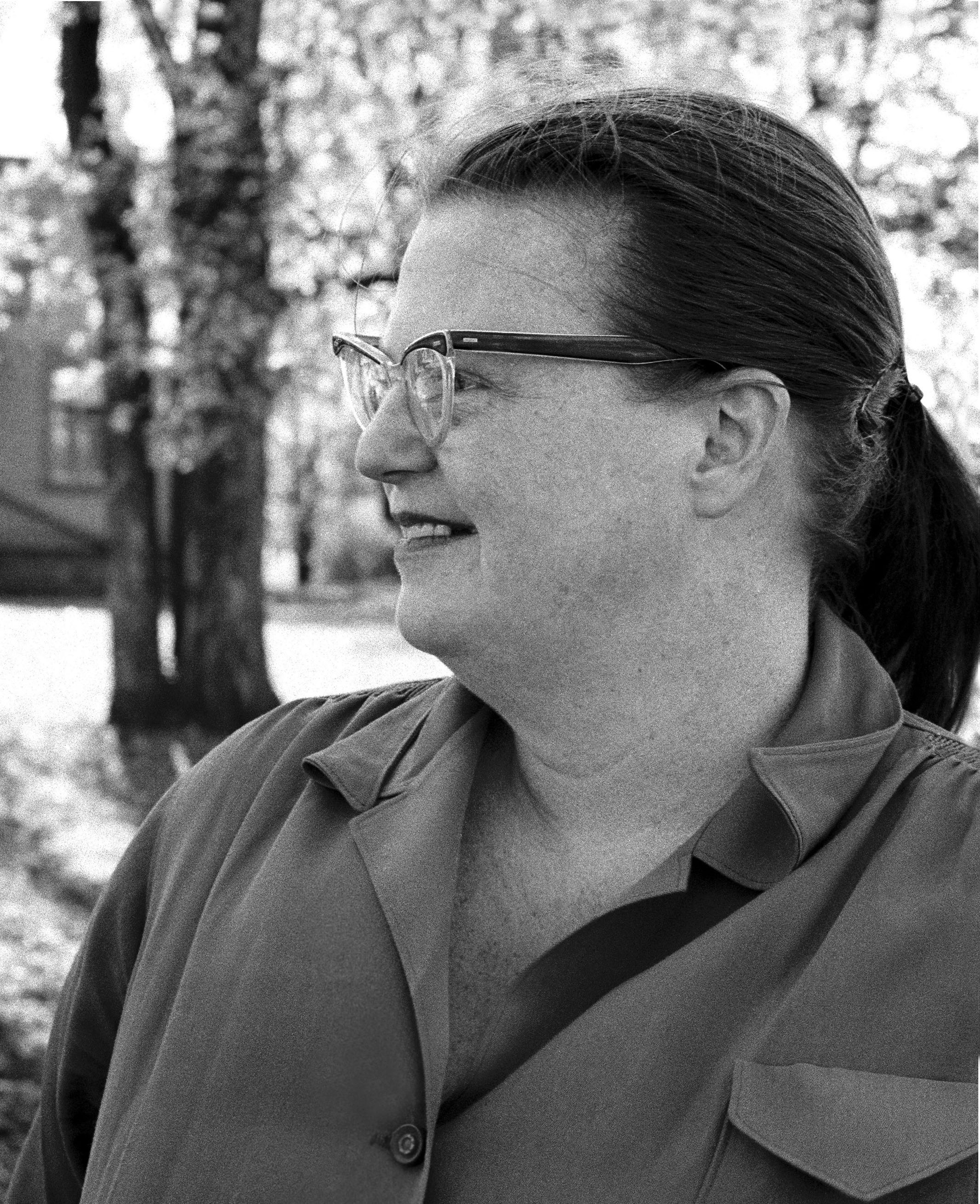
Shirley Jackson | Photo © Erich Hartmann, 1956.
I don’t recall when I was first well and truly bewitched by Shirley Jackson. Sure, like just about everybody else in America, I read “The Lottery” in junior high, no doubt in that same short-story anthology with “Leiningen Versus the Ants,” “The Most Dangerous Game,” and Katherine Mansfield’s “The Garden Party,” and no doubt I liked it, but a steady diet of ABC Movies of the Week—Olivia de Havilland in The Screaming Woman!—had acclimated me to menacing story arcs and macabre twist endings, and I can’t say that reading Jackson’s exquisitely slow-boiling account of the day poor Tessie Hutchinson is not crowned Queen for a Day made a life-changing impression on me.
I can be pretty sure that I found my way to Jackson by way of a late-night telecast—back in the days when to catch a late-night telecast one actually had to stay up late—of The Haunting, director Robert Wise’s 1963 filming of Jackson’s 1959 novel The Haunting of Hill House. The movie features a scene, which I can still barely stand to watch by myself, in which Julie Harris and Claire Bloom are beset by a spectral something-or-other whaling away cacophonously at their hopefully locked bedroom door. But as nerve-racking as the movie is, I soon learned that the novel, which I first owned in a movie tie-in paperback that eventually fell apart from overreading, is even more effectively chain-rattling. In fact, the movie’s best moments, from the housekeeper Mrs. Dudley’s grisly deadpan greeting of doomed Eleanor—
“So there won’t be anyone around if you need help.”
“I understand.”
“We couldn’t even hear you, in the night.”
“I don’t suppose—”
“No one could. No one lives any nearer than the town. No one will come any nearer than that.”
“I know,” Eleanor said tiredly.
“In the night,” Mrs. Dudley said, and smiled outright. “In the dark,” she said, and closed the door behind her.
—to Eleanor’s aghast “Whose hand was I holding?” (I leave you to find your own way to that), are pure unadulterated pretty much verbatim Jackson.
I also learned, as I read the novel, reread it almost immediately, and have continued to reread it once a year or so for decades, the wonder of Shirley Jackson’s prose: unfussy, untricky, unhurried. Stately. Consider, please, the first paragraph (I almost called it “the celebrated first paragraph,” but I imagine Jackson, who liked adjectives, “particularly odd ones . . . the reader usually has to go and look up,” frowning at a modifier so feckless and cuttable) of The Haunting of Hill House:
No live organism can continue for long to exist sanely under conditions of absolute reality; even larks and katydids are supposed, by some, to dream. Hill House, not sane, stood by itself against the hills, holding darkness within; it had stood so for eighty years and might stand for eighty more. Within, walls continued upright, bricks met neatly, floors were firm, and doors were sensibly shut; silence lay steadily against the wood and stone of Hill House, and whatever walked there, walked alone.
I urge you to read that aloud, perhaps while typing it out—as I have done just now, for the pleasure of the action. Revel in the glowering “not sane” hard on the heels of the skeptical “by some,” and begin to feel yourself losing balance; tip your hat to the trio of semicolons (of which Jackson is an enthusiast, and in whose honor I have long championed them against the sneers of some writers who very much ought to know better). Note particularly that final comma—simultaneously unnecessary and essential, a fraction of a sliver of a pause in which the reader is given one final chance to put the book down and do something, anything, else—perhaps my favorite piece of punctuation in all of literature.
This is how we truly met, Shirley Jackson and I, and she’s been my steady companion since. I am almost always reading her: The Lottery and Other Stories lives on my nightstand, and the rest of her books have a place of honor in my best, glassed-in bookcase (safely behind a door but where I can keep my eye on them). I find reading Jackson an endlessly rewarding experience: the merrily subversive family memoirs, Life Among the Savages and Raising Demons; the undersung novel of multiple personality disorder, The Bird’s Nest; the sage and charming lectures on writing you can find at the back of the volume containing the spooky and charming Come Along with Me, the novel Jackson was working on, and which she left unfinished, at the time of her death, fifty years ago this Saturday. Mostly I find myself returning to the stories, though, particularly those featuring the uneasy, unsettled women Jackson portrayed with equal parts compassion and mercilessness: Mrs. Walpole in “The Renegade,” whose neighbors offer no end of advice about how she can cure her dog of the habit of killing chickens; Clara Spencer, in “The Tooth,” who rides a bus to New York City for a dentist’s appointment and little by little loses her identity; the unnamed “she” in “The Daemon Lover,” waking up on her wedding day and finding herself playing an increasingly dire game of hide-and-seek with her fiancé, James Harris, whose name’s regular appearance in Jackson stories invariably signifies that an unpleasant situation is about to get much worse; or, my favorite, I think, the disappointed, grasping literary agent in “Elizabeth,” unkindly surnamed Style, who does a decent enough job bullying and conniving against everyone in her threadbare orbit but who is ultimately no match for Jackson herself, who after letting Elizabeth flutter haplessly for twenty-odd pages finally pins her to a board.
I’ve been working in publishing for just about a quarter of a century now, initially as a freelance copy editor, then in-house as a production editor supervising copy editors, and now, as managing editor and copy chief of the Random House division of what has evolved into Penguin Random House, as the person who supervises the people who supervise the copy editors. But I still try to get my hand in the game every now and then and choose a manuscript to spend time with, because there’s no pleasure quite like the intimate pleasure of getting cozy with the words. “Intimate” is, I’d say, just the right mot juste: I’m not sure that anyone, perhaps not even its author, ever reads a manuscript as closely as the person whose job it is to help polish it to the best possible version of itself it can be, who not only corrects typing glitches and misspellings but searches out and queries (or simply helpfully repairs) inadvertent rhymes, antecedentless pronouns, subject-verb dissonance, plot continuity problems, overuse of pet words and gestures (you’d be astonished at the amount of murmuring, head shaking, and nodding that goes on in the garden-variety precopyedited novel). A colleague once described copyediting as the action of burrowing into an author’s brain and doing to a manuscript what the author might have done had he or she had just a few more minutes to spend with every sentence—and hadn’t already read every sentence five hundred times. One author, I recall, compared getting copyedited to getting one’s teeth thoroughly cleaned. Myself, I’ve come to think of copyediting as something akin to a dance or a conversation, except that the partners meet only on the page. In the dance, a good copy editor remembers that it’s the author who leads; in the conversation, the wise copy editor knows when to shut up and listen.
The best writers I’ve worked with love to get copyedited—it’s the less best writers, I’ve found, who see copyediting as a provocation, an impertinent questioning of their skill—but that’s not to say that everything a copy editor does is embraced. “Check your ego at the door,” a former boss warned when she asked me to dust off one of my own copyediting jobs after the author had reviewed it. In my line of work, one learns to live with a lot of “Thanks but no thanks.”
It may not have been “clear and sunny, with the fresh warmth of a full-summer day,” as Jackson conjures up the perfectly pleasant lottery morning, but no doubt it was a day like any other when I found out that Random House had under submission a volume of previously uncollected and/or unpublished stories and essays by Shirley Jackson. Had I had my checkbook handy, I’d have happily emptied my bank account to chip in to help close the deal; somehow even without my assistance we secured the rights to publish Let Me Tell You, which is the title of a story fragment that is just about the most Shirley Jackson–ish thing you could ever hope to read.
Normally I’d have assigned this manuscript as I’d have assigned any other, to one of my department’s production editors, who in turn would have hired a freelancer to—
Let’s not be silly. Anyone with the temerity to so much as reach a hand toward this manuscript was going to lose a digit or two. This one was mine.
The manuscript had arrived as a sheaf of photocopied pages, and before we neatened it up into an easily editable Word file I made my way, greedily, avidly, page-flippingly, through tearsheets of the long-ago published material, including pieces from the women’s magazines—Woman’s Day, Good Housekeeping, McCall’s—that provided Jackson with a steady income. Mesmerized, I devoured copies of Jackson’s own typescripts, in the all-lowercase that I’d learned was her M.O. for first drafts. For me, even at several removes from the originals, this was a moment of awed magic. If I could see her typing, I could, by extension, see her hands. If I could see her hands, I was that much closer to being in the same room with her.
Even more magically, the material was not back-of-the-drawer stuff of interest only to the dire completist but first-rate and wholly characteristic Jackson: stories of strained family interaction and crushing social unease veneered with politeness; affectionate and monumentally wry essays about Jackson’s husband, her children, even her kitchen utensils; bracing insights into the craft and methodology of writing. And, I was delighted and relieved to discover, all of it, even the pages that had never made it to print, was in remarkably good shape: During my breathless first read—letting myself, as much as I’m ever able to, read like a reader rather than like a copy editor—I had been scarcely aware that there’d be, once I got to work, much to do.
 In preparation for my copyedit—and in anticipation of a credentials-establishing phone call I was to have with Jackson’s children Laurence Hyman and Sarah Hyman DeWitt, who had compiled and edited the volume—I reimmersed myself in Jackson’s voice by going straight to the source: her own recordings of “The Daemon Lover” and “The Lottery,” which I’d stumbled upon a few years before. (Wait, what? I hear you exclaim. You can download the recordings here.) The recordings—at the time I had no idea under what circumstances they had been made—are notably low-tech, but Jackson’s voice—low and honey-thick, with a bit of an untraceable drawl, is everything you’d want it to be, and the bits of ambient noise, including the clinking of ice in a glass (some people hear whiskey; I hear a tumbler of lemonade), add to the you-are-there-ness. For some reason or other I’d decided to play Read Along with Shirley Jackson, so I hunkered down with my iPod and a copy of The Lottery and Other Stories, slapped on my headset, and was almost immediately shocked—pleasantly, unnervingly—to realize, as I turned over the first page, that the author and I were quite clearly reading from the same edition of the book: I turned the page, she turned the page. Crinkle of paper, crinkle of paper.
Not long afterward, on the phone with the Hymans, I thought I’d entertain them with my frisson. “Oh, I made that recording!” Laurence exclaimed. “My mother didn’t like to have her picture taken, and she didn’t like to be recorded, but one day I sat her down at the dining room table with my tape recorder and got her to read those stories.”
I also did my best to establish, on the phone, that this uncached material was in good hands. Not only, I insisted, did I know their mother’s voice as well as any copy editor possibly could, but I hastened to add that the material was in great shape and that I wasn’t expecting to do much besides correct the odd typo, shake out the punctuation—and, of course, hit the shift key and provide the capital letters that Jackson, in what I imagined as bursts of determined creativity, hadn’t provided. And if there were any little infelicities of prose or other problems, I said with studied vagueness, I’d query them carefully and respectfully and leave it to her heirs to decide what might or might not warrant repair. (Or did you think this process was going to occur via a Ouija board?)
I’m not much for telling tales out of school, so had I encountered any majorly irksome gaffes as I made my way through the manuscript, I’d likely be keeping them discreetly to myself anyway rather than spilling them here, but the God’s honest truth is that even at close scrutiny—very close: I like to copyedit more or less in Cinerama, with a document set in 14-point type and, furthermore, at 150 percent, so that I can barely see beyond the margins unless I turn my head—Jackson’s prose remained resolutely fine. I confess that I was oddly pleased to learn that my paragon was, in manuscript, not entirely infallible: Jackson goes to the well of “suddenly” and “and then” a bit too frequently (with the Hymans’ approval, there are now quite a few fewer of those in the finished book), and she occasionally puts more pressure on the worthy semicolon than a semicolon can bear. (I may well, though I will not confirm it, on occasion have yelled at my screen “A period, for pete’s sake, a period!”) But mostly, sentence after sentence, I was happily awed.
So happily awed that I quickly—and easily, I should stress—established a rule of self-restraint: Anything I felt the need to do that couldn’t be easily accomplished with a mild rejiggering of punctuation or the addition or deletion of no more than two words at a time would be weighed carefully before I even dared suggest it. As it turned out, I found maybe a half-dozen knotted-up sentences that were easily untangled—just as, I’m certain, Jackson herself would have untangled them on a subsequent run-through. At one point I spent a good fifteen minutes willing a sentence to move from the beginning of a paragraph to the end before I decided it was fine where its author had placed it. Once and only once did I venture to suggest that a couple of words more interesting than “that” or “the” needed to be added to fill out a resolutely unsatisfactory sentence, and the Hymans accepted my suggestion. It’s a heady thing for me that I actually contributed two whole substantive words to a Shirley Jackson story, but the truth is that if I did my job properly, if I did that brain burrowing that my colleague said was the real art of copyediting, they’re not my words at all; they’re Jackson’s. I just had to listen for them.
As I was working, quite a few fellow Jackson aficionados of my acquaintance (it’s a bit of a cult, actually) offered nudging variations on “Well, if there’s anything you’re doing that she’s not happy with, I’m sure she’ll let you know,” but so far, months later, there have still been no alarmingly blown-open windows or inexplicably smashed crockery, so I’d like to think that Shirley—because, yes, at some point in this process she went from being Jackson, or “Shirleyjackson,” as I think I always used to call her, to being Shirley—is content.
Tags: benjamin dreyer, books, copyediting, publishing, shirley jackson, writing
Related Posts
 It’s Fun When There’s Good News About Publishing: Nobody Doesn’t Like Graywolf Press
 What To Expect When You’re Expecting, By Shirley Jackson
 An Interview with Celeste Ng, Author of Everything I Never Told You
 An Interview with Alexander Chee
 Every Scottish Novel Ever
 Report from Romancelandia: The 35th Annual Romance Writers of America Conference

Oh wow, what an honor it must have been to handle those pages! She’s amazing, and I’m so happy to have found out about her here, through The Toast a while back. When I ordered her books Life Among The Savages and Raising Demons, my husband saw the covers and said, “I hope those aren’t parenting manuals.” Actually, they ARE!!! Ha ha ha!
Great line, Benjamin: “they’re not my words at all; they’re Jackson’s. I just had to listen for them.”
Also… I Fucking Love Semicolons; They’re The Best.
Thank you for all those excellently kind words, Marissa. It was indeed an honor. An experience of a lifetime, even.
Also, semicolons rule.
When I worked for my high school’s paper we were given a quick and dirty rundown of acceptable style. The one rule that always stood out to me as weird was, “Always place a semicolon after the word however.” So, totally not understanding this as a hard and fast rule, I avoided the word however for the rest of the year. Worked for me!
Also, copy-editing wise, I vowed to only use one or three exclamation points after reading the moving and lovely diary of Alicia Parlette, who was a copy editor for the SF Chronicle. She shared a sweet anecdote between her and a friend, who said he always remembered her because that “!” rule (one, or three, never two or four) was one she used in a school report they did together. It’s funny how these things stick with you when you write. I always think of the Scholar & Athlete when I use a semicolon, and about Alicia Parlette’s story when I use three exclamation points.
I absolutely love her writing. The understated wryness of some passages in Raising Demons makes me want to cheer. I’ve really enjoyed re-reading Hill House, then going back and sensing something dark and amused and uneasy and loving in the family essays. I’m not surprised that her writing was a pleasure to copy-edit, especially for a fan, but I’m glad.
Also, it was fascinating to get this glimpse into the process. Thank you for sharing!
Years ago I saw a musical adaptation of We Have Always Lived in the Castle and frankly I don’t think I’ve slept right since.
As a do-er of similar work, thanks for your thoughtful exploration of the process.
wait, a musical adaptation?? where? how?
Wait, what? Need more information. I’m aware there have been stage versions, though I can’t get a copy of the play. I’ve not heard of an actual musical though and need to know everything about it.
You have brought us the gift of Shirley Jackson reading her own writing out loud, and for this we will be forever grateful. (NB: I’m making assumptions that everyone feels as strongly about Shirley Jackson as I do, not using the royal “we.”)
I picked “We Have Always Lived in the Castle” for my book group a few months ago, and I was shocked – SHOCKED! – to find that at least half the group not only not read The Lottery, but had not heard of Shirley Jackson. It is my mission, in my book group, to fill in these inexplicable gaps. I’m sure I’m not pretentious about it at all.
I make everyone I know read We Have Always Lived in the Castle. I’m actually getting my first tattoo soon, and it is based on that book, no joke!
What a thrill to copy edit her work. I would have spent the whole time thinking, “I am not worthy!”
Ooh wow! This is wonderful, thank you.
hearts.
Wonderful article. Can’t wait to read the book, as well as reread “The Haunting of Hill House.” I always stop everything when I hear Lois Smith read “Charles” on Selected Shorts.
Shirley Jackson is my favorite writer, and I am so glad that you are the one chosen as the caretaker of these stories. Thank you.
How I loved reading this, and look forward to reading “Let Me Tell You”. Ms. Jackson is indeed in the safest and most respectful hands. Thank you, Mr. Dreyer.
THIS IS THE BEST DAY. THE. BEST. DAY. I got home tonight to find this very book on my kitchen counter and am going to have to stretch out reading it for as long as I possibly can.
(ps: Team Semicolon forever.)
Thanks for the vicarious journey into Shirley Jackson’s process and your own–it was interesting and amusing. Looking forward to getting my hands onto (I almost said my fangs into) the new collection, as well as a number of other books you’ve referenced here. We Have Always Lived in the Castle is one of my favorite novels, but you have convinced me it revisit Hill House (I loved that movie, too.). I’m sure Shirley is happy with you since she fed you those two words. Editing the dead might be the only legitimate form of mediumship. Would telling us what they are be a breach of trust? And how many semi-colons is too many? I am very glad you found each other. 🙂
My heart beat fast when you started talking about the minutiae of copyediting. As the first editor of “Let Me Tell You”, I spent months and months adding commas, changing “which” to “that”, smoothing the rough first-draft language, and putting sentences in order. My brother and I passed every story back and forth several times, him often questioning my determination to make every sentence perfect, and the scary words “changing Shirley Jackson” were hurled and hated and defended and now proudly–as you put so well–owned. Some pages we had to have retyped, there were so many editing marks. I love the labor toward perfectionism, defending English against the hordes who want it changed and dumbed down. My mother’s wonderful writing taught me how to shape words and sentences, and my father gave me Fowler’s “Dictionary of Modern English Usage” when I was ten. Thank you for this wonderful article, and the link to her recordings, and for fixing and finishing such a beautiful edition of this book.
What lovely words! Thank you. I couldn’t ask for a better endorsement than this. Congratulations to you, for this indeed beautiful book.
What a honor & privilege to be able to copy edit Shirley Jackson’s new adventure in writing which became “Let Me Tell You”!!
Benjamin, as I read along thinking I must read Shirley Jackson, if for no other reason, as an example of superb writing, I came to your “but the truth is that if I did my job properly, if I did that brain burrowing that my colleague said was the real art of copyediting, they’re not my words at all; they’re Jackson’s. I just had to listen for them” and fully realized what I had known all along, that this is an exquisite example of superb writing.
What a compliment, Jean! I’m honored and touched (not sure if that’s ascending or descending order). Thank you for your words about my words; I hope you derive as much pleasure from Shirley’s (I’m sure you will).
Can’t imagine a more wonderful place for this piece than The Toast. Your opening (“The manuscript had arrived…”) set a delightfully noirish, “Maltese Falcon”-flavored tone of literary mystery. So glad her children stayed devoted to their brilliant mom’s work, and also glad her work made it into your loving hands!
Bravo!
Maureen Murphy (“Moe Murph”)
As a former copy editor–indeed, a former copy editor at Random House and a few other random houses–I will say that this is the best essay I’ve ever read on the craft of copy-editing. Well done; good job; bravo!
Well, thank you!
Just curious, as compound modifiers are somewhat tricky, why does “red pencil wielder” not need a hyphen? Hoping to pursue courses to become a proofreader/editor for local magazine and making notes on items that make me querious!
That’s a fine question. Under other circumstances I might have included a hyphen. Ten years ago, I certainly would have. There’s generally a trend toward lightening up on punctuation, especially commas and hyphens. Clearly I am not a pencil wielder who is red, but somehow this seemed a hyphen I could live without. And now I may go off and enjoy a cream cone made of ice.
Wonderful, wonderful!!! Lucky you to be able to get so close to new works of your literary darling!! I’ll have to find some ShirleyJackson and read up on her myself. Beyond the obligatory high school “Lottery” and the fabulous Julie Harris movie of “The Haunting,” I’m unfamiliar with her work. Enjoyed your article tremendously. Tweeting.
Wonderful, wonderful!!! Lucky you to be able to get so close to new works of your literary darling!! I'll have to find some ShirleyJackson and read up on her myself. Beyond the obligatory high school "Lottery" and the fabulous Julie Harris movie of "The Haunting," I'm unfamiliar with her work. Enjoyed your article tremendously. Tweeting.
I absolutely loved this. What an instantly endearing, witty, illuminating and (of course) impeccably worded recounting of a collaboration between a premier orchestrator and his most beloved composer…a tender, joyful pas de deux in which Benjamin Dryer’s craft has a last dance with the subject/verb/object of his affection. We’re also granted a fascinating glimpse into the role of being editor’s editor to an author’s author, as he sensitively and deferentially endeavors to remove the “near” from “near-perfection,” and bring a fresh, caring eye to a master’s work after the creator’s own sight had likely grown bleary from staring at a hundred indecisions, visions and revisions. Don Juan once said that for a man to dress well, he need only allow the woman who truly loves him to select all his clothes, for she knows best and truest what is most attractive about him. How lucky are we that Ms. Jackson’s last hurrah has been overseen by a devoted editor who adroitly insured that she stepped out in public looking her very best. A charming, droll, insightful and heartfelt piece about a writer and his beloved writer…to which we can only cry, “Author, Author!”
Incidentally, I’m sure all I’ve just typed would have been ten times more eloquent (and half the length) if only Benjamin Dreyer had edited it.
I was a bit derailed from this excellent article by the reference to “cuttable adjectives”, as if any word was in itself cuttable or not cuttable without reference to its context. Which made me think of Sam: Johnson, as follows (reparagraphed for online legibility):
I [Boswell] read to him a letter which Lord Monboddo had written to me, containing some critical remarks upon the style of his Journey to the Western Islands of Scotland. His Lordship praised the very fine passage upon landing at Icolmkill; but his own style being exceedingly dry and hard, he disapproved of the richness of Johnson’s language, and of his frequent use of metaphorical expressions.
JOHNSON. ‘Why, Sir, this criticism would be just, if in my style, superfluous words, or words too big for the thoughts, could be pointed out; but this I do not believe can be done. For instance; in the passage which Lord Monboddo admires, “We were now treading that illustrious region,” the word illustrious, contributes nothing to the mere narration; for the fact might be told without it: but it is not, therefore, superfluous; for it wakes the mind to peculiar attention, where something of more than usual importance is to be presented. “Illustrious!”–for what? and then the sentence proceeds to expand the circumstances connected with Iona.
‘And, Sir, as to metaphorical expression, that is a great excellence in style, when it is used with propriety, for it gives you two ideas for one;–conveys the meaning more luminously, and generally with a perception of delight.’