
In November 2013, a few months into our friendship, I sent Mallory an email about a piece I hoped to write for her recently launched website, The Toast.
I’m not ready yet to write it – I have to finish watching it first. but I want to write about the importance of the show and how it’s been overshadowed by subsequent shows, which is a shame, because I think it’s actually the only show I’ve seen that actually depicts men and men’s relationships honestly, in a way that is not “single male character where the world that revolves around him” or “male tyrant” or “idealized male desires.” it’s not tony soprano, walter white, don draper. it’s men dealing with friendship, love, sex, vulnerability. men not having control over their lives or their bodies – something women can relate to. those who accept their guilt and responsibility fare better in some ways than those who don’t. the show takes violence and sexual assault very seriously, both for men and women. it has some terrible subplots but some incredible character arcs that are astonishing.
The ways in which the characters sometimes change and become men to the best of their abilities within a very constrained, confined context because that’s all they can do. nothing is actually transformative in a huge way, but sometimes some things are transformative in small, daily struggle ways that are realistic, heartbreaking, real. these are men who are not allowed to be “men” as we see them in society but some of them struggle and grow much more than the men we see depicted elsewhere.
ALSO ALSO ALSO
how intense Said gets in season 5, like he consumes Adebisi and transforms into him, his rage and guilt
“YEP,” she replied, in what I would come to know was classic Ortbergian fashion.
I never wrote that piece.
When Oz first aired in July of 1997, I was 22 years old. A year out of college, I didn’t even own a TV. My roommate had a small one, but I hadn’t been able to watch much TV since the last time 90210 and Melrose Place aired back-to-back on the same night. I kept reading about this wild, boundary-pushing new TV show HBO was showing. When I got a new job in 1998, I befriended an intensely smart and acerbic guy who watched every episode. He would tell me how graphic it was: full-frontal nudity and violence and sex. It seemed at times too much even for him. It was too new, too different, a TV show that was doing what TV shows had never done before. More than merely depicting the existence of violence and rape, more even than showing deeply human characters in a maximum security prison, Oz was showing what it was like for men to survive in a place where the boundaries of their own bodies were constantly subjected to the rules, laws, whims, and desires of others.
The thing you should absolutely know about Oz before you watch it is that it is at times ridiculously over-the-top. Occasionally it’s just plain ridiculous. It is not artfully subtle by any means. There are some abysmal subplots. At least one character’s fate betrays the the beauty of his many seasons-long story, as well as the investment you’ll make in his growth, and this will make you mad for a very long time.
You should also know that the show is very graphic. There are scenes depicting assault where the camera does not cut away. There are violent scenes between characters of all types, between men and women, and between men of all kinds.
There are also many transcendent moments. Beauty, pain, friendship, love, loss, affection, growth. There’s betrayal of others and betrayal of the self. There’s hope and its immediate erasure. (Speaking of transcendent, there are some incredible butts and at least one kiss that will make you stand up and cheer.)
There are characters who are so vile you wish for their destruction. When they turn around and reveal how they too are flawed and human, you think about the part of you that wanted them to suffer—what does that mean? How are they different from the other flawed, broken men who you wanted to succeed? What does wishing you could see anyone be destroyed make you?
Oz is a show that asks, sometime forces, you to think about men in ways we rarely do. In the daily grind of Oswald Maximum Security Penitentiary, surrounded almost entirely by other men and under constant surveillance by guards and fellow prisoners alike, you begin to wonder how a person maintains his sense of humanity. The endless machinations of particular characters and the show’s steady stream of violence and death keep things lively and were doubtlessly useful in those early HBO days (a few seasons aired before The Sopranos even existed). But beneath the ruckus you can see the characters blossom—then wither and crumble, and then sometimes blossom again.
A human has needs beyond fresh air, decent food, and freedom. But a human also needs friendship, affection, trust, non-violent physical touch. Oz is about life on the inside, so it allows you to consider a lifetime of literally having to live inside—inside your own self, a place deep within you that you try to protect at all costs because everything and everyone wants to break it and you.
Oz creates artistic freedom through the virtue of constraint: It closes its characters in, and so it allows them to open up in very small, real ways.
This is why it’s fascinating to watch a group of men make choices about trust, friendship, love. They succumb to manipulation, to hope, and to the very basic desire of needing to feel loved. When Beecher and Keller (calling all Christopher Meloni fans) go through round after round of love and betrayal, you want them to stop being horrible to each other but god, do you also want them to make it. And make out. Or when you watch Miguel deal with the emotions around his baby, you want him to make better choices, to believe in the man he wishes he could be.
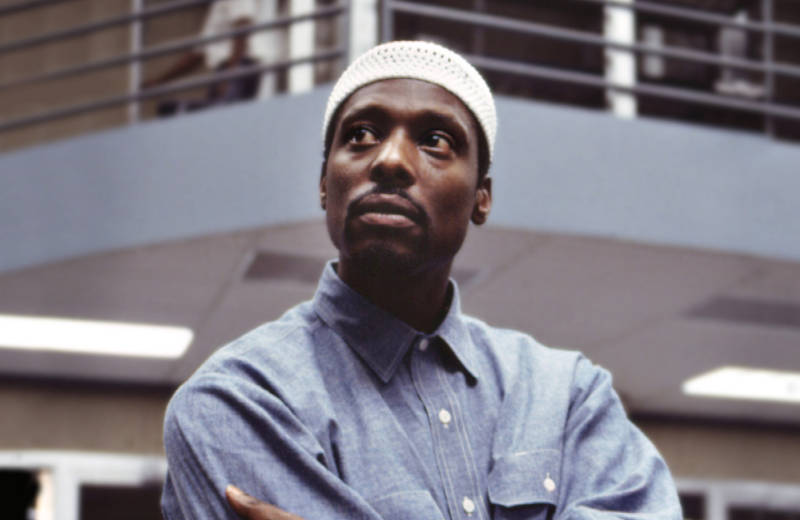
Oz approaches this need for an internal strength through faith as much as it does through human connection. Even better, it does this in part through Father Mukada and Sister Peter Marie, played by B.D. Wong and Rita Moreno, respectively (on the secular side, Patti Lupone makes a cameo. I’m telling you, Oz is a miracle). Oz was also one of the only mainstream American shows to depict Black Muslim characters with nuance and respect, particularly the character of Kareem Said, played by Eamonn Walker (particularly surprising, considering nearly three full seasons aired after 9/11). In fact, one of the show’s only true missteps, one that lazily and without reason violates the show’s own logic and careful treatment of faith-related issues, is with a Jewish character (one of maybe two Jewish people depicted in the entire series). This will make you mad for many reasons. In fact, much of the last season will make you mad for many reasons. We can talk about it when you get there.
I didn’t watch Oz when it aired on HBO. In fact, I didn’t see a single episode until 2013, the year I became friends with Mallory. She immediately shoved the DVDs for the first season in my hands. We watched the first few episodes, and then I made the huge mistake of bingeing the rest of the season on my own. I called her, distraught. “Don’t watch any more by yourself!” she admonished me. “You need me there.” She was right.
Oz flipped many scripts. It didn’t shy away from race riots. It put characters on death row and didn’t always pardon them, put them the hole and in solitary and showed how that damaged them. It showed men struggling to find emotional and spiritual connection, while also contending with not owning or being in control of their own bodies. I thought about my old friend in 1998, and I wonder if he was ready to think about all those things, especially on his own.
So if you are going to watch Oz, watch it with someone. Sure, Mallory and I will forever share a love of Dino’s need to run the kitchen, of Adebisi’s hat, of Martin Querns and of Torquemada (I love you, Bobby Cannavale!). We’ve referenced Oz to make a lot of jokes but we have also talked seriously about this show and its implications. Of course, art and music and film give people a shared language and a tangible culture to use as shortcuts in getting to know one another. But I like to think that as much as it entertained and allowed us to shriek at Beecher’s-gone-wild facial hair or the dentistry scene, Oz made us go inside a little bit too.
PS: This time I’m the Beecher, the one who finally stopped being so goddamn afraid of writing an essay about a television show.

Hi Leah!
That’s all I have to contribute because I’ve never seen Oz because I don’t think my fragile anxiety-brain could handle it.
Hi! I totally understand. But full disclosure: I have a big time anxiety brain too, and I can’t watch shows like Curb Your Enthusiasm, but I loooooove Oz.
My parents wouldn’t let us watch “Trainspotting” because they thought it was too mature for us. But my dad would reliably and obediently set a tape for “Oz” for me every Friday night when I was 14-16 years old because I goddamn loved that show and they wanted to make me happy. Nobody would watch it with me, it was my own little thing.
I think it was a really formative influence on my gender conceptions as much as any of my other politics, because it got that “masculinity so toxic / fragile” thing into my head very early.
is this you? https://www.youtube.com/watch?v=-sMfKEvv1nA
I’m glad we’re here to ask the hardest question about Oz: HOW DID ADEBISI’S HAT STAY ON HIS HEAD?!
I can’t believe this article has so few comments! Oz was indeed a miracle, and it’s a travesty that people don’t talk about it more. I haven’t rewatched it since college (too afraid that it won’t hold up to my memories? Possibly) but something related to that show, a character, a moment, probably pops into my head at least once or twice a week.
Just yesterday I was thinking about that violin prodigy who was killed in the Season One riot, and his tender, tentative friendship with Augustus. If only I’d been into slash fic back then, I could’ve written a masterpiece!
I too think this article has more comments! <3
Anyway, it’s never too late for that slash fic, I will totally read it.
I used to watch Oz secretly, late at night in the living room and hope that my parents wouldn’t walk in during anything awkward. I loved that show so much, I loved that there were no heroes (except maybe Hill? But he was the one telling the story, so not surprising?) And that scene with Miguel and Torquemada… oh my
Said <3
Who else religiously watches things that the Oz cast turn up in? Why the hell isn’t Lee Tergesen bigger?
I love them all! I just rewatched Good Will Hunting and finally recognized the “how do you like them apples?” guy.
The Oz cast shows up everywhere and I love it.
Also, I always think Lee Tergesen is bigger than he is but that’s mainly because I’m forever mixing him up with the pictures I’ve seen of Alexander Skarsgård in True Blood.
Whenever my friends and I used to talk about 30 Rock, I’d always refer to Dennis Duffy as “OMG Ryan O’Reilly!!!” and none of them had a clue what I was talking about.
Lee Tergesen should definitely be in more stuff, but on the bright side, JK Simmon’s success has been a balm to my soul. Also, I may have had a small coronary a few years ago when I realized that the little boy from Kate and Allie was one of Schillinger’s sons.
The day I realiseed the guy who played Adebisi was the 2IC bad guy in one of the Thor movies was a very good one.
Lee was wasted in a very small bit part on House and utilised much better in his bit part on Castle. Maybe I should wait for him to show up on Elementary? McManus’s episode on Elementary was brilliant. Finally he got to be the bad guy and he was terrifying.
Ooh, McManus was also Julia Stiles’ dad in Save the Last Dance! Not quite a villain, but not a great father either. I can’t believe I just remembered that!
Our baby’s nickname for FAR TOO LONG was “Adebisi” because of how his teeny hospital-issued hat just barely managed to cling to his enormous heed.
See?
I have a picture of my kid at maybe 10 days old that I took because my wife said “OMG he looks like Adebisi, take a picture before the hat falls off”
Oz was the first time I really considered the full possible complexities of human relationships, romantic or otherwise.
My friends and I would sneeks peeks at this show when we were little because of the male nudity, but I binge watched the whole thing a few years ago. JK Simmons gave me nightmares 🙂
No-one speaks and writes about Oz anymore so found your article makes me happy and found it was so good makes me more happy. Oz is the show of my heart, not my fav show (and not a perfect show) but the one with I’m more related, more emotionally invested. I felt empathy with every characters sooner or later (even if Beechballs is my soft spot), everyone even if they were all guilty, all bad like Adebisi said.
And Oz was funny. Sometime I forget that, but it was really funny (and I have a good friend that I obliged to watch the show and when we male a joke about Oz is always a pleasure).
(And is one of the few show where I loved the kids, in real life I like kids but in tv show I’m more “meh” but I love how Oz spoke about fathers/sons relationship and I love the kids).