
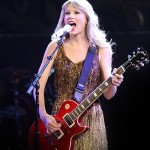
 While performing at the Grammys in January, Taylor Swift’s hair did something: it flipped – or, more accurately, it was expressively tossed by the anguished throes of her head and neck. Swift did a bit of heartbreak induced head-banging, her backlit golden hair looked haloesque, and it moved fans to wallow in a briny pool of their own tears.
Swift’s hairography is something worth talking about. From the blonde ringlets of her early country music days to her to the long, straight locks of her mature oeuvre, Swift’s hair (and the obsession with it) has always had a life of its own. And that ever-expanding life was on full display during her Grammy performance: A few hair vigorous flips – coupled with some pointed looks – signified the transformation of Taylor Swift from a spurned naïf into something more potent, maybe even more sexual.
But why is Swift’s blonde hair so powerful? Its power isn’t about Swift qua Swift, it’s about the literary power of blonde hair and writerly preoccupation with that power. Swift’s carefully choreographed hair flip tapped into that long cultural fascination. Swift could shift between virtuous and wayward simply by whipping her blonde hair. Yes, it was downright literary.
***
Literary blondes have always held a totemic power. Well before the contemporary age of the “dumb blonde” joke, many writers found in blonde hair an ideal vehicle for expressing a debauched interest in female sexuality. At the same time, golden hair became the crowning glory of saintly femininity. Writers might have disagreed on what kind of sex appeal blonde hair had – angel or devil, pick your fetish – but they agreed that it was sexy. This poetic construction of ideal beauty was purposefully very white; blondes, a kind of “unspoiled” whiteness, often stood in for an ideal Europe whose beauty needed to be untouched by colonial expansion. The link between blondeness and nationalism (compounded with nineteenth-century science) was solidified in the twentieth century. Sex, politics, and power: fictional blondes had it all.
 Renaissance poet Petrarch might be to blame for all of this: his ever-idealized dream girl, Laura, couldn’t stop getting her blonde hair caught in Florentine gusts. “Breeze, blowing that blonde curling hair, stirring it, and being softly stirred in turn, scattering that sweet gold about, then gathering it, in a lovely knot of curls again,” he writes in Sonnet 227.
But every age gets the blonde fetish it deserves. And if Petrarch and his followers were content with innocently inhaling golden hair from afar, letting their lusts going forever unconsummated, then the Victorians wanted desperately to consummate.
They did so in a particularly nineteenth century way: pushing and pulling through innuendoes. The untamed mane of Robert Browning’s Pauline envelopes the poet so that he may “unlock the sleepless brood/Of fancies from my soul, their lurking place.” Blonde hair is a protective muse, releasing poetic prowess.
 Of course, for Browning this obsession with hair’s creative power wasn’t just a metaphor. Over the course of his courtship with Elizabeth Barrett (sadly, a brunette), he constantly asked for a lock of her hair:
What I have always dared to think I would as you for…one day! Who never dream of being worth such a gift…give me so much of you—all precious that you are—as may be given in a lock of your hair.
Barrett replied:
I never gave away what you ask me to give to you, to a human being…never, though reproached for it, –and it is just three weeks since I said last to an asker that I was “too great a prude for such a thing”! it was best to anticipate the accusation!—and prude of not, I could not—I never could—something would not let me.
Just remember, they’re talking about hair.
 Charles Dickens, unsurprisingly, championed virginal blondes with angelic powers. In A Tale of Two Cities, Lucie Manette’s long golden hair restores the health of memory of her long imprisoned father. When upon seeing his daughter the amnesic doctor cries out: “What is your name, my gentle angel?” When Dr. Manette reaches for Lucie, “His cold white head mingled with her radiant hair, which warmed lighted it as through it were the light of Freedom shining on him.” Since it’s a Dickens novel, Dr. Manette is, of course, immediately restored by the virginal powers of angelic womanhood. But if blonde hair is restorative, then it’s also procreative. Once married Lucie’s hair is “the golden thread that bound them all together, weaving the service of her happy influence through the tissue of their lives.”
Poet/painter Dante Gabriel Rossetti took Dickens and Browning’s cloying hints of blonde hair’s sexuality – its woven procreative and poetic nurture – and went full on down and dirrrty blonde girl. When Rossetti writes of the biblical Lilith, in the sonnet Body’s Beauty that “her enchanted hair was the first gold,” he is alluding to a long literary tradition of golden-haired ladies. Rossetti’s Lilith isn’t just a blonde to be admired, she’s a “witch” who weaves “round his heart one strangling golden hair.” In Rossetti’s estimation, flaxen female sexuality was otherworldly, dangerous and even deadly.
 The death-fetish wasn’t just for men. George Eliot put the poetic metaphor to more sophisticated use in Middlemarch. Poor Dr. Lydgate is entrapped by the “infantine blonde” of Rosamond Vincy’s “wonderous” hair plaits. Eliot smartly posits (and maybe even satirizes) a connection between Rosamond’s perfectly coifed blonde hair and her industrious lacing and netting. Eliot lays it out pretty plainly: blonde Rosamond is weaving her web. Lydgate cannot, of course, resist, his escape is no longer possible when he finally notices that Rosamond’s hair and handiwork was a matrimonial web that hopelessly trapped him. Lydate had imagined, in his “old dreamland,” that Rosamond was “that perfect piece of womanhood who would reverence her husband’s mind after the fashion of an accomplished mermaid, using her comb and looking-glass and singing her song for the relaxation of his adored wisdom alone.”
Sadly, poor Lydate was not well versed in the mermaid fantasy he constructs for Rosamond – as the narrator of Vanity Fair points out, mermaids are “fiendish marine cannibals, reveling and feasting on their wretched pickled victims.” In some surreal sense Rosamond is an “accomplished mermaid,” she lures a man with his beauty only to suck the life out of him. George Eliot, in her infinite wisdom, saw that the sexual enticement of blonde hair was mermaid-like: deceptive, monstrous, and cannibalistic. That’s probably why Dorothea was a brunette.
 But if writers couldn’t agree on whether blonde sexual allure was deadly or maternal, they could on agree on one thing: DON’T CUT YOUR HAIR. DON’T EVER CUT YOUR POWERFUL BLONDE HAIR. In poet Christina Rossetti’s Goblin Market the aptly named Laura, longing for “goblin fruit,” laments her poverty, the goblins reply:
“You have much gold upon your head,”
“Buy from us with a golden curl.”
She clipped a precious golden lock,
She dropped a tear more rare than a pearl
Then sucked their fruit globes fair or red
Sure, this poem is about trading hair. Christina Rossetti, always a great public hater of her brother, Dante Gabriel tells it like it is: Use your blonde hair for profit or pleasure and you’ll end up sucking fruit globes. But Christina Rossetti also finalizes the strange intersection of the blonde fantasy – a simple trim can move a blonde back and forth between two sexualized fetishes. But whatever you do, Swift, don’t pull a Jennifer Lawrence and cut your hair because, as W.B. Yeats would have it, “Never shall a young man… Love you for yourself alone/And not your yellow hair.”
***
That’s why Swift’s Grammy performance was so fascinating. When she walked the pre-show red carpet, she wore her hair tied in a vintage inspired-ponytail – everything about it said prim, proper, virginal. But when performing her heartbreak ballad “All Too Well,” down came long, flowing locks and out came the emotional hair tossing. With a flat iron and a great blowout, Swift signified her transition from angelic femininity to accomplished mermaid – no need for the purposefully scandalous performance à la Christina Aguilera or Miley Cyrus; Taylor Swift’s blonde hair does it alone. As the New York Times’ Jon Caramanica joked, “So impressive how Taylor as gone from the teenage door-busting threat…to a 45-year-old adult contemporary balladeer in just five years or so.”
Swift’s music, of course, has always walked the line between virginal disappointment and scorned revenge taker. In turn, that’s entered a broader conversation about Swift and her very public relationships: is she simply a victimized by men who don’t share her domestic fantasies or has she ensnared them in her ever-growing web? It’s nice to see her hair finally get in on the action. Hopefully her hairography will forever expand – maybe one day she’ll take a page from John Keats’s La Belle Dame Sans Merci and murder an unsuspecting knight with her flaxen web.
Tags: beauty, hair, milton wept, music, stassa edwards, taylor swift




I hope Stassa knows what semiotics means bc I didn’t check.
Also, this was really fun and I enjoyed screencapping her hair.
This is fantastic. Can we get another installation on straight v. curly hair in terms of representing sexuality v. innocence? Or just, more hair talk in general?
Also, what does it mean that Swift was a brunette in the “I Knew You Were Trouble” video? Brunettes are trouble? Brunettes know when people are trouble? Brunettes should writhe in the dirt, not blondes?
I’m a dark brunette with thick, curly hair and I am CONSTANTLY dirty and hysterical. (My curls fall on the “hysterical” side of the ringlets=cute, frizz=banshee scale)
I’m a dirty blonde (or dishwater blonde, which is a tad less appealing), so I guess I’m on the slutty side of the Blonde Madonna, Blonde Whore scale.
Brunettes are 100% trouble at all times.
Recently dyed my hair brunette. Can confirm that I am more trouble now than I was a month ago, when I was blonde.
I really enjoyed your weaving of authors, pop culture and poetry together with humanity’s fascination of blonde hair. Whimsical but seriously informative and altogether a fun read!
Any chance on covering redheads?
Loved the article, but this…
“It’s nice to see her hair finally get in on the action”
this was brilliant.
Hairiography! Hairiography! Perfect! Wonderful!
“Then sucked their fruit globes fair or red”
Uhhhhh….
I am a naturally super-blonde person (like, crayola marker yellow meets white corn) and I’ve always been fascinated by the way people put it on such a pedestal. I once dyed my hair dark brown on a whim and people FLIPPED OUT. Friends, family, strangers- they all had the same reaction, which was NOOOOOO. When I walked into the salon for my appointment, the receptionist literally said “oh my god. why.” It’s like people feel that I’m obligated to uphold these strange blonde ideals. It weirded me out.
As someone who was born with jet-black hair that no amount of peroxide could ever lighten enough to take a color (without destroying it utterly) I say EFF THOSE HATERS. You do whatever color you want, bb. Whatever and whenever.
I’m jealous of blonde hair but mostly because my hair is brown and too dark to dye dramatically without lightening, which I don’t want to do for fear it would wreck my hair.
People are definitely super weird about altering blond hair. On the plus side, I pretty much got all the rebellious kicks I needed by cutting and dyeing when I was younger. Why take up smoking or mischief when people will freak the hell out and rhapsodize my lost innocence after I’ve gone short or pink or blue?*
*Note, fellow blondes: do not go blue. It will wash out green, and then your college theater director will make you bleach it back blonde.
My hair’s a darker shade of blonde but I recently dyed it red for the first time and I’ve gotten a handful of reactions like that, including one random lady in a neighboring office who asked my natural hair color then FREAKED OUT when I told her, and one cousin who actually said, “WHAT DID YOU TO DO YOURSELF??!!” when she saw me.
When I went from my natural, dirty blonde to red I got mostly positive reactions (my mother being the exception), but then I also discovered a whole weird world of red-head fetishists. I got a lot more attention on the street than I’m used to and one guy on the subway who straight up told me about his love of red heads at length. Eventually I decided to switch to a honey blonde, which seems to be the right balance between me liking it and not getting bothered by weirdos on the the subway.
Natural blonde here (dark blonde, though, now, in my DOTTAGE) and I dyed my hair red on and off for years. Typically when people heard I was a natural blonde, they’d look baffled and say “but then WHY do you DYE it??” like the idea was just incomprehensible.
I have also had brown hair, and the length and style has varied wildly over the years. I swear I could write a thesis on the different types of attention you get with different hair/length color combinations. It has been fascinating.
OH OH THIS WAS WONNNNDERFUL
“That’s why Swift’s Grammy performance was so fascinating.”
That is some fierce, fierce pronoun antecedent business right there.
I’m not that familiar with Taylor Swift’s career or music, but that does seem like a pivotal moment. She seems to be streching what she can say with the song, trying to express what’s maybe a new meaning. Not sure why, but at times, it reminded me of the visuals in Frozen’s “Let It Go”. Somewhat excited to see what Swift does next.
Ooooohhh this is very relevant to my interests! I went through a heavy “hair period” in college, but more in terms of art and representations of femininity, so the literary/historical angle is very fascinating. Joining the chorus of MORE PLEASE.
Oh yes, this is excellent! More like this please! I would love to read something about what hair up versus hair down means, both in terms of “what it means in art” and “what it means in the contemporary business world” etc. So fraught! SO FASCINATING. How is it that what grows out of our heads can seem more important than what comes out of our heads?
Another literary blonde (who probably influenced Petrarch): the subject of Dante Aligheri’s Rime Petrose, who had long blonde braids with which the narrator fantasized about being whipped. She was more part of the evil ice queen trope of blondeness than an image of sweet virginity, though.
(I was nineteen and pretentious, once.)
Am I the only person who is struck to near-incoherence by her actual performance, though? I mean HOLY CRAP that was AMAZING.
Pop culture semiotics are pretty much my favorite thing, and of course I knew about the dichotomous nature of blonde hair, but I never thought about how it could be used as a tool for storytelling. This was so awesome!
man all this time I thought the whole point of the Yeats was that you SHOULD cut your yellow hair, shave it all right off. Young men can’t love you for your hair when you haven’t got any, can they! Bring out the clippers! take that off right down to the scalp, leave the patriarchy on the barbershop floor. like you are symbolically castrating your admirers as you denude your scalp. I mean or else the point of the poem is Yeats was being a cock that day, I don’t know, I don’t really care for poetry.
“or else the point of the poem is Yeats was being a cock”
hahaha I don’t kow if it’s true in this case but I have read A LOT OF POETRY and so many poets are cocks
I even really like Yeats most of the time (“don’t really care for poetry” = I like Eliot and Yeats and Thomas Wyatt and that is basically it because I am a 150-year-old man, Harold Bloom wishes he could be as reactionary as me) but that poem! Jesus! I cannot think of a single other poem that is as much about the narrator being a dick as that poem is.
also what is up with superblondeness being the ultimate incest signifier?? You know how in A.S. Byatt’s Angels & Insects the main character does not realize until too late that his wife is sleeping with her brother who is also BLOND and all their babies are BLOND(E) and then he runs away with the other woman because she is a brunette, or because ants are better than bees, or something.
and then I guess Flowers in the Attic and those dumb Song of Ice and Fire people. Just at the moment I cannot think of a literary character who sleeps with her brother who is not a blonde, although I am sure there must be one, somewhere.
(Joleta in the Lymond books had hair the color of I want to say apricots? But it was 100 percent her brother’s fault not hers so it makes sense that she was only a borderline blonde.)
EDIT: Oh jeez and Charles and Camilla Macaulay, right? So blond.
“those dumb Song of Ice and Fire people” yes
oh and surprise surprise, look what John Hurt did to his hair when he was incesting it up in I, Claudius:
http://www.kcet.org/shows/i_claudius/assets/image…
my goodness.
Is it a sort of foreshadowing? Because blonde hair is recessive, something something.
Maybe it has something to do with blond hair being recessive? Although under that logic I guess with red hair being so rare, it would work even better.
I think it is, but its less of a “cheating” signifier if the writer remembers that dark haired people can have blond kids, but not the other way around. Though I suppose if its incest that one doesn’t work any way.
*SPOILERS*
The God Of Small Things has non-blonde incest, seeing as the characters are Indian (I mean, I’m presuming that means they wouldn’t be blonde…)
Good article. It made me remember reading Marina Warner’s “From the Beast to the Blonde”.
"those dumb Song of Ice and Fire people" yes
1. ehmagerd Taylor. Seeing her in London tomorrow. Will report back on hair, etc.
2. Can we have redhead chat please? Like, I always feel that when I see other Real Redheads in the street, we have a moment of eye contact and emotional connection. Can someone please confirm this is a real thing and not just in my head. Thnx.
1. ehmagerd Taylor. Seeing her in London tomorrow. Will report back on hair, etc.
2. Can we have redhead chat please? Like, I always feel that when I see other Real Redheads in the street, we have a moment of eye contact and emotional connection. Can someone please confirm this is a real thing and not just in my head. Thnx.
Should you decide not to wait until then. . . the upside of being blonde is that temporary dyes meant to just give a hint of color will straight up change your color but wash out. I enjoy Clairol Nice n Easy for "natural" hair colors (the red shades work great, rinse out slowly; brown is nice but rinses out quickly; black just looks brown). I greatly mourn the passing of L'Oreal Color Pulse for nice vivid pinks and purples, but apparently you can still get it on Overstock? I feel weird about that, it's been discontinued for awhile.
I can't help you with green. You could always go swimming, I suppose. : )
Haha. But also I’m disappointed that “qua” didn’t link to the wiktionary page about “qua.”
Natural blonde here (dark blonde, though, now, in my DOTTAGE) and I dyed my hair red on and off for years. Typically when people heard I was a natural blonde, they'd look baffled and say "but then WHY do you DYE it??" like the idea was just incomprehensible.
I have also had brown hair, and the length and style has varied wildly over the years. I swear I could write a thesis on the different types of attention you get with different hair/length color combinations. It has been fascinating.
I found myself at the Taylor Swift concert last weekend (I was accompanying a 9 year old). I found her hair fascinating. She changed frock between each song just about, and her hair changed almost as often, from casual ponytails when she was being just folks and playing the banjo, to the full Sarah Brightman be-gowned head toss in a filmy gown. I don’t know if the child’s education has included semiotics, but she is a master of yer Roland Barthes-style denotation and connotation.