
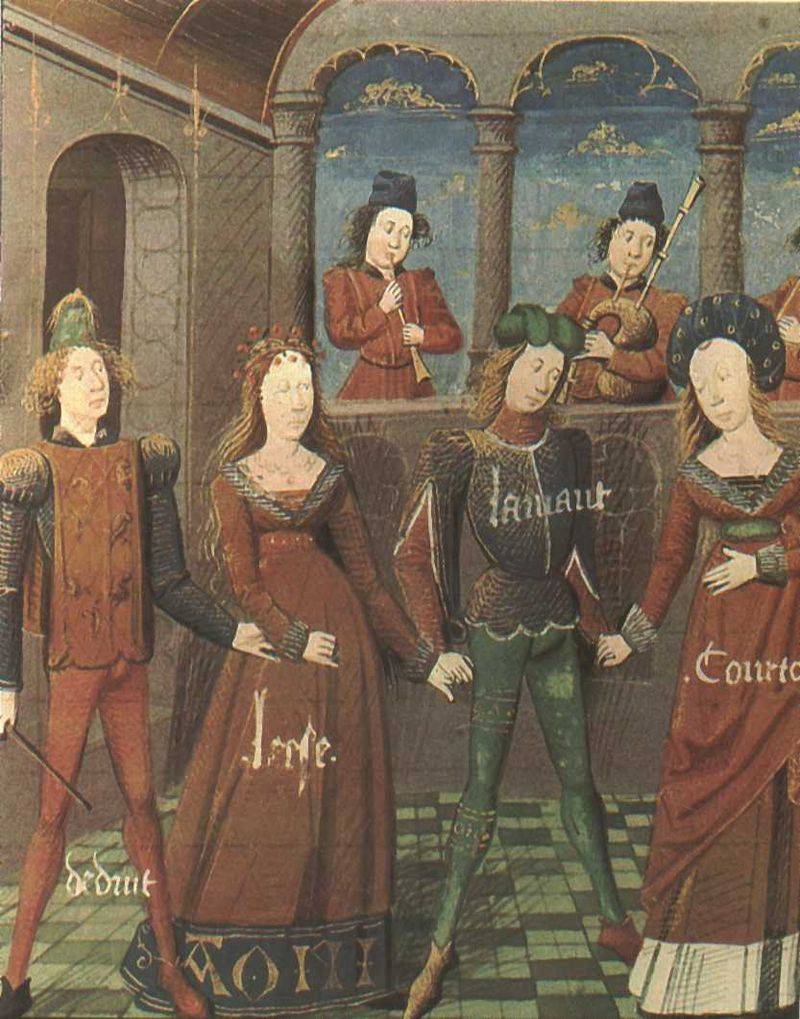
You are familiar with “Sumer Is Icumen In,” if nowhere else, as the song the murderous villagers sing at the end of the original Wicker Man. It’s one of the oldest known songs in English, and an early example of polyphony. It’s a sweet little example of English pastoralism! Birds, and bleating, and growing bits, and whatnot. Very pagan, very seasonal, no hidden meanings here.
Summer has come in,
Loudly sing, Cuckoo!
The seed grows and the meadow blooms
And the wood springs anew,
Sing, Cuckoo!
The ewe bleats after the lamb
The cow lows after the calf.
The bullock stirs, the stag farts,
Merrily sing, Cuckoo!
Cuckoo, cuckoo, well you sing, cuckoo;
Don’t ever you stop now,Sing cuckoo now. Sing, Cuckoo.
Sing Cuckoo. Sing cuckoo now!
And yet were you aware that it was also subject to one of the most charmingly clunky attempts at Christianization of all time? Friend, it was:
Observe, Christian,
such honour!
The heavenly farmer,
owing to a defect in the vine,
not sparing the Son,
exposed him to the destruction of death.
To the captives half-dead from torment,
He gives them life and crowns them with himself
on the throne of heaven.
MONK #1: “Sorry, how did you get Christ out of farting goats?”
MONK #2: “Don’t worry about it.”

Aw, two monks, just doing their best to make it in this crazy, mixed up, goat-farting world.
Why is the font on everything except the masthead and intensedebate logo messed up this morning? Is it on my end?
I think it perhaps may be you!
But the heavenly farmer, Mallory.
I feel this is the right time to say that “Sumer Is Icumen In” was my ringtone for two entire years of graduate school. I also used to sing it to my British Lit students and force them to sing the round with me. YESSSS.
My first favorite professor in undergrad sang it to us on our first day of Intro to Poetry and then I became an English major. So, you know… you’re doing good in the world.
I sang this in a concert on Saturday and wondered why the Latin words were so unrelated to Sumer is icumen in… Monks, man.
The Toast is almost too relevant to my life.
When you sing it in Latin, do you use the same melody as the usual English version, i.e. this one? https://www.youtube.com/watch?v=sMCA9nYnLWo
Because this is the Latin text from wikipedia, and I can’t figure out if it fits to the melody:
Perspice Christicola
que dignacio
Celicus agricola
pro vitis vicio
Filio non parcens
exposuit mortis exicio
Qui captivos semiuiuos a supplicio
Vite donat et secum coronat
in celi solio
Also, the idea of singing a chipper round about the captives half-dead from torment is hilarious to me.
Yep, that’s the one. I’ll do a side by side, forgive my mixture of spelling for the english, I’m typing on my ipad which is unforgiving of me changing tabs to check spelling!
Perspice christicola que dignacio – sumer is icumen in, lhude sing cuccu
Celicus agricola pro vitis vicio – groweth seed and bloweth mead and springeth wode new.
Filio! – sing cuccu!
Non parcens exposuit mortis exicio – Awe bleateth after lambe lowth after calf the cu
Qui captivos semivivos a supplicio – bulluc sterteth buck verteth, meri sing cuccu
Vite donat et secum coronat – cuccu, cuccu, well singst thu cuccu
In celi solio – ne swik thu naver nu
Does that help? And all the c’s in the latin we pronounced as ‘s’ unlike classical latin or Italian.
It’s even funnier to see them side by side.
To the captives half-dead from torment…farteth the stag!
Is Christicola really the Latin for Christian? Or is it a word someone made up so that it would rhyme with agricola?
…Because I still don’t like it as much as Tim Rice’s choice to rhyme “pajamas” with “farmers” in Joseph and the Amazing Technicolor Dream Coat.
Your comment confused me, being from Australia where “pyjamas” does rhyme with “farmers”.
In my part of the UK (south-east England), too!
Eh, the devil may have the best tunes, but he’s never minded sharing them with the church.
In any case, where I am that’s an unseasonal poem to be reciting. It’s almost time for the version from that dirtbag, Ezra Pound–
Winter is icumen in,
Lhude sing Goddamm,
Raineth drop and staineth slop,
And how the wind doth ramm!
Sing: Goddamm.
Skiddeth bus and sloppeth us,
An ague hath my ham.
Freezeth river, turneth liver,
Damm you; Sing: Goddamm.
Pound: an OG Problematic Fave.
I double-love that because I discovered it before the original, kind of like learning that The View was an actual show and not just some ridiculous shit they made up on SNL.
I couldn’t decide what I was in the mood for: a) the clunky rhythm of a bad translation of Russian poetry, b) doge-speak, or c) the work of a writer who thinks they are the first to use farming symbolism in the context of religion.
Luckily, I got all three, plus the phrase “crowns them with himself”.
“sat on their head” i guess??
ha ha ha! It’s fun when songs/hymns are peppy about crucifixion, damnation and hellfire.
Although after reading Caroline Walker Bynum, I’m convinced monks can make a Jesus analogy out of ANYTHING.
Also, after teaching English 101 this morning, I want to nicely ask the monks if they see how “crowns them with himself” could feel a bit ambiguous, image wise. Heavy is the head that wears the crown, especially if the crown is a 32-year-old man.
“crowns them with himself” sounds so dirty to me no matter how I try and turn it around. Ah well, filthy minds and all.
It sounds like one of those dirty Shakespearean puns that you don’t realize it a euphemism until someone explains it to you.
I remember the pagan version from Sarah, Plain and Tall, primarily because it sparked off a heated discussion about orthography and the history of the English language in my fourth-grade class.
I still remember the first time I encountered “deer ferteth” and giggled for two weeks straight. Very Christian, I tell you what.
I am reconsidering my opinion on the sinfullness of Babylon if Sumer invading your country means that suddenly cuckoos are attractive.
I mean, whatever you do with fermented honey beverages is your own business, but I draw the line at sexy singing birds.
I always thought “sumer” meant spring? http://lyricstranslate.com/en/sumer-icumen-spring…
Any Flanders & Swann fans here? Remember that bit during their piece “Greenfleeves” when they remark in passing that “Sumer is icumen in” had been banned because people had been singing cuccu a little too lhudely?
I didn’t get that joke for years, until my Survey of British Literature.
"sat on their head" i guess??
Your comment confused me, being from Australia where "pyjamas" does rhyme with "farmers".
Is this related in some way to Hal-an-Tow?
Hal-an-tow, jolly rumbalow
We were up long before the day-O
To welcome in the summer,
To welcome in the May-O
The summer is a-coming in
And winter’s gone away-O