
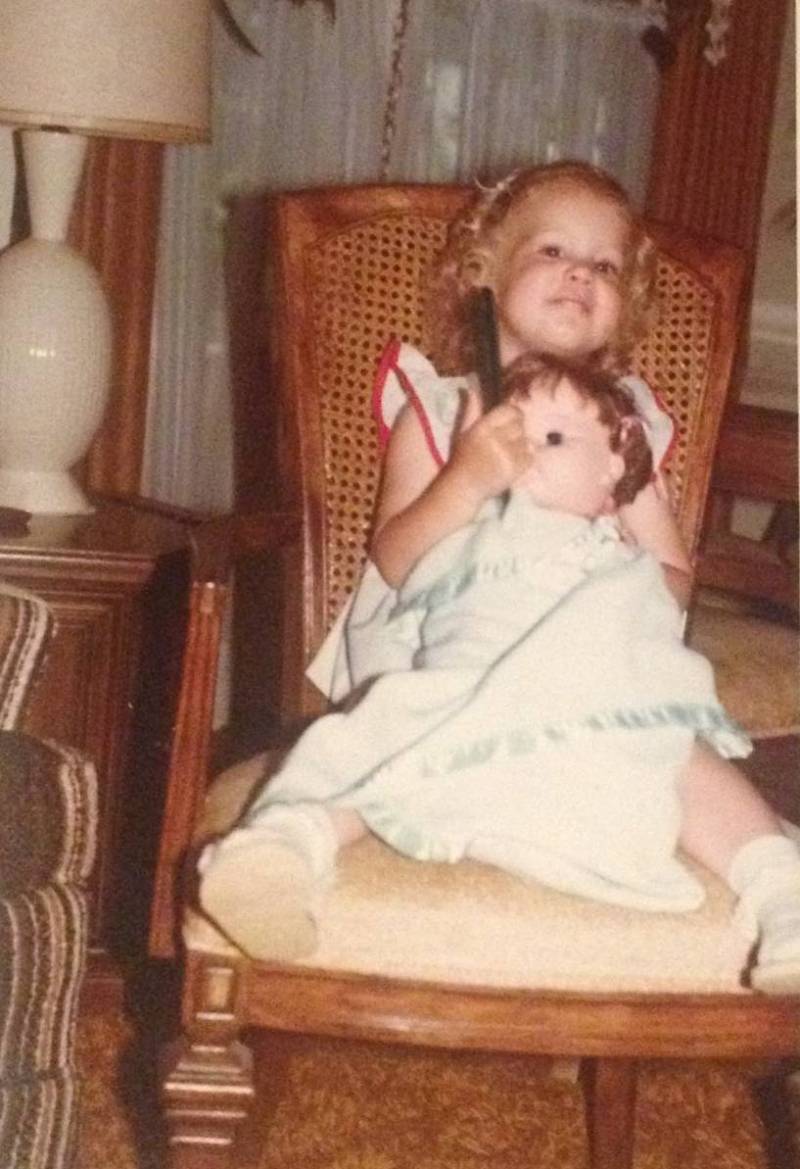
Sometimes I feel like an adopted kid from a bygone era. Back when no one admitted you were “not theirs,” older cousins and siblings who happened upon the truth were threatened with boogeymen and punishment if they told you this wasn’t your “real family.” The fear was that finding out your origin differed from what you’d been told or thought would shake you, making you question who you were and your trust in the people who raised you.
It turns out you can grow up knowing you were adopted and still be shaken by the truth well into your thirties.
My origin story was the last childhood token I held in my heart. It was a bedtime story from before I had memory, one I’ve simply always known. Its importance survived 25 years of rocky and often abusive periods with my mother and complacency from my father. My inner five-year-old needed that happy start where my parents waited nearly ten years for me, dreaming of the day they’d become a whole family.
The length of time it took to “find” me, as my mother always told it, was one of the ways she explained how much she loved me — the parental version of when people place greater importance on the partner they “waited so long to find.” I grew up using what I was sure must have been a painful time for someone who desperately wanted to be a parent as an excuse for her behavior and why my own feelings mattered less. I may not want children, but I can empathize with a seemingly unending wait for something you desperately want. I have always honored my mother’s pain and sadness, her patience as well as her excruciating joy at finally having a child placed in her arms.
So when my cousin casually dropped a detail about why I in particular had been selected — why it had taken years and years for my parents to adopt — I was shaken. “My mom told me that it took a while to find a perfect match because your mom was completely unwilling to negotiate regarding you being ‘female, all white,’” she told me one day when we were chatting online.
Suddenly the coffee shop where I sat with my laptop felt like it was on a fault line, and I was getting a lesson in plate tectonics.
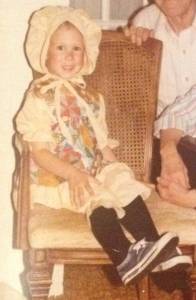 The author, age 2, on Halloween
The whole conversation had started because my cousin and I were recalling the weird way my mom used to compliment me. Her style was so overblown that the compliments always seemed “off” because they were never really about me. Then we began discussing how my mom had gone from being very open about my adoption to cutting me off if I started to matter-of-factly tell someone I was adopted. It happened when I was around eight or nine — which was the time I got taller, my hair got darker, and I generally stopped looking like her. The topic of her overprotectiveness — which was legendary amongst friends and family — was a natural transition, and I mentioned that my mom had cut me off from a friend when I was in middle school because, in my mother’s words, “she ‘went with a mulatto boy.’” She later insulted a friend of mine in high school because he was “half black.” When he picked me up for a mutual friend’s graduation open house, my mother made sure to remind me, “This is not a date.” (No shit. He was two years older and way cooler than I was; I was lucky we were even friends.)
Considering all this, it wasn’t necessarily my mother’s prejudice regarding her potential adopted offspring that struck me; it was this racism infecting my origin story. She hadn’t waited years and years to adopt me because there was some baby shortage in our small Midwestern town, or because international adoption wasn’t as trendy in 1979. She had waited to adopt because she wanted to make sure she got an “all white” infant girl.
I trust my cousin implicitly; she is the voice in my head, my conscience, my “audience of one,” and has been for most of my life. But we were only kids when her mother told her that my mom had insisted on a white child. I needed to know more. “How old were you when you found this out, and how did this come up with your mom?” I asked.
“I would have been around fourteen,” she replied. “I was trying to understand how the adoption process actually worked — as in, waiting lists, matching, closed versus open. I asked my mom how come it took so long to adopt you. We had another friend who had decided to adopt, and like seven months later — bam! Kiddo!”
“Right,” I said, nodding along.
“Then my mom said all matter-of-factly, as though it was common knowledge, ‘Oh, they only wanted a female who was all white,’ and my dad interrupted and said, ‘I don’t think he [meaning your father] had a preference.’”
“JESUS CHRIST, HOW COULD YOU NOT HAVE TOLD ME ANY OF THIS?” My cousin and I tell each other everything. Then the reason occurred to me: “You thought I knew.”
“Yes, of course! I mean, we all knew you were adopted, but I never really asked any questions until I was in high school.”
She didn’t realize it, but my cousin was about to hit on the real reason why my race would have been so important to my mom, and why our relationship had changed so drastically: My mother couldn’t handle feeling like I wasn’t hers. She wanted there to be no chance for outsiders to question whether or not I “belonged” to her.
“My mom said it was important for people to think you were your mom’s biological child, but I don’t think that’s it,” my cousin said. “Your mom never hid the fact that you were adopted. So I think it was more that she believes ‘white parents should raise white kids.’”
“No,” I said. “Your mom was right. Do you remember how my mom’s attitude about telling people I was adopted started changing when I was eight or nine?”
“I remember that’s when she started frosting your hair, because I was jealous,” my cousin recalled.
“I hated that. It wasn’t my choice,” I said. “She frosted it because she frosted hers. My hair was getting darker (not like hers) and I was getting taller (not like her).”
“I never knew that!”
I realized I hadn’t talked about it at the time — even to the person I talked to about everything. It still hurt to remember how things had changed. “She would interrupt if my answer to a question from someone at the grocery store was about to be ‘Oh, I’m adopted’ and interject with ‘Oh, she’s just lucky.’ She’d find a reason to scurry us off, leaving me confused because we’d never been ashamed of it before,” I told my cousin. “I mean, Family Day — the day the caseworkers brought me to my parents when I was two weeks old — was a goddamn bedtime story. I couldn’t figure out if getting older meant I was supposed to be ashamed of being adopted.”
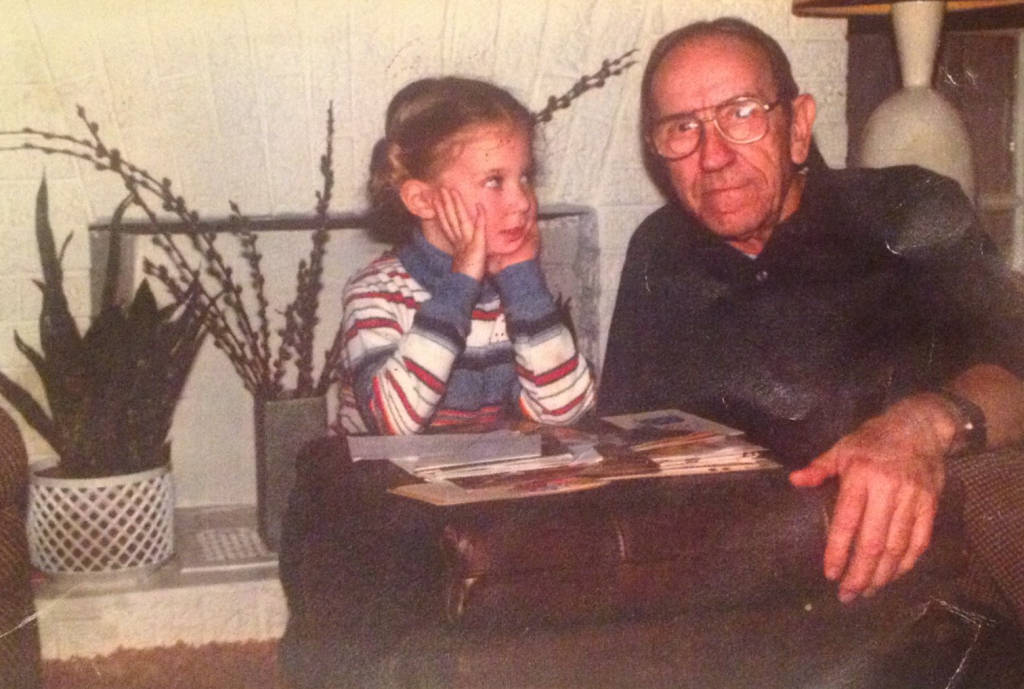 Katie at age 3, with her maternal grandfather
I recalled how my mother used to roll her eyes about my musical talent: “Well, I don’t know where you get that.” Any personality trait she didn’t recognize, any surprising talent or difference was seen as foreign and therefore suspect. I could feel her discomfort long before I was old enough to understand or explain it.
I did feel sad thinking about all of this — sad for my inner five-year-old, learning that her adoption bedtime story was basically a sham. But now that I was forced to face this knowledge head-on and begin processing it, it did fill in some big gaps for me. I didn’t have to explain this to my cousin. We often talk about what’s missing — and filling in these gaps through validation and information-sharing is part of what we have always done for each other. She understood that this conversation clarified a few things from my childhood, and was willing to verify her own story to make sure her memory was accurate. When she followed up with her mom about how long my parents had waited to adopt me, my aunt confirmed it took a long time because my mother had indeed insisted on a newborn, “all white” girl.
Of course. For me to be entirely “hers,” I’d need to be as young as possible (I was two weeks old at my adoption) and have the deck stacked enough so I’d fall in line with her mostly German looks. That way people would assume a biological connection — that is, sameness and ownership. All efforts were made to prevent or at least reduce the chances of my being spotted as an “other.”
Any trait my mother didn’t recognize, any surprising talent or difference was seen as foreign and therefore suspect. I could feel her discomfort long before I was old enough to understand or explain it.
And it worked — for a while. To the best of my knowledge, I’m probably English, German, and Irish; odds are that’s true simply because most while folks from my hometown are from that part of Europe originally (or at least say they are). The twist is that my adoptive father is Hungarian — the dark-haired, dark-eyed, tans-in-an-instant darker-complected phenotype, not the closer-to-Austrian blond-haired, blue-eyed type. So when I hit a growth spurt at age eight, when my hair got darker and my deep summer tan lasted into the fall, anyone outside the family could just have assumed I was starting to look more like my dad. I was clearly going to be taller than both my parents, but no one would have said, “Gosh, she sure doesn’t look like either of you! Where did she come from?”
That wasn’t good enough for my mom. I started to look more like I was theirs, but I no longer definitively looked like I was hers. Commenters who knew I was adopted stopped remarking on how much I looked like my mom despite my origins. They weren’t saying the opposite, but the reassurance that total strangers would look at me and see a reflection of her was waning.
Over time, my mother probably couldn’t see herself in me at all anymore. My interests and talents entirely diverged from hers. When I eventually stopped letting her frost and straighten my hair, grew a few more inches, and immersed myself in school and church activities trying to earn my way into college, we had less and less in common. All of the ways we seemed to differ, all the choices I made that she didn’t agree with — even if only minor slights — seemed to affect my mom so deeply. It puzzled me when I was growing up, but suddenly made much more sense in the context of her imagined, “ideal” vision of parenting: She had adopted me hoping I would look and be just like her, so no one would ever question where or with whom I truly belonged.
***
While I was initially sad that my favorite childhood bedtime story turned out to be nothing but a revisionist fairy tale, my therapist helped me find a way to understand and reclaim my adoption story, and complete it on my own terms. We talked about how I have always divided my childhood into “up to age eight” and “after age eight,” and why, with this new information now factored into the analysis. Age eight was when I started to feel stifled and “othered” in my own adoptive family, because my dad emotionally withdrew and my mom started showing signs of being injured by my very interests and personality. I could see it on her face as she flinched her way through my stories, reflecting dismay at my new interests and storytelling style. Age eight is when I began to change from the child she’d hoped I would be, the mirror image of herself.
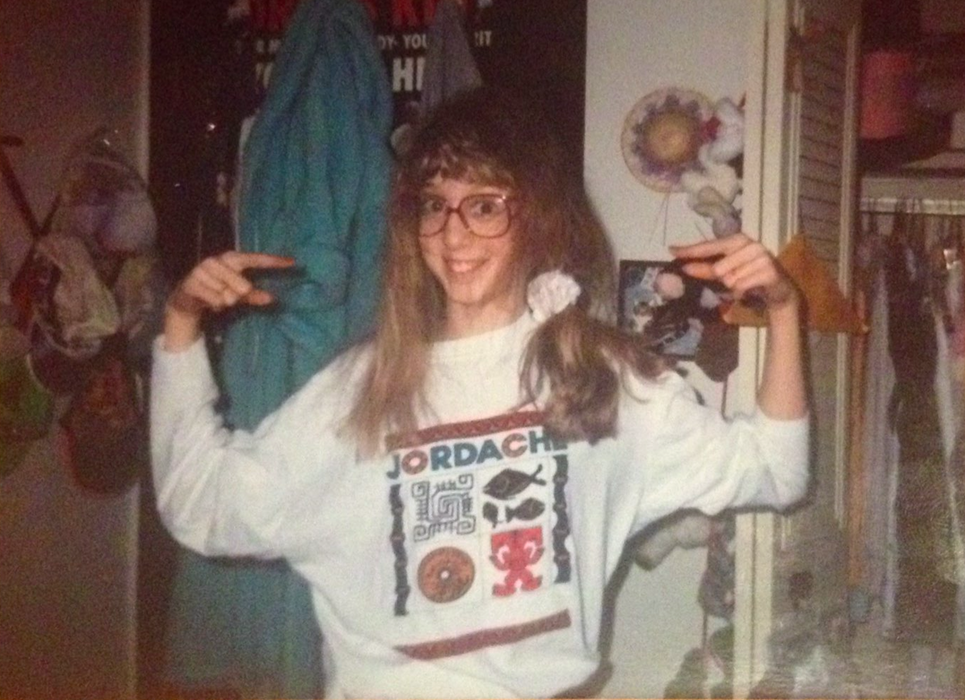 Katie, age 12
Having a more complete understanding of why this happened when it did also helped me realize that my mother wasn’t pretending when I was younger. She loved me very intensely and completely, and tried to create a safe space for me to develop and grow — into the person she thought I should be. What was real to me when I was little is still real in my memory: I felt loved and secure as a young child, nourished by my mother’s songs and stories and lessons, and that was incredibly important to my development. I wouldn’t have had a foundation to become me at all without that safety and support. Even if she couldn’t continue in what felt so much like unconditional love into my pre-teen years and after, I still benefited from it in those early years.
Seeing my mother pop back up in my text messages the week before Christmas, despite the fact that she mostly disowned me four years ago, didn’t phase me so much. As my therapist charitably said when the text came in: “That’s all she can do.” Understanding that seemingly small thing — “That’s all she can do” — was revolutionary for my mental and emotional health; it’s how I eventually let go of the anger I felt toward my mother for what I’d always perceived as a withdrawal of love and support.
If I never knew my adoption story until recently, my mother did, and she lost control of it when I was still a child. It’s possible she never quite recovered from that disappointment.
I never meant to let my mom down, and she should never have expected me to fill the role of ideal lookalike child in the first place. But if I never knew my full adoption story until recently, my mother did, and she lost control of it when I was still a child. It’s possible that she never quite recovered from that disappointment. I wish I could talk to her about this (or anything) for confirmation, and to fill in any remaining holes. I’ve had to piece it together myself, due to a combination of her choices and an unwillingness to get help for her issues, despite my asking her for years to either participate in my therapy or seek her out her own.
With my adoption origin story recovered and retold, all that’s left is for me to try and find myself again — to invent or fight my way back to the person I can feel comfortable and confident being. Finally, I understand the path that brought me here, adoption and all, and I’m able to see who I really am. It may have taken me a couple of decades to reconnect to the confident, warm, open person I was trying to become when everything changed at home, but I think I’ve found her again.
Now, thanks to my cousin’s accidental gift of knowledge, I can see the fork in the road where my mother’s perfect adopted daughter and who I truly am diverges. I can let go of the last of the self-blame I carried into adulthood. I know that her disappointment is not my fault, and that she did and still does love me. My foundation might have been rocked with my cousin’s revelation, but I’ve settled into a healthier, happier place because I now know the truth about my adoption.

Dang. In my experience, parents try to get their kids to be like them in general, but adopting to have a child who is as much like you as possible is a new level. On the other hand, your mom did try to make sure you felt safe and accepted as a young child. It’s a pity that it came with conditions on what you should be.
In a weird parallel, I know a family that would only adopt a Dutch boy. American Dutch boy. Not Swedish. Not Belgian. Dutch. Considering that there’s not a huge population of Dutch people in the region they were in, it understandably took them several years before they could adopt. Apparently they really took the adage “If you ain’t dutch, you ain’t much” way too seriously.
Is this family based in Western MI? I will never forget the first time someone said that to me and meant it.
My (American Dutch) mom always said that that phrase wasn’t actually too much of a joke to some people in her social circle while she was growing up in the greater Grand Rapids area. The things some people will find to dislike others for…
I’ve just moved to a Dutch community and it’s weirldy…insular. It’s been made to clear to me that I’m not in the “Dutch Club”. It’s fine though, because I don’t like nasi goreng or speculaas or calvinism that much anyway.
My parents are both super dutch. Like my mom’s 100% and my dad is the shame of the family because my great-grandmother was part german. It’s so weird, tbh. Chicago dutch have genetic tests done on them because for about 100 years or so, they wouldn’t marry out of the group, so there’s weird almost incest everywhere. (My great-great-grandmother shows up on both sides of my mom’s family, although she only had children on one side, narrowly escaping incest with my grandparents).
You’re really only missing out on Oliebollen and Bonket. The Calvinism is sort of eh, as are speculaas. I mean, fried dough and pastry with almond paste. Can’t say no to that stuff.
BANKET
We just ran out of this year’s batch (I make almost a kilogram of marzipan every year and my mom makes it into banket! I have never met anyone outside my family or the Michigan community who has even heard of it.)
AND CALVINISM YES (altho’ I remain a bit partial to that in some respects, NOT in others…)
PRAYING BEFORE *AND AFTER* MEALS
That alcoholic preserved-raisins thing
Having a stroopwafel iron (and using it several times a year)
SUPER CLEAN AND ORGANIZED EVERYTHING
That cheesy milk soup thing with the toast
…I may be a proud Black woman but I’m also proud to be an American Dutch woman. I love all my heritages. Being mixed is not as angsty as it used to be!
My mom and sister always make it! BUT THEY NEVER MAKE ENOUGH. (And by enough, I mean endless eating bonket all year around).
Oh my god, I forgot about the praying thing, because we did it when we were kids but then my family fell out of it.
Stroopwafels. Nothing else matters.
It still isn’t much of a joke in that neck of the woods!
Usually, right after they say that phrase, they ask about your “church home”.
Oh god you just gave me one hell of a flashback.
From Western Michigan. They were living in Minnesota (land of 1,000,000 Swedish people who weren’t apparently white enough).
My family (both parents, and their parents, and…) is Dutch and comes from the Grand Rapids area, so I’ve heard that saying, but NEVER in a way that indicated they meant it! Although my grandma, bless her, said she tried hiring in a cleaning lady once in a while as she started getting older and less mobile, but decided to let her go because “she doesn’t clean the house the way a Dutch girl would.”
Oh man, Dutch clean! My family isn’t Dutch, but my parents moved to Holland before I was born and it’s where I was born and raised. Mom never got our house “Dutch clean” like some of my friends’ moms did. I asked my internet friends a few years back if they were familiar with the phrase, and no one could say they were. Seems like a regional-ism.
(Another fun fact from growing up in that area: in elementary school, Mom always sent me to school with Irish soda bread at St. Patrick’s Day every year, because being Irish was about as multi-cultural as the neighborhood got at the time. I’m very happy to report it’s gotten a bit more diverse)
Apparently, it’s related to dairy practices where you’d have to make sure the dairy was clean so you could make the best butter and cheese.
THE MORE YOU KNOW.
My dad had a Dutch colleague when I was a kid. His mother-in-law came to visit once, and they came home to find her on her hands and knees, scrubbing the front steps of the giant house they rented an 1/8 of (and their entrance was in the back!) When they said “You don’t have to do that!” her response was “Well, nobody else is doing it!”
I’m adopted, so not ACTUALLY Dutch like the rest of my family, but this is one of my favorite stories from my childhood: I was visiting one of my aunts/uncles/cousins’ homes in MI, and while the adults were out grocery shopping, my brother locked me in my cousin’s room. (My cousin would sleepwalk, so naturally his parents’ solution was to reverse the doorknobs so they could lock him in at night … ???) Instead of freaking out and screaming and crying or trying to climb out a window or something, I just shrugged, and … an hour or so later, my parents and aunt came home, figured out I was locked in, and let me out, only to find that I had cleaned my cousin’s room floor to ceiling.
My dad is Dutch and my mom is American. They met and got married in the Netherlands, and lived with my Dutch grandmother for a period of time. My mom eventually broke out into stress hives because she couldn’t measure up to my grandmother’s high domestic standards.
The Dutch are (or at least were, up to a certain generation) also VERY aware of class. We moved to the US when I was a baby and my grandmother would come visit. Once my mom brought her to visit with an older Dutch couple that lived in our general area and she basically sat there in stony silence and being the bare minimum of polite. After they left she told my mom they were low-class! And they had a nice house so we don’t even know how she would KNOW that! Their last name? Their accent? It’s still a mystery to this day.
Probably last name. My grandmother married “down” to my grandfather. It was, and still is, apparently a thing on that side of the family.
Oh man, on the topic of “Dutch clean”, I never knew this was a thing until I had a one-night stand with a Dutch boy and he tidied my bedroom while I was at work the next day. At the time I was mildly offended and a bit weirded out; now I look back and think, Why did I ever let him go back to Holland?
This is a really, really great read. I’m so sorry you had your story shifted out from under you, but I am very glad you’re being the best YOU you can be. And it sounds like your cousin is a wonderful person.
This was really well written and a great addition to the Toast content on adoption.
The Toast has absolutely been killing it with these adoption stories and yours is just as compelling and wonderfully told. Thank you for sharing.
Dang. This is painful and beautiful and gave me a much needed reality check. I have a daughter, 18 months, and she is beautiful and amazing and looks nothing like me. My whole pregnancy I wished fervently for her to look just like her father, who is tall and slender and astoundingly handsome, blue-eyed and fair but gets a cracking good tan in the summer. I wanted for her all the privilege that beauty provides, and specifically that being white and blue-eyed and fair provides.
But still, as she’s grown and looks more and more like him, I get a little gut check when I look at her. Is there nothing of me in her at all? When her newborn blue eyes failed to darken to muddy brown like mine, I got that weird twisted feeling of getting what you thought you wanted that was actually not what you wanted at all. People comment on it all the time, and I joke about it, but it hurts sometimes. I don’t understand why people feel the need to comment on it, the woman in the grocery store who stopped me specifically to exclaim “where in the world did YOU get THAT baby??” Or the waitress the other day who was talking to us about how pretty our daughter is and turned to me and asked “and are you the mother?”
I know it’s ridiculous, that in the scheme of things I have a beautiful, precocious child who is everything I didn’t know I wanted, who is everything I didn’t even know how to ask for, and this piece is such a wonderful reminder for me that she is not an extension of me out in the world. I am here to love her unconditionally no matter if she is a carbon copy of her father (which admittedly would not be too difficult) or if she is something completely unlike either of us. Thank you for sharing this, and I’ll be returning to it when I get shallow and need a reminder that it is best for her to love her because she is and not because she is mine.
Can you be my mother?
I would LOVE TO. My specialties are get-a-grip talks, fashion advice, exploratory discussions of the patriarchy and semiotics, a willingness to bake ridiculous cakes and pastries, cooking lessons, and help with math homework. My daughter is currently not capable of availing herself of any of these services and thus I find myself at loose ends. Reply at your leisure if you feel the situation would suit you.
Uh I think you may have just signed up for SEVERAL new children, hi
I feel like we have the basis for a reasonable parent-child situation.
Yes excellent, what ridiculous cakes and pastries are currently on your list?
Two latest projects were a bûche de Noël and a naked cake.
I’ve learned my servingware leaves much to be desired. The bûche de Noël had to be dramatically shortened to fit on the platter and my discount cake stand is obviously uneven since the cake got all slidey!
Speaking as your-kid-aged-34, there will come a time that despite the frankly ridiculous physical resemblance between your daughter and her father, more people will think she resembles you than him, because as she grows into her personality and body and mannerisms and patterns of speech, you will be there in a way that he probably won’t be.
Neither my brother or I look anything like our mom–we both take after our fathers 100%, and Mom’s always been very open about how weird it was to not see any of herself in us. But personality-wise, we are both SO MUCH MORE like her than our dads, and I think that’s been reassuring to her.
Yep, this, except with opposite parents. I very much look like my mother but as I’m growing older my father’s personality is coming out in me more and more.
My daughter is the same – blonde haired and blue-eyed like her dad, and looks nothing like dark haired, dark eyed me. It can be annoying that, “She’s so beautiful!” is so often followed by, “She looks just like her dad!” or “She must look like her dad!” or “Where did she get those blue eyes?” I always pictured a little version of me whenever I thought of having a daughter, and she isn’t that at all, but she is my favorite person in the world, and I wouldn’t change a thing about her.
We’re always trying to guess who she looks like or who she is going to be like, but in the end she’s just going to be herself, whoever that is (she’s going to be 2 in April), and she is awesome even if she’s nothing like either of us.
I hear the same kind of things. My daughter looks like my husband and people have asked if I’m the babysitter. It is difficult to respond gracefully when strangers seem shocked that I could have somehow produced a beautiful child. I’m not a complete troll, honestly! But I also don’t want my kid to think that I am concerned by some stranger’s opinion of my appearance either. Woohoo, catch 22 baggage. Parenting is hard.
White people tell me our kids look just like my husband and Asians tell me they look just like me. I am here to state before God and all of you that the Asians are 100% correct and the white people are 100% wrong. The kids look EXACTLY like me. Both of them. They do. LIKE ME.
eff those ‘babysitter’ comments, too.
Right! Babysitte, nothing. I made these kids. In my body. And it was a trial, believe it! Really no sane reasonable way to say it though.
lots of unreasonable ways, though
How interesting! I’m the daughter of a Chinese mother and white father, and my white friends/relatives/acquaintances have always said that my brother and I look like our mother, while my Asian friends/relatives/acquaintances have always said my brother and I look like our father. (I personally don’t think I look a whole lot like either parent, though I do think I look quite a bit like my brother.)
My mom had me when she was 40 – in the 1970s. People would compliment her on her beautiful grand-baby. Feh. People are stupid.
People are stupid!
Same here! It made me so mad, when I was old enough to understand it. Today, nobody would have made that assumption.
I’m told that people thought my mom was my grandmother when I was a baby, in the 90s. Mom was 30 when I was born, but she went solidly grey very young, so she already had silver hair, and left it natural. When my brother was 2-3 and I was about 11, there were people who’d think I was his mother and our mom was his grandmother. I repeat, I was eleven at the time. And mom is still almost entirely wrinkle-free, so it’s not like she even really looked any older than she was, other than her hair color!
My oldest son looked just like me for the first few years of his life, and now (at age 6) is clearly starting to exhibit traits he got from my husband. So there is hope she’ll get something from you yet… plus, as the old adage says, all women turn into their mothers eventually anyway, right? (I’m laughing/groaning because this has certainly become true for me!!)
Whenever someone says I look like one (biological) parent or the other, I find myself thinking about the context in which they know that parent. If they know my dad, they say I look like him because of my smile, my good nature, my laugh. If they know my mom, they say I look like her because of my expressions, my sarcasm, my opinions. I like to hope that I resemble my parents in the ways that matter – not my eyes or my hair, but in the personality traits that I’ve taken on because I admire them.
Physically, I most resemble my grand-mere, who was 4’10” and had an extremely pronounced hunch when she died.
I am still completely unable to articulate what this comment means to me. All I can do is thank you for sharing this.
re: the waitress and everyone — it never ceases to amaze me what human beings are willing to say to another human being. I’m sorry you had that experience.
“What was real to me when I was little is still real in my memory: I felt loved and secure as a young child, nourished by my mother’s songs and stories and lessons, and that was incredibly important to my development. I wouldn’t have had a foundation to become me at all without that safety and support.”
This is so kind and wise and understanding. Brava. I hope your mother does decide to join you in therapy some day. But either way you’ve got this sorted 🙂
I am my mother’s biological child, and I still had an impossible time of trying (and trying and trying and failing) to get her to acknowledge me as anything other than an extension of herself. Thank you for a beautifully written essay.
My parents also waited it out for an all-white child, eventually obtaining both my sister and I under this classification. As much as I love them, that’s more than a bit upsetting. Thanks for this. I know my dad always wanted a lot of kids, and sometimes it’s funny to think about how easy it would have been for him to fulfill that dream if he’d just let that construct down.
This hit a lot of buttons for me. Hoo boy. Before 8 and after 8. Yeah.
Beautifully written.
Yes, i thought I was the only one who divided my childhood into periods like that. Before 3rd grade/After 3rd grade.
My (adoptive) mother is very open about why it took her so long to adopt me and my brother – she was waiting for healthy white infants. (I don’t think she cared what order we came in but she also wanted one boy and one girl.) I have grown up knowing that fact, and knowing that she’s racist, and it is SO hard to shake off those deeply-embedded prejudices that she tried passing down to me. It sucks.
As a transracial adoptee I’m always torn between frustration with people who insist on adopting white kids, and relief that they didn’t kid themselves into thinking they could or should raise kids of color. It is hard enough to parent transracially adopted kids if you are 100% on board already.
I was neither white nor considered “healthy” as a several-months-premie, and I don’t think my adoptive parents were heroes or anything, but their faith that I’d be okay despite actual doctors suggesting otherwise has always struck me.
Thanks for this beautiful and honest post. I’ve thought about adopting a lot, and this is causing me to think deeply about my baggage going into it. I have 2-going-on-3 boys, and want a daughter so badly (yes I love and am very grateful for my boys). When I think about the option of adopting, I’m scared by the intensity of my feelings and what I would project onto this baby girl to be “mine.” Probably every parent struggles with that, on a base animal instinct level, but I’m sure it’s on a totally different planet when adoption comes into the mix. Anyway, more stuff to bring up in therapy.
Obvs YMMV, but you might be surprised. My sister, who grew my niece in her own personal uterus, has struggled with how unexpectedly not-her-expectations her child is. I, OTOH, am constantly surprised and mostly delighted by discovering who my daughter is…because one of the gifts of adopting, should you choose to unwrap it, is raising a person to be herself.
This resonated deeply with me as another person who was not adopted, but had a mother who saw them as an extension of themselves. Thank you for writing this wonderful piece, it has helped me clarify some things in my own life.
It’s “faze” you, not “phase” you.
thanks!
Talk about blessings in disguise! Just imagine how difficult healthy adult individuation would have been if you’d grown up looking like your mother.
This piece and the Prudie letter about the lazy, ungrateful 10 year old combine to give me a timely reminder about managing my expectations for my children, especially the one who most resembles me. Thank you.
I have definitely thought about this re: what if my mom had had a kid of “her own.” What a nightmare for everyone….
My biological parents, whom I lived with since birth for my first 18 years, deliberately told me I had been adopted from a family of a different race than theirs. Pretty much exactly the opposite history of yours. Why they wanted me to believe this, I will never know, and you probably won’t be surprised to learn that we no longer speak.
WHAT
Why?
I honestly don’t know. They would often threaten to return me to the Yamaguchi family. I’m Caucasian and resemble both my biological parents. Best case is that they had zero understanding of child psychology and they thought it was a funny joke. This was early 90s, Kristy Yamaguchi was a star, maybe they secretly wished she and I had been switched at birth so they had a famous daughter? But the worst, and most likely, case is that they were cruel and negligent people who should never have been together nor reproduced in the first place.
This is beautiful. Thank you, Katie.
Your therapist is so right about “That’s all she can do” – this is something I, too, have to learn: My parents are trying to do their best, and while their best is often not what I need or want, it is all they can do.
Love this piece, love all of these comments. Thank you.
This is really beautiful, thanks. I’ve had some of the same thoughts as wakatopatopa above. I think this is a more common parental struggle than we realize.
I needed IVF with a donor egg to get pregnant and one of the criteria for choosing our donor was that I wanted her to resemble me at least a little. We chose someone who looked a little like me, but also looked like she could be my sibling or cousin. It was an amazing gift that we were given and my son is the cutest baby ever (not that I’m biased).
But it’s weird when people try to figure out who he looks like. When they ask me what I think, I usually just say he looks like his dad. It’s even stranger when people tell me he looks just like me. It makes me happy to watch my husband find himself in our son, but I’m also sad that I won’t have that experience. I’ve thought about what it would be like to be one of those people who gets pregnant after years of trying and failing — although this is extremely unlikely given my specific infertility diagnosis — I worry that I’d unconsciously favor my genetic child.
We’re lucky to have family who are just happy he’s in the world with us and would love any child we brought into our family. Not everyone knows we needed to use a donor, and I’m waiting for my grandmother (our family’s unofficial geneologist) to make a comment about who he looks like as he gets older. She’s definitely going to pull out some obscure relative 8-times removed who none of us have ever heard of and tell us he looks just like him!
I was an egg donor in my early 20’s — I was sort of perfect: young, broke, in good health, not (ever) sexually active, and apparently really fertile. They eventually matched me with people who’d had trouble with the process. The real irony of this story with my mom’s inability to see me as anything but “other” is that I was selected regularly specifically BECAUSE of exactly what you said — I could be any generic caucasian-y european descent. My DNA intertwined with the paternal DNA pretty much guaranteed the resulting child was likely to at least look somewhat like they “belonged.”
I definitely get why people who utilize IVF specifically want a close match; you’re going to carry the child and it’s not everyone’s business that half the genetic material was donated. I think that your being aware that you *could* have that tendency to favor the genetic child (can you imagine if my mom had had “her own” kid???) makes you less likely to play it out. That kind of self-awareness often prevents the kind of experience I had.
Thank you for sharing your story. –kk
I have been thinking about this since yesterday. It is an amazing piece. I think that the phrase ‘all white’ is somehow more revealing and disturbing than the (related?) desire of some adoptive parents to adopt kids who look like them. Does that make any sense? ‘All white’ is a REALLY racist phrase/concept. And it seems sometimes obliviously racist. Like so much assumed, taken for granted, racism. (I am a white person. I live in privilege every day. Discussing race and prejudice is difficult, please forgive me if this is out of line.)
Short version- ‘all white’ seems even more racist than ‘white’
My mom is absolutely racist. I tried to include some of that without obscuring the narcissistic (very likely clinical) need to fight against “other” in general. With my mom it’s definitely deeper than just not wanting to raise a non-white child. But you are right to apply that label to her.
Whenever someone says I look like one (biological) parent or the other, I find myself thinking about the context in which they know that parent. If they know my dad, they say I look like him because of my smile, my good nature, my laugh. If they know my mom, they say I look like her because of my expressions, my sarcasm, my opinions. I like to hope that I resemble my parents in the ways that matter – not my eyes or my hair, but in the personality traits that I've taken on because I admire them.
Physically, I most resemble my grand-mere, who was 4'10" and had an extremely pronounced hunch when she died.
I have friends – a female couple – who have kids, and obviously a sperm donor was involved. Only one of them gave birth to the kids.
MY mother is absolutely adamant about how "amazing" it is that the kids so resemble the non-birth mother. They actually don't, other than the birth mother being quite dark-haired and the other mother being fair – both kids are quite fair at present.
I think this is my mother being "cool" about the whole thing. Sigh.
This story really hones in on the narcissism of parents and how they can view their children as an extension of themselves and become deeply invested in their child’s outcome as a mirror of their own idealized self. With a birth child, a mingling of DNA identifies the child. With adoption, there is inherent a selection process. The agency asks what you “want” in a child to adopt- and what you don’t want. It’s interesting to think how this would play into that narcissistic tendency. You can see here that a mom hoped to select a child who would reflect her (idealized) self and she became deeply disappointed when the child did not- a narcissistic injury she couldn’t navigate successfully. And the child grows up with that sense of being a disappointment, that lack of acceptance and appreciation for her authentic self. On a positive note, that conflict that has haunted her likely contributes to her insights and creative talents as an adult.
Thank you for taking the time to comment! My mother’s likely clinical narcissism and her inability to be consistent at loving anything that hits her as “other” definitely intensified the critical/analytical lens through which I see myself, other people, and the world. Perhaps it’s perfect that this skill I learned for survival as a kid as made me good at analyzing her and the world as an adult — and lead me to the kind of writing she detests (the social justice-oriented, progressive sort).
My mom is absolutely racist. I tried to include some of that without obscuring the narcissistic (very likely clinical) need to fight against "other" in general. With my mom it's definitely deeper than just not wanting to raise a non-white child. But you are right to apply that label to her.
Thank you for taking the time to comment! My mother's likely clinical narcissism and her inability to be consistent at loving anything that hits her as "other" definitely intensified the critical/analytical lens through which I see myself, other people, and the world. Perhaps it's perfect that this skill I learned for survival as a kid as made me good at analyzing her and the world as an adult — and lead me to the kind of writing she detests (the social justice-oriented, progressive sort).
I can’t thank all the commenters enough. This was the hardest thing I’ve ever written and knowing I could go straight to the comments when it published was quite a comfort. Thank you especially to the parents whose comments about needing to hear this story — well, I’m still teary-eyed with gratitude. You all have helped heal a wound that is still raw, even if I have put it in perspective and found a it to be a healing discovery.
Thank you for giving so much of yourselves in a comment thread. –k
I just saw this article today and wanted to drop you a line to let you know how much it means to me to read it – I have a very similar adoption story where a divorce + my coming into being a very different person both visually and personality-wise than my family led to severe abuse from my mother – she valued petiteness, prettiness, and femininity above all else and I am none of these. Do you ever just want to shoot lasers out your eyes when you say you’re adopted and you get the “at least your parents wanted you!” crap? I swear.
I ran away from home after she disowned/stopped speaking to me for refusing to let her do my hair for family photos, and was homeless or in shelters for much for my early 20s, having no support network. I haven’t found forgiveness and healing in the same way you have but it’s really valuable to hear the path you’re taking there and the insights you’ve made – even if I’m not ready to go there it gives me heart that there’s still progress to be made on this big ol pile of baggage. Thank you for sharing your story!
Hey Katie – just wanted to say that I came back to this today after having another “why can’t she be more like meeeeeeeee” moment re: my daughter and it was even more beautiful and valuable having read it a second time.
She can’t be more like meeeeeeeee because she is so totally herself and that is a feature and not a bug!
Thank you so very much for sharing. I needed this today.
Amazing! I was adopted in 1971 after my parents ‘waited 5 years’. Same story, down to the adult estrangement pf my mother. Thanks for telling your story.
I can't thank all the commenters enough. This was the hardest thing I've ever written and knowing I could go straight to the comments when it published was quite a comfort. Thank you especially to the parents whose comments about needing to hear this story — well, I'm still teary-eyed with gratitude. You all have helped heal a wound that is still raw, even if I have put it in perspective and found a it to be a healing discovery.
Thank you for giving so much of yourselves in a comment thread. –k
I am still completely unable to articulate what this comment means to me. All I can do is thank you for sharing this.
re: the waitress and everyone — it never ceases to amaze me what human beings are willing to say to another human being. I'm sorry you had that experience.
I was an egg donor in my early 20's — I was sort of perfect: young, broke, in good health, not (ever) sexually active, and apparently really fertile. They eventually matched me with people who'd had trouble with the process. The real irony of this story with my mom's inability to see me as anything but "other" is that I was selected regularly specifically BECAUSE of exactly what you said — I could be any generic caucasian-y european descent. My DNA intertwined with the paternal DNA pretty much guaranteed the resulting child was likely to at least look somewhat like they "belonged."
I definitely get why people who utilize IVF specifically want a close match; you're going to carry the child and it's not everyone's business that half the genetic material was donated. I think that your being aware that you *could* have that tendency to favor the genetic child (can you imagine if my mom had had "her own" kid???) makes you less likely to play it out. That kind of self-awareness often prevents the kind of experience I had.
Thank you for sharing your story. –kk
I have definitely thought about this re: what if my mom had had a kid of "her own." What a nightmare for everyone….
I think that a lot of people, particularly in the past, wanted to adopt children from the same race as them. I thought this was more common than not? Not saying it isn’t a terrible thing, just that for years it was pretty much the norm.
This is a wonderful, painful, and thought-provoking essay–thank you for sharing your story. I just wanted to mention (since there seems to be a lot of ire and disbelief in the comments toward people who choose to adopt within their own race) that this issue is really a lot more complex than “do you think white babies are better than babies of any other color?”
For one thing trans-racial adoption means you’re making a decision for a child/baby who has no say that they will *always* look different than their family–that strangers will know they’re adopted immediately. Not that it should be a secret (of course not!) but, unlike the author in this essay, it will never be their own information to reveal when they want to.
If you live in a very homogeneous part of the country, and your child will be the only person of color in your house, neighborhood, and school, is that a fair choice for them?
Would I, as a white woman, be equipped to teach a black boy what he needs to know to be safe and secure but also proud of and connected to his identity?
A quippy way to put this that I encountered is, “your child should not be your first black friend.” If you are not already living and working and engaging in an environment where that child would find a reflection of him/herself, perhaps it’s worth thinking deeply and preparing before making the decision.
There is no single answer to this question–some parents surely are up for the challenge of thoughtful, successful trans-racial adoption and some surely are not–but the question surely needs to be reckoned with. It could be argued that it’s just as “selfish” for someone to want to swiftly get a baby into their arms without considering how to chart the course toward the adult that baby will become, as it might seem to wait 10 years for the baby you feel capable of parenting.
We wrestled with this question long and hard before making a decision either way and while in the end we decided we would adopt a child of any race, it was not an easy decision. It had nothing to do with how we wanted our family pictures to look and everything to do with what the experience would be for our child to be raised by parents of a different race, and how we would rise to that challenge. Our daughter is bi-racial, but she “looks” more white (so far) and we while have contact with/information about her white biological mother, but not her black biological father. How to honor this largely unseen part of her identity as she grows is constantly on my mind.
Anyway, some of the people described in these comments clearly are just straight up racist, so boo to them. But I can sympathize with someone who knows this is not something they’re willing to take on, and faces that truth honestly, rather than letting the harsh and potentially disastrous consequences fall on the child.
Thank you so very much for sharing. I needed this today.