Other posts in The Toast’s National Adoption Month series can be found here.
You should be with your own kind.
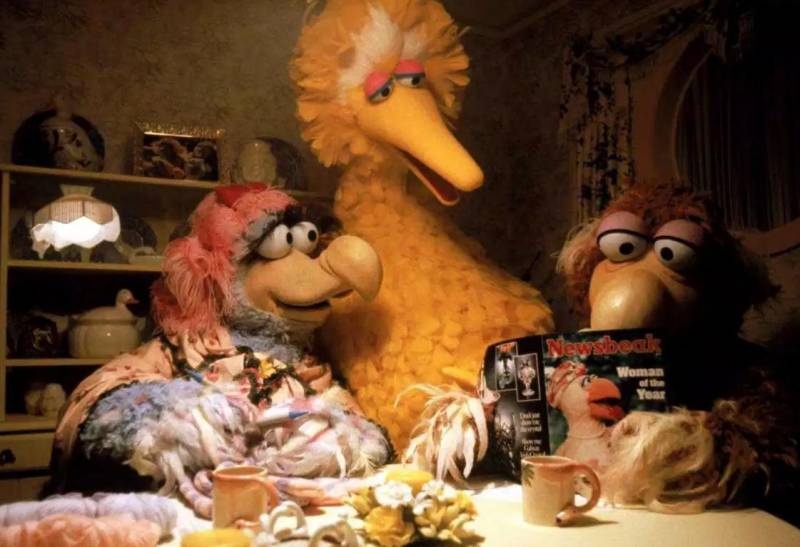
I doubt the creators of Sesame Street decided to make a full-length feature film starring their most popular Muppet character of the 1980s in order to make a definitive statement about adoption, transracial or otherwise. Follow That Bird (1985) wasn’t made for me, or for adoptive families like mine — I just remember thinking it might as well have been. My aunt gave the movie to me one Christmas, and I must have watched it dozens of times despite the confusing tangle of feelings it inspired. On Sesame Street, home to grown-ups and kids and animals and monsters and one outsize bird, everyone is happy and everyone is family until the arrival of Miss Finch, the formidable representative of the “Feathered Friends Society,” who is horrified to find Big Bird living on Sesame Street with no other birds around:
Miss Finch: You know, Big, you shouldn’t be living here all alone.
Big Bird: Well, I’m not all alone. Why, there’s Gordon and Susan and…
Miss Finch: But they’re not birds like we are… Wouldn’t you like to be with your own kind? Wouldn’t you like to live in a big, beautiful birdhouse with a nice bird family of your own?
While I was not encouraged to dwell on questions for which we had no answers, like many adopted kids I thought about my birth parents all the time. I also knew there were plenty of people who, like Miss Finch, looked at my white family and then at me and wondered how we came to be, or thought we just didn’t fit. I knew this because I sometimes felt that way myself. I often went years between seeing a fellow Asian in my small Oregon town, and at times it just seemed impossible to comprehend that this was really where I lived, where I had been planted, where I was expected to thrive.
The terms are sometimes used interchangeably, but I think of open adoption and openness in adoption as two different things. An open adoption is an adoption in which there is ongoing contact between the parties, first between the birth and adoptive parents and then — as they get older — the adoptee. There is a broad spectrum when it comes to open adoption, but in general names are known, details are shared, questions are asked and answered. In closer open adoption relationships, regular calls and visits might be made. It’s not always easy; like any relationship, an open adoption relationship will have its smoother stretches, its bumps in the road. But the adoptee’s origins aren’t kept sealed and secret, with no one to throw any light into the dark corners.
Open adoption is the most common form of domestic infant adoption today. Adoptions from foster care are typically open as well — children are old enough to remember and want to be in contact with their original families. My adoption is an open one, only because I took steps to open it.
Openness in adoption means more than acknowledging the fact of the adoption, “honoring” the birth mother’s decision, celebrating “Gotcha Day.” Openness means recognizing the adoptee’s right to their own history and their own feelings about adoption.
Openness in adoption is something you can strive for, even in a closed adoption. Decades ago, it was uncommon for there to be ongoing contact or identifying information exchanged between the birth and adoptive families. Many adopting families didn’t want the added complication in their lives, and social workers thought that it was better for children to simply assimilate into their adoptive homes and not look back. The stigma of extramarital sexual activity — for women — and unwed motherhood meant that closed adoptions were sometimes considered better for birth mothers as well (now you can just move on with your life). But even then, in the bad old days, I think there must have been a stark difference between the families in which adoption was acknowledged and openly discussed, and the (no doubt far larger number of) families who preferred to gloss over it.
Plenty of adoptees today might still know very little about their families of origin, either because their adoptions were kept closed or because they were adopted internationally. But a culture of openness within the adoptive family is still possible, still necessary, even if more detailed information about the birth family is off-limits or out of reach.
Openness in adoption means more than acknowledging the fact of the adoption, “honoring” the birth mother’s decision, celebrating “Gotcha Day” on the legal anniversary. Openness means that everything is on the table. Openness means talking about it all — especially the hard parts. Openness means recognizing the adoptee’s right to their own history (insofar as it can be known) and their own feelings about adoption.
I wouldn’t say that my family had a great deal of trouble discussing my adoption. We were always open about the fact that it had happened, that it had formed our family, that it was nothing of which to be ashamed; it was never a source of distress or drama for my parents. They were also glad to talk with me about their infertility once I was old enough to ask, and share how it had felt to be approaching ten years married with no children. But we all struggled when it came to talking about my birth parents, their decision to give me up, and exactly what it meant — and how hard it often was — to be a family that was multiracial and multicultural through adoption. There was very little room to admit how much it bothered me that I had so little in common (not just in appearance) with my adoptive family. It was next to impossible for me to share feelings of inadequacy or rejection, or even explain the humiliation of hearing racial slurs at school. In a thousand tiny ways, both spoken and unspoken, most avenues for expressing any ambivalence about my adoption, or admitting to obsessive wondering about my birth family and my confusing identity, were closed.
So maybe I shouldn’t have been surprised to learn that my parents weren’t comfortable with what they perceived as my birth family’s attempt to pry my adoption open after years of silence. When I was five or six, my birth parents reached out to us through the attorney who had facilitated my placement. Spooked by the sudden contact, my adoptive parents sent a message back through the lawyer saying that I was fine; they were unwilling to share any photos or provide more detailed information. Being in regular communication, as my birth parents had requested, was definitely out of the question.
I wouldn’t learn of this lone overture toward a more open adoption for over a decade.
“It would have been so hard, so confusing for you,” my mother explained. “You were our daughter. We didn’t want them thinking they could contact you whenever they wanted. We didn’t know what kind of people they were, or what they might want from you.”
I asked if my parents had kept the letter, records from the attorney, anything that might have told me anything about my birth parents and what they wanted.
“It was a long time ago,” my mother said, and I had my answer. “If we ever had any of that, we’ve lost it by now.”
In Follow That Bird, despite Maria’s protests (“we’re your family!”), Miss Finch convinces Big Bird to leave his home and all his friends and move to Ocean View, Illinois to live with the Dodos. But he finds that he has nothing in common with his fellow birds, and so he runs away and tries to find his way back to Sesame Street, hounded at every step by Miss Finch. In some ways, the single-minded social worker is even more frightening than the hapless criminals who kidnap Big Bird, paint him blue, and force him to perform in their sideshow — while the threat they pose is easily understood and quickly resolved, Miss Finch’s is of a subtler and still more common variety, that of a trusted, twisted authority figure who just believes she knows best. She is ultimately forced to reckon with the love everyone on Sesame Street feels for Big Bird and concede that they are his true family, but only after she removes him from the only home he’s ever known (“for your own good, Big”).
As a kid I never would have questioned, in earnest, aloud, whether I belonged with my adoptive parents: I was a girl who understood my place in the world and usually did what was expected of me. But I still had nightmares, for years running, about my birth parents or someone else turning up and forcing me to leave my family. I had nightmares about my birth family finding me, and then sending me away again because they knew I didn’t belong with them. I had nightmares about just being taken, in the middle of the night, plucked right out of my bedroom by cold, faceless strangers who never listened when I begged them to take me home. While I knew, deep down, that no one was coming to get me, it wasn’t easy to watch some of my deepest fears being played out onscreen.
Perhaps the movie wouldn’t have struck that warning note had it not stood alongside so many similar morals and messages about adoption, messages I absorbed and internalized in countless ways: Be content with what you have.
I never seriously considered running off to be with my “own kind,” nor did I think it was likely I would ever meet or speak with my birth family. The few open adoption and reunion stories I can remember hearing were laced with sadness and drama, from the teenager whose birth mother ghosted on him after years of regular contact (“it was like being rejected all over again”) to the young woman who found her birth parents and then gave them loan after loan (“they were only after her money”).
These stories were offered to me like bedtime fables, cautionary tales, their prevailing moral easy to discern: I shouldn’t go looking for trouble. So powerful was this message that I couldn’t help remembering it, words of warning playing in the back of my mind, when I found myself weighing my own search years later. I knew, by then, what I wanted — needed — to do, and still I put off telling my adoptive family until it was too late to turn back.
When I did tell them, they listened to my plans, and never asked me to reconsider. They told me they understood. Then they said, “Remember who your real family is.”
The lesson finally learned by Miss Finch – about the value of chosen family, and love being all that truly matters – is likely the reason my well-intentioned aunt gifted me with the video in the first place. As I spent a great deal of time as a kid explaining adoption and defending my family to people who didn’t understand either, perhaps I should have been comforted by this most obvious of morals.
But to me, the ending never felt like the neat and tidy resolution it was supposed to be. The truth is, we often “belong” where we’re told we belong. Living his entire life apart from his fellow birds meant that Big Bird was ill suited to life with them – and so the only home he’d ever known was also the only one possible for him. As an adoptee who had never even met another Korean, this happy ending always left me feeling rather conflicted. If I made the choice to try and find my birth family one day – or even just find people who were more like me – would I fare any better?
I recently watched Follow That Bird with my own kids, my first viewing in years. At one point, my older daughter said, “Big Bird should have stayed at home all along, but I guess that would have been a pretty short movie.” Stay where you are was the moral I plucked from the movie as a child, too. And perhaps it wouldn’t have struck that warning note had it not stood alongside so many similar morals and messages about adoption, messages I absorbed and internalized in countless ways: Be content with what you have, because the alternatives are many, and unknowable, and too frightening to contemplate. The best choice you can make is to remain where you’ve been planted – even if it sometimes pinches, even if you feel you don’t quite fit – and hope all the mysteries that hover, the questions that haunt you, will one day fade away.
Remember who your real family is.
Sometimes people are visibly surprised when they learn how old I was when I met my birth family. Sometimes they ask, “Why did you wait so long?”
But to me, the real surprise is that I didn’t wait longer to search. I have talked with fellow adoptees who are deeply curious about their origins and cannot bring themselves to look for answers, so concerned are they about letting their adoptive family members down. It’s no wonder some of us feel premature guilt and insecurity, given the messages often drummed into adopted kids, even unintentionally, about love and family and gratitude and belonging. While this is changing for many who are adopted today, I was raised to believe that I was only supposed to want one family; that anything else would be foundation-shattering for me and everyone I cared about.
I could only think of search and reunion, open adoption, as unnatural risks; betrayals of the bonds upon which I depended. If I had to choose just one family — and I thought I did — of course I’d choose my known family. Every time. I couldn’t even begin to contemplate a search, a more open adoption, until I had separated from my adoptive family and started a family of my own. Once “home” and all the safety and security it implied no longer depended on my parents, once I didn’t have so much to lose, I was able to make a different choice for myself. I still don’t know that I ever would have done so had I not had a child of my own, one whose questions would someday need answering.
I could only think of search and reunion, open adoption, as unnatural risks; betrayals of the bonds upon which I depended. If I had to choose just one family — and I thought I did — of course I’d choose my known family. Every time.
I know that I am fortunate to have been loved so much. I am especially fortunate that when I finally made up my mind to look for answers, I was able to find them. My search also forced my adoptive family to have many frank but necessary conversations about things we might not have been brave enough to tackle otherwise, and I am grateful for that. I know it has brought us closer.
Still, I cannot help but wish we’d found a way to have these conversations earlier – out in the open, and as often as I needed – before my reunion forced the issue. I wish someone had been willing to tell me that the unknown but unforgotten people I came from would always be part of me, whether or not I ever chose to seek them out. I wish I had been encouraged, all along, to voice the complicated but essential questions I could only ask of myself in countless quiet moments; to understand and believe that it really is possible to belong to more than one family — more than one place — at a time, and you do not always have to choose.

Another great article from a fascinating series.
I’m operating with anecdata here, but every story I’ve heard about open adoptions ends up being, well, not so open. I myself was adopted under the premise of it being open, but once it was finalized my adoptive parents refused contact with my biological mother. It seems fairly common and all in the name of not ‘confusing’ the child. I don’t necessarily buy that it actually would, but again, there’s so little real data to work with it’s difficult to say.
Regardless, thanks for writing this. 🙂
Thanks for reading. 🙂
Not presuming to guess at your parents’ exact reasons — am sure they had them — but I’ve just heard so many stories of birth parents who were promised some degree of openness, only to have the door slammed shut. I understand why legal parental rights can only go to one set of parents. It just seems so hard. Birth mothers have to take the adoptive parents at their word; they don’t have legal rights post-adoption.
Thank you for this beautifully honest piece. I am neither an adoptee or adoptive parent, but I am someone who has members of my extended families who are adopted, and I would love to share this with them. I remember as a child sharing that sense of proprietary ownership over my adopted cousins (“How could they have other cousins? X is our cousin”) – I would like to think that as a parent I wouldn’t have the same fears your own parents did, but I suspect my own insecurities would manifest themselves. Openness in adoption it seems to me, would require all of us to acknowledge that a child’s love (or a family’s for that matter) is not fixed and finite.
Yes. Adoption, open or not, is not a simple thing, no matter how much we might like it to be!
People in adoptive families don’t always want to hear this, but it’s true: adoption isn’t just like having a biological child. It’s not LESS THAN. But it’s different. It requires different things!
This is so beautiful, Nicole. Poignant and eloquent and so, so moving. You write so many essential things.
thank you for reading! <3
This is lovely. I’m so glad you were able to find your birth family.
me, too.
I am neither adopted nor an adoptive parent. But, many years ago while struggling with infertility, I spent considerable time thinking deeply about adoption. From my perspective at the time, the “openness” of adoption was the most terrifying aspect of potential adoption. Ask yourself, as a mother, how comfortable you feel about permitting and encouraging someone about whom you know next-to-nothing to have a significant role in your child’s life and development.
I’m not advocating for one position or another. I’m only advocating compassion for people who have tried to do the right thing in complicated circumstances–whether one agrees with their choices or not.
Lots of things about parenthood are terrifying.
The child comes first. And adoptive parents have all the legal rights; birth mothers/parents/extended family are pretty much at their mercy in terms of previously agreed-upon terms (for contact, visits, etc.). So if the relationship with the birth mother/parents/family ever becomes a genuine source of harm, of course adoptive parents are well within their rights to take whatever steps they think necessary to ensure their child’s safety and wellbeing.
That said, when you have a child biologically, you’re already opening yourself up to having and loving a person whose life, environment, development, future relationships, etc. you cannot hope to control forever. But we’re in agreement on the need for compassion, always, something I really try to keep in mind when I write about adoption and family.
I think you talking about your experience and how reuniting was a positive thing for toy and your family can help current and future adoptive parents gain the confidence to do by their children right. Hopefully more adoptees speak out in the future.
Yeah, I feel like it’s very much situation dependent rather than ‘every child would definitely benefit from this’. A lot of kids might find their bio parents having a significant role in their life causes insecurity and confusion.
I mean, to use a non-adoption analogy, there are plenty of kids exposed to relatives/parents for visitation where the situation isn’t necessarily a source of immediate physical harm; but the child is exposed to what they shouldn’t be (parents repeatedly not turning up; requesting visitation and then leaving the children with other relatives; constant introductions to new partners; criminal behaviour…) where concern for the long term emotional effects can get swept aside as being controlling.
I don’t have any close personal experience with adoption from any perspective, but this is such a great series and I’m so glad that The Toast is publishing it.
Thanks! We might do it again next year.
Hi Nichole, what an exceptional article and one of many I have enjoyed as part of your series! As an adoptee I have enjoyed the opportunity to identify with much of what you have written and also reflect on my own experiences of adoption. Thanks Nicholas
thanks for reading!
I’m the mother of a son by birth and a daughter, now 30, by adoption from Korea. I understand that the issue of searching and reunion could add enormous complications and provoke significant fears and discomfort, and I don’t share these comments to criticize those who have chosen another way. But I can’t imagine blocking contact with our child’s family of origin. I never considered that decision to be up to me.
Our daughter’s birth parents, her culture, her ethnicity *belong* to her, and she has every right to claim them. I always assumed it was my job to support her to pursue a connection with her origins in any way she chose.
When I first took her back to Korea (where I grew up) when she was 14, we hoped to search, but it turned out that she was too young by the agency’s standards. We left a letter for her birthmother in case she ever contacted the agency to find her daughter.
Our daughter found that connecting with my extended Korean family filled her need and hasn’t felt the desire to search. Yet. If she ever decides that’s what she wants, I’d do anything I could to help. She’s our precious daughter; how could I not want her to claim what belongs to her?
Whoa.
“You were our daughter. We didn’t want them thinking they could contact you whenever they wanted. We didn’t know what kind of people they were, or what they might want from you.”
I knew that APs thought this. I thought it myself, once. I can hardly remember, now, who I was when I thought the only choices were no contact or unmediated contact between my 11yo and her Cambodian family. All I can say is, I was someone else then.
Meeting her other family, and finding a way to be open that works for the adopted person, changed me as much as it changed my child…and this is why I preach* openness, even if the adopted child doesn’t fight for it, in childhood. The options are various; ‘someone who I don’t know influencing my kid’ is one extreme and a rare one.
Many are the APs who have scolded me for ‘thrusting’ openness on my kid, on the rationale that the adopted person should get to choose. And they’re right, except that as a parent I make all kinds of less consequential choices for my child every day than ‘whether you can know where you came from’. She is entitled to that information regardless of whether she feels she can ask for it while she is a child.
Once she’s fledged, we will transition the connection and it will be hers to manage, negotiate and maintain…or not. I’m her consultant as she decides what her story is, but she owns the facts.
*Like other converts struck down by a Truth higher than their own wills in the course of a crisis, it really is preaching. I’ve figured that out recently–I’m fervent about adoptive parents creating a culture of openness to the complex reality that adoption is.
It’s a lot to ask to expect a young child to be able to advocate for themselves effectively about something as emotionally complex as contact with their birth family. No matter how supportive the adoptive parents themselves are, there are so many messages from other sources that tell us as adoptees that we ought not to want that… which is to say, I think it’s really great that you are actively encouraging and supporting your daughter in having a relationship with her birth family, rather than just passively being open to it if she were to ask. I don’t think I would have been able to ask. Hell, even as a thirty-something adult I was terrified to TELL my parents that I had made contact with my birth parents, even though my mother had told me, in so many words, that she would support me if I wanted to.
Thank you for this, Nicole.
I wish there were more room for us adoptees to acknowledge our complicated feelings. Sometimes I feel like we are always being called on to reassure the other members of the triad, that we must extend bottomless compassion to everyone else and never express any emotions about adoption that are not positive. Normal kids aren’t accused of not loving their parents if they feel ambivalent about the choices that their parents made.
My birth mother chose a closed adoption. I don’t think open adoptions were very common at all when I was born, but even if they had been, I think she would have chosen to go with a closed adoption anyway. I think she truly believed that it was better for me not to know anything about her. She was wrong. She made a mistake. I understand why she made it. I understand that it was a hard decision in a series of hard decisions during a very difficult time in her life. She’s a human being, and she got a lot of things right, but she was wrong about that. It would have been better for me to know.
I don’t know what my parents would have chosen, if it had been up to them. I imagine they would have wanted to go with a closed adoption anyway. They tried to be fairly open with me. I was never punished for asking questions about my birth mother or anything like that, but at the same time, they had no answers to give me, besides the generic “she loved you, but she couldn’t take care of you, so she chose us to be your parents.” And although they tried, they couldn’t hide their discomfort with my curiosity. So although my parents never TOLD me that I shouldn’t be curious, or that I should just be grateful for what I have, I still learned that my curiosity hurt them, and I still learned to quiet that part of myself, to silence that need for answers. It would have been so much better for me, if the answers had just been there. I know that some people think it will be confusing for a child to have the birth family involved, but kids accept as normal whatever their normal is. I think it’s much more confusing to have questions you can’t get answers to.
Anyway. Thank you, thank you for this whole series.
Thanks for this comment! Closed adoption was usually just the default in domestic infant adoptions – for many, many years – so I feel like it’s hard to know what people would have chosen had they had more options. I know my adoptive parents would never have been comfortable with an open adoption. I don’t think my birth parents thought they COULD ask for communication, updates, etc. at the time of placement; it only occurred to them years after the fact. They didn’t even know they could ask for more money (I was pretty much a steal). I just don’t think they knew much about how adoption worked here in the U.S., where I was born and adopted, and so they didn’t know what their options were as far as closed versus partly open or very open. But I don’t know what they would have wanted to do, even if they’d known; they kept my adoption a secret from my own sisters for many years, and if there had been ongoing contact, I think the secret might have gotten out earlier.
I think it’s difficult for some parents to realize that “she loved you, so she chose us to be your parents” raises so many more questions than it answers! And I totally know what you mean about subliminal messages as opposed to verbal ones, and how being curious caused discomfort within the adoptive home. I really was SO curious, and it was incredible to me that no one else in my family seemed to be. But then, they also kind of saw my adoption as God or fate or what have you, and I really didn’t – couldn’t – see it that way. Even as a little kid in a religious family, I remember thinking God wouldn’t take a kid from one family just to give them to another; that wasn’t how God’s “plans” worked. If I’d ever been able to believe that, like my family, maybe I’d have been less curious – I don’t know.
I don’t know if you’ve considered trying to find some social/family history, short of actual contact if that’s not what you want, but depending on the state you’re from it’s possible. Let me know if you want to email about it.
You’re so sweet, Nikki, thank you! I am actually in contact with both of my first parents now, and have had a little bit of contact with the other children of my birth mother.
I was just reading an article about adoptees elsewhere on the internet and I wanted to come back here and say thanks again for creating this welcoming space where it’s ok to have both positive and negative feelings about adoption. In so many other places the discussion gets so polarized, where you have one side insisting that adoption is Always Good and another side insisting that adoption is Always Bad, and that just doesn’t reflect my reality at all. Like, it has good sides and bad sides, it’s complicated, like any other human institution. It can be made better, but we have to stop shouting at each other and start listening.
I love you, the Toast!
Thanks for this comment! Closed adoption was usually just the default in domestic infant adoptions – for many, many years – so I feel like it's hard to know what people would have chosen had they had more options. I know my adoptive parents would never have been comfortable with an open adoption. I don't think my birth parents thought they COULD ask for communication, updates, etc. at the time of placement; it only occurred to them years after the fact. They didn't even know they could ask for more money (I was pretty much a steal). I just don't think they knew much about how adoption worked here in the U.S., where I was born and adopted, and so they didn't know what their options were as far as closed versus partly open or very open. But I don't know what they would have wanted to do, even if they'd known; they kept my adoption a secret from my own sisters for many years, and if there had been ongoing contact, I think the secret might have gotten out earlier.
I think it's difficult for some parents to realize that "she loved you, so she chose us to be your parents" raises so many more questions than it answers! And I totally know what you mean about subliminal messages as opposed to verbal ones, and how being curious caused discomfort within the adoptive home. I really was SO curious, and it was incredible to me that no one else in my family seemed to be. But then, they also kind of saw my adoption as God or fate or what have you, and I really didn't – couldn't – see it that way. Even as a little kid in a religious family, I remember thinking God wouldn't take a kid from one family just to give them to another; that wasn't how God's "plans" worked. If I'd ever been able to believe that, like my family, maybe I'd have been less curious – I don't know.
I don't know if you've considered trying to find some social/family history, short of actual contact if that's not what you want, but depending on the state you're from it's possible. Let me know if you want to email about it.
I just wanted to say, like all of your articles on this topic, this is so well written and most of all, cathartic. I don’t talk much about my adoption except on my personal tumblr where I vent in informal, crude ways. I feel like at times I’m just going in circles over the same thing over and over thing, even though adoption is such a nuanced, complicated experience.
Your articles are incredibly clarifying about the transracial, transnational adoptee experience in a way that i can point and go “This is it! This is how I feel,” even if it’s just for my own validation. We don’t have exactly the same experiences, both in childhood or adulthood (I’m only a 22 year old undergrad with no children nor knowledge of my bio family, but was very fortunate to have basically no racialized bullying or teasing experiences), but your retelling and examination of your experiences resonates with me deeply.
Anyway, about this article specifically: I also did have that experience, where my mom (my parents divorced when I was very young, and primary custody was with my mom) was open about my adoption as a building block of our family. She even told me about China’s one child policy at some point.
And I was okay with that, just knowing I was adopted was enough. I had my “real” family. But when I got older, though I could never articulate it, I never wanted to broach my adoption deeply, beyond “curiosity” about the process. What little bits I found out were treasured but I acted as if that was simply just good trivia to know (not consciously, I just think I tried to play it off as no big deal, because why SHOULD it be a big deal when I already have a family?).
As I’ve gotten older, I’ve gotten more curious. I’ve also read more writing by adoptees, looked more critically at media depictions of adoption, and looked inside myself. My mom has never acted uncomfortable about this topic but she’s also never come to me with this information except for when I’ve asked (and I’ve always asked in the lightest, most detached ways possible). It’s…a very tough internalized wall of guilt and fear to break through, especially when you’re young and you feel like otherwise, your parents are mostly great. I don’t even consider myself having gotten past it now.
And funny enough, I also saw a movie that awakened a lot of complex feelings: Kung Fu Panda 2! It’s probably the closest I’ve ever had a story not specifically written about adoption (as in, this is a Realistic Story exploring adoption, which there aren’t really much of anyway) that resonated with me so deeply, beyond “be grateful for your loving parents.” It still ends on that note, but it also validated adoptees caring about and searching for answers.
I’m so sorry for such a long, rambling comment, I just want to say this series has been really great and now I’ve really considered talking to my mom about these issues (especially traveling back to my birth place and maybe looking for my family), and using some of these articles to open up discussion. I regret not bringing them up when I was younger when my life was a bit more flexible and maybe I would’ve hurt less but waiting much longer isn’t going to help. You’re doing wonderful work.
There is so much that is good and more important in this comment but first I just have to say that you’ve made me really curious about Kung Fu Panda 2 — quite a feat.
Thank you for sharing some of your experiences. I hope is goes well if you do decide to talk more with your mom about some of these issues! It’s hard to know how to raise the subject when you’re a kid. (I know that feeling of watching your tone, trying to say things casually, while looking for any hint of distress on your parent’s face.) You depend on your parents for so much when you’re a child — and it’s hard to imagine any other kind of life than the one you have. Your family is your whole world and then often remains at the center of that world for a long time.
For whatever reason, it was easier for my parents and me to talk about this once I was an adult and, well, once we had no real choice in the matter because of my search. I know when I was a kid they saw me as just that, a kid, and THEIR kid, and vulnerable in the way that children are, and they were so afraid my birth parents would show up and want something (like me back). My parents knew my birth family didn’t have legal standing to do that, but just the thought of them showing up, me knowing them, having the words spoken aloud really frightened them. (And there were occasional custody battles, birth parents challenging adoptions, or so they told me.)
I really wish you all the best and if you ever want to email or talk about any of this, my email address is on the staff contact page. <3
Yes, I am a father who’s child they, the adopters, the state & their lackies chose to ignore. I found out four years later, by chance & from a boyfriend of my daughter’s mother. I had been looking for her ever since she told me she was pregnant. It makes me sick what they did to angle her baby away from her, us. You need to know how sick this business of adoption is. I wanted nothing more than to claim my child, to know where they secreted my child. To let her know how much she is wanted by her father, her family. That did not happen for 27 years. I am so angry with adopters being afraid we want our children back. What they did to us- the sick, selfish, self serving people who thank their incubators & summarily dismiss them. I see nothing christ like or loving in the taking of babies from mothers who are economically challenged. Teaching to fish, leaving tools in the field for the aliens to use, this is christ like. Taking advantage of mothers & their children is expressly forbidden in the bible. The secrets in adoption serve not the child or the family of their origin. I am disgusted with their entitlement to child, their fear is the result of the sin they committed, the lies they chose to be part of. The shame is on the adopters shoulders, no matter how they try and turn that into something else, their untruths are theirs whether they accept the responsibility for the manufacture of that lie, they are the ones supporting the lie with their inaction or deliberate action to ensure it.
There is so much that is good and more important in this comment but first I just have to say that you've made me really curious about Kung Fu Panda 2 — quite a feat.
Thank you for sharing some of your experiences. I hope is goes well if you do decide to talk more with your mom about some of these issues! It's hard to know how to raise the subject when you're a kid. (I know that feeling of watching your tone, trying to say things casually, while looking for any hint of distress on your parent's face.) You depend on your parents for so much when you're a child — and it's hard to imagine any other kind of life than the one you have. Your family is your whole world and then often remains at the center of that world for a long time.
For whatever reason, it was easier for my parents and me to talk about this once I was an adult and, well, once we had no real choice in the matter because of my search. I know when I was a kid they saw me as just that, a kid, and THEIR kid, and vulnerable in the way that children are, and they were so afraid my birth parents would show up and want something (like me back). My parents knew my birth family didn't have legal standing to do that, but just the thought of them showing up, me knowing them, having the words spoken aloud really frightened them. (And there were occasional custody battles, birth parents challenging adoptions, or so they told me.)
I really wish you all the best and if you ever want to email or talk about any of this, my email address is on the staff contact page. <3
Thanks for a wonderful series of articles. I recently came to the conclusion that I will likely not have biological children (am queer and single) and have started considering foster-to-adopt. Your open and honest articles have helped me to think about the ways an adopted child of mine would think or feel and the support they would need from me and other people. Beyond that, I’m awed at how you write about complex personal issues with grace. Thank you again.
Wow, what a touching, honest account. I was adopted at a time when closed adoptions were the only adoptions (not that long ago, the 70's). It was instilled in me from before i can remember that I was adopted but the people who brought me up were my "real" parents and felt no desire to contact my biological folks. Both biological parents have subsequently & independently made contact with me and I have a relationship with both of them and their families. On finding out about the first contact (when I was 21) my dad who brought me up said "if you want to meet them, go ahead, but i dont want to hear about it and remember we are your real family". I completely understand why he feels this way and respect it. Downside is, it means keeping a whole part of my life a secret from him. Thanks for your thought provoking article 🙂
As a mom-via-adoption to two teens, I have come to agree with you, Nicole. While “contact” and “openness” are similar, they are not the same. Contact is what happens among the adults; openness is what happens within each person and between the parent and the adopted person. As you say, even without contact, we can strive for openness.
I conceptualize it as a grid. http://lavenderluz.com/2013/01/open-adoption-grid…
It’s openness, even more so than open adoption, that helps us avoid splitting the baby.
When you remove the mother you already split the baby. The importance of mother has already been established. I cry that adoption happens. So unecessary but so desired. Secrets are cruel, those who make them & those that keep them, are copable no matter how they try to shed that responsibility. Guardianship, encouraging a mother to keep, helping her keep is how to avoid the baby split. Intermediaries have reason to omit & invent, both of these are lies. Adoptions foundations are built on lies, deceit, & selfishness, then they call the possessiveness, love.
As a mom-via-adoption to two teens, I have come to agree with you, Nicole. While "contact" and "openness" are similar, they are not the same. Contact is what happens among the adults; openness is what happens within each person and between the parent and the adopted person. As you say, even without contact, we can strive for openness.
I conceptualize it as a grid. http://lavenderluz.com/2013/01/open-adoption-grid…
It's openness, even more so than open adoption, that helps us avoid splitting the baby.