
Lee and Low Books, an independent publisher, just released a Diversity Baseline Survey of the publishing industry for 2015, and it’s well worth reading:
“Countless panels, articles, and even conferences have been dedicated to exploring the causes and effects of this lack of diversity. Yet one key piece of the puzzle remained a question mark: diversity among publishing staff. While the lack of diversity among publishing staff was often spoken about, there was very little hard data about who exactly works in publishing.
At the beginning of 2015 we decided to conduct a survey to establish a baseline that would measure the amount of diversity among publishing staff. We believed in the power of hard numbers to illuminate a problem that can otherwise be dismissed or swept under the rug. We felt that having hard numbers released publicly would help publishers take ownership of the problem and increase accountability. We also felt that a baseline was needed to measure whether or not initiatives to increase diversity among publishing staff were actually working.
Our Diversity Baseline Survey took a year to complete. The results include responses from 8 review journals and 34 publishers of all sizes from across North America.”
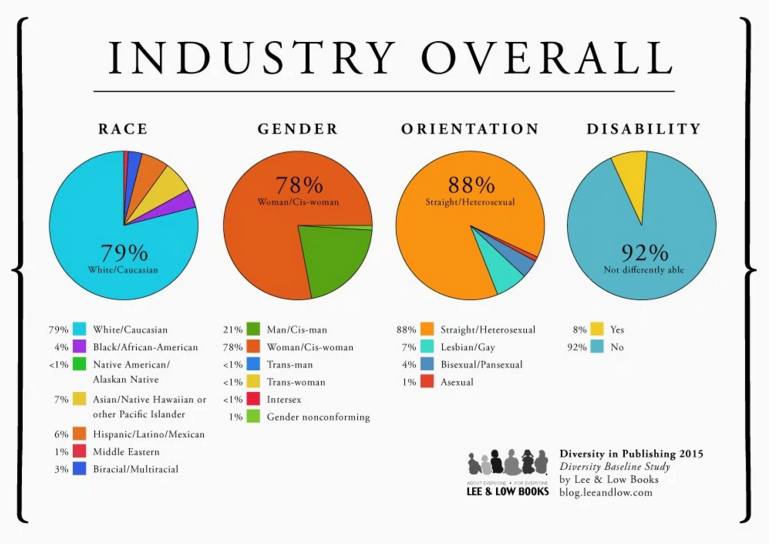
Read the rest of the report here.

This reflects my experience in the publishing industry very accurately, unfortunately. When I suggested to my former boss that I didn’t feel comfortable coming out at work and that it might be possible to address that through training/workshops, she rolled her eyes at me.
One thing I’m surprised not to see mentioned at all in this report, though, is the enormous (at least from my perspective) issue of pay/remuneration. Publishing notoriously doesn’t pay well, and especially at the lower levels–what correlation might there be between that fact and the fact that that part of the workforce is largely made up of women/cis-women?
That would be a really interesting metric to include in their next survey – I would be willing to bet there’s a direct correlation.
White cis middle class women who can both afford the lifestyle/levels of education & also accept the wages. As a white cis lady in the industry as well, I think class plays a really big part of it.
Yes. I went into publishing in 1986 as an editorial assistant – the lowest on the totem pole, salarywise. The expectation back then was not so far removed from the previous generation’s assumption that whoever took these sorts of jobs (requiring high education, giving low pay) had a trust fund. By the time I came on the scene, it was acceptable to have a second job (in a bookstore, freelance copy editing or indexing). But then we had Jackie Onassis telling us that a great way to lose weight was to have your maid cut up carrots and celery for you to take to work.
Freelance copy editor / proofreader / rewriter here–yes, I am an educated white cis-woman who lives (voluntarily) below the poverty line (no kids, no debt, and I have things to do in life besides work–but I recognize that it’s a luxury). I love my work but I’m damned if I can see a future in it. The only reason I can make a living at all is that I have clients in Japan who pay me well. (But I have some pretty depressing stories about working in publishing there, too…)
Really happy to see this article, and to read this thread. Thank you for your efforts to open up the field! It’s good to know there are editors like you out there.
Is this an appropriate place to drop a shout-out for the wonderful Jenn Baker and her Minorities in Publishing project? http://minoritiesinpublishing.tumblr.com/
I had to leave publishing as I could not afford that low pay life, but yes, this seems pretty…pretty accurate.
Can I ask what field you went into instead? I’m currently in publishing and am not sure how I would apply my skills elsewhere.
I left publishing for libraryland – best decision ever!
I was in marketing so I lateralled into the advertising world and now I do social media marketing in an agency setting
Lots of interesting stuff here, though the thing that jumped out at me first is how the gender percentages suddenly change when you get to the executive level.
It also looks like much of their focus was on children’s book presses (though obviously a lot of the presses included publish much more and have some of the big-name publishers), and I’d be interested to see how these hold up against a wider survey of all publishers.
Anecdotally, that lines up with my experience in trade and academic publishing, both at independent houses and at the Big 5. Entry-level publishing is almost entirely women (at my publishing course I once spotted five men standing in a protective knot in the corner, murmuring, “I mean I guess I was a little outnumbered in English classes but this . . .”), but once you reach the executive level the ladies start to disappear.
At one press where I worked there was only one women in management (head of marketing because where else would you put a lady?). When I suggested to the editor-in-chief that this was not an ideal arrangement he was deeply confused. “Oh,” he said. “I guess it just happened to work out that way.”
It’s amazing how often lack of diversity “just happens to work out that way.” Seriously, let’s put some statisticians on it or something…
“I guess”
*shrug*
It’s very true, but I will say that in one of my big-five jobs, the publisher was a minority woman, the associate publishers were mostly women (then one woman got replaced with a wunderkind dude…and she got sailed off to the place where older women go…), and probably half the editorial directors were women.
The other important factor in the gender divide, is that men rise MUCH more quickly, and seemingly for no reason. I’ve seen more than a few male assistants get promoted where their female colleagues have lingered. When often, the female colleagues were covering their butts. Oh, I have stories…
Maybe, though I do note that a couple of the really big publishers (Penguin Random House, Hachette) are included.
Yes, this aligns with my experience, though it looks like a lot of the publishers they surveyed are children’s publishers, and I would guess (based on experience but still, guessing) that those firms skew more female than others. (Everywhere I’ve worked, men outnumber women on the editorial side.)
However, I am delighted to know that there is a publisher called Dancing Lemur Press.
Honestly, it just makes me more disappointed that they went for Penguin Random House in that merger — they could have been Random Penguin!!!
oof, this makes me want to go into book publishing.
(I’m SURE it’s very hard and takes a long time to get good at; I’m definitely not saying this because I think just anyone can do it, or or do it well — this just makes me feel A Way, that’s all.)
I participated in this survey, because it’s important. And it’s central to representation on bookshelves.
I’ve heard so many versions of, “I guess this is good…for a [identity] writer…” As if any writer with an “identity” (because being a middle class cis white dude isn’t an identity?) is held to a lower standard. And it’s time to call out white cis male mediocrity on bookshelves. Like, I cannot. I FUCKING CANNOT sit through another conversation that calls BORING SHITTY WHITE DUDE FICTION GENIUS BECAUSE IT ISN’T. If you have diverse editors, you hear diverse voices. PERIOD. If you have diverse publishers, they let editors buy diverse voices. I have been kiboshed on projects because my boss has told me no. And sometimes I’m told no because diversity.
I have sat through the worst editorial boards and sales launches. I have fought back tears (in particular, one very Islamophobic book, that everyone felt comfortable talking about because there wasn’t another muslim in the room). I have spoke my mind, and been passed over for promotions because of that–and gotten better jobs because of it too. The biggest problem is that without a voice at that table, there’s no one to check the racism. I have spoken up and said, “That’s really problematic” and not been heard–and dismissed as a young, idealistic opinion–and not an actual ethic that we should live & work by. Because it’s a room full of white people. There was ONE minority woman in the room who was a secretary taking notes SUFFERING THROUGH THIS SHIT BECAUSE NO ONE SEES HER, sitting in a chair against the wall with the assistants, not at the actual table. DIVERSITY AT THE TABLE.
A few years ago at a list launch (when editors present upcoming books to sales), my (white cis lady) colleague bought memoir by a trans woman. And I SHIT YOU NOT the head of sales said, “But do trans people buy books?” SERIOUSLY THIS WAS SAID IN A CORPORATE MEETING AND THIS PERSON STILL HAS A JOB. And an older Italian cis male executive editor who has been around for a million years stood up and said, “People in this industry have told me that black people don’t buy books. People have told me this group doesn’t buy books and that group, and they’re wrong. People. Buy. Books. And if you can’t sell it, you’re failing. Not the consumer.” And he walked out of the room. It was like a real slow clap out of a movie. Ah! He was fuming and it was glorious and I can still feel it. But this was an outlier. Without representation, the shit that gets said–and the books that don’t make it into the world because a publisher “doesn’t see it” because they’re so fucking isolated in their world is what keeps it happening. It’s ALL ABOUT changing who is in the room and the power they have.
I’m still mad. This shit makes me the maddest. dlaksdjflksdjfkKEYBOARDMASHOFRAGElksdjflksdjflkdkf
I just wanted to thank you for this comment, and add that I’d be really interested in publishing anything you wanted to write about this, but completely understand if that’s not something you feel comfortable doing!
Ugh, I feel this so much. I was just having a conversation about my book reviewing job, for which I get to choose what I want to review and I have a fairly strict “no cis het white dudes” policy (which means that sometimes I just don’t review because the whole list is comprised of that category). I mentioned this policy to a cis male white het friend, who made a pained face and then inquired as to how I knew that I wasn’t missing out on some really great writing because of it.
How do I know? a) experience – the books that I chose for this gig that do not follow this policy have been uniformly mediocre at best and b) publication bias – for every privilege point that an author does not have, it makes it that much harder to be published, which means that your work has to be that much better. It’s not rocket science, yo.
He at least had the grace to accede that, bias being what it is, I have better odds of getting a great book with this policy in place.
Also. As a side note – even IF trans ppl don’t buy books (which is a ludicrous statement), I don’t have to be a transperson to appreciate a story about and/or written by a transperson (like Nevada by Imogen Binnie, OMG so good, it resonated with me SO HARD). Just like I don’t have to be a cis het white dude to appreciate a story about and/or written by a cis het white dude. (although maybe it helps? idk)
Well, this survey is long overdue.
Hey Mallory, I’m curious — did you edit the pie chart to “not differently able,” or was it pulled from a different version elsewhere?
Very much a side note, but Lee & Low is an EXCELLENT children’s book publisher. A huge chunk of their books are available in both English and Spanish, and both their fiction and nonfiction both feature diverse characters. There’s are plenty of holiday/historical figure type diversity, but also just everyday, this book happens to be about non-white, not necessarily rich people–there’s a nonfiction book about a kid making kimchee with his mom, a book about a South Asian kid and his mom going to school, a book about doing laundry at the laundromat… I just really love them.
I work as an ed. assistant in children’s publishing at one of the big 5, and I have Seen Some Shit (I’ve had this job for a little over six months so this isn’t even like…anything that’s maybe changed).
I was at a diversity panel recently wherein the panel was made up of two white women and one woman of color, in a room that had…six people in it maybe? We were lectured on how inadvisable it was to talk openly about a lack of diversity in publishing on our PERSONAL SOCIAL MEDIA ACCTS. because “it could be traced back to us or our company,” and “could reflect badly” on us.
I edited a book on Lincoln where slave owners “sometimes mistreated their slaves.” I had to specifically ask my supervisor if we could toughen up that language.
I’ve seen an editor refer to a black writer as a “raw talent” and “articulate” and a marketing editor talk about how difficult it is to market to “those people,” meaning black teen girls, both bemoaning the lack of submissions from black writers we get. The whole while, as an ed. assistant, who are meant to be seen and not heard, I glowered in the corner, nearly in tears.
I have the opposite reaction to Nicole to these numbers…I thought I wanted this job and felt really naively that I could Change The System From The Inside, and instead I just quietly seethe all the time while I look for a new job. AND DON’T GET ME WRONG: I feel massively guilty about wanting to leave. When you’re 1/2 of all the editorial assistants of color in yr division of 30+, it’s hard not to feel like even the little you can do is a lot, hard to feel like you don’t owe something to all the other writers of color and editors of color you can welcome in. It’s hard not to feel like you owe something to all the kids that will see themselves in a book, even as a side character, because you suggested that a character might not be white.
I’m tired and angry, and I’ve been angry for at least a few months, and honestly, I don’t get paid enough to deal with this bullshit. (I’m not sure how much I /would/ need to get paid to deal with it, but more than barely-living-in-NYC wages, that’s for sure).
SPEAK THE HELL UP! IT’S OKAY! Someone might not hear you, someone might “remind you of your place.” But speak up. Remember that Scholastic thing with the “oops, we made slavery seem fun like baking cookies?” They need an EA to say, “Hey, you’re gonna get social media flak because this is TERRIBLE.” They don’t want another PR mess–the PR mess costs more than keeping you on staff. Remind them of your power. You need to get promoted to an assit. editor who can acquire books. We need you to sit at the table. It takes time, but you can do it! Find allies! Make partnerships! Find a sympathetic editor or marketer or production manager or illustrator or author who will have your back when shit gets real. Make a formal complaint if a situation warrants it. And when someone says “those people,” just say, “Um, maybe it isn’t a lack of interest in books, but our inability as a publisher to access those markets…so it would be good business sense to adjust our sales strategies to reach those consumers?” And leave it at that.
Replying to you so you can see this too–as I said to ourlady, if you need a bookseller (or several) to back you up or be a squeaky wheel, I am one and know lots. I can give y’all my email if you’d like.
Hey! I work in a bookstore committed to inclusion on our shelves. If you want/need to get in touch with booksellers who are in your corner, please let me know. We are out there and we do know this shit needs to change. We have sales info and sometimes a direct line to editors that not even people on the publishing side have.
What’s your bookstore?? I’m ALL ABOUT ’em! We should have a bookstore party! Also, are you the same bookseller who gave me the Graywolf Yaywolf line a million internet years ago?
I'm not in the publishing industry but I feel your rage – so, in spirit, you are not alone. Thank you for being a lone voice of reason. I know how incredibly hard that can be.
I feel like the publishing industry’s problem with diversity really stems from a very incestuous hiring process. I’m biased, because I was never able to actually break into a big 5 job, so I guess take my opinion with a grain of salt. But I had an Ivy degree, an internship and a student position at my Uni press, and went to the NYU publishing institute. So I feel like at least I should have gotten some traction. It was damn near impossible to get interviews without knowing someone, and I didn’t know anyone. I don’t have friends of a friend. There are so many applications that I feel like hiring managers or HR sometimes would rather just find someone through social connections than look at the full range of people who have applied. Another girl I went to uni with decided a few years later that she wanted to be in publishing, called someone she knew, and was an Associate Editor at Scholastic in less than a year.
And if I had managed to get any of those NYC jobs, I would have needed a second job to afford the first job, and to afford to live near NYC. One, at Columbia UP, was offering a whopping 28k per year. I mean…if that’s what you offer, you’re only going to get rich (mostly white) people working there, because it’s only viable for people who can have their parents help them significantly. And when you have most people coming from the same backgrounds, you’re going to get the same voices represented in your output.
And I totally agree with the gender issues. Women at my NYU class outnumbered men by…I think it was like 85-90 women to 5-8 men, something along those lines. But the vast majority of the executives that came to speak with us were men. One of the first things I noticed about the industry.