
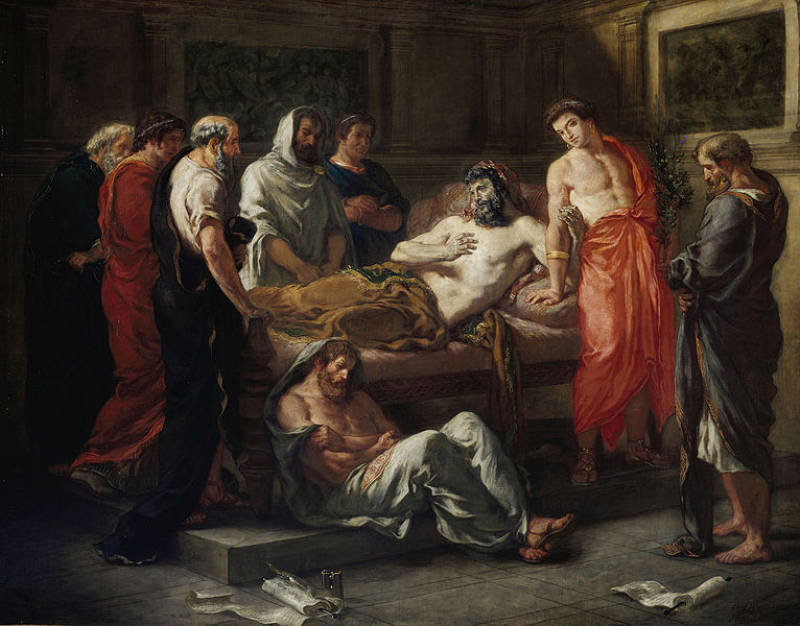
POINT: “I would very much like or prefer to have success, approval, or comfort,” and then end with the conclusion, “But I don’t have to have it. I won’t die without it. And I could be happy (though not as happy) without it.”
COUNTERPOINT: YES I DO AND YES I WILL AND NO I CAN’T, RESPECTIVELY
POINT: “Say to yourself in the early morning: I shall meet today ungrateful, violent, treacherous, envious, uncharitable men…I can neither be harmed by any of them, for no man will involve me in wrong, nor can I be angry with my kinsman or hate him; for we have come into the world to work together.”
COUNTERPOINT: Honestly, fuck you.
POINT: “To the rational being only the irrational is unendurable, but the rational is endurable.”
COUNTERPOINT: NOTHING IS ENDURABLE HOW DARE YOU
POINT: “Study how to give as one that is sick: that thou mayest hereafter give as one that is whole. Fast; drink water only; abstain altogether from desire, that thou mayest hereafter confirm thy desire to Reason.”
COUNTERPOINT: HONESTLY WHY DON’T YOU TRY NOT EATING AND WANTING THINGS AND SEE HOW GOOD IT MAKES YOU FEEL
POINT: Worse than war is the very fear of war.
COUNTERPOINT: THAT’S RIDICULOUS, PROBABLY
POINT: The old Romans had a custom which survived even into my lifetime. They would add to the opening words of a letter: “If you are well, it is well; I also am well.”
COUNTERPOINT: WELL THAT IS A STUPID CUSTOM TO HAVE
POINT: “Does aught befall you? It is good. It is part of the destiny of the Universe ordained for you from the beginning. All that befalls you is part of the great web.”
COUNTERPOINT: THEN IT’S A STUPID WEB AND I HATE IT
POINT: “To you, all you have seems small: to me, all I have seems great. Your desire is insatiable, mine is satisfied. See children thrusting their hands into a narrow-necked jar, and striving to pull out the nuts and figs it contains: if they fill the hand, they cannot pull it out again, and then they fall to tears.—’Let go a few of them, and then you can draw out the rest!’ — You, too, let your desire go! covet not many things, and you will obtain.”
COUNTERPOINT: I’M NOT GOING TO WANT LESS STUFF JUST BECAUSE I DON’T HAVE ENOUGH FIGS, BUDDY
POINT: “How can it be that one who hath nothing, neither raiment, nor house, nor home, nor bodily tendance, nor servant, nor city, should live tranquil and contented? Behold God hath sent you a man to show you in act and deed that it may be so. Behold me! I have neither city nor house nor possessions nor servants: the ground is my couch; I have no wife, no children, no shelter—nothing but earth and sky, and one poor cloak. And what lack I yet? am I not untouched by sorrow, by fear? am I not free?”
COUNTERPOINT: Well, congratulations on not wanting anything, GUY, I’ll be over here wanting and getting stuff
POINT: “In the morning, when thou art sluggish at rousing thee, let this thought be present; ‘I am rising to a man’s work.’”
COUNTERPOINT: SHAN’T
POINT: “Think of God more often than thou breathest.”
COUNTERPOINT: THAT SOUNDS TERRIBLE
POINT: “‘My brother ought not to have treated me thus.’ True: but he must see to that. However he may treat me, I must deal rightly by him. This is what lies with me, what none can hinder.”
COUNTERPOINT: THAT SOUNDS EVEN WORSE THAN THE OTHER THING, I WANT TO PUNISH HIM
[Quotes mostly via Seneca and Zeno and whatnot]

That second one- what? Yes, Stoics, let us work together with ungrateful, treacherous men, because that never sunk a group project ever!
In fairness, Marcus A was an emperor, he didn’t have much of a choice in dealing with those people.
Also, I expect it’s a lot easier to work with treacherous, ungrateful people if you can have them thrown into the river sometimes.
Truth.
The real lesson for Marcus Aurelius though is probably that in Rome, no matter how many shitheads you have thrown in the river, there’s always going to be one more.
Yep. And he handled it with remarked upon grace. I mean, the Meditations are his diary of trying to not suck and the historical record bears out pretty well that he didn’t, unlike some emperors who reflected on nothing and stabbed everyone.
“…no matter how many shitheads you have thrown in the river, there’s always going to be one more.”
Oh man, I need a needlepoint of that.
Spreadsheet updated!
Grad school would have been much more productive if river-throwing was an option.
SHAN’T is the best response.
Came here to agree! I will be using this more often!
Also, it feels like it’s from a movie where a woman responds “No, shan’t” but I don’t know what! Any idea?
ETA: It’s from Devil Wears Prada! http://www.popsugar.com/entertainment/photo-galle…
“I would prefer not to.”
Wait, was that an Outcasts of 19 Schuyler Place reference?!
Pretty sure it’s Bartleby the Scrivener
It’s from a short story by Herman Melville. Enjoy, it is necessary reading for all office workers, and, actually probably more useful to managers.
In fact my boss often wears a shirt that says “I WOULD PREFER NOT TO”
Until recently, I only knew the phrase from that and not Melville!
I mean, maaaaybe it’s worth learning from something else, but Margaret Rose is my hero now and forever, and I prefer to remember it from her one-woman summer camp resistance movement.
Batleby is always there with words to scrive by.
“Worse than war is the very fear of war.”
For any fellow comedy podcast wonks: this sounds like vintage Maxwell “Time” Keeper
“The old Romans had a custom which survived even into my (very) lifeTIIIME…”
and it’s essentially a comedic idea itself. I watch a lot of war documentaries, so I’m super scared of war.
This fear is not worse than:
a) actually being shot
b) actually being blown up
c) getting trenchfoot
d) living with rationing and deprivation
e) being dragged out of my house and executed for supposedly aiding the enemy
f) the movie “This Means War” with Reese Witherspoon.
REESE
TOM HARDY
CHRIS PINE
You’re BETTER than this
(maybe not you, Chris)
WHY
WHYYYYYY
I skim-read the “This Means War” as the “The Menses War” with Reese Witherspoon and I was like “Huh that actually sounds kind of cool.”
g) cholera
(Why yes, I have been reading up on the Crimean War, why do you ask?)
Behold me! I have neither city nor house nor possessions nor servants: the ground is my couch; I have no wife, no children, no shelter—nothing but earth and sky, and one poor cloak. And what lack I yet? am I not untouched by sorrow, by fear? am I not free?
*beholds you*
*rolls eyes*
*checks twitter, walks away*
My couch…is my couch. Can confirm, it is much more couch-y.
… I have no wife…
SURPRISE
She’d only, like, want to eat pancakes instead of Stoicing all day.
Ah, but he still obviously has an audience. He cannot live without an audience to be superior to and adored by.
TRUTH
Dude.
None of that is true.
You’re a fucking EMPEROR.
Jesus, Mallory, Nicole already killed the guy, you don’t have to exhume him just to keep beating on him.
Yes she does, someone has to serve as a warning.
“To you, all you have seems small: to me, all I have seems great. Your desire is insatiable, mine is satisfied. See children thrusting their hands into a narrow-necked jar, and striving to pull out the nuts and figs it contains: if they fill the hand, they cannot pull it out again, and then they fall to tears.—’Let go a few of them, and then you can draw out the rest!’ — You, too, let your desire go! covet not many things, and you will obtain.”
Or you can smash the jar.
Or turn it over.
Given the way the behaved about all the things they wanted but didn’t have, I think the Romans really went for the “smash the jar” philosophy yes. Although! One could say their downfall did come from grasping too far!
Or pour the contents directly into your mouth.
Cut that Gordian knot, Alex.
I’ve experimented with Not Wanting Things since I was 8. Now, 30 years later, it’s come back to bite me in the ass. Yes, wanting things is PAINFUL, but suppressing wanting things is even more detrimental.
This.
Right? Because the last thing I need on top of wanting things is feeling SHAME about wanting things.
Right? This is part of the reason why I can never fully get behind Buddhism as a philosophy. I LIKE WANTING THINGS, OK? IT MAKES ME FEEL ALIVE.
This was one of the main lessons of Ouran High School Host Club (specifically for Honey’s backstory), which is one of the greatest animes of all time. It embraced hedonism as its philosophy. I think of it often.
Yeah, the horrible trick about detachment is that only the genuine article is any good. Pretending not to want because you think that’s the right thing to do turns out worse than if you just hadn’t bothered about it in the first place.
Aww but I love the Stoics.
I do want to see a Western Art History that’s just Mallory in a chiton arguing with Stoics.
Basically, I love Marcus.
If I don’t Want, then you can’t ever stop me from having what I want, and you have no power over me, so THERE!!!!!
Also I strive for somewhat more emotional maturity than he had.
But I don’t WANT that emotional maturity, so if I don’t get it then you STILL HAVE NO POWER OVER ME, HAHAHAHHAHA
This is my approach to Stoicism. IF I MAKE IT IN MY HEAD THAT YOU DON’T MATTER YOU CAN DO NOTHING TO ME.
MY WILL IS AS STRONG AS YOURS, AND MY KINGDOM AS GREAT.
I complained a lot at work today and someone got me a pastry. Stoicism is for pastryless losers.
Yes! At least twice my workplace has INSTRUCTED us to complain about things like office temperatures or disrespectful behavior because if no higher power knows about them they will never get fixed.
And there is no more Stoicism Prize.* They stopped giving it out after the Great War. Take your pain meds. Tell people when their behavior hurts you. Put bacitracin and a bandaid on your cuts. Eat your lunch during your lunch hour.
*Sometimes British actors get awards for acting stoicism on camera for money, but that’s different.
Stiff upper lip martyr stuff isn’t really Stoicism, though, in the sense here, but rather about sorting out what you can control (telling someone about the office temp!) versus what you cannot (illness, aging, etc) and using your energy on what you can control instead of wasting it on what you can’t.
/is unreasonably defensive of her philosophy
Fair point. Incidentally, the Gershwins wrote a great song about the stiff upper lip version and Fred Astaire and Gracie Allen danced to it here: https://www.youtube.com/watch?v=dWxAlt_Fw4Y (afraid it’s just the instrumental rather than the words.)
Every time I hear/read the words “stiff upper lip” this is now in my head. Not sure what Marcus and the lads would recommend about *that*.
I consider earworms outside of my control and to be endured joyfully or replaced with other earworms when possible; not sure about the lads.
“In the morning, when thou art sluggish at rousing thee, let this thought be present; ‘I am rising to a man’s work.’”
What I actually tell myself is “If I get out of bed now, I’ll have enough time for some kick-ass makeup!”
“To the rational being only the irrational is unendurable, but the rational is endurable.”
Economics is irrational, gender is irrational, life revolves around these two; conclusion: life is unendurable.
“To love is to suffer. To avoid suffering one must not love. But then one suffers from not loving. Therefore, to love is to suffer; not to love is to suffer; to suffer is to suffer. To be happy is to love. To be happy, then, is to suffer, but suffering makes one unhappy. Therefore, to be unhappy, one must love or love to suffer or suffer from too much happiness. I hope you’re getting this down.”
“So… you’re going to suffer, but… you’re gonna be happy about it.”
Bwahaha, A+ quote.
You take, Zathras die. You leave, Zathras die. Either way, it is bad for Zathras.
Zathras have very sad life. Will probably have very sad death. But at least there is symmetry.
Did anyone else think of the “logic” letter writer with the broken-glass-on-the-floor boyfriend? Because “logic” in my head now equals “gaslight-y”, apparently.
For me, it’s not “logic” so much as a strict rational/irrational dichotomy.
This sounds like the original manual for stoic Sicilian Grandmas
What are you stoic about? I went and had a filling done at the dentist this morning, and I felt stoic. I am not stoic about needing car or house repairs.
I am super stoic about: dentist appointments, putting money into savings. Not stoic about: getting up ANY EARLIER than I ABSOLUTELY HAVE TO, not buying books I reeeeaallly want.
(As an aside, last night I was at a Very Boring Book Launch and then I saw a new Catherine M. Valente book I didn’t even know existed so I bought it and bailed the hell out of there. It’s The Boy Who Left Fairyland and it’s delicious!)
BOY is sublime Fairyland.
Have you read her collection THE MELANCHOLY OF MECHAGIRL? It has my favorite of all my many favorite Valente novellas, SILENTLY & VERY FAST, as well as the eponymous poem which is in my top 3 of her poems. Highly recommend.
I remember being compelled to read the Stoic’s Handbook or whatever in high school freshman English and actually finding it kind of profound, which is more than I can say about 95% of the philosophy I’ve ever been asked to read. just now I realize it might’ve influenced my advice-philosophy of “things you want to have are bottomless, so happiness can only come of ridding yourself of things you want not to have, like financial worry and your nightmare girlfriend”
also, like, does it not infuriate anyone else when translations of non-Abrahamic texts use the term “God,” singular, capitalized, because not even pretending not to wash out the fact that yours is one of countless myth traditions, there, Renaissance-era monks
To be fair, sometimes the texts in fact use singular “god,” I think especially when the author is not particularly pious but is relying on some rather vague sense of the ultimate beneficence of the universe (like Marcus Aurelius). E.g., the end of the Apology is “adelon panti plen e toi theoi,” “unclear to all except (the) god,” not “tois theois,” “the gods.” Even though Socrates has just argued that, contrary to the charges against him, he in fact believes in the gods of Athens.
Christians and Jews both got their monotheism from Greek philosophy. Ancient Jews were perfectly happily henotheistic (there are lots of gods, but WE only have ONE) until a lot later than people think. I haven’t read Marcus in Latin (because my Latin is balls), but a whole bunch of Greek and Latin philosophers refer to the divine in the singular, as “God.” It’s Plato’s Monad, basically (insert long explanation of the geocentric universe and philosophical religion that would honestly not be as good as what’s probably on Wikipedia).
Anyway, the fact that we see Aurelius’s “God” and assume the translators are just being all Christian on us is more our problem than his.
I put that part in specifically so people could tell me how wrong I was and I could avoid having to google the singular Greek “God” (apparently the best way to get Linux tech support is to go to a Linux forum and say it can’t do X thing that Windows can) it but I’m still not entirely clear on how this works
As a proud Linux user, I have used this method many times, and it never fails.
🙂 Incredibly short messy version: Several centuries before Christianity started, Greek mathematicians discovered that the Earth is round and not flat, and therefore the sun, moon, and other planets must orbit it (apparently some dude postulated the solar-centric universe a couple hundred years later but got shouted down because everybody’s cosmology was already super dependent on the geocentric one). So the world went from being a flat thing in a two-thousand-foot-tall snow globe to being infinite and the traditional ideas about the gods and their relationships to the world didn’t work anymore, especially if the orbiting bodies are associated with gods. This plus influence from Persia gives us western monotheism. Philosophers decided that what was out past the farthest orbiting body must be infinity itself, and since there was no concept of vacuum then that had to be SOMETHING. That thing, it turns out, is the Divine, which has to be singular because the source of the universe must be perfect and something can’t be perfect if it’s divided (or other philosophical reasons, depending on who you ask). So Plato has the Monad, which is Greek for basically “the singular thing” or “the One Alone.” Even polytheists were often using the singular “God” to mean “the supreme god” (usually Zeus or Jupiter but not always), so it was easy enough for philosophers to say “ACTUALLY guys, the supreme god is that infinite unknowable untouchable unchanging and all sorts of other un- things Divine Up There, inside of which the entire universe exists.”
Jews were already henotheistic, so when Greek education became the gold standard throughout the Mediterranean it wasn’t too difficult for educated Jews to jump on the Platonic bandwagon, but philosophically educated Jews were about the same segment of the population as educated Greeks, and everyone else just kept doing more or less what they’d always been doing, which is why polytheism didn’t die out completely in the empire until long after Christianity took over, and some Jews were still henotheists until at least a few centuries after Christianity got started. Actually a lot (most? all?) of the major controversies in early Christianity have to do with reconciling the idea of Christ with monotheism, because they were combining several systems and trying to subordinate all of them to the Greek one.
This is what I love about the Toast.
I definitely don’t learn about classical conceptions of the universe from YouTube comments!
And the Toast is like that, but with more librarians and fewer Skinheads!
Yeah, when I was reading Marcus Aurelius in translation, I wondered about this very thing, but I think there was a note and it led me to Wikipedia and I learned about pantheism and I was like “Oh. Yes! This!”
Actually the stoics invented their own form of monotheism:
https://en.m.wikipedia.org/wiki/Stoic_physics
It’s sort of more like a sentient panentheism with room for synchronistic polythiesm, kind of like Hinduism. In the early Christian era, Stoicism was VERY influential on the development of the idea of the Trinity (logos, pneumos, etc.) You could say Christianity is a mash up of abrahamic monotheism and platonic monotheism.
I try to be a practicing Stoic, it’s the only thing that makes perfect sense to me – figure out what is in your power, focus on what’s in your power instead of wasting your energy on the stuff you don’t and can’t control. As a person with a lot of anxiety about the latter, it helps.
Tip out that narrow-necked jar the fuck out on the counter. You can have it all.
Or, like, reach in a second time. There are a lot of options here besides “desire fewer figs.”
But the kids in the example just grab, fail and cry about failing because of what’s outside their control (the jar shape) instead of looking at what’s in their control (taking less figs, pouring out figs, making multiple grabs of less figs) and getting what they want (figs).
That example has always reminded me of Wentworth in the first Tiffany Aching novel: show him too many candies and he has a meltdown because he can’t eat them all at once.
There’s a good chance you have two hands!
That “the ground is my couch” would not survive one winter in Canada. (Literally lots of homeless people do not survive the winter. It is Very Sad & Indicative Of A Need For Economic Justice, not Stoic.)
Yeah, it’s probably a lot easier to be Stoic when you live in flipping Greece.
When I see homeless people on my way to work I feel many things, but “envy about how they have managed to free themselves from desire” is not one of them.
(A few winters ago, when it got very cold and my colleagues and I were talking about what the Brighton council was doing to stop homeless people from freezing to death, my manager casually mentioned that freezing to death wasn’t such a bad way to go; her brother-in-law, it turned out, had been one of the guides in the 1996 Everest disaster. That was a very weird conversation.)
Yeah, unfortunately she was wrong. Freezing is pretty painful (I won’t say “freezing to death,” because obviously we don’t have data from people who have, but people who’ve nearly frozen to death say it hurt like hell).
This is based on the satellite phonecall between her sister and her brother-in-law, as he was in the process of freezing to death and saying his goodbyes; apparently a certain amount of euphoria sets in. It probably differs from person to person, but I thought it sounded like reasonably reliable data.
Very much feeling that it all is a STUPID WEB indeed.
This post is pretty much how I reacted to Marie Kondo’s tidying book.
I liked her book because she’s all, “I love stuff. This stuff makes me so happy. If you love that dirty coffee can filled with broken glass, keep it.”
Though I will admit, your reaction is totally legit.
Yeah, just from reading descriptions of it I got the impression it was more about “keep the stuff you love and that genuinely makes you happy, that’s just as important as the useful or valuable stuff you own” unlike most minimalist self-help books which go the “BURN IT ALL” route.
EPICTETUS FOREVER SORRY NOT SORRY.
SENECA WAS A BETTER WRITER EPICTETUS IS OVERRATED
Were I not so awesome at Stoicism that the wrong opinions of others don’t bug me, I’d tell you to fight me. ;p
A+ stoicism.
anybody reading the newest tim powers? (it came out…like two days ago i think). there’s a scene with two women, one of whom has her hand stuck in a jar. the dialog goes something like this:
woman 1: you look like a monkey with your hand stuck
woman 2: yeah well you look like a monkey with your head stuck
woman 1: …my head?
woman 2: yes. up your ass.
I need those Last Call sequels to come out on audio god damn it
Seconded! I do have Medusa’s Web waiting to be read this weekend, though.
i was reading it last night and i screamed when my boyfriend came in the front door. to be fair, he was several hours earlier than i had expected, but yeah. it is atmospheric.
No-one can possibly ever have imagined Stoicism to be a Toasty virtue. Ever. QED.
“Study how to give as one that is sick: that thou mayest hereafter give as one that is whole. Fast; drink water only; abstain altogether from desire, that thou mayest hereafter confirm thy desire to Reason.”
Yeah, buddy, I don’t think you’ve seen me when I’m both upset and hungry. Trust me, if you hand me some crackers and cheese, and I’ll be on a lot better terms with Reason.
COUNTERPOINT: Honestly, fuck you.
This was me in my Intro to Philosophy class freshman year. I’m pretty sure I wrote one paper where I basically just said that Socrates is a moron (that did not go over well with pretentious TA guy). I think it had to do with Socrates insisting that the soul lives after we die, because it gives life to the body and death is just separating the soul from the body. And apparently I had to prove this was NOT true. But only using philosophical arguments, not science. I was not amused.
I wonder if it’s even possible for modern people to wrap our heads around a world where you could just make assertions about the function of the cosmos without evidence. I think even religious people today are kiiind of faking it, for the most part.
I’ve wondered about that, too, but I’m starting to think that they didn’t experience it like that? To me, evidence of truth means observation of the physical world. If it doesn’t fit with the world, it can’t be true. But that argument rests on an invisible assumption that observations can tell you what the observed thing is like without distorting the truth. I believe that (not in the literal way that my own eyes are sufficient, but that scientific observation “works”), but they probably didn’t? And in fairness, they DIDN’T have access to scientific instruments, but only to their own senses, and everyone must have noticed that looks can deceive. So, you can’t tell the truth just by looking at the world, you have to think. You have to pick one thought to start with and then figure out your way forward, and it has to be consistent, so you better pick a really good starting thought. You’d have to compare your own thoughts to known wisdom, because you won’t get very far by yourself, so you’d need to read a lot of philosophers and study religious texts very closely. If opinions differ, you’d have to prove that your thought is better, and the only shared framework would be philosophical and religious arguments, because (again) observations might be wrong.
This would explain (I think) both why people could believe implausible things from, say, the Bible, and why they didn’t mind the lack of physical evidence. If a religious/philosophical argument stands up for a long time even though lots of people have tried to argue against it, it’s reasonable to promote it to “truth”. But there are several ways to interpret the same things, and that way you may end up with several consistent schools of thought that can’t all be true at once but still can’t be disproved – and now you’ve already accepted that “truth” doesn’t have to be one single thing! The schools of thought don’t even match up with each other, so why should they match up with the physical world? In the real world, people can’t even agree on what they SEE, so they don’t have anything in common to debate. The people in pre-scientific times must have felt that the WORLD was the unstable, vague part, while a good argument is perfectly clear.
After all, you need a leap of faith to do science. It actually isn’t logical to assume that just because gravity has always been observed to exist every time we’ve looked, it’ll still be there tomorrow. But in philosophy, you can prove and disprove conclusively, just like in math. If the physical world doesn’t look like the philosophical truths, it only proves that the world is a mirage. Obviously you can’t use your subjective, probably wrong observations of an unstable mirage to prove anything. You’d need real arguments, real philosophy.
At least this is how I imagine it.
Ooh, this is all quite mind-blowing. Thank you!
I have to say I really still can’t wrap my brain around that! obviously in some areas observed principles were recognized to be repeatable–architecture, after all, existed long before science as we know it, right? the ancients were able to put enough trust in engineering to build hundred-mile aqueducts. the simple fact that that could even be conceived of and that anyone’d be crazy enough to put money into it seems to indicate a certain confidence that we can anticipate how the world will behave in response to our behavior.
on the other hand, maybe once you’ve committed a colossal act of hubris like that successfully you end up with more confidence that your pure thought can contain the world, not less, because you were able to plan out such an insane enterprise and pull it off.
I think people who are very pro-science also miss out on how much science-/evidence-based belief is actually based on “trusting the institutions which transmit the information to me that someone observed this.” Have I observed the movement of the planets? Have I fuck. Do I trust the teacher who taught me when I was twelve that the planets move like this, and the only mathematical way that makes sense if if the solar system looks like this? Yeah, i pretty much do. Do I believe that she’d looked at the planets and done the calculations herself? Not really. What I believe is a whole chain of people doing the observation, repeating it, testing it and agreeing with each other, and that eventually filtering down to me. For more cutting-edge science, and particularly medical science, I have to trust the institutions of higher education, peer review, and publishing. I don’t think that’s really so different than believing what the Church Fathers say because the Church Fathers said it and everyone who has read the Church Fathers believes it.
I took one intro to philosophy class, it was at 7:30 every morning in a quite room next to some machinery so it was warm and filled with white noise. I still congratulate myself on only falling asleep once in there AND writing some snarky as hell papers. I got an A probably just because I stayed awake and had read the material.
Ugh. It’s good to know that the whole “THE UNIVERSE HAS A PLAN AND IT TELLS ME THINGS” has been around forever. cf. that one Inside Amy Schumer sketch.
Also EVERYTHING HAPPENS FOR A REASON except I think most people who say that these days are not, in any sense of the word, Stoics.
Oh man, I’m having a very “fuck you, fuck this shit, fuck everything” day, and this post was exactly what I needed.
“In the morning, when thou art sluggish at rousing thee, let this thought be present; ‘I am rising to a man’s work.’”
So…couchsurfing and explaining how it’s actually awesome being poor?
Lololol
I want Marcus to come back and smite all MGTOW/MRA/PUA as insufficiently virtuous.
Me, every day.
That was, in fact, what I was thinking of. “Fuck this thing in particular” is an excellent shorthand for my feelings on today.
It’s possible that I have have more seasonal depression than I thought. Or irritation at the prospect of having an entire winter in one weekend, rather than gradually over the course of several months, as is normal and expected.
Also, I need a word for “ennui, but angry about it.” German must have a term for that.
ANGERNNUI
COINING IT.
I’m pretty sure that the reason I never joined a debate team or took a philosophy class while in school is that my instinct to roll my eyes and say “Oh fuck off” is way too strong to suppress.
Did that a lot in philosophy classes. It goes over surprisingly well if you can back it up with something.
“In the morning, when thou art sluggish at rousing thee, let this thought be present; ‘I am rising to a man’s work.’”
That makes me feel even more demoralised. I normally just pull the duvet over my head and long for more time to spend in sweet unconsciousness.
Yes, I think a more motivating thought would be I am rising to PANCAKES (not mancakes)
Counterpoint: I have delicious cheese.
I love the one Epictetus example about the guy who didn’t go to his trial because he knew it was a setup, went to the baths as was his routine, got the verdict later, found out he was banished but without loss of his property, and went to lunch. I aspire to this.
Ok, but being banished without loss of property in ancient Rome was essentially being sent on a permanent picnic. Oh no, I must move to my country villa, where there will be no political machinations afoot, and where I shall simply putter around in the Mediterranean sun all day. Le sigh.
He could have been executed or had his property seized, per the example,and rolled on to the baths anyway. I thought it was pretty baller.
I wanna get banished to my villa where there are no politics. How do I get in on that action?
The old Romans had a custom which survived even into my lifetime. They would add to the opening words of a letter: “If you are well, it is well; I also am well.”
Marcus Aurelius; The Hippy Years
At some point I started reading every counterpoint in the voice of a very aggravated Moss from IT Crowd. I don’t know why, but it made me giggle and now I can’t unhear it. So while you guys are discussing the actual Stoics I’ll be here pondering what to replace the one swear with, probably forever. Rich tapestry, etc.
I wish I had something clever to say, but I am just pretty much imagining this as an argument between Spock and McCoy and killing myself laughing. I’m sorry.
… and Kirk is not part of the discussion because he’s off somewhere taking what he wants.
Listen, all those gold shirts aren’t just going to rip themselves. You have to get out there.
I have been waiting for this article my entire life