
Previously: Is Itt Feminist?
Being a telepathic brain unattached to a body, IT clearly dispels with even the concept of gender. +6
However, IT chooses to speak through the Man With Red Eyes instead of a woman. -4
A Wrinkle In Time was published in 1963, the same year The Feminine Mystique came out. +10
There’s something vaguely clitoric about IT. +5
Manifestations of pure evil should generally not be associated with the feminist movement. -12
The thing that ultimately defeats IT is Meg’s ability to love, which is a nice twist, turning something so traditionally associated with the feminine, and thus weak, into a strength. +1
But also couldn’t Meg have defeated IT with her superior knowledge of quantum physics or something? -1
Murdering people for inefficiency on the planet you control doesn’t really seem intersectional. -7
Though that’s the ultimate question, isn’t it? Can equality come out of such profound differences, or would true equality mean everyone being controlled by the same sentient, sadistic brain-thing? +3
On one hand, free will and the ability to choose is the cornerstone of feminism. -5
On the other, is feminism even an issue on a planet where there is basically one being? +4
But if it really weren’t an issue, then why does it look like all the women on Camazotz are housewives while all the men are at work in the big scary building? -8
RESULTS: -8, officially not feminist

I literally barked with laughter at my desk when I saw the title. I’m glad I’m the only one in the office right now.
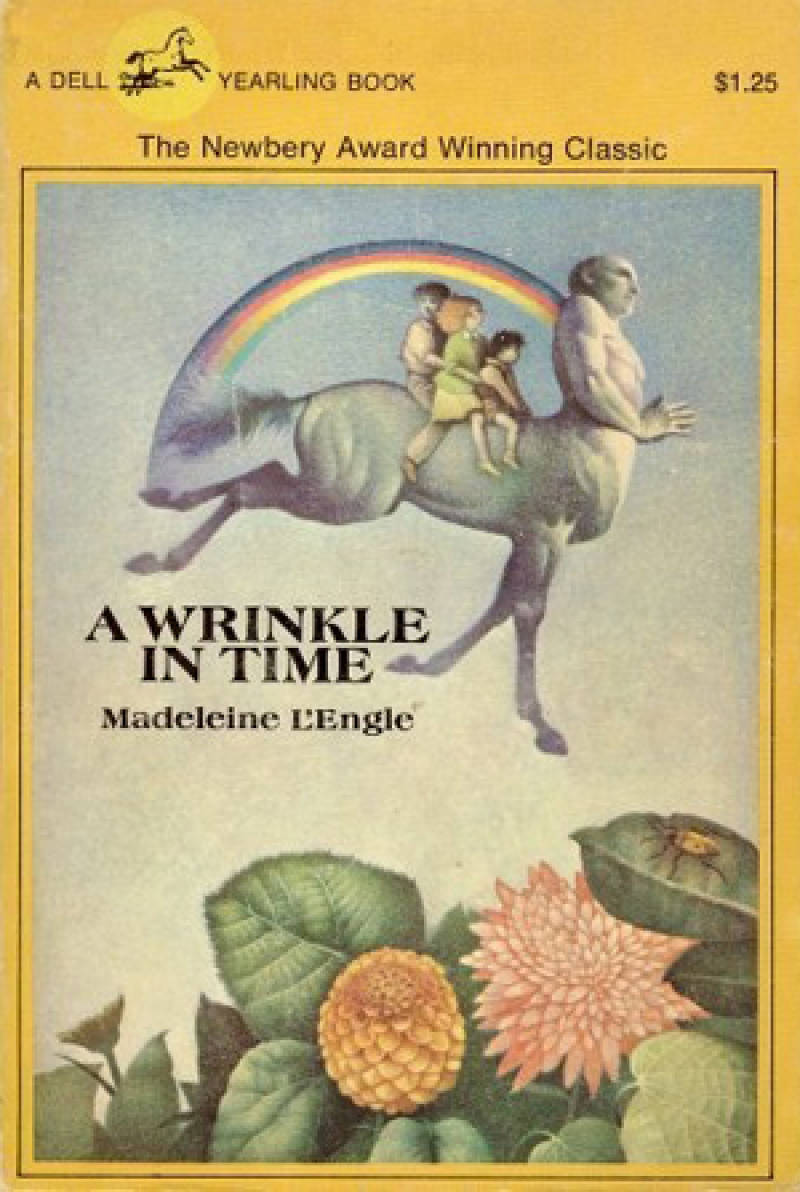
Also that cover is the same edition I had as a child and seeing it just gave me brief but intense déjà vu.
Me too–and the sad time-lapse from pristine copy, to beaten, food-stained pulpy mass, with a few loose pages sticking out.
It is the same edition that still sadly sits on my shelf. I have another copy that’s less…well-loved, but my Grandma who died when I was 12 gave me this one and damn it I’m not throwing it away ever you can’t make me.
ME TOO.
I FEEL SO ALIVE
I love this series, and I agree with its conclusions
I like to think of myself as all relaxed and descriptivist but really I will never forgive Rubio if “dispel with” becomes standard American English.
YES, people kept running him saying it THREE TIMES and I was all, Dispense With, or Dispel. No discussion.
laaate but I fear this will be “nucular” for a new generation.
What a good series this is.
I love it so much.
are we going to run out of things called ‘it’? the only thing i can think of that hasn’t already been covered is the definition of ‘it’ i learned from a classmate in second grade, as part of the phrase ‘doing it’.
Information technology?
ha! my career experience tells me that one is a solid no.
We haven’t had It of E. Nesbitt fame yet, have we?
On the one hand, the Psammead was never actually called “it” in the Five Children and It trilogy except in the title of the first book. On the other hand, I really need to know if it is, in fact, feminist.
is pretty much constantly grumpy: +5
rejects archaic notions of domesticity and home-making to live in a sand pit: +10
Makes it clear to all that Anthea is by far the smartest and most competent of the children. + 5
Witnesses and supports mystical gay marriage. While not specifically feminist, this is definitely progressive, so + 5.
It’s male, but could still be feminist. Certainly it seems to despise all the children equally with no regard to gender, so … maybe?
Yes it was. It was NOT called “he” or “she,” but consistently “it.” (Kipling, of course, got this wrong in his letter to E. Nesbit.)
—–
When breakfast had been cleared away–it was a very nice breakfast with hot rolls to it, a luxury quite out of the common way–Anthea went and dragged out the bath, and woke the Psammead.
It stretched and shook itself.
‘You must have bolted your breakfast most unwholesomely,’ it said, ‘you can’t have been five minutes over it.’
‘We’ve been nearly an hour,’ said Anthea. ‘Come–you know you promised.’
‘Now look here,’ said the Psammead, sitting back on the sand and shooting out its long eyes suddenly, ‘we’d better begin as we mean to go on. It won’t do to have any misunderstanding, so I tell you plainly that–‘
—–
Nesbit also used to say things like “Every man, woman, and child in the village fell on its face on the sand.”
Hello Friend who has also read Kipling’s letter to E. Nesbit! Good catch on Kipling gendering the Psammead. I never noticed that.
If it comes down to a Nesbit/Kipling battle, though, I think Kipling wins on the grounds of not including raging anti-Semitism in his children’s literature.
I wouldn’t give Kipling any pass there. Kadmiel’s yearn for “Power–Power–Power! That is our God in captivity!” in Puck of Pook’s Hill is right out of the conspiracy theorists’ playbook, as is his manipulation of money. It may not be couched in terms of greasiness or hooked noses, but it still sticks in my craw.
See, i think Kipling is deliberately playing with stereotypes in an interesting – albeit problematic – way. He’s pointing out where the stereotype comes from – Kadmiel doesn’t want to be a moneylender, but it’s one of the few professions open to him. And if he uses that position as a source of power, it’s explicitly in order to protect his people – and by extension the English people in general – against oppression.
As far as the other, individual stereotypes are concerned – Kadmiel as Wandering Jew, Kadmiel as plague-carrier – this is Kadmiel using people’s preconceptions about him as part of his plan – a plan that is entirely and selflessly for the good of England. Because the point here is that even though Kadmiel is acting to protect Jews, he deliberately goes about it in a way that provides protection for all oppressed peoples. And in doing so he becomes the last link in the chain that makes England England – because, Kipling points out, a country that is not safe for the Jews is a country that is not safe for anyone.
None of this, of course, removes your objection to the story, and to some extent I agree with you. I don’t think it’s necessarily a stereotype to say that if you leave oppressed and powerless people a single source of influence, they will do what they can with it. I agree that KIpling goes further than that, though, and here he’s on very thin ice, because the central irony of the story is that the friendly Jewish financial conspiracy comes along and saves the ignorant racist English from themselves. I think it’s well meant, but it’s the sort of thing that would have to be very carefully done indeed – probably by a Jewish writer – to work in exactly the way I believe Kipling meant it to work. It lurches a little bit. it’s unbalanced. The framing narrative, with the children and Kadmiel listening to the sound of gunfire in the woods, has one wonderful moment – Una saying, “The silly birds are going back to their own woods instead of ours, where they would be safe,” to which Kadmiel says, “Safe till it pleased you to kill them” – but it’s undermined by the presence of Mr. Meyer, the not-quite-assimilated Jew who will fire at rabbits.
I can’t see Kadmiel as a stereotype, though. Not really. It’s not just lack of greasiness or hooked noses, or the fact that Kipling never calls him “the Jew” – it’s also that Kadmiel is so obviously an individual human being, and an admirable one, proud and courageous, with a sense of humor and a strong personal code of ethics. And he gets his wonderful hero moment, when, after sinking the gold that would have furnished King John with an army, he falls across his friends’ threshold, crying, “I have sunk an army with horsemen in the sea!”
Now, for all the flaws in “The Treasure and the Law,” compare it to the chapter in The Story of the Amulet in which Jewish financiers with comic accents first go into meltdown at the sight of poor people being fed, and then get their heads lopped off.
Aaand that comment got really long. I wrote my undergrad thesis on Kipling and Nesbit and the Jews, so I got a little carried away.
TL;DR: As I see it, the difference between “The Story of the Amulet” and “The Treasure and the Law” is the difference between vicious antisemitism and clumsy philosemitism.
i love this series so damn much. jaya, you’re a treasure.
#truth
Madeleine L’Engle was Smith College Class of ’41. (Betty Friedan was ’42.)
This might just have been the subtext of #3.
This is perfect, and you reached the only logical conclusion, no way IT is feminist.
Meg’s capacity for love is also inherent in her ability to name and thus in defeating the Echthroi (I’ll admit I had to look that name up) in A Wind in the Door (god L’Engle had a feel for titles).
I HAVE BEEN WAITING FOR THIS.
Guest-starred on Star Trek TOS: No formal point ranking, just kind of awesome.
Can I just say that The Toast’s unparalleled L’Engle coverage is what brought me here in the first place? This is what I’m here for…obviously
Now I need to go reread every Madeleine L’Engle book ever.
RELATED
has ANYONE else in on this planet read “And Both Were Young”, which is by far my favorite/the best L’Engle book?
Yes, and it’s also my favorite L’Engle book. The main character, her friends, her dad, Switzerland…*kisses fingers*
It was just unbearably romantic when I was a lonely 12-year-old. I read and reread my copy until the cover fell off. I taped it back together and kept going. *sigh*
yes!
ISN’T IT WONDERFUL? The first time I read it I was a painfully lonely 6th-grader. I may have cried at how much L’Engle GOT lonely young people.
I had the exact same experience. i have no idea what happened to my copy and its very sad
Yes! Although it is not my favourite (that honour goes to A Ring of Endless Light) I did like it a lot.
A Ring of Endless Light oh yes.
To have a Wise Grandfather who lives in a stable full of books, and is capable of celebrating life and honoring death…
And dolphins.
And yeah, Adam.
(also Zachary.)
(also Leo I wanted to collect them all).
I have. I really liked the boarding school, obviously based on L’Engle’s own experiences. Incidentally, the Tor reread of L’Engle is well worth it, though highly critical of her work at times. http://www.tor.com/series/the-madeleine-lengle-re…
I’m not sure I ever finished And Both Were Young- I was trying to read all her books in either sixth or seventh grade, and the description of the boarding school and how claustrophobic everything feels was waaay too close to home to pre-teen me who spent a lot of time trying to avoid hordes of people in school. I spent a lot of time in the bathroom just for the solitude. Never thought of hiding out in the library, for some reason, which would have been much more pleasant.
I’ll have to try it again now that it’s been (jeebus I’m old) 20 years
So much love for that edition, which is the one I had (and still have, somewhere) and can never find in bookstores because of course the cover has been updated 63 times since I bought that used copy…all of which is to say, thanks for triggering my nostalgia. =)
Also, when I was in 5th grade, I convinced myself I could kythe.
This is the edition I first read – I loved the Ellen Raskin covers. $700, signed bookplate and all, is a little rich for my blood. 🙁
I was just reading A Wrinkle in Time a few days ago! I had forgotten about all of the extremely overt Christianity references, which now strike me as kind of … unnecessary? I mean, I am a Christian, and I remember some pope or other saying we need free will so we can choose to do good, so perhaps it is not that farfetched, but STILL.
I really liked her Christianity + Science route, rather than say the Narinian mythos route.
A very late reply here, but yes, it bugs me too. I think i failed to notice it as a kid, but I tried re-reading it a few years ago and couldn’t deal with how overt the Christian stuff was. And I read a lot of Victorian and Edwardian literature, so I’m used to Christianity in my reading material, but A Wrinkle in Time does give me the feeling of being preached to.
My mom has issues with A Wrinkle in Time too, but she doesn’t object to the Christianity so much as to the bad math. Apparently a tesseract is actually just a hypercube.
Hmm, maybe that is why I have never found the Ellen Raskin covers when searching in used bookstores. They are the best
Whereas I was brought up completely atheist, and the Christianity stuff flew right over my head (as it did with the Narnia books).
And to be honest, aside from all the Love is the Best stuff, I don't recognise any Jesus figure in them? (Still not religious, so I'm hardly the best person to pick up on the relevant symbolism.)
So yeah, not seeing it that much, so it doesn't bug me. 🙂
I have more Madeleine L'engle books than I have ever seen in one place, including freaking POWELLS in Portland. I HAVE MORE L'ENGLE THAN POWELLS. I just got And Both Were Young and now I am even more excited to read it.
But I guess you could have gotten that from my internet pseudonym being Vicky Austin.