
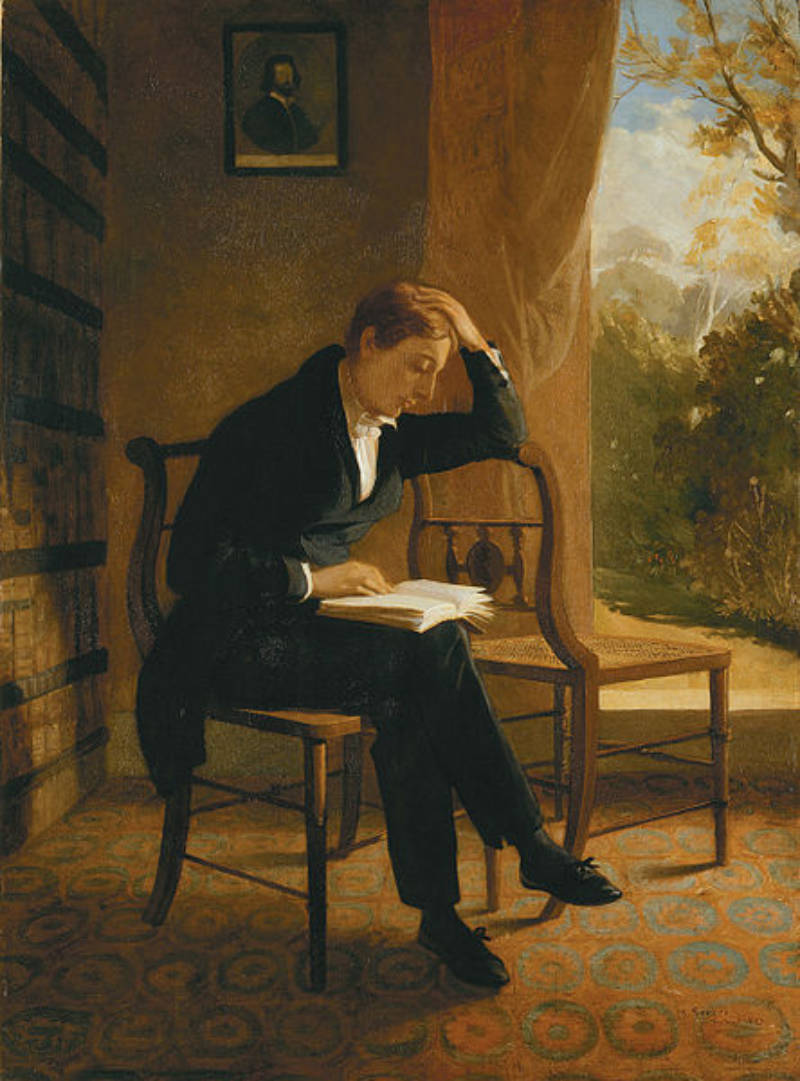
I know “On First Looking into Chapman’s Homer” is a classic description of the ability of art to create emotional epiphanies in a reader, but I never realized how much Keats sounds like a kid reading his report to the class and going way overboard praising the book because he obviously hasn’t read it. Like, allegedly, Keats was so struck by George Chapman’s translation of the works of Homer that he stayed up all night reading and screaming over it:
From Lord Houghton’s edition of the Poetical Works of John Keats, we learn that the fine folio edition of Chapman’s translation of Homer had been lent to Mr. Charles Cowden Clarke, and he and Keats sat up till daylight over their new acquisition; Keats shouting with delight as some passage of especial energy struck his imagination. At ten o’clock the next morning, Mr. Clarke found this sonnet by Keats on his breakfast-table.
Which, okay, maybe happened, in the sense that anything can happen, but you read this poem and tell me if it sounds like something written by someone who has thoroughly read and absorbed Chapman’s Homer:
Much have I travelled in the realms of gold,
And many goodly states and kingdoms seen;
Round many western Islands have I been,
Which bards in fealty to Apollo hold;
But of one wide expanse had I been told,
That deep-browed Homer ruled as his demesne;
Yet could I never judge what men could mean,
Till I heard Chapman speak out loud and bold.
Then felt I like some watcher of the skies,
When a new planet swims into his ken.
Or like a stout Cortez, when with eagle eyes
He stared at the Pacific, — and all his men
Looked at each other with a wild surmise,—
Silent, upon a peak in Darien.
This is clearly the shit you pull out to buy time when your teacher asks you what part of the book you liked the most. “Oh, uh, what do I like best about Chapman’s Homer? That’s really hard to say, because honestly the whole book reminded me of how much even though I’ve traveled all over the world, I’ve never read a book as good as this one. Since time immemorial, people have wanted to know, is there a book that can make you feel like Cortez, and the answer now is yes. I would recommend this book to anyone, no matter what kind of book you’re looking for. This book made me understand all books in a new way. What I especially like was how loud and bold Chapman was. Homer may have been blind, but Chapman certainly isn’t. Yes, Chap or man, he’s all Homer. Chapman: A land of contrasts. This book was so good, I’d recommend it to anyone who likes reading, or even if you don’t. Homer? More like Go-mer. Go…read this book. If you have ever wondered how Rome was founded and whether or not Achilles was invulnerable over his whole body like everyone says, this is the book for you.”
John Keats never read a word of Chapman’s Homer. Here I stake my claim.

The “stout Cortez” part is a dead giveaway. Cortez was quite lean and fit after crossing from the Atlantic to the Pacific side on foot.
Fun fact: Keats actually means Balboa. Someone pointed out that it was Balboa, not Cortez, who got to the Pacific Ocean, but he refused to change it because “stout Balboa” didn’t scan.
Except… that doesn’t prove anything about whether or not he read Homer?
I can’t even with this, Mallory. Imagine if Keats was being such a hipster about classical Greek art and poetry, but he only basically read the Cliff Notes or Wikipedia about it or something!
Actually, don’t. Don’t imagine that.
But Chapman’s WAS the Cliff Notes! All the good students read Homer in Greek.
If Keats had turned this in to my 12th grade Humanities teacher Mrs. Christiansen, she would have called it “artful” and given him a pitying look.
As a teacher of literature, I wish for nothing more than to master the art of the pitying look.
As an educator: All of this, but especially the repeated, assurances that this is a great book and anyone would like it. An analytical essay is not a book review! In the words of Amy Poehler:
I can’t read the image, and I must know what words of Amy Poehler’s are relevant here!
UGH I spent 20 minutes trying to fix the HTML embed code– I can never make it work! Ahem: I DON’T FUCKING CARE IF YOU LIKE IT.
Hahaha thanks!
(Did that work?)
Not in the slightest ashamed that *this* is where I know it from. Come at me, bros! (Also, Thank You, Jeeves, read by the incomparable Jonathan Cecil is the bee’s knees and the sardine’s whiskers!)
“‘Jeeves,’ I recollect saying, on returning to the apartment, ‘who was the fellow who on looking at something felt like somebody looking at something? I learned the passage at school, but it has escaped me.’
‘I fancy the individual you have in mind, sir, is the poet Keats, who compared his emotions on first reading Chapman’s Homer to those of stout Cortez when with eagle eyes he stared at the Pacific’
‘The Pacific, eh?’
‘Yes, sir. And all his men looked at each other with a wild surmise, silent upon a peak in Darien.'”
Thank You, Vera!
What you did there, I see it 😉
Yes! I was like, wow, that silent upon a peak in Darien bit really rings a bell…
I thought I recognized that part!
“This book is very good, the book about Homer. I especially liked-” (checks Sparknotes)- “the bit with Achilles. The Odyssey was cool because when Homer writes about a famous explorer, it reminds me of other famous explorers, which is what-” (skims list of literary devices for next Friday’s vocab test)- “an allusion is. I like that everyone dies young because I am sick and will probably do so myself. It makes me feel better about my own mortality and really makes you think. In conclusion, Homer was very talented.”
“The exports of Libya are numerous in amount. One thing they export is corn, or as the Indians call it, ‘maize’. Another famous Indian was “Crazy Horse”. In conclusion, Libya is a land of contrast. Thank you.”
This delightful post led me down a research rabbit-hole in which I discovered the almost-as-delightful academic article title, “‘Cortez: Or Balboa, or Somebody like That”‘: Form, Fact, and Forgetting in Keats’s ‘Chapman’s Homer’ Sonnet.”
The most delightful article title I have ever found is “A Snip-Snip Here, and a Snip-Snip There, and a Couple of Tra-la-las: The History of Castrati in 18th-century Opera.”
New life goal: find the person who came up with this title and be their BFF
But where is the “fuck Keats and the tuberculosis he road in on” tag?
It is Keats’ intention to sit down and play video games for several hours.
And then the sonnet had several pound notes taped onto the last page.
Always been a fan of E V Rieu’s translation
I mean, I can ‘look’ into any book I like, but doesn’t mean I’ve read it!
So if Keats and Mr Charles Cowden Clarke weren’t reading Chapman’s Homer, just what *were* they up to all night together until morning, hmmmmmm?
My new headcanon: “Looking into Chapman’s Homer” is a euphemism. Makes for a much more interesting sonnet.
Examining the intricacies of Classical pottery. By which I mean studying the male nude.
The last time I (non-euphemistically) studied the intricacies of Classical pottery, I happened upon some examples of dick-birds: images of winged penises with little chicken feet and a human-esque eye at the tip. My friend and I kept breaking into uncontrollable laughter every few minutes for the rest of our visit at the museum. The docents probably thought we were drunk.
They knew.
“We stayed up ALL night reading Chapman”s Homer”
“Really? What’d you think of it? Don’t you think there was a bit too much special pleading?”
“Uhhhhhhh” *scribbles furiously* “HERE”
ugh, KEATS
Footage of Keats giving another report: https://www.youtube.com/watch?v=FgAGkxAtzIg
To be fair, people from The Past seem to have been a lot more enthusiastic about a lot of works of literature than they really seem to warrant. Nobody ever talks about being bored by impenetrable prose!
A friend of mine once called this the Emperor’s New Clothes phenomenon of literary criticism. If you don’t get it, you’re stupid! And no one wants to look stupid! So Moby Dick (the book we were discussing at the time) is SO AMAZING and Chapman’s Homer is worthy of a sonnet.
ok but we all know that Keats didn’t know Greek and it was kind of a sore point with him because he didn’t go to university like the other kids, right? So Chapman’s translation was actually genuinely a big deal for him because he’d never read Homer (thanks to the aforementioned not knowing Greek)?
I am taking this too seriously but I feel irrationally protective of my little bb cinnamon roll Keats, who was definitely too good for this world, too pure.
And everybody read Homer back in those days, so this poem is actually about Keats’ inferiority complex because he was juuuuust lower class enough to not have learned Greek.
And now I’m reminded of Mr. Mowett, discussing Homer with Stephen Maturin:
‘Lord, what a fellow he was! Ever since I began reading in him, I have quite lost any notion of writing myself, he being such a… ‘ Mowett’s voice trailed away in admiration, and Stephen said, ‘I had no idea you were a Grecian.’
‘No more I am, sir,’ replied Mowett. ‘I read him in translation, a book a young lady gave me for a keepsake in Gibraltar, by a cove named Chapman, a very splendid cove… it is magnificent, a great booming, sometimes, like a heavy sea, the Iliad being in fourteeners; and I am sure it is very like the Greek. I must show it to you. But then I daresay you have read him in the original.’
‘I had no choice. When I was a boy it was Homer and Virgil, Homer and Virgil, and many a stripe and many a tear in between.’
Allllllthough there were multiple translations into English he could have read before, if he’d felt like it, and Chapman’s was, I think, pretty outdated by that point. It’s not like it was previously untranslated and then Chapman published his version and new worlds actually opened up.
Oh yes, didn’t mean to imply that it was the first English translation ever. But it was the standard translation for a long time, and presumably the first translation that Keats got his paws on.
I thought the official line was that he’d previously only read the Pope one, which is in rhymed couplets, because Pope, and very stiff and 18th-century, and Chapman was way cooler.
I agree, but also this is basically how I talk about The Toast when I share pieces, so….
Maybe I’ve been reading a different Keats all these years. This totally seems like the easily excitable romantic. I don’t find this reaction at all strange coming from the same guy that wrote “Ode On A Grecian Urn”
lol I never said “Keats didn’t write this” I said “this sounds like me giving a book report about something I didn’t read in the fourth grade”
Not to get toooo serious but there’s a kinda sweet account of this in Adam Nicolson’s The Mighty Dead: Why Homer Matters wherein Keats and Clarke read the Chapman translation sitting side by side in Clarke’s house and Keats recalls ‘turning to some of the “famousest” passages.’ Which makes them sound a bit like Sam and Frodo …
Yes! I was like, wow, that silent upon a peak in Darien bit really rings a bell…
I think we should all nominate Mallory for a TED Talk. Take any number of all her posts (literature, western art, and especially this one with Keats’ book report on Homer) and just explain to the audience finally what’s going on there.
People might actually then go to museums or read some lit-tra-toor. Maybe fund the arts.
We’ll call it, The Arts: What’s Goin’ On There?
I think we should all nominate Mallory for a TED Talk. Take any number of all her posts (literature, western art, and especially this one with Keats' book report on Homer) and just explain to the audience finally what's going on there.
People might actually then go to museums or read some lit-tra-toor. Maybe fund the arts.
We'll call it, The Arts: What's Goin' On There?