My older daughter wakes me by clambering up on my bed one chilly Saturday morning, all high spirits and flailing limbs. Seven years old, still chubby-cheeked and often pigtailed, her generous smile is a mirror of my husband’s, her big brown eyes almost identical to mine. Many people see her father first when they look at her, but I am continually amazed by how much she resembles me. She was the first person in whom I ever clearly saw myself, and adoptees don’t take these things for granted.
“Mama,” she says, thrusting a piece of torn-out notebook paper in my face, “look what I did!” I expect to glimpse a colorful drawing, a poem, or her latest story. Instead I find myself gazing at a page filled top to bottom with Korean words. She laughs her delighted toy-car horn of a laugh and informs me that she’s been practicing with the language flash cards I gave her a while ago.
In kindergarten she began pestering me to learn Korean and teach it to her. I had a tutor at one point, until life got too overwhelming and the money for lessons evaporated; now I study only off and on, without a teacher. I am under no illusions about my skills — after a solid year away from one-on-one instruction, I can read some Korean if you give me all afternoon to do it, say hello and thank you and a few other phrases, spout some useful-but-on-their-own-useless vocabulary words, order from a Korean menu, and…that’s about it.
My Rosetta Stone software doesn’t trip my years-dormant homework anxiety or stare at me expectantly like my tutor could, and is therefore less than motivating. Of course I should be motivated anyway, because my daughter has asked me to please study more and teach her. At her age, she’s already gathered that language is a big, obvious cultural indicator, a test neither of us can pass. I don’t know how much her multiracial identity affects her desire to learn Korean, if indeed it is related at all. While our situations are not the same, I can’t help but see a great deal of overlap between our experiences – between her trying to figure out what it means to be more than one thing, and me being just the one thing and always feeling like something else entirely.
There is and always will be a limit to how much I can teach and pass on to my kids when it comes to our shared heritage. If my hands aren’t precisely empty, they are far from full. My sister Cindy swears I could never pass for a Korean raised in a traditional Korean family. Everything about you screams American, she said, the first time we met. Cindy describes herself as “Americanized” – she was born in Korea and raised by my birth parents, but eventually married and has made most of her closest friends outside the Korean American community. I, on the other hand, am just plain old “American”; I never had a Korean culture to try and tamp down or turn away from.
As a kid, the fact of being Korean, showing my own face to the world, meant little more to me than a catalogue of differences, negative space I wasn’t sure how to fill. I saw people who resembled me only on television and only sparingly, and they seemed almost as foreign, as exotic to me as they were to the white kids I grew up with. It was a struggle for me not to think of Asian people in terms of stereotypes (shy; reserved; studious and good at math; robotic rule-followers). Some white friends and family members would joke about “nerdy Asians” and comment on my good grades as if these things were just part of my nature, built into my DNA. I would be a first-generation college attendee, but that didn’t seem to matter to anyone – the expectation was always that I would excel; the implication that my race was the reason.
Could one appropriate one’s own culture of origin? Was the desire to learn more about my birth culture hopeless, or even wrong?
The hope that I could one day learn how to be Korean and not just look it was one I could only have acquired as a young adult, free from the confines of my rural white upbringing and surrounded by fellow Asians for the first time. I had spent all of my childhood as “the only one,” wishing away my Koreanness. By eighteen, though, while I understood what I wasn’t (white), I had yet to figure out what I was.
In college and after, I don’t think I was quite conscious of this desire I had to learn how to seek out, imitate, re-absorb Koreanness in some fashion — but I did notice other Koreans, other Asians, and quietly envy them. I came to recognize that Koreans were not being complimentary when they told me I didn’t look Korean. Are you Chinese? Are you part white? Are you sure? I mean, you’re adopted, so how can you be sure?
While I didn’t appreciate being called a banana, it was tough to argue the point when it happened. And perhaps, as an adoptee, I had no right to try and grasp at the knowledge others had that I didn’t. Could one appropriate one’s own culture of origin? Was the desire to learn more about my birth culture hopeless, or even wrong? This exploration had certainly never been encouraged when I was young — was it just too late for me to start now?
Today I still really haven’t got answers to these questions. I can’t help but feel envious of other Koreans at times – not only because many of them can speak a language I can’t, but because that language represents a real and undeniable link to a culture and community of which I have never been a part. Language fluency may be only one of countless ways to feel connected to a history, a people, a clan, but from where I stand – well outside the barrier – it seems like a deeply important one, one of so many codes I’ll never be able to crack.
At the café where I had my first Korean lesson, I spotted her right away, the way you do when you are looking for someone who also happens to be looking for you. I watched her enter and saw her eyes dart around behind rimless rectangular glasses before settling on me. I wondered what she saw, and if she could already tell that I was an imposter.
My sister and father, who have both taught language lessons at their respective churches, suggested that I find a language school at my local Korean church. But when I called the Korean Presbyterian parish just down the road to inquire about lessons, the man who answered told me that the school only accepted students who were native speakers; who already heard and spoke some Korean at home. “Children only,” he said. “Are you a child?”
“Uh, no, but –”
He hung up on me mid-sentence. Which might have ended my search for lessons, honestly, if I hadn’t had my daughter to report back to.
The effects of adoption don’t end at placement, or even when an adopted child grows into an adult. Nor are they limited to the adopted person — they can be felt unto the next generation, and the next.
Of the potential tutors I found online, Angie was the only one who got back to me. As we shook hands I was acutely aware of the anxiety I always feel around Koreans older than myself — as if I am about to make some grievous mistake, or say something rude without realizing it. Once we were seated, Angie asked me why I wanted to study Korean. It was a perfectly natural question, but before answering I busied myself with pulling out my notebook and pencil, weighing how much I ought to tell her.
The truth was complicated, with roots in my adoption and the fact that my chatty eldest child came home from school one afternoon and told me that a Korean classmate had asked her why she couldn’t speak Korean and why she didn’t “look” Korean. This was nothing new – as far back as preschool, her Asian classmates would express surprise when they first saw me. At that age, it makes sense some kids would have a fairly narrow view of what Asian people looked like. It’s not limited to kids; one time, when I picked her up in the carpool lane, a new teacher at the preschool almost didn’t let her get in the car with me. “I would never have known she was yours!” she exclaimed.
These comments aren’t necessarily increasing in frequency as my daughter gets older, but I think they are beginning to bother her. As much as a child her age can be, she is proud of her heritage. She readily identifies as Asian and American, Korean and Lebanese and Irish. We’ve tried to avoid stressing the fractions, so she’s Korean, not half-Korean — as Korean as I am. When given the choice of what country to present on at school, she chose Korea, and proudly showed off her hanbok. At home we talk a lot about race, and history, and how bigotry isn’t a thing of the past, and she is the one who begins many of these conversations.
In years past, when people said unfortunate things to her or to me or to both of us, she didn’t seem to care that much. This year, for the first time, she’s seemed a bit more troubled by the questions from nosy white people, the occasional cultural test posed by a fellow Asian kid. She knows I’m adopted. She knows that part of my history has made me different from other Koreans (not that they are a monolith) in some very particular ways, and so – in ways she is just beginning to think about – it’s made her and her sister different, too.
What I always knew, but rarely thought much about before having a child of my own, is that the effects of adoption don’t end at placement, or even when an adopted child grows into an adult. Nor are they limited to the adopted person — they can be felt unto the next generation, and the next. I know my kids will one day have far more complicated questions of identity to consider for themselves, questions that won’t be answered with any language litmus test. For now, I want to help them understand as much as they can about how our family got to be this way, and all the different parts that make them who they are, so they can eventually decide for themselves who they want to be.
In the café, over the low chatter of other evening customers and the click-clack of laptop keys, I told Angie about reuniting with my birth family, adding that I wasn’t really here for their sake. When I mentioned my daughters, she seemed to understand. She rummaged in her bag for a workbook and pushed it across the table: “For you and your kids to share!” Grinning, brightly clothed children — none of whom appeared to be Korean — danced around the book’s pale yellow jacket. The cover wear and faint pencil markings betrayed years of use, but the book had clearly been well cared for. “It used to be my son’s,” she told me.
She began by taking me through all the consonant and vowel sounds, one by one. I did my best to parrot pronunciations and copy each pencil stroke. She showed me how to pair up sounds — side-by-side or one on top of the other — to construct syllables and short words. Some were familiar to me, thanks to my birth family: grandmother, grandfather, mama, daddy. Older sister. Hello. Thank you. I practiced new words, too, and characters, syllables, and words bloomed from my pencil, diminutive bars and circles and boxes that I would have to learn to how to decode.
“Did your parents give you a Korean name?” Angie asked. On a fresh piece of notebook paper, I carefully wrote out my Korean name: 수정. The name my father chose for me before I was born. Next to it, I wrote Cindy’s Korean name: 인정. There was the common syllable, linking us together, long before either of us knew the other existed.
The smell of coffee and pastries mingled with pencil lead as I bent over my notebook, letting my too-sweet black tea go cold. At the end of the lesson Angie gave me her son’s book, telling me to study until I could write all the letters and combine them into syllables and short words without looking. I felt heartened by the relative ease with which I had just learned to write – it was the easy part, I knew, but Angie hadn’t laughed or called me a banana or implied I was too far behind to bother, and as we packed up our things she said, “I give you credit, you know. I wouldn’t have tried to learn a new language at your age.”
The letters filling the opening pages of my new college-ruled notebook in neat, orderly columns already seemed like friendly new acquaintances, if not old comrades. They were only basic building blocks, and I might never achieve the fluency I needed to construct whole worlds, but the language of my original family did seem a little less mysterious than it had before.
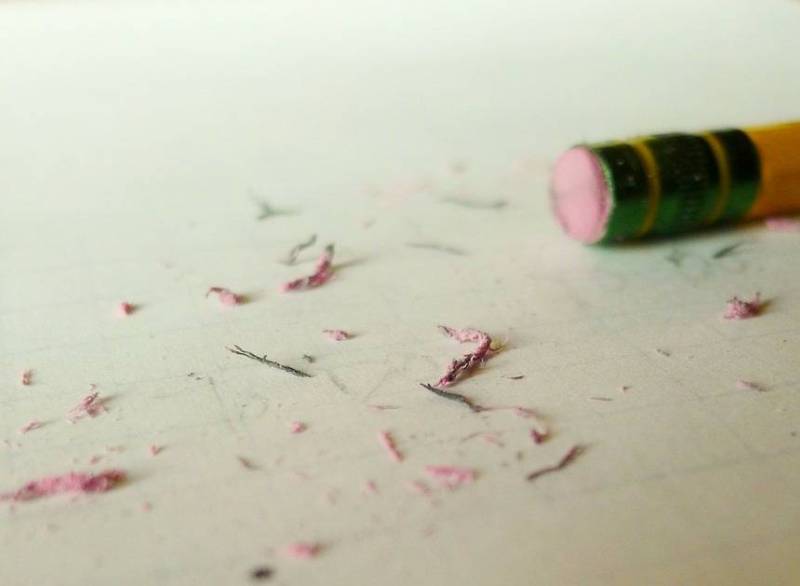
When my daughter and I “study” Korean together now, I make her write out all the sounds. Sometimes she gets her flash cards and writes vocabulary words. She labors over the characters, erasing and recreating words, trying to make each one perfect. She can count, knows her colors, can recite the different names for different family members. She’s capable of learning so much more, I know — she should probably have formal lessons. I wish a tutor for her were in the budget, but for now she’s stuck with Rosetta Stone, books and flash cards, and me.
The work of recovery and healing after adoption never ends — there are always new stumbling blocks, new and unexpected gifts. There are many different kinds of victories to be found.
I often think back to my sister’s pronouncement, about how everything about me “screams American.” I think she was just trying to explain that there are many things that mark some Koreans as Korean beyond appearance, and so most would quite naturally and instantly realize there is something off about me. She is probably right; I know that I will never be Korean the way our birth parents are, the way she is. My adoption isolated me, cut me off from our culture, in countless irrevocable ways. For me, this might be the toughest thing about being adopted, now that I’ve reunited with my birth family and have the answers to questions I always wondered about. The biggest gap left in my life, the real legacy of adoption for me and my children, is the disconnect between the culture I was born into and the one in which I’ve been raised and completely assimilated.
I’ll spend the rest of my life contemplating, considering and reconsidering adoption and its impact on what family and identity and belonging all mean to me. But I’m not alone anymore; I have company on this island. Even the casual, snail’s-pace study of my family’s first language is important, an inheritance I never thought I’d be able to share with my kids. The work of recovery and healing after adoption, for me at least, never ends — there are always new stumbling blocks, new and unexpected gifts. When I watch my daughter writing in Korean, when we talk about our family history, when she seems sure about who she is (never mind what other people say) and her place in our family and in the world, I cannot help but feel there are many different kinds of victories to be found, and many ways to heal.
Sitting side by side, my daughter and I scan the familiar characters she has written, the rows of letters she has already deployed into words. She taps the page with the tip of her pencil. “I wrote all the words I could think of. Should I practice the alphabet again?” When I say say sure and smile at her, she smiles back. “Okay, then,” she says. “I’ll start at the beginning.”

I am trying to find a way to express to you how much I want you to get to learn Korean to whatever fluency you desire. another free resource might be https://www.duolingo.com/. They don't offer Korean yet, but they offer English in Korean. So maybe someday soon they will go the other way. Don't give up at the churches either. Just keep asking and someday someone will hear you and let you in. I wish I could remove any pain that you experience from feeling "different" as an adoptee.
Although I'm white and not adopted, I identify with the language part a lot, and with wondering if you can appropriate your own culture. My dad is a first generation American and was raised speaking both English and Lithuanian. His brother married another child of Lithuanian immigrants, and so my cousins were raised speaking the language, going to Lithuanian school and camps, and lived much nearer my Lithuanian grandparents and the large community in their state. My sister and I were never taught the language – I did try to learn as a child (I was tired of feeling left out at family gatherings while everyone else chattered away), but I didn't know how to teach myself and my dad insisted his Lithuanian was too rudimentary to teach me anything. I'd still like to learn something beyond Merry Christmas, thank you, and good night, but I no longer attend many Lithuanian functions, and my motivation is pretty low. I do try to incorporate a few specific traditions into my family's life, but it seems very haphazard. Good for you for sticking with it and helping your daughter!
I was adopted from a German orphanage. In this TV interview I discuss international adoption from a unique perspective, the foreign-child adopted into America. The discussion includes the foreign adoptee's loss of language and it's emotional and psychological repercussions. http://www.youtube.com/watch?v=C1kEbQ-5p5g
Such a well written article! You captured the intersection of language, culture and identity so well- and with the additional dimension of parenting… You guys should try a family program at Sup Sogui Hosu, the Korean Language Village in Minnesota. Great program, mix of staff and participants with different language backgrounds, usually including adoptees.
You, and other people in the comments, have discussed the difficulties you experience being partway between cultures and wondering if it's possible to 'appropriate' your birth culture.
I appreciate that growing up in a culture like America where whiteness is the norm means that you may feel like you will never be able to 'own' American culture, it's shut to you fully by racist norms and gatekeeping and questions like "but where are you REALLY from?" and a million things like that.
But…
As an Indian woman it sometimes frustrates me that people I consider American want to take from my culture. I understand that my 3rd generation cousins feel a tie to India, even though they have never lived here and don't speak any Hindi, but I sometimes want them to realise that they have immense amounts of privilege that I don't. They aren't marked by accent in any way. They have grown up as Westerners with all the privilege that entails. I sometimes wonder if the insularity of America and the fact that it sometimes feels like the whole world is designed around its culture, wants, needs mean that POCs in the USA can't see what they have. Rather like when people say White People don't have a culture- they do, it's just considered so much the norm that people think they aren't doing anything but being human and everyone else is acting strangely.
David Sedaris wrote about American privilege once and it really struck me:
'As an American abroad, you’re bolstered by an innate sense of security. Something goes wrong, and you instinctively think, “We’ll just call the embassy and see what they have to say.” People know where America is on the map. They know that it’s loud and powerful. With certain other countries there’s no such guarantee. “Oh, right, Laos,” I once heard someone say to a dinner guest. “Didn’t we bomb you a couple of times?”'
At the end of the day my cousins when they come to visit are just enjoying a holiday where they can play at being desi, but they'll go back to America at the end and don't have to live within the strictures of my society. You get to enjoy the shiny, sparkly bits of being Indian without having to deal with the cultural oppression I experience all the time from my society and from my family that still lives here. And I understand my cousins a whole lot more than I understand Americans who say they're Irish but have only got ancestor who travelled to America about a century ago…
Obviously I am no expert or even someone with an opinion that needs to be listened to, so please don't if this creates any deeper anxieties. I'm aware that I'm coming onto an American site where you are all talking specifically about your experiences as POCs who aren't even offered the opportunity to fit into a singular culture in America the way I am. Also I've never commented here before, so it's not like I am a part of this community, apart from as faithful reader, and therefore able to speak a little more candidly than might be appropriate.
But sometimes I think it would be interesting to discuss these ideas of privilege and cultural appropriation and everything from an international point of view, instead of just looking at it from within American/British/Australian etc culture?
Maybe it depends on your degree of distance, and your sensitivity to the culture of origin. There are Irish people who are bothered by Irish-Americans laying claim to Irish language, mannerisms, holidays, and history. They see us as Americans overrunning their hard-won cultural heritage or misunderstanding what it means to be Irish. Sometimes they're right.
This is stunning.
How great that your little girl needs to learn Korean with you.
Okay, my "maybe I'll comment" button just got pushed to "definitely." <3
This is the first article that's made me realize that there might be a few threads shared between my own experience and that of other people who, for reasons of adoption (or not), feel some vast ocean between their lives and where they're "from." (My dad was born in Latvia; they left a few weeks later and eventually ended up in a DP camp; the family moved here when he was in elementary school.) And finding another half-Baltic kid who feels that same sort of thing really drove it home.
My dad speaks Latvian well, and English fluently/natively/without an accent. My 10-years-older sister hung out with our grandparents a bunch when she was little, and speaks fluent Latvian. But my dad never spoke it at home, so yeah, I can say thank you, Merry Christmas, happy birthday, milk, bear. My little brother's in the same boat.
And we went to Latvian summer camp, and Saturday school for a while! But even there I didn't belong — I was always in the "dumb" group of kids with only one Latvian parent (the horror), and worse, most of us in that group didn't even speak Latvian at home. (At my Latvian school graduation, the director noted with some horror that it was the first year that they hadn't had anyone graduating with two Latvian parents.) I learned to pronounce the language almost perfectly (I can sing all the folk songs if someone gives me a book!), but I can't have the most basic conversations.
Last summer, I went to Latvia for the first time, at 30, with my dad, and finally met all these relatives I'd never met. It's weird; my name is entirely Latvian, I look Latvian enough for Latvians to try to speak to me, and my dad can talk to all of the relatives, and I'm…in this little bubble of incomprehension. My grandmother's little sister is still alive; they're spitting images of each other. And all I could say to her was, "thank you." I read something out loud at my dad's birthday party there, and one of the women said something, and someone told me, "she says your Latvian is better than your dad's!" But even if his accent is lousy, he's still the one who can share stories, and I can't, and I don't really know what to do with that as an adult.
Me, my dad, my sister, my brother, and one of my dad's siblings all got our citizenship last year, though (there was a process for exiles/descendants). Any day now, I'll be getting my Latvian passport in the mail. And I feel like SUCH a fraud about it. The non-English language I learned was French. France, not Latvian, is the only foreign country I've ever felt at home in. And now I could stay there as long as I want, because my dad was born nearby in a time of occupation? It feels so, so weird.
In short, I totally totally get it, and you're not alone, and I'm sorry that we're both in this weird boat, but at least there's company?
Yes, yes, and yes. Thank you for writing. As a Vietnamese American adoptee, as a parent, and more, I appreciate this article on so many levels. Yes, OneofthePinkLadies, thank you for your comments and questions. In my experience, the "international" sorts of questions arise all the time, about the various privileges coupled with the losses, the irony of being "saved" to a "dominant" (and domineering?) culture. Capital, political, and linguistic power, citizenship, insider-outsider questions, gratitude, criticism, historical analysis, etc. are all areas for exploration, discussion, and discovery. It is one of the ironies of life that international adoptees are "gifted" the West (predominantly), even as they are separated from their families, languages, biological connections, and histories, which seems to be part of what Nicole Chung is exploring here, these currents of gain and loss.
Thank you for your insightful piece. I am a Korean adoptee and you basically verbalized so many things that I feel inside but couldn't verbalize myself. It feels good to know others out there have similar feelings and experiences.
great article… we can learn more from it..