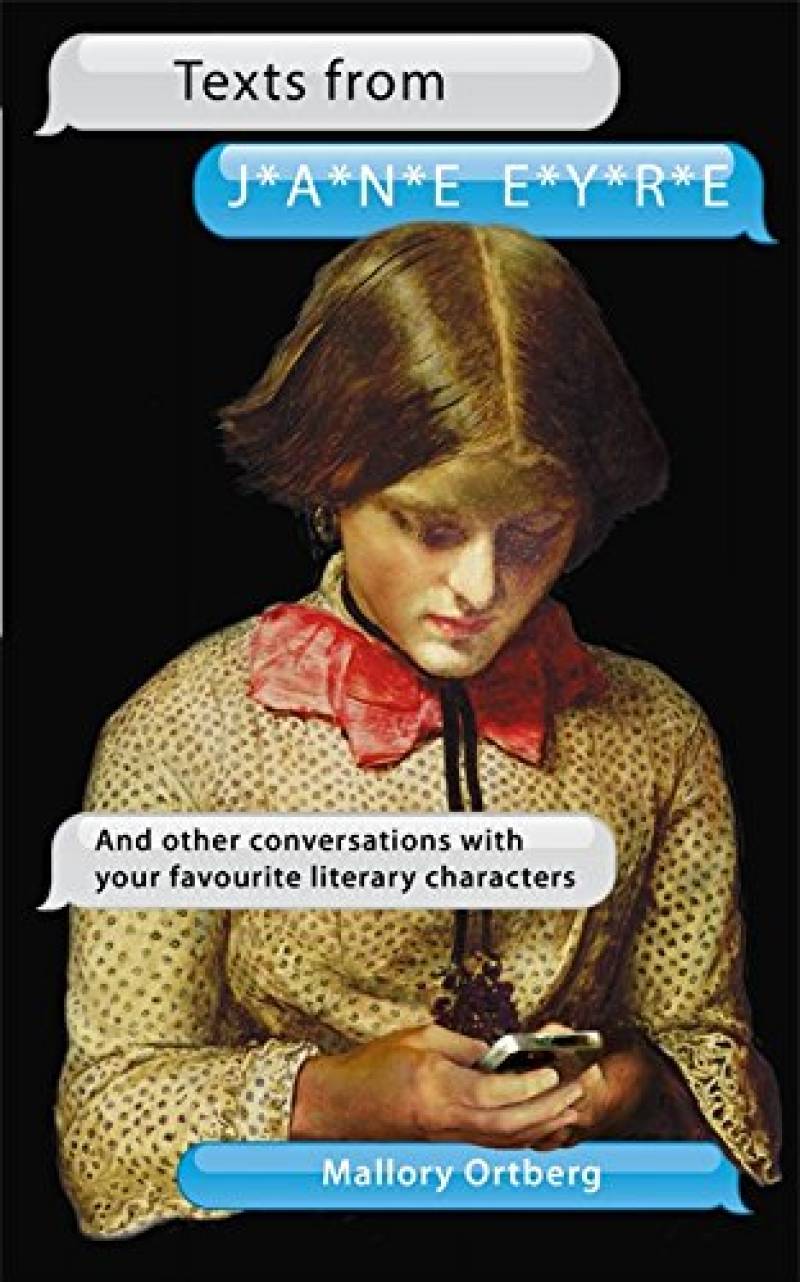
If you are in Great Britain and have felt STYMIED by the US-centricity of Texts From Jane Eyre, rage no more! You can buy the UK edition today, online or in your nearest bookshop. (There’s nothing else going on today, right?)
I feel so joyful and excited about this! I hoped, when I wrote this goofy book of jokes, that it would be a meaningful delight to the people who read it, and not an embarrassing flash in the pan, and it feels so rewarding, that some English editors have bunged a set of unnecessary u’s into all of my precious jokes and packaged them for a Great British audience. It makes me proud of myself and grateful to the world! And that is a nice way to feel. Now I will carry on with the rest of my life, and feel a variety of other feelings, and someday die, and stop feeling anything ever again. But, you know, until then, excelsior and huzzah!

Just in time for my birthday!
And mine!
Yes, that’s right, My favoUrite literary characters. woo.
Has Mallory’s writing always been this existential, or is this a recent thing?
I wished I’d seen this when the shops were still open. There’s always tomorrow, presumably.
Always.
THE U’S ARE ALWAYS NECESSARY.
Yay!
Excelsior, indeed!
“by Malloury Ourtberg” phew, fixed it.
Excelsiour.
and someday die, and stop feeling anything ever again.
Mallory.
#you’re not wrong though
Yesssssssssss. I like to think we got all the “u”s in the revolution.
Actually, you did! After the revolution, someone (Webster, I think?) went through and established “American” spellings, mostly by making them more phonetic. Everyone was having a lot of angst about still speaking English but TOTALLY NOT BEING ENGLISH ANYMORE YOU GUYS WE’RE DIFFERENT WE’RE THE AMERICANS. At least that’s my vague memory from American history.
Yes! Some of the things he did caught on everywhere (dropping the unnecessary ‘k’ from words like magick), some were regionally successful (dropping the ‘u’s, reversing the re in theatre), and some ideas never got any traction (still lots of extra letters – knife debt, etc.)
Angry spellers! A surprisingly contentious historical debate.
I did not know that’s how magick lost its k! I do remember reading through a list of suggested words and laughing at some that were really aggressively phonetic. I’m wondering now if knife was one of them.
I just got curious and googled. Here’s a list from no less than Merriam-Webster.
“Cloke”
WIMMEN
That is jenius. I am yousing wimmen from now on in all my spellin.
Some of these are flat-out Molesworth. Would it have damaged America’s standing in the world if newpapers, diplomats, and such rote like thay fayled skool?
Webster’s use of lexicography to push particular agendas is fascinating! (Um, to me.) I wrote an essay at university which (among other things) compared his 1807 dictionary (A Compendious Dictionary of the English Language) to his 1828 one (An American Dictionary of the English Language – the big influential one). He became an evangelical Christian in the intervening period, and it is fascinating to see how that affects the words included and their definitions. (This is why, when attempting to find a version of that dictionary with the original text, the only one available in all the libraries in Oxford was a recent facsimile edition published by an American Christian organisation that felt current teaching materials in schools were not Christian enough, and so they wanted to make Webster’s dictionary available for schoolchildren to avoid all that secular corruption.) The big push for “American” spellings is also a major part of the later dictionary.
Also, did other people know that Dewey (of the Dewey Decimal classification scheme) was a big proponent of spelling reform? That is why he changed the spelling of his name from Melville to Melvil. Some of his choices were extremely entertaining.
I’m actually fascinated at the idea of tinkering with language as a means of nation-building. On the one hand, it’s just SO laughably petty to be like “Oh yeah? Well we don’t spell color with a u anymore! Nyah.” But on the other hand, shared language IS really powerful. That’s why home dialects have so much meaning, and in-groups have jargon. It’s also interesting, looking at your dates, that he wasn’t inspired by the 1776 revolution but by the War of 1812. IIRC, the War of 1812 is when England got really serious about getting their colony back, and it really changed things for a bunch of people. England eventually decided to accept we were serious about this whole independence business, and I think the remaining loyalists on this side of the pond also had to accept reunification wasn’t going to happen. Also I think there were a lot of hurt feelings about the burning of Washington, DC. So it’s interesting that it’s about 15 years later that Webster releases the first American dictionary.
Somehow I did not know the dictionary was evangelical as well, though! I’d love to see your paper on how that’s represented!
Weirdly enough, I love the Dewey Decimal System so much that I tend to avoid learning about Dewey, since most librarians I’ve talked to seem to think he was a very odd duck. (I’ve worked a total of 5 years in public libraries but don’t have the degree.) Things could get VERY odd in the late 1800s and I’m afraid of what I’d find out! That’s actually sort of charming though. He just wants everything to be orderly!
Dewey was fascinating – he was interested in so many things (did you know he invented the hanging file system?) as well as dictionaries. DDC has a lot of issues, though.
I should dig out the essay and see what examples of religion-influenced definitions I found. There were definitely some interesting changes in the second dictionary compared to the first.
If you do, I’d love to see them!
This is soooo nerdy of me but um… I would love to see that essay posted on the Toast!!!
Edited to say, instead of “kind of like,” I would LOVE to read that essay.
Thank you, that is very kind! It deals with a few other dictionaries (Samuel Johnson’s and the OED) and the ways in which personal agendas shape definitions, even if the stated goal is objectivity, but I wrote it as an undergraduate a few years ago and it is probably not very good.
I love this cover art. Also, “I will … someday die, and stop feeling anything ever again. But, you know, until then, excelsior and huzzah!” is my new guiding principle of life.
Excited to get this! I know you probably get affiliate moneys from Amazon, but could I maybe request though that you include a link to get it from Hive as well? It’s a network of local independent bookshops but you can still buy online and get free shipping. http://www.hive.co.uk/Product/Mallory-Ortberg/Tex…
Also, any idea when the paperback might be out?
I don’t know if we’re going to have a paperback! We have never talked about it.
Weird! Hive have it up with a cover and RRP and everything! http://www.hive.co.uk/Product/Texts-from-Jane-Eyr…
Last Christmas I was singing Mallory’s praises to my partner’s sister, and she made some polite comment about “yes, I think I’ve heard of her.” Then I opened my Christmas present and it was Texts From Jane Eyre. This was already awesome, but I am now wondering how she obtained it, if it has only just been put on sale in the UK. She is evidently even more awesome than I had realised. I’m not really one for Christmas presents, so I ended up hastily beginning a wall hanging for her, realising I wouldn’t finish it before she left, and getting it finished in good time for her birthday in May.
(And obviously: buy it, it’s great.)
Commenting to say I ordered the book the day I read this article and it arrived today! Exciting! – Skimmed it for stories I knew, but at some time very soon I will sit down with a cup of tea and read it all the way through. Also: nice illustrations. 🙂